Building a Supervision System That Actually Works
Presented by Lauren Donovan
Cancel any time. Cert delivered to your inbox the moment you pass the quiz.
Learner ratings
from 150 learners
94% would recommend this CEU to other professionals in their field (112 responses)
“The idea of reactive supervision. Got me thinking about being more proactive.”
— Celeste M.
About this CEU
Supervision is a core part of the role for behavior analysts, but most supervisors are never actually taught how to supervise. As a result, supervision often becomes unstructured, inconsistent, and dependent on the individual supervisor rather than a clear system. This training introduces supervision as a system rather than a single meeting and focuses on practical ways to improve organization, consistency, and preparation. The goal is to reduce guesswork so supervisors can show up prepared, use their time effectively, and support stronger clinical outcomes.
Credits
1 supervision CEU · 60 min
From the talk
What was covered
Supervision breaks when it lives in one meeting. Lauren Donovan's five-part system covers trust, structure, observation, feedback, and review.
- Treat supervision as a weekly system, not a single hour on the calendar.
- Re-read the supervision section of the ethics code and the supervision curriculum this month.
- Build one tracker that holds prep notes, goals, the agenda, and your action plan.
- Block observations early in the week, because late week plans get eaten.
- Before you correct a performance problem, check training, resources, and clear expectations.
- Ask the people you supervise for feedback on your supervision, every meeting.
Why Most Supervisors Were Never Taught to Supervise
Most supervisors learn the job while doing the job. Lauren Donovan got promoted about two weeks after she sat for her exam. All at once she was leading staff who were in master's programs. Her own boss told her there was no training for the new role. She had taken the eight hour course (the class you take before you supervise). She does not remember much of it now.
She now visits teams all over the world as a consultant. The same gap shows up almost everywhere she goes. New therapists get a lot of care on the way in. They get overlap shifts, skill checks, and set time on the floor. New supervisors get thrown in and wished well. The job is much bigger, and the training is much thinner.
The result is what she calls reactive supervision (rushed, last minute, no real plan). In her first years she showed up and checked the boxes. She ran late, and she read email in the middle of meetings. She is clear that the problem was not effort. She had no system to lean on when the week went sideways.
She keeps at this work for a reason. Therapists she once trained went on to earn their own credentials. Some now direct school programs or lead clinical teams at their organizations. Their work reaches learners she will never meet, and she calls that impact generational.
My supervisor said to me, hey, we don't really have a training for this because we don't put people into this position often
From the talk — Lauren Donovan
Meeting-Based Supervision Versus System-Based Supervision
Meeting based supervision treats the weekly hour as the whole job. The hour happens, and what goes in it depends on the week. Quality then rides on the person, not on the plan. System based supervision is much wider than that. The meeting is one part of a routine that runs every single week.
The difference matters because the week fights back. Billable hours pile up. Staff call out sick, and a child has a hard morning. Someone stops you in the hall with a question you cannot dodge. Donovan asked the room to name their biggest barrier. Time won by a mile, with large caseloads and too many hats close behind. Fear of an audit came up again and again.
She is also honest about the evidence base. Much of the writing on this topic is conceptual or discussion based. There is not much hard data on which practices work best. She built her framework from the ethics code, the training curriculum, and that writing. Most of it traces back to basics we already trust: goals, modeling, praise, and data.
Time is never on our side, there's never enough of it.
From the talk — Lauren Donovan
Supervision Is a Responsibility, Not a Stack of Forms
Two documents sit under everything Donovan teaches. The first is the ethics code, and in it, the section on supervision. The second is the Supervision Curriculum 2.0 (the outline your eight hour course covers). Both live on the board's website. Much of the room had not read either one in years.
The curriculum asks for far more than a signed form. It asks for training goals. It asks you to measure both knowledge and real performance. It asks you to check whether your supervision is working at all. Donovan says she was doing some of that, but not with data. It also splits two groups: staff on your caseload, and trainees (people earning hours toward a credential).
Two more parts of the job get skipped. The first is capacity. Take on the number of people you can truly serve well. The second is fit. We build a plan for each learner, so we should do the same for staff. Strengths, values, learning style, and feedback style all differ. Culture and background matter too. More neurodivergent staff (people whose brains work in different ways) are joining the field. Some will need formal support from HR.
I was just kind of following the vibe.
From the talk — Lauren Donovan
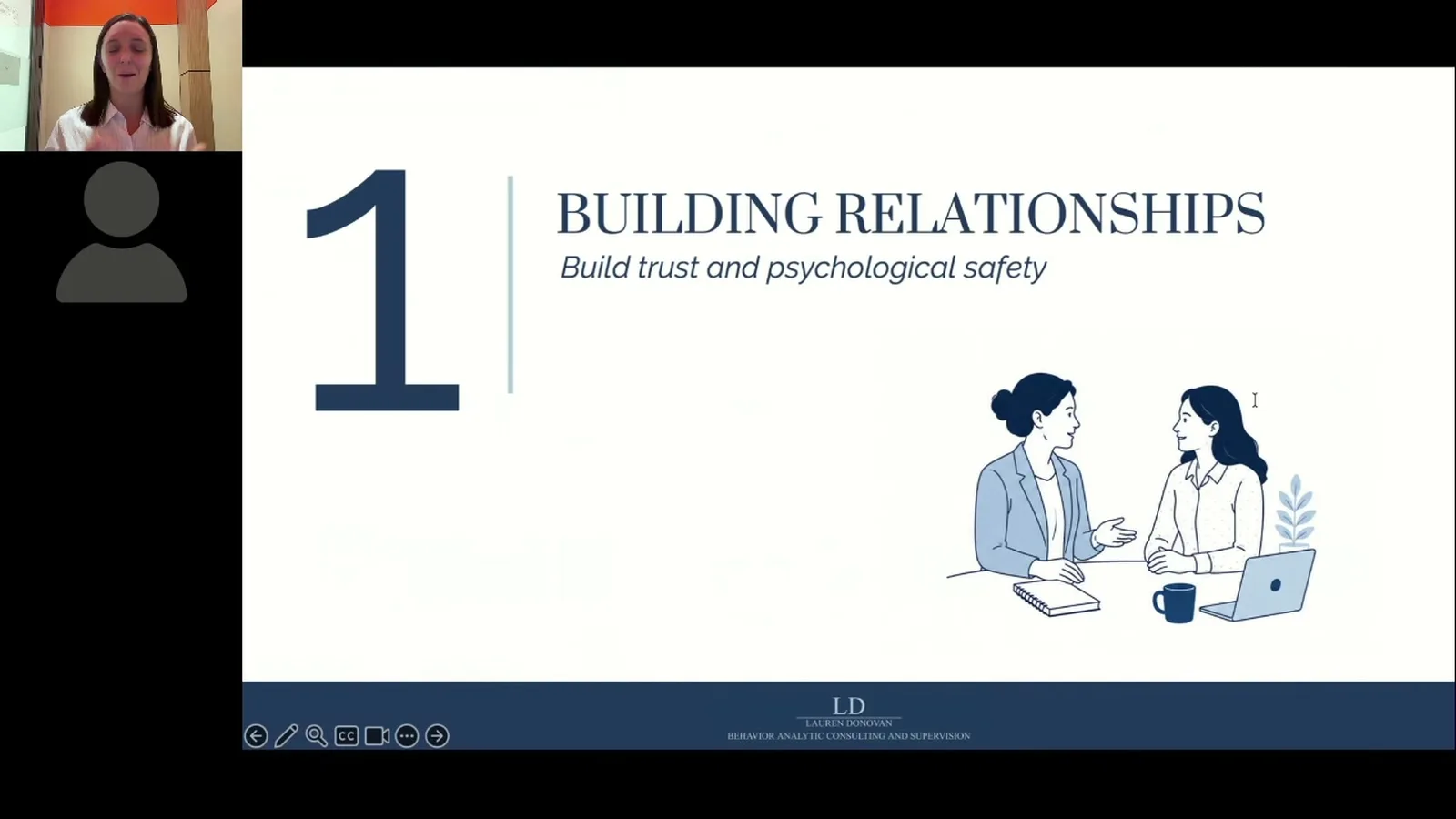
Step One: Build Trust Before You Build Trackers
The framework has five parts, and the first one is relationships. Donovan calls it psychological safety (feeling safe enough to ask questions and make mistakes). Staff need room to ask questions and admit mistakes. They need to hear hard feedback without feeling small. That is tough to hold next to a high bar for quality, but both can be true.
Trust gets built in small moments, not in big speeches. Ask how someone is doing. Ask what they want you to watch before you walk in. Cover a student for two minutes so they can take a break. Keep the meeting on the schedule, and then actually keep it. Put the phone face down and turn on do not disturb.
The rest is plain reliability. Do the thing you said you would do. If your head is full, ask them to email you the request. Take a lap before you answer while annoyed. Name the work that is going right, not just the errors. Send that late night email on a delay so nobody feels on call at nine.
Before we talk about trackers and systems, or feedback, we have to build trust.
From the talk — Lauren Donovan
Step Two: Create Structure That Holds Up on a Bad Week
Step two is structure, and it is her favorite part. Donovan runs her week on a calendar and voice reminders. Observation blocks go in early in the week on purpose. An old boss taught her why. Plan them all for Friday and the week will eat them.
Contracts come next, and they carry more weight than people think. A contract spells out who owes what to whom. The board's site tells you what belongs in one. Do not reuse the same file for years without reading it. She caught herself doing exactly that.
Her main tool is one meeting tracker in a spreadsheet. It holds her prep notes, the observation, and the data review. It holds goals for each person, so goals do not get filed and lost. It holds the agenda, the notes, and the action plan. It holds a two way reflection and a check on required hours. A second sheet tracks trainees across knowledge, application, and performance. Current trackers also make an audit boring, which is the whole point.
But having strong systems for yourself is going to make you more effective.
From the talk — Lauren Donovan
Step Three: Observe Performance With a Plan
Step three is watching the work in real time. When trust and structure are in place, staff want you there. Donovan's therapists used to flag a program and ask her to come look. The visit turned into shared problem solving instead of a test.
Go in with a plan for what you want to see. Name the programs first. Pull up a few graphs for two minutes before you walk in the door. Watch for integrity (whether the steps get run as written). Then make the program change and run the training in that same visit. Stack the tasks and you buy back your own time.
When someone is struggling, hunt for the cause. Is it a skill deficit (they were never taught it)? Is it a performance deficit (they can do it but do not)? The Performance Diagnostic Checklist (a tool that finds barriers at work) helps you sort that out. It asks if the person was really trained. It asks about resources, clear expectations, and other demands pulling at them. Her own form tracks how closely steps are run and how two observers agree.
But people don't want to be bad at their jobs.
From the talk — Lauren Donovan
Step Four: Teach and Give Feedback People Can Use
Step four is teaching and feedback. The word feedback now sounds like bad news to a lot of people. A large share of it should be praise for work done right. New hires hear that praise all the time. Strong staff who have been there for years often hear nothing.
Corrective feedback is a timing question. Ask yourself if it is urgent or if it can wait an hour. Some people take a note and use it right away. Others will spin out and lose the rest of the session. Know your people well enough to choose. Ask them to say the plan back to you. Video of their own session lets them score themselves.
Hard talks deserve prep. Rehearse what you plan to say. Bring a second person when the talk is serious, so it is not one word against another. Write it down and follow up. And run all the steps of behavior skills training (a hands on way to teach a new skill). People tell her they use it, then admit they modeled once, three weeks back.
We've gotten so good at spotting errors.
From the talk — Lauren Donovan
Step Five: Reflect, Then Ask How Your Supervision Is Landing
Step five closes the loop. Give yourself twenty quiet minutes at the end of the week. Did you hold the meetings and observations you planned? Did you write them up? Are your staff growing, and are their learners making real progress?
Then turn the mirror around. Send a short survey to staff, families, and teams. Build a two way reflection into every single meeting. Ask what is working and what you could do better. Do it often enough that speaking up starts to feel normal.
What you evaluate shifts by level. Trainees need a tracker across every skill they must master. Supervisors need review of their oversight and their team's results. The payoff is the reason to bother with any of this. Strong supervision keeps good people, and steady teams serve learners better.
And then think about when was the last time you actually ask for feedback on your supervision?
From the talk — Lauren Donovan
Common questions
What is the difference between meeting-based and system-based supervision?▾
Meeting based supervision treats the weekly hour as the entire job. Quality then depends on who is running it that week. System based supervision makes the meeting one piece of a routine that repeats. The routine covers prep, observation, goals, notes, and review. It holds even when the week falls apart.
What are the core parts of a structured supervision system?▾
Donovan uses five parts: build relationships, create structure, observe performance, teach and give feedback, then reflect and evaluate. Each part has tools behind it, such as a contract, a meeting tracker, an observation form, and a short survey. The parts build on each other. Skipping trust makes the rest feel like an audit.
I am a new supervisor. What should I set up first?▾
Start with a calendar you actually live in, and block observations early in the week. Write or refresh a contract so expectations are clear on both sides. Then build one tracker that holds prep, goals, notes, and follow ups in a single place. One sheet beats five scattered ones.
Does research tell us which supervision practices work best?▾
Not yet, and Donovan says so plainly. Most of the published work on supervision is conceptual or discussion based rather than experimental. The field still needs data on which specific practices produce the best outcomes. The current guidance leans on basic principles we already know work, such as goal setting, modeling, measurement, and praise.
How do I tell if a struggling staff member needs more training or something else?▾
Look for the cause instead of repeating the same correction. Ask whether the person was ever trained well, whether they have the resources, and whether expectations are clear. Also look for competing demands that pull them off task. The Performance Diagnostic Checklist walks you through those questions.
About the speaker
Lauren Donovan is a BCBA (a certified behavior analyst) and an international consultant. She started in the field as a therapist in Florida. She earned her master's degree in Boston. She then worked in the UAE for six years before moving into independent practice. She has supervised therapists and trainees for twelve years. Her consulting work centers on clinical quality and supervision systems.
This summary was generated from the recording’s transcript. Quotes are taken word for word from the talk.
What you'll learn
- 11. Participants will be able to describe the difference between meeting-based and system-based supervision 2. Participants will be able to identify core components of a structured supervision system 3. Participants will be able to describe one strategy to improve organization and consistency in supervision
Concepts in this CEU
Related talks
Talks that cover the same concepts
Toward an Evidence-based Supervision Model: Training Students in Independent Fieldwork
Willow Mentorship & Consulting, LLC

Teaching RBTs to Think Clinically: Training In-the-Moment Decision Making
Copper Consulting Group
Dunder Mifflin’s Guide to BCBA Supervision: Lessons from The Office
The Behaviorist Bookclub
From Hours to Competence: Assessing and Developing Supervisee Skills
The Behaviorist Bookclub

Developing Team Culture Through Psychological Safety
Copper Consulting Group
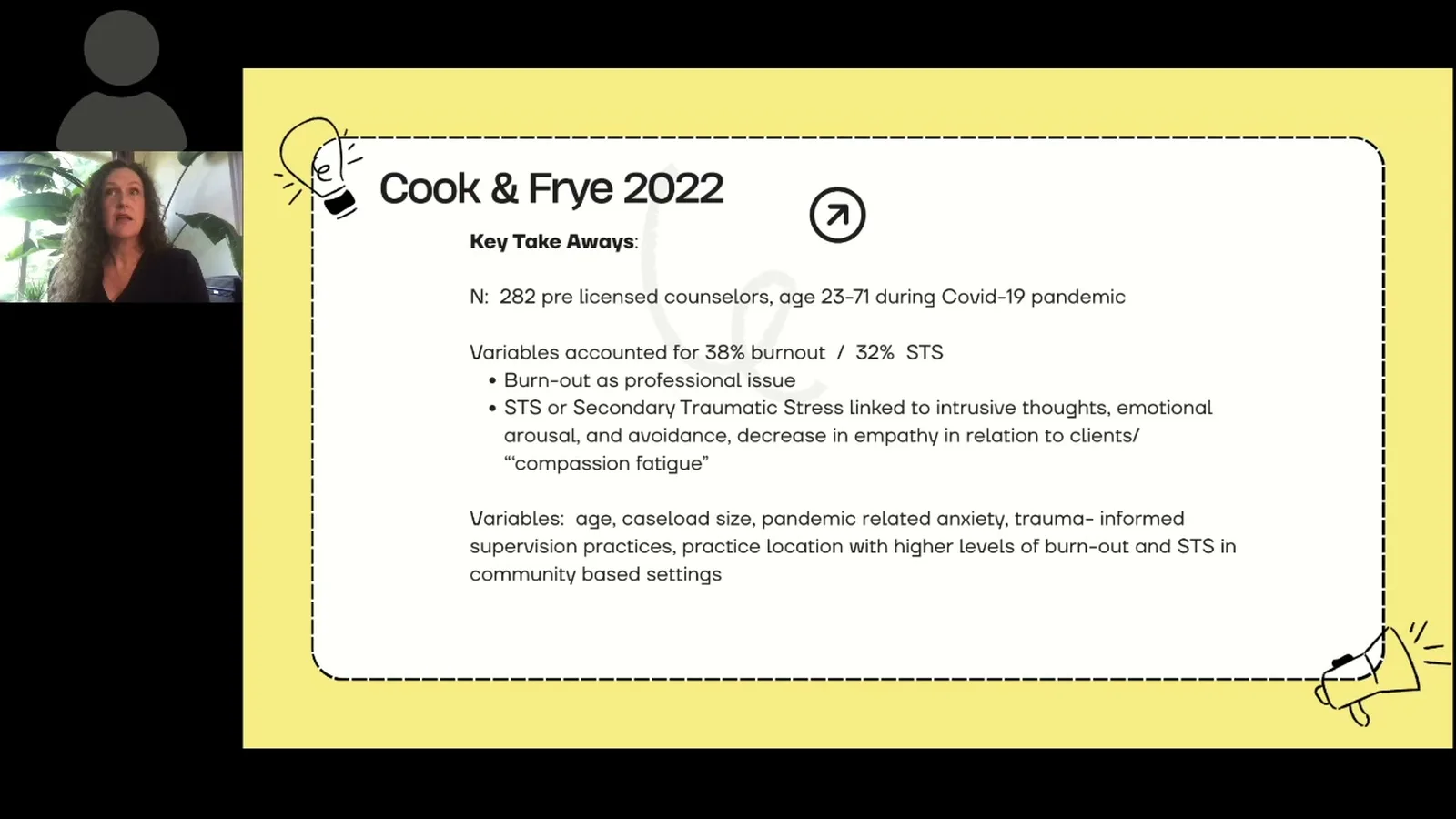
Reflective Supervision and Provider Outcomes in ABA
The Behaviorist Bookclub
More from The Behaviorist Bookclub
Real World” BCBAs, the “Behavior Crisis”, and Pathological Demand Avoidance
The Behaviorist Bookclub
Collaboration and Building Rapport: Starting a Strong Foundation With Caregivers and Stakeholders in the Home
The Behaviorist Bookclub
Harm Reduction Within ABA Practice
The Behaviorist Bookclub
OpenCEU is supported by advertising from third-party sponsors. Sponsors are clearly labeled, have no influence over course content, instructors, or CEU decisions, and never appear on certificates. The BACB does not sponsor, approve, or endorse OpenCEU sponsors or their products.