What Is a Functional Analysis in ABA? A BCBA Explains
A functional analysis is a search for an if-then relationship with one or more test and control conditions. Plain definition, from a BCBA-led CEU.
Key takeaway
A functional analysis (FA) is a pretreatment test where a clinician sets up situations on purpose to see if a behavior turns on or off.
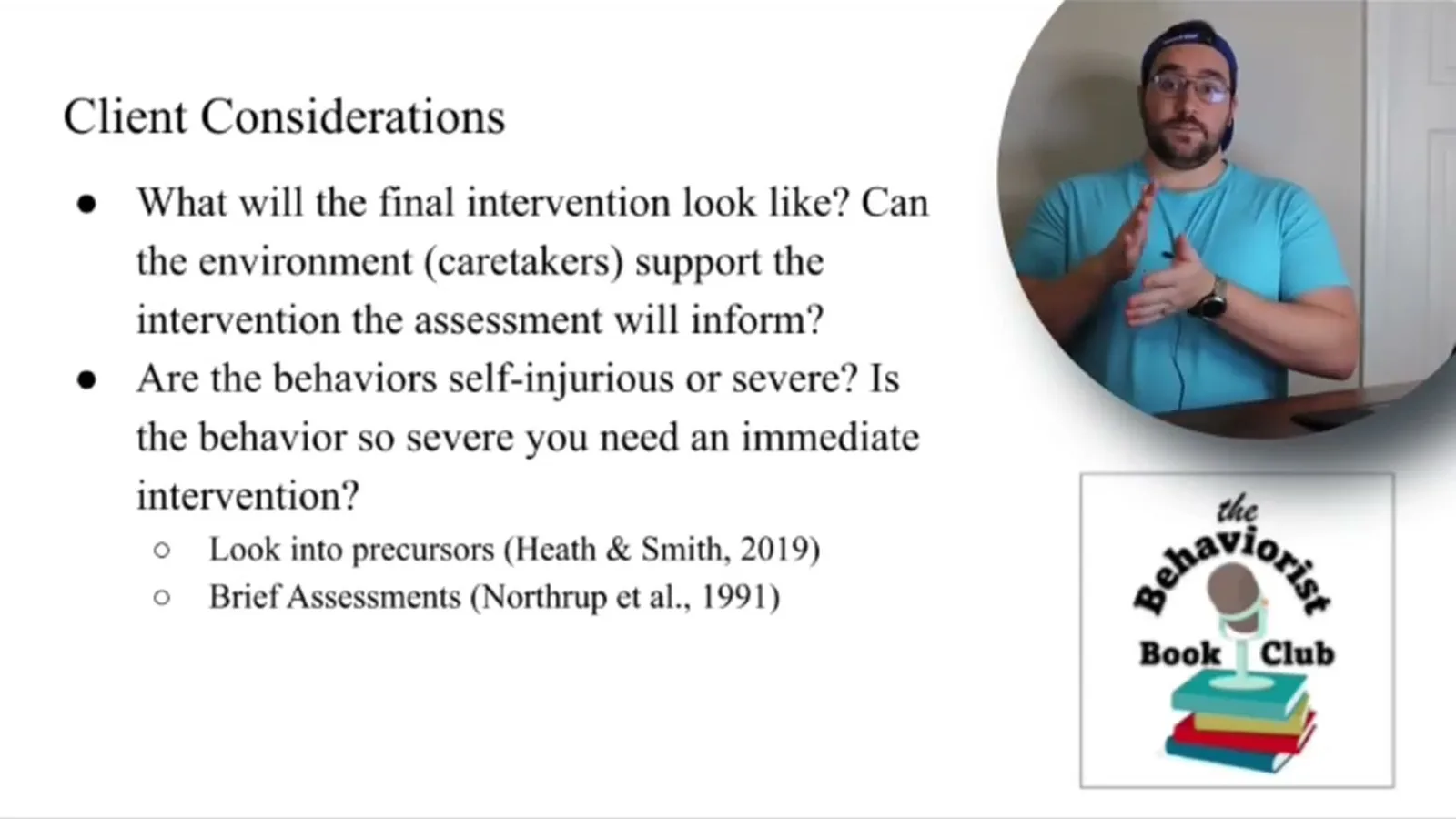
Confessions of a New Behavior Analyst in Functional Analysis
Free learning path on this topic
Child Development for Behavior Analysts
Typical development for behavior analysts. Kristen Byra's overview, then Kelly Brzak's deep dives on ages 2 to 5, 6 to 8, and 9 to 11, with milestones, common problem behaviors, and programming tips for each band.
On this page · 8 sections▾
A functional analysis (FA) is a pretreatment test where a clinician sets up situations on purpose to see if a behavior turns on or off. In plain words, it is a search for an if-then relationship: if I take away your attention, then does the behavior show up? If I give you a hard task, then does it show up? Schlinger and Norman wrote in 2013 that an FA is "a pretreatment clinical assessment that manipulates potential antecedent variables as well as potential reinforcers for problem behavior." That is the cleanest definition in the field, and it matters because most people treat the original 1982 Iwata procedures like the Ten Commandments instead of one example of the idea. An FA is also one piece of a bigger process called a functional behavior assessment (FBA), which has three phases: the indirect assessment (you ask people questions), the descriptive assessment (you watch what happens in the natural setting), and the functional analysis itself (you test it). Skipping any of those phases is how a Board Certified Behavior Analyst (BCBA) ends up wasting ninety minutes on the wrong condition, which is exactly what happened to me with a PICA case that a set of Santa's toy magnets ended up explaining in fifteen minutes. This page walks through what an FA actually is, where it sits inside an FBA, what gets manipulated, and what an FA is not.
Plain definition: a search for an if-then relationship#
If you ask ten BCBAs to define a functional analysis, six of them will recite the four-condition Iwata setup: attention, escape, alone, and play. That is one format. It is not the definition. The definition is much smaller than that, and once you see it, every format that has come out since 1982 starts to fit the same shape.
The shape is this: you pick a thing you think might be driving a behavior, you set up a situation where that thing is present, you set up another situation where it is not, and you watch what the behavior does. That is it. If the behavior shows up in one condition and not the other, you have found an if-then relationship. The if-then relationship is the whole point.
I like to think of it as a simple search for an if-then relationship. It's a search for an if-then relationship with at least one or more test and control conditions. From the talk — Matt Harrington
That is why a latency-based FA counts as an FA. So does a trial-based FA. So does an interview-informed synthesized contingency analysis (ISCA). So does a single-session ISCA. They are all the same idea wearing different clothes. You set up a test condition. You set up a control condition. You see if the behavior responds. The format is the wardrobe. The if-then is the body.
This matters for parents, teachers, and new clinicians for one reason. When you treat the 1982 procedures as the only "real" FA, you end up running them in places where they do not fit, and you skip simpler tests that would have answered the question in fifteen minutes.
Where the functional analysis sits inside the larger FBA#
A lot of the confusion in this field comes from one bad habit: people use "FA" and "FBA" like they mean the same thing. They do not. The FBA is the umbrella. The FA is one piece under it.
I like to think of the functional behavior assessment, the functional assessment in general, as an umbrella term for three distinct phases. You have the indirect assessment, the descriptive assessment, and then the functional analysis. Each of those phases are there for a reason. From the talk — Matt Harrington
The three phases stack like this:
- Indirect assessment. You talk to the people who know the client. Caregiver interviews, teacher interviews, rating scales. You are not watching the behavior yet. You are building a hypothesis.
- Descriptive assessment. You go to the natural setting and watch. You take ABC data. You notice what tends to happen right before and right after the behavior. You are still not changing anything.
- Functional analysis. Now you change things on purpose. You set up test conditions and control conditions to confirm whether your hypothesis is right.
Each phase exists for a reason, and the reason is that the next phase is more expensive than the last one. An interview takes twenty minutes. A descriptive assessment takes a few hours. A full FA can eat half a day of clinic time and pull a BCBA off other clients. If you skip the cheap phases, you end up paying for the expensive phase twice. Schlinger and Norman's 2013 reframe sits on top of all of this: an FA is a pretreatment assessment, which means it is meant to inform treatment, not to be the treatment.
What gets manipulated (and what doesn't)#
The verb in the Schlinger and Norman definition is manipulates. You are not observing. You are not waiting. You are turning a dial.
The dials you can turn fall into two buckets:
Antecedents. Anything that happens before the behavior. The presence or absence of attention. The presence of a demand. The presence of a preferred item. The presence of a specific person, a specific room, a specific time of day. An establishing operation (EO), which is anything that temporarily raises or lowers how much someone wants a particular reinforcer, also lives here. If your client just ate a giant lunch, the EO for food is low. If they have not slept, the EO for escape from demands is high.
Consequences. What you do after the behavior. Do you give attention? Do you remove the task? Do you give the preferred item? In an FA, you deliver the suspected reinforcer on purpose when the behavior happens, so you can see if that reinforcer is actually maintaining it.
What does not get manipulated: the client's diagnosis, the client's history, the client's family, the client's school. Those are context. They shape the hypothesis. They do not get tested directly.
The mistake new BCBAs make is manipulating ten things at once. If your test condition has a different room, a different therapist, a different task, and a different reinforcer than your control, you cannot tell which dial caused the change. One dial at a time. Sometimes two if you are running a synthesized condition on purpose. Never ten.
An everyday example: the PICA case Santa's magnets explained#
I had a young client at the clinic. PICA, which is the eating of non-food items, had come up in the caregiver interview, but the parent said it was getting better at home and we were not seeing it in the clinic. So I did the thing you should not do. I deprioritized it. I told myself it was not socially significant right now and moved on.
Four months later, PICA spiked. The client was mouthing things during sessions. I scheduled an experimental FA. I ran a full hour and a half of conditions: attention, escape, tangible, alone. I got a flat graph. Nothing differentiated. I had wasted an entire session and was no closer to an answer.
Then I called the parents. I asked what had changed at home. The parent told me Santa had brought the client a new set of toy magnets for the holidays. The client had started mouthing the magnets at home. We used the same kind of magnets in our clinic conditions as part of our materials rotation. The magnets, not attention or escape, were the relevant antecedent. A fifteen-minute follow-up with magnets present in one condition and absent in another confirmed it.
I wasted an hour and a half when I could have just talked to the parents for 20 minutes and then confirmed with a 15-minute analysis that magnets were a really relevant variable that I should test out. From the talk — Matt Harrington
The lesson is not that the FA failed. The FA worked exactly the way an FA works. It tested the hypothesis I had. The hypothesis was wrong because I skipped the indirect assessment. The cheap phase would have told me about the magnets in twenty minutes.
Why one FA is not the FA: the family of formats#
There is no single "functional analysis." There is a family of formats, and good clinicians pick the one that fits the setting, the behavior, and the time they have.
- Traditional Iwata-style FA. Four conditions, ten-minute sessions, repeated until you get a clear pattern. Gold standard for inpatient and research settings. Expensive in time.
- Latency-based FA. Instead of running each condition for ten minutes, you end the session the moment the behavior occurs and record how long it took. Good for severe behavior where you do not want repeated exposures.
- Trial-based FA. Short trials embedded in the natural environment, often in a classroom. Good for school settings where you cannot pull a kid into an analog room.
- Interview-informed synthesized contingency analysis (ISCA). You combine the antecedents and consequences the caregiver describes into one test condition that matches real life, then compare it to a matched control. Good for outpatient clinics with limited time.
- Single-session ISCA. One test, one control, one session. Fastest format. Useful when you need a hypothesis quickly.
- Precursor FA. You analyze a smaller, lower-risk behavior that reliably precedes the dangerous one. Good when running an FA on the dangerous behavior is unsafe.
Hagopian and colleagues in 2013 looked at over 170 FAs in an inpatient unit and found that, with modifications, the team could identify at least one reinforcer in the large majority of cases. That is the real headline. FAs work when you treat the format as a tool, not a doctrine.
What a functional analysis is NOT#
An FA is not:
- An FBA. The FBA is the whole umbrella. The FA is one phase.
- A treatment. It is a pretreatment assessment. You learn from it, then you write a function-based plan.
- A fixed recipe. Iwata 1982 is one example, not the only example. Schlinger and Norman 2013 makes that explicit.
- A way to prove a function exists. It is a way to test whether a specific if-then relationship holds. The function is your hypothesis, not the FA's conclusion.
- Optional when challenging behavior is on the plan. If you are writing a behavior reduction goal, you owe the client a function-based rationale, and an FA is usually how you get there.
Frequently asked questions#
Do you have to run a functional analysis for every client?
No. You run an FA when challenging behavior is a target for reduction and an indirect plus descriptive assessment has not given you a clear, defensible function. For skill acquisition goals only, an FA is usually not needed. Your ethics code asks you to use the least intrusive valid assessment that answers the question.
Who is qualified to run a functional analysis?
A BCBA, BCBA-D, or BCaBA under BCBA supervision, with training specific to the FA format being used. A latency-based FA on severe self-injury requires more training and supervision than a trial-based FA in a classroom. Match the format to your training, your setting, and your supervision.
How long does a functional analysis take in a real clinic?
It depends entirely on the format. A single-session ISCA can take an hour. A traditional Iwata-style FA can run across several sessions over a week or more. The Hagopian 2013 inpatient data showed that when modifications are made along the way, most cases land on a function with a manageable number of sessions. In outpatient ABA, plan for at least one full session, plus the indirect and descriptive phases that come before it.
Keep going#
A clean definition is the foundation. The next questions are which format to pick, how the FA differs from the broader FBA, what the most common new-BCBA mistakes look like, and how to run one inside a school. The siblings below pick up each of those threads.
Turn this topic into a CEU
You just studied this. Now get credit for it.
Watch Confessions of a New Behavior Analyst in Functional Analysis with Matt Harrington and earn 2.5 free BCBA CEUs. Detailed certificate, delivered the moment you finish.
Keep going with a free learning path
Child Development for Behavior Analysts
Typical development for behavior analysts. Kristen Byra's overview, then Kelly Brzak's deep dives on ages 2 to 5, 6 to 8, and 9 to 11, with milestones, common problem behaviors, and programming tips for each band.