5 Functional Analysis Mistakes Every New BCBA Makes
The five FA mistakes a BCBA made in his first year out of Kennedy Krieger, and what to do instead, from a BCBA-led CEU.
Key takeaway
The five mistakes a new Board Certified Behavior Analyst (BCBA) makes in functional analysis (FA) are skipping the caregiver interview, picking the wrong FA format for the room, running cookie-cutter conditions on a kid who needs custom ones, over-controlling the environment until the trial never naturally happens, and chasing a perfect graph past the point you already had your answer.
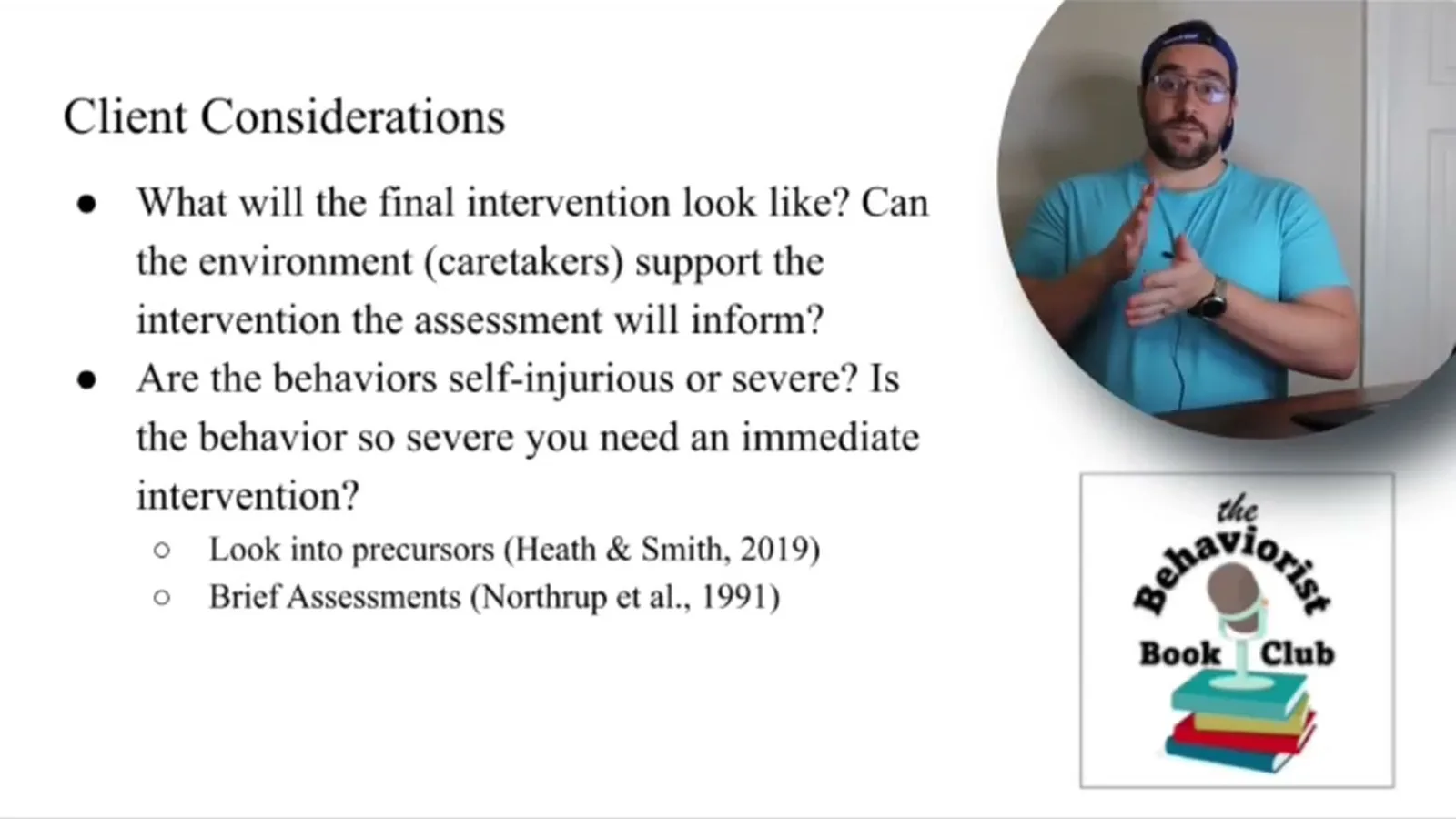
Confessions of a New Behavior Analyst in Functional Analysis
Free learning path on this topic
Child Development for Behavior Analysts
Typical development for behavior analysts. Kristen Byra's overview, then Kelly Brzak's deep dives on ages 2 to 5, 6 to 8, and 9 to 11, with milestones, common problem behaviors, and programming tips for each band.
On this page · 9 sections▾
The five mistakes a new Board Certified Behavior Analyst (BCBA) makes in functional analysis (FA) are skipping the caregiver interview, picking the wrong FA format for the room, running cookie-cutter conditions on a kid who needs custom ones, over-controlling the environment until the trial never naturally happens, and chasing a perfect graph past the point you already had your answer. I made all five in my first year out of Kennedy Krieger, and I will walk through each one the way I admitted them in the talk, including the imposter-syndrome moment that opened up the Q&A. If you are early in your career and your last FA felt off, this page is for you.
Why first-year BCBAs blow their first FAs (and it's not a skill problem)#
If you ran functional analyses at your practicum, you can run one now. The problem is not your skill. The problem is the room.
Grad school and most practicum sites set you up in conditions you will never see again once you start billing. At Kennedy Krieger I had nursing on the floor, multiple staff on every trial, and protective equipment in the cabinet. The day I moved to a clinic in Gainesville, all of that disappeared. The procedures I had memorized were built for a setting that does not exist in outpatient ABA.
That gap is what causes the five mistakes below. They are not skill mistakes. They are translation mistakes. You learned the science in one room, and now you are running it in a different room with fewer hands and looser rules. Every mistake on this page is a place where I copied a procedure from my old room instead of rewriting it for my new one.
The good news is that you can fix all five without re-reading Iwata 1982. You just need to notice which room you are actually in.
Mistake 1: Skipping the caregiver interview to save 30 minutes#
The first one is the one I am most embarrassed about. I had run hundreds of FAs by the time I got to the clinic. I felt fast. I felt confident. So when a young client showed up with a long history of putting non-food items in their mouth, also known as pica, I jumped straight to the experimental analysis.
I ran ninety minutes of conditions: attention, escape, tangible, alone. The graph came back flat. Nothing differentiated. I had nothing to show the family and nothing to write a plan from.
I knew how to do functional analyses like the back of my hand. I had conducted hundreds at my practicum, and I had even started conducting them in the clinical work. But I skipped the interview, and my functional analysis was crap because of it. From the talk — Matt Harrington
I called the parent the next day. Twenty minutes into the call she mentioned that Santa had brought a set of toy magnets at the holidays, and the client had started mouthing them at home. Those same magnets were in our materials rotation in the clinic. A fifteen-minute follow-up confirmed it.
The fix is small. Before you write a single condition, do the indirect assessment. Caregiver interview. Teacher interview. A rating scale if you have time. The functional behavior assessment (FBA) has three phases for a reason: indirect, descriptive, then functional analysis. The cheap phases protect you from spending the expensive phase on the wrong hypothesis.
If you skip the interview, you are not saving thirty minutes. You are spending ninety on a graph you cannot use.
Mistake 2: Picking the wrong FA format for the room#
There is no single functional analysis. There is a family of formats: traditional Iwata-style, latency-based, trial-based, interview-informed synthesized contingency analysis (ISCA), single-session ISCA, precursor FA. Picking the wrong one for your setting is the second mistake, and I made it on a telehealth case.
The client had severe behavior. I was supervising remotely. The right call was a precursor FA or a short single-session ISCA, because I could not be in the room if things went sideways. Instead I tried to run a trial-based FA over video. The tech was alone with the client, the conditions kept stretching, and the trials I needed were not happening on screen. I had to stop the session and run a different format the next day.
Format follows setting. Inpatient with backup staff is where Iwata-style sessions belong. School pull-outs almost always want trial-based. A busy outpatient clinic with a forty-five-minute slot wants an ISCA. Telehealth with a single tech on the floor wants the shortest, safest format you can defend.
Before you build conditions, ask three questions. How much time do I actually have. How much help is in the room. How dangerous is the behavior if I am wrong. The answers pick the format for you.
Mistake 3: Running cookie-cutter conditions on a non-cookie-cutter kid#
The third mistake comes from siblings on my caseload. Two kids in the same family. I wrote a clean individualized ISCA for each one. On paper the conditions were tight. In a one-on-one room, both ISCAs worked. The second they were in the same room together, both fell apart. The attention condition for one kid was a tangible condition for the other. The escape condition turned into a sibling-attention condition I had not planned for.
That is the third mistake in one sentence. A condition that works for a kid in isolation can mean something completely different when the real environment shows up. Stephen Covey called it "begin with the end in mind." For an FA that means building conditions for the room the behavior actually happens in, not the analog version of that room.
Celia Heyman gave me a two-point reminder that lives on a sticky note on my monitor. Who is in the room. What is on the table. If you cannot answer both for the home or school setting where the behavior occurs, your conditions are still a draft.
When in doubt, observe first. Take ABC data in the natural setting before you write a single test condition. Then build a condition that looks like that setting, not like a textbook page.
Mistake 4: Over-controlling the environment until no trial ever runs#
The fourth mistake is the opposite of the third. Instead of conditions that drift, you build conditions so tight that the trial never starts. I did this on the same telehealth case.
I briefed the tech on the exact conditions to set up. This thing going onto this thing and then this EO happens when we're in this specific spot. But the conditions were so finicky that they never ended up happening naturally. From the talk — Matt Harrington
I was scared. The behavior was dangerous and I was on the other side of a screen, so I tried to script every motion. The result was a tech standing in a corner waiting for an establishing operation (EO) that the real environment was never going to produce.
The clinical-chaos versus systematic-chaos distinction lives here. Clinical chaos is what happens when you run with too few rules and you get noise. Systematic chaos is what happens when you set the room up loosely enough that the natural EO can occur, then you measure what falls out. You want the second one. The trial has to be allowed to happen.
If you find yourself writing the fifteenth bullet on the setup checklist, stop. Cut the checklist in half. Let the room behave like a room.
Mistake 5: Chasing the perfect graph past the point you had your answer#
The last one I am still working on. I had a case where I softly confirmed an escape function in the first few sessions. The graph was not pretty. I could see the function, but the bars were not as clean as the ones in the textbook. So I kept going. Another session. Another modification. Looking for the graph that would let me publish if I wanted to.
I think looking back, I think I knew that I had the data. I had a decent amount of believability in my data, but I really, I think we just wanted to show like without a shadow of a doubt. I didn't need the information that I got after I was able to softly confirm an escape condition. From the talk — Matt Harrington
The client did not need a prettier graph. The client needed treatment to start. Every session I added after the soft confirmation was a session of unaddressed challenging behavior at home.
Hagopian and colleagues looked at over one hundred and seventy FAs in an inpatient setting in 2013 and showed that with modifications most cases land on a function in a manageable number of sessions. The headline is not that more sessions are better. The headline is that a defensible function with modifications beats a perfect graph that arrives two weeks late.
When you have enough data to write a function-based plan, write the plan. The graph is a tool, not the deliverable.
What to do this week if you've made one of these#
You probably saw yourself in at least two of these. That is normal. Here is the order I would fix them in if I were starting over on Monday.
- Add a fifteen-minute caregiver interview to every new FA referral. No exceptions.
- Before you build conditions, write down how much time, how much help, and how much risk are in the room. Let those three answers pick your format.
- Take a single ABC observation in the actual setting before you finalize a single condition.
- Cap your setup checklist at five lines. If you need more than five, your conditions are too tight.
- Set a soft-confirmation stopping rule before the FA starts. If you reach it, write the plan.
If you do those five things, four of the five mistakes go away on their own. The fifth one, chasing the perfect graph, is more about you than about the case.
I don't have beautiful graphs all the time. I don't take IOA for 30% of the sessions, and you better believe my treatment integrity data is not at the recommended percentage. I do my best, and I try to get those very high-quality functional analysis graphs, but it just doesn't happen all the time. From the talk — Matt Harrington
That admission is the part of the talk people email me about. Your first FA is not supposed to look like the one in the chapter. It is supposed to inform a plan for a real kid in a real room. That is the bar.
Frequently asked questions#
How long should my first functional analysis actually take?
Plan for one full session for the analysis itself, plus the indirect and descriptive phases before it. A single-session ISCA can land in an hour if your interview was thorough. A traditional Iwata-style FA can stretch across several sessions over a week or more. If you are past three sessions and still have a flat graph, stop and revisit your interview data before adding a fourth.
Should I tell my BCBA supervisor I'm not confident running an FA?
Yes. Confidence comes from supervised reps, not from quiet ones. Tell your supervisor which format you are nervous about and ask for one observed practice run before the live case. If your supervisor cannot give you that, ask for a peer BCBA who runs that format weekly. Hiding it costs the client.
What happens if my FA comes back undifferentiated?
A flat graph is information. It almost always means one of three things. Your interview missed a relevant antecedent, the format you picked does not fit the setting, or the EO you needed never happened during the conditions. Walk back through this page. Most undifferentiated FAs I have seen, including the pica case, were really mistake one or mistake four wearing a graph.
Keep going#
If one of these mistakes hit close to home, the next pages on this site go deeper on the pieces. The definition page covers what an FA is and is not. The FA versus FBA page covers the umbrella the FA sits inside. The methods page walks through how to pick a format on purpose. The school page covers the trial-based setting where mistakes two and four show up most.
Turn this topic into a CEU
You just studied this. Now get credit for it.
Watch Confessions of a New Behavior Analyst in Functional Analysis with Matt Harrington and earn 2.5 free BCBA CEUs. Detailed certificate, delivered the moment you finish.
Keep going with a free learning path
Child Development for Behavior Analysts
Typical development for behavior analysts. Kristen Byra's overview, then Kelly Brzak's deep dives on ages 2 to 5, 6 to 8, and 9 to 11, with milestones, common problem behaviors, and programming tips for each band.