How to Choose Between Functional Analysis Methods
Pick the FA format that fits the client, not your camp. Four barriers to check before you commit, from a BCBA-led CEU.
Key takeaway
The way to choose between functional analysis methods is to walk a four-barrier checklist before you pick a format, reject the camp warfare around synthesized versus isolated contingencies, and let treatment utility (Menner et al.
Confessions of a New Behavior Analyst in Functional Analysis
Free learning path on this topic
Child Development for Behavior Analysts
Typical development for behavior analysts. Kristen Byra's overview, then Kelly Brzak's deep dives on ages 2 to 5, 6 to 8, and 9 to 11, with milestones, common problem behaviors, and programming tips for each band.
On this page · 9 sections▾
The way to choose between functional analysis methods is to walk a four-barrier checklist before you pick a format, reject the camp warfare around synthesized versus isolated contingencies, and let treatment utility (Menner et al. 2022) break ties when two formats look equally clean on paper. The four barriers are implementer competency, environmental constraints, client characteristics, and behavior topography. A functional analysis (FA, the experimental manipulation of consequences to identify what is maintaining a behavior) is only as good as the intervention it produces. Stephen Covey said begin with the end in mind. In practice that means picking the FA backwards from the hand-off plan, not forwards from your favorite paper.
Stop picking your FA based on your camp#
There is a tribal split in the field right now. One side runs the ISCA (interview-informed synthesized contingency analysis, where reinforcers are tested together in a combined contingency). The other side runs the traditional isolated FA where attention, escape, tangible, and alone conditions get tested one at a time. People get loud about it. The loudness is not the point.
We shouldn't be choosing our functional analyses based on whatever camp we're in. From the talk — Matt Harrington
Both formats are tools. Each one fits some cases and breaks down in others. If you pick by camp, you are picking by identity, not by client. The cleaner question is which format the client in front of you can actually benefit from, given who is going to run it, where, and what the behavior looks like.
The four barriers to check first#
Before you choose a format, run a four-part check. Each barrier can kill an otherwise sound choice. The point is not to score them on a sheet. The point is to slow you down for ninety seconds before you commit.
- Implementer competency. Who is in the room, can they run it, and who is taking data.
- Environmental constraints. Where will it run, what time pressure exists, what is the staffing.
- Client characteristics. Age, language, medical, sibling presence, history of trauma.
- Behavior topography. Severity, precursors, single versus multi-controlled response classes.
The four barriers are not new. They are the ones every supervisor mentions in feedback and most clinicians forget the first time they design an FA on their own. The cost of skipping them is a wasted session, sometimes a wasted day, and almost always a graph that has to be reinterpreted by the next clinician who reads the chart.
Implementer competency: can the person in the room actually run it#
The first barrier is the people. That is you if you are coaching the session, you if you are participating, the staff implementing the conditions, and the person taking the data. If any one of those roles is shaky, the FA format has to bend toward simpler.
A trial-based FA (where short discrete trials are run inside the natural routine rather than in long alternating conditions) can be run by a trained teacher with coaching. A multi-element FA with five conditions and counterbalancing cannot. A precursor FA (where you target a milder precursor behavior in the chain instead of the dangerous topography) needs an implementer who can correctly identify the precursor in the moment without overshooting.
If the implementer has not been trained on the format with BST (behavior skills training, the loop of instruction, modeling, rehearsal, feedback), the format does not exist for that case yet. You either train them first, change the format, or change the implementer. Picking a fancier FA and hoping the team rises to it is the most common version of this mistake.
Environmental barriers: telehealth, staffing, time on the clock#
The second barrier is the room and the clock. Telehealth FAs and clinic FAs and home FAs are not the same thing. A telehealth trial-based FA done over a tablet has a different ceiling than the same procedure in person. If the caregiver has to also be the implementer and the camera holder and the parent, you are stacking demands on one person.
Time on the clock matters too. A funder may have authorized two assessment sessions. A school may give you forty minutes. A clinic may give you a half-day and then need the room. Long alternating treatment FAs need session time you may not have. Latency FAs (where you measure how fast the behavior occurs once a condition starts and end the trial on first response) are built for cases where you cannot afford a full ten minutes per condition.
Staffing is the last piece of the environment. Two siblings in the same waiting room can wreck a clean ISCA the moment the second one walks in. Run the FA where it can actually run, with the people who can actually staff it, or change the format.
Client and topography: severity, precursors, single vs multi-controlled#
The third and fourth barriers travel together. Client characteristics tell you what the person can tolerate. Behavior topography tells you what is safe to evoke.
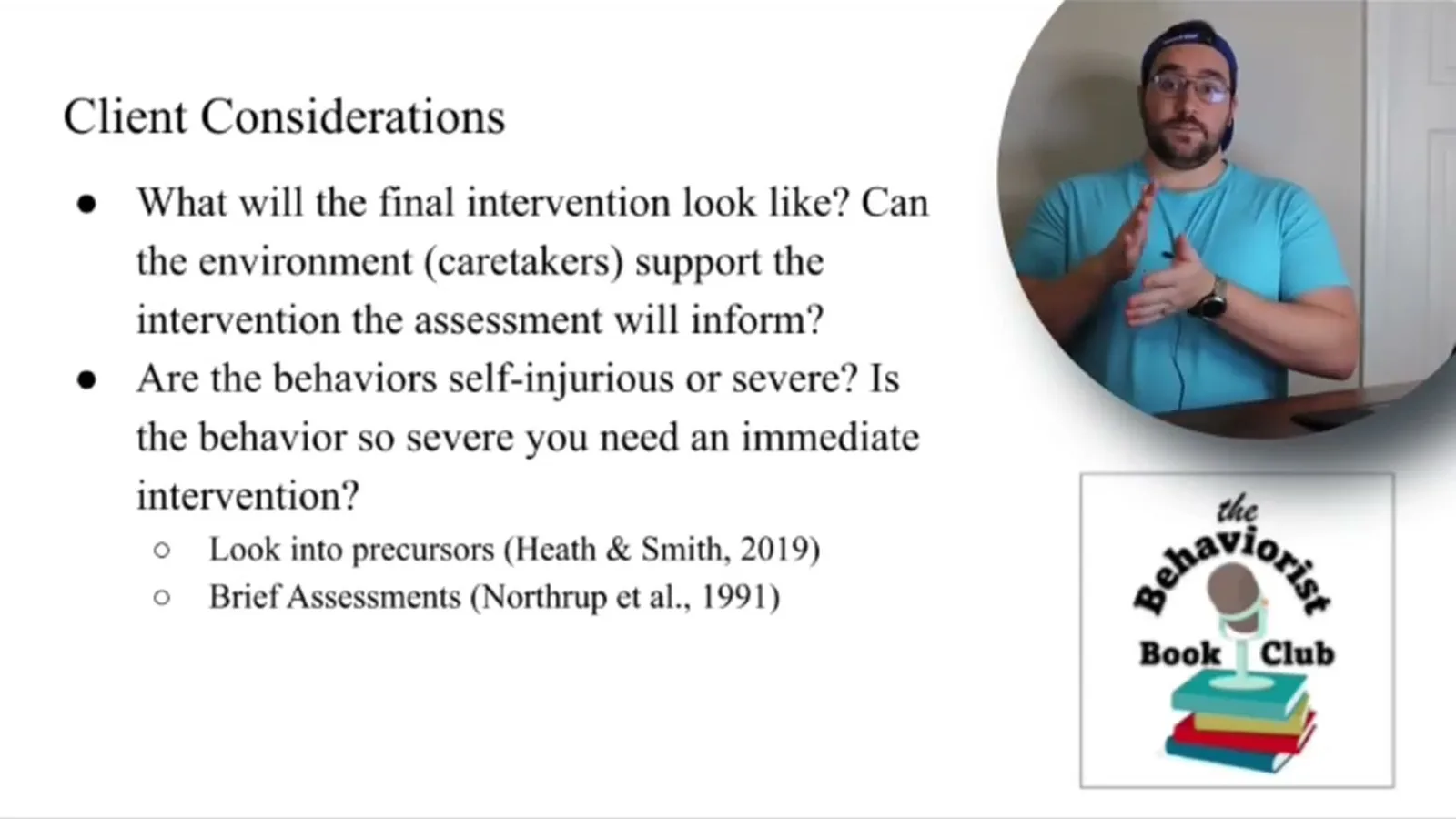
If the behavior is severe self-injury or aggression that produces tissue damage, you do not start with a traditional FA that requires evoking the full topography. A precursor FA targets the chain earlier. A latency FA ends the trial on the first instance. A trial-based FA limits the exposure window.
If the behavior is socially mediated and looks single-controlled on the indirect and descriptive data, an isolated contingency FA gets you a clean answer. If the indirect data and the descriptive data both suggest a synthesized contingency (attention plus tangible plus escape from a transition), the ISCA is the format that maps to the reality of the reinforcer.
If you're going to use a synthesized contingency analysis like the ISCA, you're probably almost guaranteed to end up with a synthesized contingency as a functional reinforcer. From the talk — Matt Harrington
That is not a knock on the ISCA. It is a reminder that the format you choose shapes the answer you get. Pick the format that maps to what the indirect and descriptive data already suggest, and you avoid forcing the answer.
Working backwards from the intervention you will have to hand off#
This is where Covey shows up. Begin with the end in mind. The end is not a clean graph. The end is a caregiver, a teacher, or a paraprofessional running the intervention without you in the room.
If your FA produces a synthesized contingency, your intervention will probably be a skill-based treatment with multiple reinforcers chained together. That intervention has to be hand-offable. Can the parent run it. Can the school RBT run it inside a forty-minute block. Can the new clinician inherit it without unpacking three layers of clinical decisions.
If your FA produces a single isolated function, your intervention is simpler. One reinforcer to control. One replacement behavior to teach. One extinction contingency to manage. That simplicity has its own hand-off value.
The choice is not which graph is prettier. The choice is which intervention you can hand off cleanly to the person who will live with it. If you cannot answer that question, the FA you picked is the wrong one regardless of how clean the data come out.
Treatment utility as the tiebreaker#
Sometimes two formats look equally good on the four barriers. The tiebreaker is treatment utility.
Treatment utility is the extent to which the assessment contributes to a positive treatment outcome. Without treatment utility, why are we doing an assessment? From the talk — Matt Harrington
That definition is from Menner et al. 2022. It is the cleanest single sentence the field has for what the assessment is for. The FA is not a research artifact. The FA is the first step of treatment. The format that produces the cleanest, most usable, most hand-offable treatment plan wins the tie.
In practice that often means choosing the slightly less elegant format because it produces a treatment the team can run on Monday. A clean isolated FA that produces a treatment the parent will not implement is worse than a less ornate trial-based FA that produces a treatment the parent will implement.
Treatment utility is also how you defend the choice in a supervision meeting or a peer review. The question is not whether your FA was the gold standard. The question is whether it moved the case forward. If the answer is yes, you picked the right format.
Frequently asked questions#
Is the ISCA always better than a traditional functional analysis?
No. The ISCA is one tool. It is well suited to cases where the indirect and descriptive data already suggest a synthesized contingency and where the team can run a skill-based treatment afterward. For cases that look single-controlled on the front-end data, an isolated FA gives a cleaner answer and a simpler treatment. The format follows the case, not the camp.
Can you switch FA formats in the middle of an assessment?
Yes, and sometimes you should. If the environment changes (the sibling shows up, the caregiver cannot leave the room, the session has to move to telehealth), the format has to change with it. Document the change, note why, and run the new format from a clean baseline. A messy mid-session pivot is still better than finishing a format the situation no longer supports.
What FA format should a brand new BCBA start with?
A trial-based FA or a precursor FA with a senior clinician on the case. Both formats limit the topography you have to evoke, both are easier to run inside a real session, and both produce a clear answer when run correctly. Save the multi-element traditional FA for cases where you have time, space, a trained team, and a supervisor in the room.
Want the full case examples and the four-barrier walkthrough#
The CEU walks through the Kennedy Krieger to Gainesville clinic shift, the wasted ninety-minute PICA FA that a pair of Santa's magnets explained, the telehealth trial-based FA that had to stop and restart the next day, and the siblings whose individualized ISCAs fell apart the second they were in the same room. Watch the talk to hear Matt apply the four barriers to each one and explain why he changed formats.
Turn this topic into a CEU
You just studied this. Now get credit for it.
Watch Confessions of a New Behavior Analyst in Functional Analysis with Matt Harrington and earn 2.5 free BCBA CEUs. Detailed certificate, delivered the moment you finish.
Keep going with a free learning path
Child Development for Behavior Analysts
Typical development for behavior analysts. Kristen Byra's overview, then Kelly Brzak's deep dives on ages 2 to 5, 6 to 8, and 9 to 11, with milestones, common problem behaviors, and programming tips for each band.