Instructional Design for ABA Staff Training: 5 Mistakes to Fix
The five training mistakes that wreck ABA staff onboarding, and the instructional design fixes that work, from a BCBA-led CEU.
Key takeaway
Most ABA staff training fails for five reasons you can fix this week, and BCBA Ally Wharam unpacked the two clearest ones in a recent CEU: a team that asked for a "critical thinking" workshop when new RBTs really needed field supervision, and a school team that wanted a data collection training when the actual problem was that the data sheets prompted duration data on goals that should have been frequency.
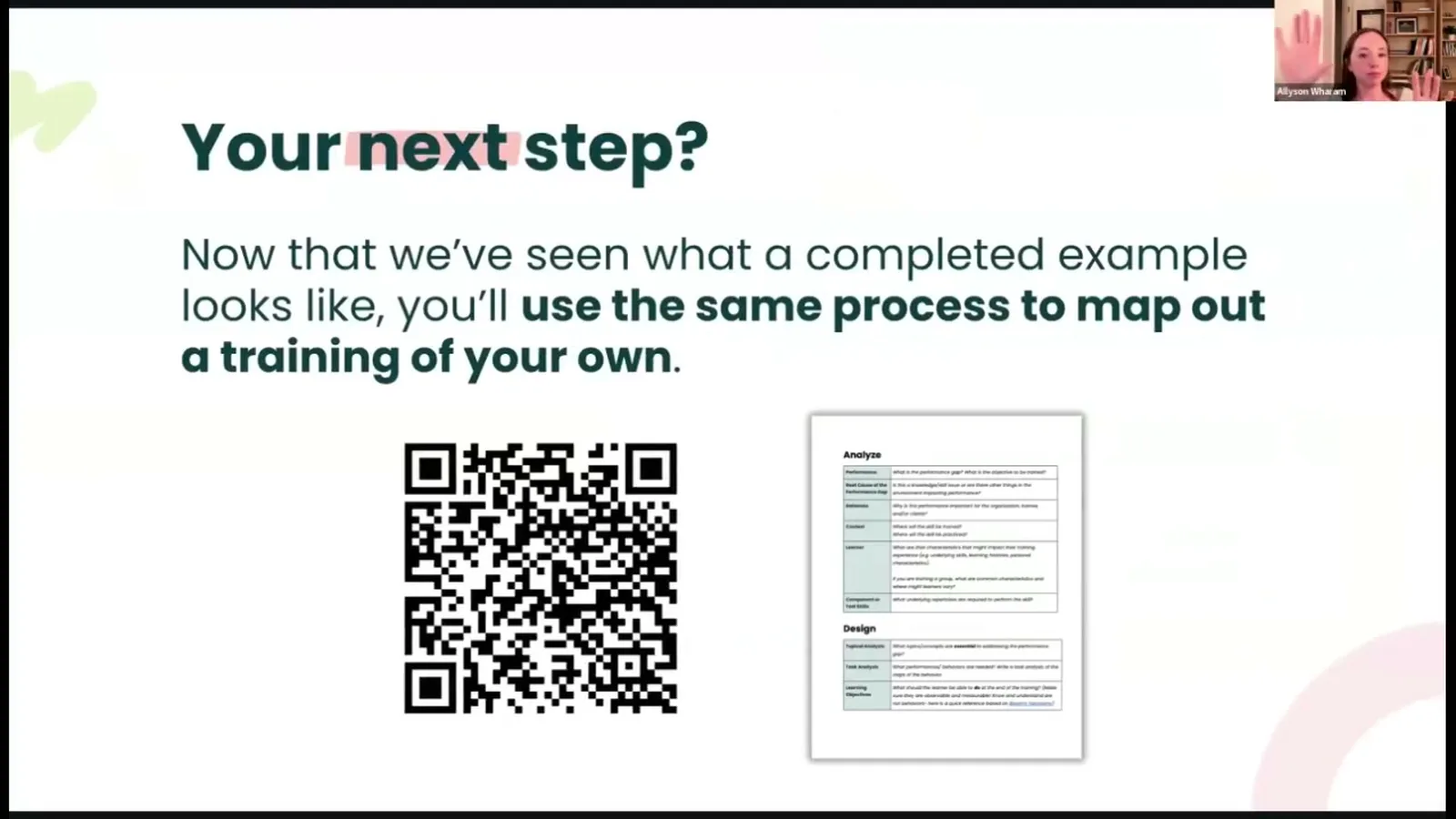
Design Smarter: Using Instructional Design to Improve Staff and Stakeholder Training
Free learning path on this topic
Supervision, Done Right
Four supervision CEUs that build on each other. What reflective supervision is, how to build a supervision system, how to assess supervisee competence instead of counting hours, and how supervision affects provider outcomes. The BACB asks supervisors for three supervision CEUs per cycle. This covers it.
On this page · 9 sections▾
Most ABA staff training fails for five reasons you can fix this week, and BCBA Ally Wharam unpacked the two clearest ones in a recent CEU: a team that asked for a "critical thinking" workshop when new RBTs really needed field supervision, and a school team that wanted a data collection training when the actual problem was that the data sheets prompted duration data on goals that should have been frequency. Both teams wanted training. Both teams needed something else. If you run RBT onboarding, supervise paraprofessionals, or coach caregivers, you have probably defaulted to the same fix. This page walks through the five mistakes Ally names, the instructional design moves that solve each one, and how to know when training is not the answer at all.
Why most ABA staff training fails the transfer test#
Transfer is the test that matters. Did the RBT do the thing in the home, in the classroom, on the floor, after you trained them? If the answer is no, the training did not work, no matter how good it felt in the room. Most BCBAs have sat through a training that was interesting, well-paced, even fun, and then left the room with nothing to actually change on Monday. That is the gap.
Instructional design is the planned process of building a learning experience that ends in behavior change. It starts with the end behavior you need on the floor, then works backward to the meeting, the slide, the checklist. Behavior skills training (BST) sits inside this larger frame. So does shaping, task analysis, and generalization planning. You are already doing most of it with your clients. The job is to use the same toolkit on your staff and your caregivers.
The five mistakes below are the patterns that break transfer. Each one has a fix, and each fix uses skills you already have.
Mistake 1: defaulting to training when the real fix is supervision or systems#
This is the trap every agency falls into. A performance gap shows up. Someone says "we should run a training on that." Sometimes that is right. Often it is not.
The response from higher ups and leadership was that we should develop a training on critical thinking to support them. As you can imagine, a training workshop on critical thinking was not the missing piece there. The missing piece was actual supervision and transition of support to the field.
The new technicians were not short on knowledge. They were short on supervision in the field. A workshop would have eaten three hours and changed nothing. The same pattern shows up with data collection, session notes, and parent collaboration. The behavior looks like a skill gap. The root cause is something else in the environment.
Before you build a training, run a real root cause check. The Performance Diagnostic Checklist - Human Services (PDC-HS) is the standard tool. Ask: have these staff ever done this skill correctly? Do they have the materials to do it? Do they get feedback when they try? If the answer to any of those is no, training will not fix it. Fix the antecedent. Fix the data sheet. Add the supervision cycle. Then decide if a training still needs to happen on top.
Here is the second story Ally told, and it lands hard for school BCBAs:
They wanted to deliver training for these paraprofessionals on how to collect data accurately. However, when we actually started to peel back the layers and looked at the data sheets and looked at what the root cause was, the data sheets themselves were incredibly unclear.
The fix was a better data sheet, not a better training. That is the move most BCBAs miss.
Mistake 2: content dumping every term in the textbook#
Once a BCBA decides to train, the next failure shows up fast. You sit down to build the slide deck and you start with what you know instead of what your audience needs to do.
Content dumping, and not really tailoring it to the needs of people that you're talking to. So really just focusing on like, what is interesting? But not starting with the end goal of what does the person need to do with this information? So when we're training, we really need to be starting with that end goal.
Content dumping wastes RBT meeting time. It also produces the training everyone in the room rates as "interesting" but no one uses on the floor.
The fix is the same one you use with client programs. Write the end behavior first. Not "they will understand reinforcement." Write the observable, measurable behavior you want a tech to do in a session, in a home, in a classroom. Then filter every slide, every story, every example through that goal. If a piece of content does not move the learner closer to the end behavior, it does not belong in the training. This is the design-backward move, and it is the single biggest lift you can give your staff trainings.
Mistake 3: pitching at the wrong technical level for RBTs#
Even when BCBAs pick a clear end behavior, they often pitch it at the wrong level. A graduate-level discussion of reinforcement schedules does not help an RBT figure out what to do when a kid throws a toy.
Do they necessarily need to be able to discriminate between positive and negative reinforcement and punishment and have all the technical terminology or do they need to be able to understand and practice when something is functioning as a reinforcer or not?
Right-size the depth. An RBT needs to spot when something is working as a reinforcer in the moment and adjust. They do not need to recite the four-term contingency on demand. A paraprofessional taking data needs to know what counts as a target response and what does not, not the full literature on response measurement.
A useful filter: would this content change what the person does in a session? If yes, teach it. If no, skip it. Save the deeper theory for staff who are working toward BCBA supervision hours.
Mistake 4: skipping the bridge from training room to session#
This is the gap that swallows most well-designed trainings. The content is right. The level is right. The room is engaged. Then everyone walks out, the week starts, and nothing changes.
The bridge is the planned path from training to performance. Job aids, checklists, worked examples, in-session prompts, and the first round of supervision feedback all live on this bridge. BST handles the modeling, rehearsal, and feedback in the room. The bridge handles what happens between the room and the next session. Without it, even strong BST does not generalize.
For a session notes training, the bridge is the checklist the RBT pulls up on their phone before they submit a note, the supervisor who reads the first three notes that week and gives written feedback, and a worked example pinned somewhere they can find it. Build the bridge before you build the slides.
Mistake 5: no evaluation, no follow-up, no idea if it worked#
If you do not measure whether the training transferred, you cannot improve it. You also cannot tell your director why the next training will land better.
Evaluation does not have to be heavy. Pick one or two behaviors you can score after the training. For a session notes training, score a sample of notes against the rubric you taught from. For a prompting training, run a brief in-session probe. Add a social validity check: did staff find it useful, did they actually use the checklist, what got in the way. Use that data to iterate the next round.
This is the antecedent-plus-consequence frame Ally pointed to. Training is the antecedent. Supervision feedback, performance data, and the rubric are the consequence side. Without the consequence side, the antecedent decays.
The fix: write the end behavior first, design backward#
The whole instructional design move collapses to one habit. Write the end behavior first. Then design backward.
For staff and caregiver training, that means: name the observable behavior you need in the natural setting, run a root cause check before you build anything, write measurable learning objectives that mirror the end behavior, pick the smallest set of content that gets the learner there, design the bridge to performance with job aids and supervision touchpoints, and decide how you will measure transfer before you run the session. The ADDIE framework (Analyze, Design, Develop, Implement, Evaluate) is the scaffolding for this loop, and it maps cleanly onto the FBA-to-intervention process you already run with clients.
If you do these five moves, your training stops competing with supervision and starts compounding with it.
FAQ#
Is staff underperformance always a training problem?
No. Often it is a supervision problem, a materials problem, or a workflow problem. Run a PDC-HS style check first. Ask whether staff have ever performed the skill correctly, whether the tools and materials support the behavior, and whether feedback is reaching them. If any of those is off, fix that first. Training a skill that the environment punishes will not stick.
What is content dumping in ABA training and how do I stop doing it?
Content dumping is when you build a training around everything that is interesting about a topic instead of the specific behavior you need on the floor. To stop, write the end behavior first as a measurable objective, then cut every slide, story, and definition that does not move the learner closer to that behavior. If a piece of content would not change what the person does in a session, it does not belong in the training.
How do I know if my RBT training actually transferred to the field?
Pick one or two observable behaviors from the training and probe them in real sessions within the next two weeks. For session notes, score a sample of notes against the rubric. For prompting, run a short in-session probe. Pair that with a social validity check on whether staff used the job aid and what blocked them. If transfer is weak, the issue is usually missing supervision touchpoints or a job aid that does not match what the floor actually looks like.
Run the design loop on your next training#
The next training on your calendar is the place to test this. Pull the end behavior out of the training brief, run a five-minute root cause check, decide whether training is even the right intervention, and if it is, build the bridge to performance before you touch a slide. Watch Ally's full CEU for the ADDIE walkthrough, the design template, and the staff training case example.
Turn this topic into a CEU
You just studied this. Now get credit for it.
Watch Design Smarter: Using Instructional Design to Improve Staff and Stakeholder Training with Ally and earn 1 free BCBA CEU. Detailed certificate, delivered the moment you finish.
Keep going with a free learning path
Supervision, Done Right
Four supervision CEUs that build on each other. What reflective supervision is, how to build a supervision system, how to assess supervisee competence instead of counting hours, and how supervision affects provider outcomes. The BACB asks supervisors for three supervision CEUs per cycle. This covers it.