Writing Measurable Learning Objectives for BST in ABA
Stop writing fuzzy ABA training goals. How to draft observable, measurable objectives for BST sessions, from a BCBA-led CEU.
Key takeaway
Write observable, measurable objectives before you run BST, and use a 3-objective session-notes template so every learner knows when they have gotten it.
Design Smarter: Using Instructional Design to Improve Staff and Stakeholder Training
Free learning path on this topic
Supervision, Done Right
Four supervision CEUs that build on each other. What reflective supervision is, how to build a supervision system, how to assess supervisee competence instead of counting hours, and how supervision affects provider outcomes. The BACB asks supervisors for three supervision CEUs per cycle. This covers it.
On this page · 8 sections▾
Write observable, measurable objectives before you run BST, and use a 3-objective session-notes template so every learner knows when they have gotten it. That is the simplest fix for the most common training failure BCBAs run into: a fuzzy goal at the top of the deck, followed by 45 minutes of modeling and rehearsal that no one can score.
This page sits in front of behavioral skills training. Get the target right first, then layer instruct, model, rehearse, and feedback on top of it.
Why most BST objectives fail the measurability test#
Open the last staff training deck you built. Look at slide two. If the goal says something like "RBTs will understand the new prompting procedure" or "the team will know how to take ABC data," you have already lost the session. You cannot run BST against a goal you cannot score.
This is the same trap we coach out of every new BCBA writing a client program. We do not write "the client will understand greetings." We write the behavior, the condition, and the criterion. Then we run a probe. Then we know.
Ally Wharam, a BCBA whose master's work is in instructional design, put it plainly in her May CEU:
These are the same sort of objectives that we would write for a client learner where we're not saying they'll be able to understand or know, or something that is not measurable. We want to look at actual behaviors and performances that we can observe to know when someone has gotten something or not.
That last clause is the part most BCBAs skip. The objective is not only so the supervisor knows when the learner has it. It is so the learner knows. A measurable target gives the RBT or paraprofessional a clean self-check. Without it, they walk out of training guessing.
The understand and know problem (and what to write instead)#
"Understand" and "know" are private events. We cannot observe them, so we cannot score them, so BST cannot close the loop on them. Every objective you write for a staff training has to translate into something the learner does in the room or in session.
Ally asks the BCBA filter question this way:
Writing behavioral objectives, not just, oh, I want them to know this thing. Well, how do we measure that? How do we actually look at the behaviors that we want them to do?
Run that question on every draft objective. If you cannot answer it in a single observable verb, rewrite the objective.
Verbs that work for staff training: identify, label, write, demonstrate, perform, score, complete, correct, deliver. Verbs that do not: understand, know, learn, appreciate, be familiar with, be aware of.
The fix is almost mechanical. Take the fuzzy verb, replace it with the closest observable behavior, then add what the learner is responding to and what counts as correct.
Three components of a usable BST objective: behavior, condition, criterion#
Every objective you write for a BST session needs three parts.
Behavior. What the learner does. One verb. Observable. Scorable by someone watching.
Condition. What they have in front of them or what is happening when they do it. A sample note. A mock session. A client showing a target behavior. A checklist on the screen.
Criterion. How well, how often, or how completely. Three out of three. All required elements present. Within 30 seconds.
When you stack the three, you get an objective you can score in real time during rehearsal. You can also reuse the same wording on the post-test, in the supervision rubric, and on the job aid the staff keeps at their station. One target, four places. That is the leverage of writing it correctly the first time.
Ally points to the same logic running underneath:
We start with our goal and we design our instruction around that and not the other way around. The next thing is to embed recall and prioritize active responding for bridging to performance. And then the last piece is really planning for generalization, collecting data whenever you can and iterating.
Goal first. Instruction second. The order matters because the instruction has nowhere to land if the goal is fuzzy.
Worked example: turning client did great into a measurable target#
Here is the kind of opening Ally walks BCBAs through in the session.
The performance gap: RBTs are writing session notes that read "client did great today" or "tough session, lots of redirects." Vague. No observable behavior. No required billing elements. Compliance flag waiting to happen.
The fuzzy version of the training goal: "RBTs will understand how to write better session notes."
You cannot score that. You cannot run BST against it. You cannot tell the RBT when they have it.
Now apply the three components. Behavior: write. Condition: a 45-minute session with a client targeting two programs. Criterion: a note that uses objective language, names the goals addressed, describes the prompting used, describes the client response, and notes any barriers.
That single rewrite gives you the template Ally uses in her staff-training example. Three objectives, in order:
Our learning objectives are to identify and correct vague or subjective language in a sample note, use objective language to describe the client performance, and then write a session note that includes all of the required elements.
Look at how clean that is. Three behaviors. Three conditions baked in. Each one scorable. And the third objective is the actual job outcome, with the first two scaffolding up to it. That is the template you can lift straight into any BST session that targets a documentation, data, or procedural-fidelity gap.
Swap the topic and the structure holds. Pairing? Identify and correct rapport-breaking moves in a sample video, demonstrate three pairing behaviors in a mock session, run a 10-minute pairing block that hits the checklist. Discrete trial? Identify error patterns in a sample run, deliver three trials with correct prompting and reinforcement, run a full program with 90 percent procedural fidelity.
Aligning BST objectives with the rehearsal and feedback phases#
When you write objectives this way, the rest of BST falls into place because every phase already has a target.
The instruct phase has a job: teach the discrimination inside objective one. Show what vague language looks like. Show what objective language looks like. Have learners label examples and non-examples until they are scoring 3 of 3.
The model phase has a job: show objective two. The supervisor narrates a worked example. Here is what I noticed. Here is the language I would use. Here is the element I made sure to include.
The rehearse phase has a job: drop the learner into a condition that demands objective three. Hand them a checklist. Hand them a 5-minute mock session video. Give them 10 minutes. Watch them write.
The feedback phase has a job: score against the rubric you already wrote when you drafted the objective. Not vibes. Not "great job, just tighten it up." Specific. "You named both goals. The prompting description was clear. The client response read as subjective in line three, here is the rewrite."
If you cannot fit each phase against the objective, the objective is wrong. Rewrite it before you build a single slide.
Quick checklist before you run the next BST session#
Before you put a training on the calendar, run the objectives through this filter. Three minutes, max.
- Is the verb observable? Can someone watching the rehearsal mark a yes or no?
- Is the condition spelled out? Do I know what the learner is responding to?
- Is the criterion specific? Could two different supervisors score the same rehearsal and agree?
- Does the objective name the actual job behavior, not a precursor? If the learner only hits the precursor, will the field problem still be there next week?
- Can I use this exact wording on the rubric, the job aid, and the follow-up supervision check? If not, why is the language different?
- Did I write between one and four objectives? More than four and your BST session will not have time to rehearse any of them to fluency.
If every objective passes, you have a target the BST session can close on. If any of them fails, fix the target before you build the deck.
FAQ#
What makes a learning objective measurable in ABA training?
A measurable objective names a behavior you can observe, the condition the learner performs it under, and a criterion for how well. If you cannot watch the rehearsal and score yes or no, the objective is not measurable. The fastest test: replace any verb like understand, know, or learn with a behavior verb like identify, write, demonstrate, or perform.
Can I just reuse my client program objectives for staff training?
Not directly, but the structure transfers. The client objective is written for a child mastering a skill. The staff objective is written for an adult performing a job task. The behavior, condition, criterion frame is the same. The condition for staff is usually a sample document, a mock session, or a live session in the field. The criterion is usually a fidelity score, a checklist completion, or a procedural pass rate.
How many learning objectives should one BST session have?
One to four, depending on session length. A 45-minute BST block can usually hit three small objectives or one large one with two scaffolding sub-targets. More than four in a single session and you will run out of time to rehearse and give feedback, which is where BST does the actual work. If you have five or more, split the training into two sessions and let the first one finish before the second one starts.
Next step#
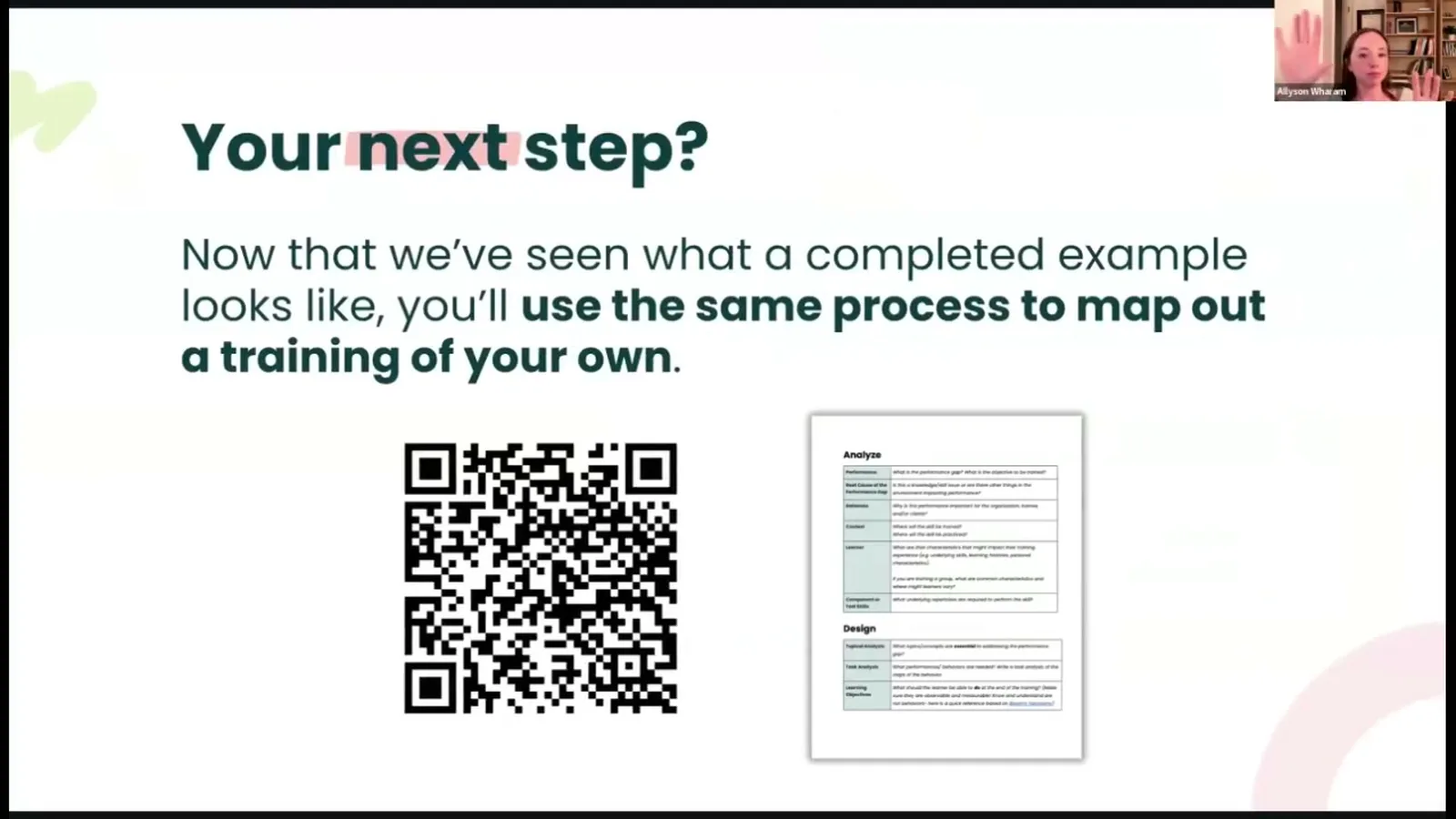
Pull the last staff training deck you ran. Open it to the objectives slide. Rewrite each one using behavior, condition, and criterion. Score the rewrite against the six-question checklist above. If you want the full instructional design walk-through, including the topical and task analysis Ally uses before she ever writes the objective, watch the recording.
Turn this topic into a CEU
You just studied this. Now get credit for it.
Watch Design Smarter: Using Instructional Design to Improve Staff and Stakeholder Training with Ally and earn 1 free BCBA CEU. Detailed certificate, delivered the moment you finish.
Keep going with a free learning path
Supervision, Done Right
Four supervision CEUs that build on each other. What reflective supervision is, how to build a supervision system, how to assess supervisee competence instead of counting hours, and how supervision affects provider outcomes. The BACB asks supervisors for three supervision CEUs per cycle. This covers it.