How to Train Group Home Staff to Support Residents Through Grief
A practical training outline for group home staff supporting adults with IDD after a death loss, from a BCBA-led CEU.
Key takeaway
A grief training for group home staff is one short program with a clear dose, a clear format, and four content blocks. The dose is one full day, or one hour a day across a week.
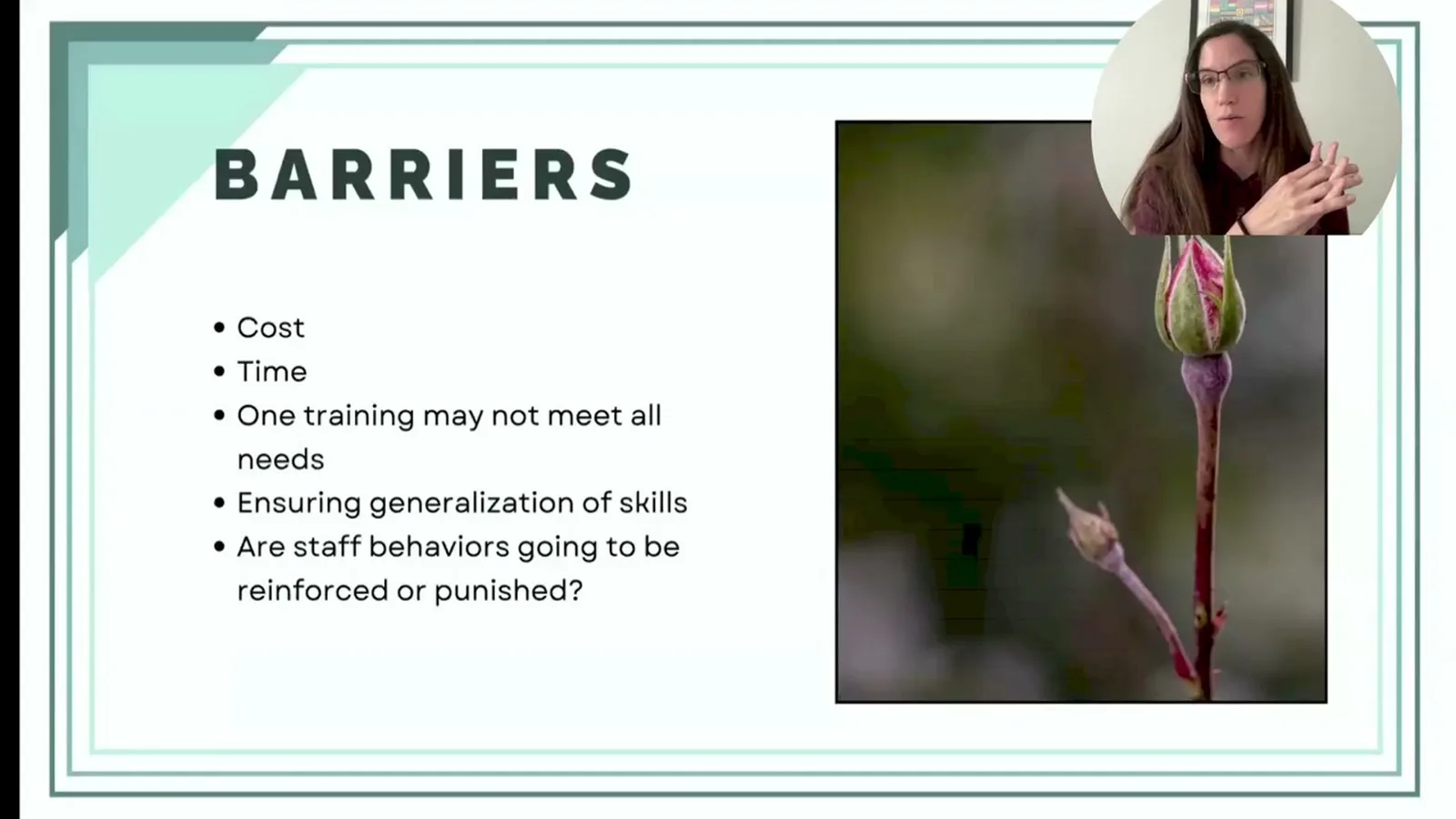
Grief Support at the Front Lines: Training Day Hab and Group Home Staff to Support Adults with IDD Through Bereavement
Free learning path on this topic
Sleep for Behavior Analysts
Lindsay Anderson's three-part series on sleep. Start with the science of sleep and how it affects your own health and work, then build an individualized bedtime routine, then work through why a child keeps waking at 2 AM. Three hours, three CEUs.
On this page · 8 sections▾
A grief training for group home staff is one short program with a clear dose, a clear format, and four content blocks. The dose is one full day, or one hour a day across a week. The format is plain teaching plus practice. The content blocks are: what grief looks like in adults with intellectual and developmental disabilities (IDD, the population most group homes serve), why punishment and distraction make it worse, what to say when a resident keeps asking "where's dad," and how to memorialize the person who died. Getting buy-in is the hard part. Tricia Lund (a Board Certified Behavior Analyst, or BCBA, who works in adult group homes) walked into her own homes and offered the training for free. They said no thanks. They said come back when there is a problem. That is the antecedent problem this page is built to solve.
Why a single-day training works (and what the research actually measured)#
The research on grief training for Direct Support Professionals (DSPs, the staff who live alongside residents day to day) does not require a counselor-level curriculum. The studies Lund pulled from used two simple formats. One was a single full-day session. The other was one hour a day for about a week. Both formats raised staff confidence. Both raised staff knowledge. That is the bar. You are not training therapists. You are educating staff on what grief is, what it looks like in adults with IDD, and how to respond without punishing the response.
The studies have a real limitation. None of them measured what staff were doing three months later. The training raised what staff said they could do. It did not prove staff kept doing it. That gap is where the BCBA on the team earns their seat. Behavior that is not reinforced fades. Behavior that is punished fades faster. So the training is step one. The reinforcement plan is step two. The generalization check is step three.
In the studies that I looked at, they did the training a couple of ways. One was a whole day training and they hashed out a whole bunch of stuff. And then one, it was done over the course of, I think like a week and they had a couple hours every single day. From the talk — Tricia Lund
The four content blocks every grief training should include#
The four content blocks Lund teaches are not theory. They are the exact gaps she has watched staff fall into.
Block one: what grief is, and that adults with IDD grieve. This sounds obvious. It is not. Research only started taking adult IDD grief seriously around the 1980s. Before that, the field assumed people with IDD did not understand death and could not grieve. Staff still carry that old assumption in without knowing it. Name it out loud on day one. Use the word "death." Use the word "died." Skip "passed away," "lost," and "went to a better place." Those soft words confuse people with autism and IDD, and they teach staff to be uncomfortable around the real word.
Block two: what grief looks like in adults with IDD. Big behaviors get noticed. Property destruction after a parent dies gets noticed. The quieter signs do not. A resident who suddenly becomes the easy one, the compliant one, the one who never asks for anything, may be grieving and shutting down. A resident who starts sleeping fourteen hours a day, or who reports new aches and pains, may be carrying grief in the body. Train staff to log these the same way they would log aggression.
Block three: what to say in the moment. Two scripts cover most situations. The first is the repeated question. A resident whose dad died will ask "where's dad" again. And again. And again. The first time you say "your dad died." The fifth time you say it again, the same way, without sighing. The repetition is the resident processing, not the resident forgetting on purpose. The second script is the schedule conflict. When a resident wants to talk about the death and cooking class starts in four minutes, the answer is not "we are not talking about this right now." The answer is "I want to hear this. Can we sit together at three when group is over?" Then you keep that appointment.
Block four: memorialization and anniversaries. The instinct to throw out photos and gifts and shirts is wrong. The research is clear that staying connected to the person who died helps grief. Lund's homes have used a candle, a pillow sewn from an old t-shirt, rice paper messages dropped in a river. The point is concrete, repeatable, and the resident chooses how much to do.
Picking your format: one full day vs. one hour a day for a week#
Both formats worked in the studies. Picking between them is an operations question, not a clinical one.
Pick the full-day format if your agency can cover shifts for a whole day, if you have a meeting room, and if your DSPs are paid for the training time. The full day lets one trainer fly in (or one BCBA carve out one day) and finish. The downside is fatigue. Six hours of grief content is heavy. Plan two breaks and a lunch. Plan time for staff to cry. Some will.
Pick the week-long format if you cannot pull staff off the floor for a whole day, if you have multiple shifts to cover, or if you want to space practice across days. One hour at the start of the morning shift is the most common slot. You lose some depth on day one. You gain the chance to assign one small task between sessions ("notice and write down one grief response you saw today"), which raises retention.
Either way, do not do a thirty-minute lunch-and-learn and call it grief training. The research did not measure that, and staff confidence does not move on thirty minutes.
How to get leadership to pay for it when they say no#
This is the part where most BCBAs stall out. Lund offered her own homes a free training. They turned her down.
I went to my group homes to see their response when it came and I'll do it for free, right? I'll, I'll, I'll do this for free. And they were not interested. They did say, well, yeah, Tricia, if you notice a problem, you can address it, but we're kind of a little bit late at that point. From the talk — Tricia Lund
The fix is not a better pitch deck. The fix is a bottom-up campaign with one number attached. Start with three to five DSPs you already work with. Ask them about the last resident who lost a parent. Ask what they wished they had known. Write down the answers. Now you have stories. Pair those stories with one piece of data leadership cares about: incident report counts in the six weeks after a death loss. If that number spikes, the training pays for itself in fewer restraints, fewer calls, fewer hospital runs.
Bring that to the program director with the DSPs in the room. The ask is small at first. One pilot. One home. Four hours. The win you are buying is not the training itself. It is the proof that the home runs better with it. After the pilot, you go up the chain with three DSPs and a director who already saw it work. That is the path. Going straight to the top with a curriculum binder does not work.
Some states are starting to require this kind of training. California is moving on it. That helps. But required click-through trainings tend to be clicked through. Live, local, small, and tied to a real resident is what moves staff behavior.
Reinforcing the training so staff actually use it three months later#
The training is the antecedent. The reinforcement is the maintenance plan. This is where the BCBA earns the contract.
BCBAs shine, right? We're very aware that a behavior that is happening may not continue to happen if it's not reinforced. We're very much aware of generalization, how that impacts someone's behavior. So I really think we are well set up to provide education around grief to direct support staff and then use strategies that we've learned in our field. From the talk — Tricia Lund
Three reinforcement moves carry most of the weight. First, when you see a DSP use a script well, name it on the spot and in writing. "I watched you sit with Marcus when he asked about his mom for the fourth time today. You did not rush him. That is the work." Second, fix the punishment trap. If a DSP stays late to sit with a grieving resident and forgets to clock out, the agency punishes the compassion. Get that policy changed before you run the training. A grief-flex policy that lets a DSP swap fifteen minutes of cooking-class prep for fifteen minutes with a grieving resident is the single highest-leverage move you can make. Third, run a thirty-day check. Sit in on a shift. Watch for one script in use. Watch for one missed signal. Write two sentences in the next team meeting about what you saw.
A sample agenda you can adapt for your next staff meeting#
This is a one-hour version you can run inside a normal staff meeting. Use it as a starter, not the whole training.
- 0 to 10 minutes. Open with one real loss the home has had in the last year. Name the resident. Name the relationship that ended. Ask staff what they remember about that week.
- 10 to 25 minutes. Teach block one and block two. Adults with IDD grieve. Here is what loud grief looks like. Here is what quiet grief looks like.
- 25 to 40 minutes. Practice the two scripts. Role play the repeated question. Role play the schedule conflict.
- 40 to 50 minutes. Walk through one memorialization option the home could run. Pick one, not three.
- 50 to 60 minutes. Name the policy gaps that are blocking compassion (clocking out, ratios, paperwork) and write them on the board. Bring those to the director.
After this hour, schedule the full day or the week.
Frequently asked questions#
Do staff need to be licensed counselors to talk about death with clients? No. Lund is direct about this. Staff are not being trained as counselors. They are being trained to respond with compassion, use the word "died," not punish grief responses, and know when to call in a clinician. That is inside the DSP scope. Counselor-level work stays with counselors.
How long does grief support training take to show up in staff behavior? Confidence and knowledge move during the training itself. The behavior shift on the floor depends on reinforcement. With a thirty-day check-in and a fixed punishment trap (the clock-out problem, the ratio problem), most homes see real script use inside six weeks. Without those, the training fades in about ninety days. That is the generalization gap the research did not measure.
Can RBTs deliver this training or does it have to come from a BCBA? A BCBA should design and lead the first run, because the reinforcement plan and the policy push need clinical authority. Registered Behavior Technicians (RBTs, the credentialed paraprofessionals on a behavior team) can co-lead refreshers, run the role-play sections, and check generalization on the floor. The RBT is great for the maintenance work, not the curriculum build.
Build the antecedent before the next death loss#
Every group home will have another death loss. The question is whether the staff who walk into that resident's room next time have a script, a memorial plan, and a director who lets them stay an extra ten minutes without losing pay. That is what this training builds. Watch Lund's full talk for the case stories, the references list, and the policy language her agencies have used.
Turn this topic into a CEU
You just studied this. Now get credit for it.
Watch Grief Support at the Front Lines: Training Day Hab and Group Home Staff to Support Adults with IDD Through Bereavement with Tricia Lund and earn 1 free BCBA CEU. Detailed certificate, delivered the moment you finish.
Keep going with a free learning path
Sleep for Behavior Analysts
Lindsay Anderson's three-part series on sleep. Start with the science of sleep and how it affects your own health and work, then build an individualized bedtime routine, then work through why a child keeps waking at 2 AM. Three hours, three CEUs.