Co-Sleeping and ABA: When to Fade It and When to Keep It
Co-sleeping is a valid family choice. Here is how a BCBA fades it ethically (the camping out plan), from a BCBA-led CEU.
Key takeaway
The fastest way to think about co-sleeping in ABA is to ask whether the sleep dependency is sustainable or unsustainable, and if a family wants out, the camping out plan is usually the kindest route. A sustainable setup stays the same all night.
Why are they Waking up at 2 AM?
On this page · 8 sections▾
The fastest way to think about co-sleeping in ABA is to ask whether the sleep dependency is sustainable or unsustainable, and if a family wants out, the camping out plan is usually the kindest route. A sustainable setup stays the same all night. An unsustainable one disappears the second the child closes their eyes. Lindsay Anderson, a BCBA and behavioral sleep practitioner, framed this distinction inside a CEU about middle of the night wakings, and it cleans up a lot of confusion about whether co-sleeping is "okay" in a behavior plan. Spoiler: it is, as long as it is honest.
Co-sleeping is not the problem (here is what is)#
Families get a lot of mixed messages about co-sleeping. Some books say it builds connection. Some pediatricians say it builds bad habits. As a BCBA, you do not have to pick a side. You just have to look at the function.
The thing that actually drives most night wakings is not where a child sleeps. It is what changes between the moment they fall asleep and the moment they naturally surface in light sleep a few hours later. Every kid surfaces. That is normal biology. The question is whether the room looks the same when they get there.
If a parent is in bed with the child at bedtime and still in bed with them at 2 AM, the child surfaces, sees mom, and rolls back over. That works. If the parent leaves once the child is out, the child surfaces, sees an empty bed, and now we have a full waking with a search-and-rescue mission attached.
So the question to ask the family is not "are you co-sleeping?" The question is "what is in the room when they fall asleep, and is it still going to be there at 2 AM?"
Sustainable versus unsustainable sleep dependencies#
This is the cleanest framework in the whole CEU. Write it on a sticky note for parents:
"Sustainable sleep dependency means it can be maintained independently the whole night, is portable, and does not require the caregiver if the caregiver does not want to co-sleep. Unsustainable means it disappears after the child is asleep.". Lindsay Anderson
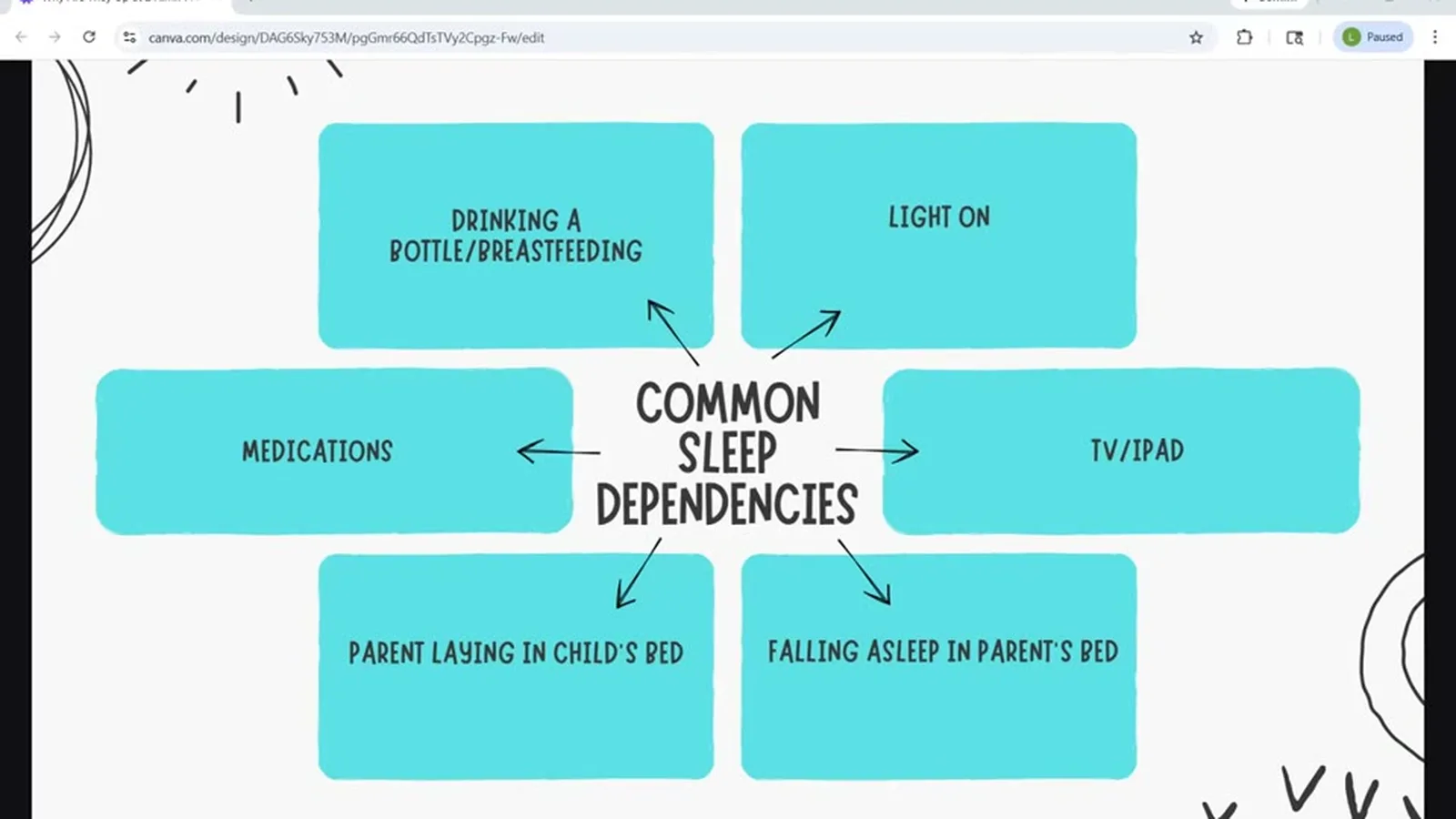
A nightlight that stays on all night is sustainable. A big light that gets turned off at 9 PM is not. A pacifier the child can find and re-insert is sustainable. A bottle that gets pulled out of their mouth is not. A parent who stays in the room until morning is sustainable. A parent who tiptoes out is not.
None of these are good or bad. They are just honest or dishonest about what the child is actually depending on to sleep.
When parents come to you exhausted because their kid keeps waking up, you do not need a sleep study. You need a five minute conversation about what is in the room at 8 PM and what is in the room at 2 AM. If those two pictures are different, you have found the wake-up.
When the family wants to keep co-sleeping#
Some families want to co-sleep. It might be culture. It might be values. It might be that nothing else has ever worked and they are too tired to fight it. Your job is not to talk them out of it.
If they want to co-sleep, the rule is simple and worth quoting straight from the source:
"Co-sleeping is a perfectly acceptable choice as long as the parent stays in the same room as the child for the whole night. Night wakings should reduce as long as nothing changes after the child falls asleep.". Lindsay Anderson
Same room, all night, no sneaking out. That is the whole protocol. If they hold the line on that, the night wakings should drop on their own, because the child surfaces, sees the parent, and goes back to sleep. There is no missing puzzle piece to look for.
The trap families fall into is doing a "half co-sleep." Parent lies down with the child until they pass out, then quietly slips out to go watch TV. That is the worst of both worlds. The child built the association with a parent in the room. Now the room is empty. The wake-up is coming.
If a family wants the bed back to themselves, you do not need to argue. You need to give them a fade plan. That is camping out.
When the family wants out: the camping out plan#
Camping out is for the family that says "we want our bed back, but we do not have the energy for full sleep training." It is the gentlest fade you can run on parental presence. It works because the parent never disappears suddenly. They just slowly move toward the door over a week or two.
Here is how Lindsay describes the core procedure:
"Camping out: put a mattress on the child's floor, parent sleeps there all night, then move the mattress closer to the door each night until it is in the hallway. Variant: sit in a chair next to the bed and leave once asleep.". Lindsay Anderson
Night one, the parent is on a mattress on the child's floor. They sleep there the whole night. The child still has a person in the room, so night wakings should already drop. The dependency is sustainable for now.
Night two or three (depending on how the child is doing), the mattress moves a foot or two toward the door. Same deal. Parent sleeps there all night. Child surfaces, sees parent, settles.
You keep going. Mattress against the wall. Mattress in the doorway. Mattress in the hallway with the door cracked. By the time you are out of the room, the child has had a week or two of practice falling asleep with less and less parent nearby. The fade is so slow that the brain barely notices.
If a mattress on the floor is not realistic, the chair variant works the same way. Parent sits in a chair next to the bed at bedtime. As the child gets stronger, the chair moves toward the door, then into the hallway. The one rule with the chair variant is the parent has to be honest about leaving once the child is asleep. If the child does not know the parent leaves, you are back to the unsustainable dependency problem.
Moving the mattress (or the chair) toward the door#
The pace is what trips families up. Too fast and the child escalates. Too slow and the family gives up. A workable rhythm looks like this:
- One to three nights at each position before moving.
- Move only after a "clean" night, meaning the child fell asleep within about 20 minutes and woke up fewer than usual.
- If a night goes sideways (illness, travel, big day), hold position. Do not move backward unless the next two nights are also rough.
- Skip ahead a step if the child seems totally unbothered. Some kids surprise everyone.
Common positions, in order: next to the bed → middle of the room → near the door → in the doorway → in the hallway with the door open → in the hallway with the door cracked. That is about six to eight stops, so a typical full fade runs ten days to three weeks.
What about night wakings during the fade? Treat them the way the CEU describes time-based visiting. The parent settles the child back down from wherever they are camping out that night. They do not return to night one's position just because there was a hard wake-up.
The other thing to coach parents on is that this is not "sleep training" in the cry-it-out sense. The child is not alone. They can see or hear the parent the entire time. The pace is the intervention.
Protecting the connection moments families do not want to lose#
A lot of parents resist sleep work because bedtime is the only time their kid slows down. That fear is real. You do not want to take connection away from a family that is barely hanging on.
The fix is timing, not subtraction.
"Bedtime is often the only time the child slows down enough for connection. Move those connected moments slightly earlier in the routine, not later.". Lindsay Anderson
Snuggles do not have to die. They just have to happen ten minutes earlier. Story time, back rubs, the song they always sing, the goodnight kiss list. All of it is allowed. The only rule is that the connection happens before lights out, not as the thing the child falls asleep to.
That way the child is not depending on a parent's hand on their back to drift off. They drift off to a quiet room. But they got the connection. They got the snuggle. Nobody lost anything.
You can frame it for parents like this: the goal is not less love at bedtime. It is more love, just shifted ten minutes to the left. Same routine. Same warmth. Different sleep cue.
Frequently Asked Questions#
Is co-sleeping bad for autistic kids? No. It is a values choice. What matters is whether the sleep setup at 9 PM still exists at 2 AM. If the parent stays in the room all night, co-sleeping can work fine.
Will my child wake up less if I just stay in the room? Usually yes, as long as nothing changes after they fall asleep. The wakings are often the child noticing the parent left. If you stay, there is nothing to notice.
How long does the camping out plan take? Most families finish in 10 days to 3 weeks. Some kids are faster. The pace depends on the child, not the clock.
What if I fall asleep in their bed and sneak out? That is the classic unsustainable dependency. The child surfaces at 2 AM, you are gone, and now you have a full waking. Either commit to staying or run the camping out fade.
Can I still snuggle at bedtime? Yes. Snuggle early in the routine, not as the last thing before sleep. Move connection ten minutes earlier and you keep the warmth without building the dependency.
Watch the full CEU#
Lindsay Anderson goes deeper into night waking assessment, screen dependencies, time-based visiting, and how to write funder-friendly goals that support sleep without making sleep itself the target.
Turn this topic into a CEU
You just studied this. Now get credit for it.
Watch Why are they Waking up at 2 AM? with Lindsay Anderson and earn 1 free BCBA CEU. Detailed certificate, delivered the moment you finish.