Caregiver Pairing in ABA Early Intervention: How to Build Trust With Stressed Parents
Caregiver pairing tips for 2-5 year old ABA cases. Suspend judgment, ask about Aunt Susan, do not take ghosting personally. Field-tested moves from a BCBA-led CEU.
Key takeaway
Before you walk into your next 2-to-5 year old early intervention visit, suspend judgment of the family, remember it was Aunt Susan who got sick last week, plan for the parent to ghost you at least once, and bring a short caregiver experience inventory so the adult in the room feels heard before you ever open a binder.
Child Development Deep Dive: Early Childhood (2-5 year olds)
On this page · 9 sections▾
Before you walk into your next 2-to-5 year old early intervention visit, suspend judgment of the family, remember it was Aunt Susan who got sick last week, plan for the parent to ghost you at least once, and bring a short caregiver experience inventory so the adult in the room feels heard before you ever open a binder. That single sentence is the whole job when you are pairing with caregivers, and it is the part most of us skip because we were trained to pair with kids, not with stressed adults who are watching us size up their living room.
This page is the soft skills companion to the programming work you already know how to do. The framing here comes directly from Kelly Brzak's CEU on early childhood development for BCBAs, where she spent a meaningful chunk of the hour on how to build trust with parents who are exhausted, judged, and sometimes scared of you. If you want the full hour with her examples, the watch card below has it.
Why caregiver pairing is different from kid pairing#
When you pair with a toddler, the rules are clean. Bring stuff. Pay attention to their hands and eyes. Pull preference. Stop pulling demands. With caregivers, the variables are messier because adults track judgment, money, time off work, what the last provider said about their parenting, and whether your shoes are still on near the rug. You are not just earning the child's reinforcement value. You are earning the right to be in the home at all.
The other gap is incentive. A toddler will tell you in real time whether you are winning. A stressed parent will smile, nod, and then stop replying to texts. If you are reading the kid only, you will believe pairing went great while the caregiver is already drafting a discharge email in their head. So treat the parent as a separate pairing target with their own preference assessment, their own reinforcement schedule, and their own escape behaviors to plan around.
The suspend judgment rule and why analysts break it#
The first rule Kelly gives is the one most clinicians break inside the first ten minutes of a home visit. We notice the unwashed dishes, the screen the toddler is glued to, the older sibling who has not been to school today, and we let that sit on our face. Caregivers see it. Then they decide how honest they are going to be with you for the next six months.
First and foremost, I would just like to encourage everybody to please, please, please suspend your judgment of the family.
The fix is not pretending you have no reactions. The fix is catching the reaction in your own head before it lands on your face or in your tone. If a thought shows up that sounds like, why would they let him eat that, replace it with, this is what surviving today looks like for them. You do not need to agree with the parent's choices to pair with them. You need to make the visit feel like a room with one less judge in it.
Aunt Susan: remembering small details that compound trust#
Most pairing wins with caregivers are not big moves. They are tiny callbacks that prove you were listening last time. Kelly's example is the patron saint of this work.
Ask how the parents are and really mean it. Take a couple extra minutes before you run in and get started with their kid to find out how they're doing. Remember that it was Aunt Susan who got sick.
A practical way to make this stick is to keep two lines in your session note that nobody else sees. One line is what the parent told you about their own life today. The other line is one thing to ask about next visit. Aunt Susan goes on the second line. So does the leaking dishwasher, the new puppy, the older kid's soccer tryout, the night shift. Then the next visit opens with, hey, how is Aunt Susan doing, and the room shifts.
Bridge this back to your BCBA instincts. You already do this with kids. You note the preferred toy and bring it back. You note the song that calmed them and hum it on entry. Caregiver pairing is the same loop, just with a longer working memory.
What to do when a parent ghosts you and what not to assume#
You will get ghosted. A canceled parent meeting is not a referendum on the relationship, and treating it like one will end the case faster than the no-show ever could.
Please don't take it personally if you get ghosted and don't stop trying to meet with them if they stand you up.
Build a no-show protocol that is warm, short, and not guilt-coded. A reasonable cadence is one same-day soft text that assumes the best ("hey, no worries, I know today got away, want me to try Thursday"), one written option for a new slot two days later, and one final low-pressure offer at the end of the week. No essays. No subtle scolding. If they come back, you greet them like nothing happened and move on.
The reframe that makes this sustainable is this: ghosting in early intervention is almost always about the parent's bandwidth, not your value. Co-pays, sick siblings, work shifts, and shame about the state of the house all show up as a missed appointment.
Tabling your own agenda in the first 90 days#
Most pairing failures with caregivers happen because the analyst showed up to session one with the BIP they wanted to run, not the BIP the parent actually needed. Kelly is blunt about this.
Table your own agenda and plan for generalization.
For the first 90 days, your agenda is whatever helps the family say "ABA is making my life easier this week." That might be a transition routine at bath time before a single mand trial happens at the table. It might be a small win on shoes-on at the door. The clinical goals are not gone. They are just sequenced behind whatever buys you parent buy-in for the long arc.
A practical filter when you sit down to write programs: would this make the parent's Tuesday at 5pm easier? If yes, prioritize it. If no, it can wait until trust is banked.
Caregiver experience inventory: prompts that open real conversations#
If you do not have a structured way to ask parents about their experience, you will default to chitchat, and chitchat does not surface what you need. A short inventory does.
I have a QR code here for a caregiver experience inventory... 23 questions. Sometimes parents have cried when I've done this with them.
You do not have to use 23 questions. Pick five that would actually move your sessions if you knew the answers. Examples that work in early intervention: what does a hard day with your child look like, what is one thing you wish a provider would stop doing, what is one routine that already works well, who else in the home should I be talking to, and what would make you say this is worth it three months from now.
Bring it on paper. Sit down. Put the pen between you. Do not type into a laptop with the screen facing you. This is a human moment, not a documentation moment, and the parent can feel the difference.
Interacting with the client's siblings without losing the session#
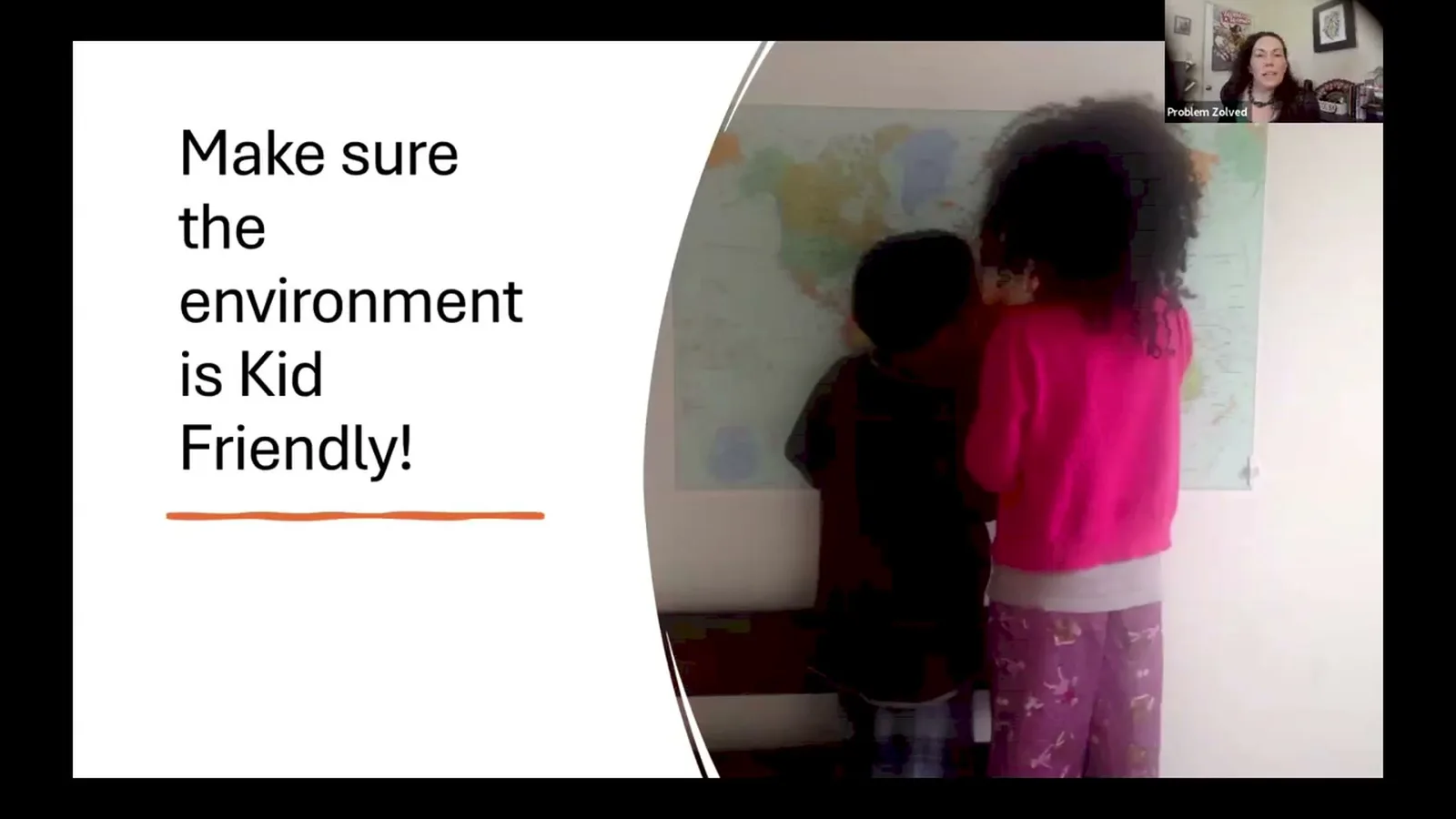
Siblings are not a distraction from caregiver pairing. They are part of it. A parent watches how you treat the older brother who keeps showing you a Lego build, and that is how they decide whether you respect their whole family.
The trick is to greet the sibling fully, give them one or two minutes of real attention at the top, and then narrate the transition out loud so the parent hears it. "I'm going to play with Jordan for our session now, and then I want to see what you built before I leave." You have given the sibling a contract, given the parent a model, and protected the session. If the older sibling is high-energy and chatty, you can also invite them into a short role inside the session, like being the one who hands you the next card, which converts them from interrupter to helper.
The bridge back to programming: every minute you spend acknowledging the sibling is a minute of social repertoire data on your client, who is watching the whole thing.
FAQ#
How long should caregiver pairing take?
There is no clean answer because trust is not a mastery criterion. A useful proxy: when the parent volunteers information you did not ask for, your pairing is working. If you are six visits in and they still answer in one-word replies, slow the clinical pace and add more parent-facing time, even if the kid is making gains.
What if the parent is openly hostile to ABA?
Do not defend the field. Ask what specifically they are worried about, write it down, and address that specific thing in your next session, not the abstract version. Most "anti-ABA" hostility in early intervention is actually a previous bad experience or a TikTok-scale fear, and both shrink when you respond to the actual concern instead of the category.
Is it OK to share my own parenting experience with families?
In small, useful doses, yes. A one-line callback like, "mine did the same thing at three," can make you feel like a person instead of a clipboard. Long stories about your kids during their session time will read as making the visit about you. Keep it brief, keep it relevant, and never use it to one-up the parent.
How do I pair with caregivers when sessions are remote?
Open with two minutes of camera-on, no-clinical talk. Ask about their week and actually listen. Send a one-line follow-up message after the session that names something the parent did well that day. Remote sessions starve parents of social reinforcement from you, so you have to deliver it on purpose.
What do I do when siblings keep interrupting?
Front-load attention. Greet them, ask about one thing they care about, and give them a clear contract for when you can talk again. If they are old enough, offer a small role. If they are too young, brief the caregiver before session on a five-minute activity they can run during your most acquisition-heavy block.
Keep going#
If you want the full hour with Kelly Brzak, including her programming guidance for 2 to 5 year olds, the trials to criterion debate, and the goals she would never write, watch the source CEU. It is a free general learning CEU on openceu.com.
Turn this topic into a CEU
You just studied this. Now get credit for it.
Watch Child Development Deep Dive: Early Childhood (2-5 year olds) with Kelly Brzak and earn 1 free BCBA CEU. Detailed certificate, delivered the moment you finish.