Design Smarter: Using Instructional Design to Improve Staff and Stakeholder Training
Presented by Ally
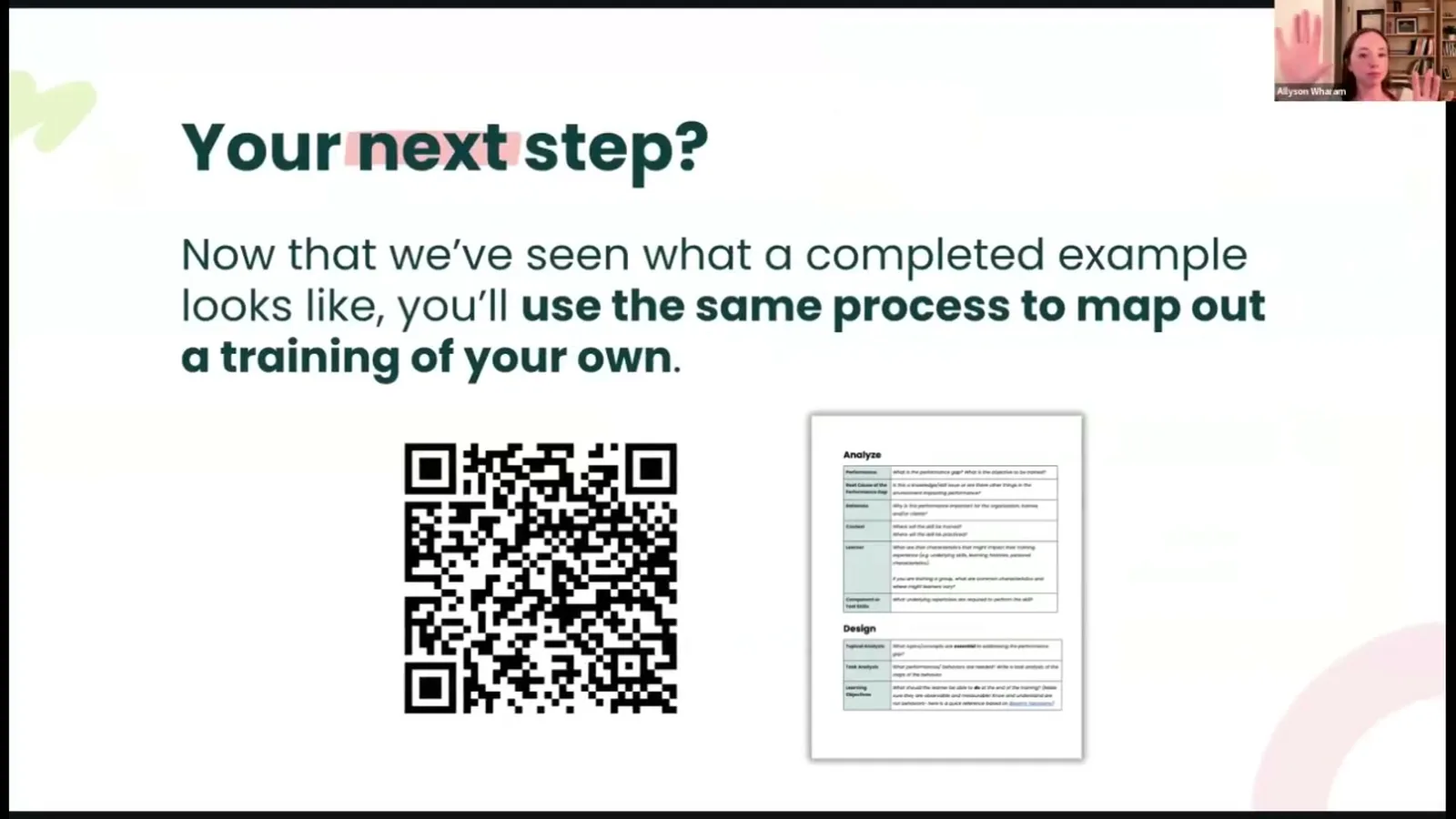
This presentation introduces a systematic approach to instructional design tailored for behavior analysts delivering training to staff, caregivers, or broader stakeholders. Using the ADDIE model (Analyze, Design, Develop, Implement, Evaluate), Allie Wharam walks participants through how to analyze performance gaps, identify root causes, and develop intentional training that leads to generalizable behavior change. Through a blend of instructional theory and behavioral application, the presentation illustrates how to connect BST with larger training structures, including multimedia delivery, job aids, and evaluation systems. Participants explore how to avoid training pitfalls such as overcomplexity, low engagement, and poor follow-through. Allie also shares actionable resources, including a design template, worked examples, and guidance for both in-person and asynchronous training design. Designed for BCBAs, supervisors, and OBM professionals, this CEU offers a concrete pathway to elevate training quality and align instruction with both learner needs and system constraints.
Register free & watch nowCancel any time. Cert delivered to your inbox the moment you pass the quiz.
Learner ratings
from 14 learners
“good content”
— Julie P.“I loved how engaging she was and how she consistently brought the information back to a way we could and do apply it!”
— Samantha B.“Thank you! Bridge the gap between theoretical instructional design and everyday clinical supervision.”
— Buu S.“This presentation was great. It was an eye opener, I learned something different, new but not new.”
— Rene D.
About this CEU
This presentation introduces a systematic approach to instructional design tailored for behavior analysts delivering training to staff, caregivers, or broader stakeholders. Using the ADDIE model (Analyze, Design, Develop, Implement, Evaluate), Allie Wharam walks participants through how to analyze performance gaps, identify root causes, and develop intentional training that leads to generalizable behavior change. Through a blend of instructional theory and behavioral application, the presentation illustrates how to connect BST with larger training structures, including multimedia delivery, job aids, and evaluation systems. Participants explore how to avoid training pitfalls such as overcomplexity, low engagement, and poor follow-through. Allie also shares actionable resources, including a design template, worked examples, and guidance for both in-person and asynchronous training design. Designed for BCBAs, supervisors, and OBM professionals, this CEU offers a concrete pathway to elevate training quality and align instruction with both learner needs and system constraints.
From the talk
What was covered
Use the ADDIE model to build staff and caregiver training that sticks: root cause first, then design, job aids, and real follow-up.
- Before you build a training, check whether the gap is a skill problem or an environment problem.
- Use the million dollar test: if cash would not get the behavior, it is a skill or knowledge gap.
- Write clear, measurable goals first, then let those goals decide what content makes the cut.
- Swap reminding learners of old content for a question that makes them pull it back up themselves.
- Pair every group training with a follow-up plan: peer checks, checklists, or supervisor feedback.
- Judge the training itself, not just the trainee, and change it when performance does not move.
What Instructional Design Is, and Why BCBAs Already Do It
Instructional design (planning how people learn) is a field of its own. Ally defined it as a planned, systematic way to build learning that changes behavior. It has five parts. You study learner needs, design the instruction, build materials, run the training, and gather feedback. She called that last step the most important one.
Her main point was simple: behavior analysts already own most of these tools. You assess needs, write measurable goals, and use a task analysis (a step by step skill breakdown). You shape skills and plan for generalization (using a skill in new places). You take data and change the plan when the data says so.
So the gap is not a missing skill set. The gap is that we rarely aim these tools at adults. We plan hard for a client goal, then throw slides together for staff the night before. Ally came back to that mismatch all hour. Instructional design has its own word for the thing we care about most.
When you see transfer in instructional design, all that means is generalization.
From the talk — Ally
Four Training Mistakes That Waste Everyone's Hour
Ally opened by asking what made the worst training people ever sat through so bad. The chat filled fast. Reading the slides word for word. No activities. No interaction. No steps anyone could act on. One person wrote that the instructor did not seem to want to be there.
She sorted the failures into a short list. The biggest one gets its own section below. The next is content dumping (teaching everything tied to a topic instead of what the learner must do). Close behind it is making things too complex. Does a paraprofessional need to sort positive from negative reinforcement (labels for why behavior goes up)? Or do they need to tell when something is working as a reinforcer in the room?
The third mistake is talking without building a path to doing. That often shows up as no active responding (learners practicing during the training). The fourth is no follow-up and no evaluation. One attendee framed training as an antecedent (something that comes before behavior). Without a consequence side, it fades.
So when we're training, we really need to be starting with that end goal of what do we want someone to be able to do with this information?
From the talk — Ally
Find the Root Cause Before You Build Anything
Ally's top mistake is defaulting to training. She told two stories. In the first, new technicians finished onboarding and then struggled in homes. Supervisors were not following up in the field. Leadership asked for a training on critical thinking. A workshop was never going to fill that hole. Supervision was.
The second story is quieter and more common. A supervisee in a school saw messy, inconsistent data from paraprofessionals. The plan was a training on accurate data collection. Then they looked at the data sheets. The sheets were unclear, and one prompted duration when frequency was the right measure. The next step became fixing the sheets, not running a training.
Her tool for this step is the PDC-HS (a checklist for finding performance barriers). It helps you ask whether the problem sits in the environment, in the tools, or in the person's skills. It can be both. Training may be one piece of a larger package. What it should never be is the reflex answer.
So ironically, the very first part of instructional design is determining whether or not we actually need to design instruction at all.
From the talk — Ally
The ADDIE Model Read as a Behavior Analyst
ADDIE stands for analyze, design, develop, implement, and evaluate. Ally asked the room what it reminded them of. People compared it to the FBA (a process that pinpoints why a behavior happens) and the treatment plan that follows. Others said treatment planning and single case design (tracking one person's progress over time). That is the point. It is the same loop you already run, pointed at an adult learner.
It is also not a line. Picture evaluate in the middle with the other four around it. You analyze, get early feedback, go back, and revise. Ally said she moves between the phases the whole time she builds a training.
The analyze phase carries the most weight. Name the gap between what people do and what they need to do. Find the root cause. Say why the skill matters to the client, the staff member, and the company. Map two settings: where you will train, and where the skill gets used. Then study the learners. Look at their underlying skills and their history with the task. Check their comfort with any tech and the competing demands on their time. In a group, look for what they share and where they differ, so the training reaches everyone.
Design comes next, in two moves. A topical analysis (a list of concepts, facts, and rules) covers the ideas behind the skill. A task analysis breaks down the physical steps. Most trainings need a mix. Then cut to what is essential. Write your objectives as behaviors you can see, not as "understand" or "know." Only after that do you build slides.
The actual development is where sometimes people start, you know, you just jump in and you start dumping content onto slides, but really the time should be spent up front.
From the talk — Ally
Gagne's Nine Events Sit Right on Top of BST
Gagne's Nine Events of Instruction (a common teaching sequence) is more niche than ADDIE. Ally picked it because it lines up so well with BST (behavioral skills training). The nine steps run like this. Gain attention. Share the objectives. Pull up what learners already know. Present the content. Give learning guidance. Have them perform. Give feedback. Assess performance. Then plan for retention and transfer.
Several steps are already in BST. Model, rehearse, feedback, and assess are all there. The events that get skipped are the ones on the ends. Gaining attention. Connecting to what people already do. Learning guidance, which is not the same as presenting content. Guidance means examples and non-examples, common pitfalls, visuals, and other ways of showing the same idea.
The cheapest upgrade she named came from a book called Powerful Teaching. In her own RBT (entry-level therapy staff) training, she used to repeat content before moving on. She would say "remember these are what the ABCs are" right before talking about function. Now she asks "before we've talked about the ABCs of behavior, what are those?" instead. Same slide, same content, very different work for the learner.
one of the most meaningful things that you can do is instead of repeating content, having someone recall content.
From the talk — Ally
A Worked Example: Fixing Vague Session Notes
The gap: staff write vague or incomplete session notes. The language is not observable, and required parts are missing. Is that a skill gap? Ally offered a fast test. If you have never seen a history of the person doing it right, that points to a knowledge gap. Then run the money check.
In this case, most staff had been trained, but informally. Someone handed them a sample note and moved on. The stakes are real: weak notes lead to compliance problems, billing rejections, and lost information for supervisors and families. Training will happen in a team meeting and get reinforced in supervision. The learners are RBTs with mixed experience. Some are new. Others have written notes the wrong way for a while with no feedback. All write English well, but writing skill varies, and time pressure is real.
The component skills behind the task are easy to miss. Staff need to know what objective language sounds like and know their clients' programs. They also need to tell relevant detail from irrelevant detail, plus basic sentence structure. The topical analysis covers objective versus subjective language, the required parts of a note, and common errors. The task analysis breaks the steps down: identify the goals, describe what you did, and describe how the client responded. Then drop the subjective labels and summarize next steps. Three objectives follow, including writing a note that has every required part.
The training itself runs 45 minutes. It opens with a note that says the client did great. Then comes one question: what do you actually know from this? Next are the objectives, then a quick round of what people already put in their notes. Content is objective versus subjective language, plus a checklist of required parts, plus examples and non-examples of good notes. A worked example (a finished sample built step by step) stands in for a live model. Learners audit a bad note or write one with the checklist, then self-assess or peer-assess. The checklist goes with them into real sessions as a job aid (a reference tool used on the job). Supervisors give feedback weekly using a rubric.
If the answer is no, then it's a knowledge or skill deficit.
From the talk — Ally
Caregiver Training: Relevance Before Content
The same process works for caregivers, with one dial turned way up. Relevance. A parent who is stretched thin will not sit through what you find interesting. Ally pushed hard on picking the skill that actually changes the day.
Root cause matters even more here. Often the parent can do the skill and simply has no time, no help, and no bandwidth left. That is not a training problem, and training will not touch it. There is now a version of the performance checklist built for caregiver support. It gives you a structured way to ask.
If it is a training need, run the same steps. Name the goal. Name what success looks like. Break the skill down. Then build materials that travel: no jargon, nothing they do not need, and something they can hold, like a checklist. Timing counts too. Do not ask a parent to first try a new skill during the hardest hour of the morning. Start somewhere easier and shape from there. Then check social validity (whether the goal matters to them).
We have to really think about what is meaningful for them and is going to make a difference in their life and their engagement with their child.
From the talk — Ally
Evaluate the Training, Not Just the Trainee
The last phase is the one most of us drop. Ally drew a sharp line here. If people leave your training and still write bad notes, that is data about your training. Maybe the design needs work. Maybe training was only ever one piece and the real fix sits in the work setting. Measure performance where the skill is used, collect social validity, and revise.
Group training makes this harder, and the chat said so. Her answer was to plan the bridge before you present. Hand the follow-up to the supervisors who see each person. Build in peer assessment. Or give learners a self-check tool and a clear rubric so they can judge their own work. Any of those beats none.
Ally shared a design template that walks through each ADDIE phase, plus the full session note example. Her ask was concrete: take one training you already run and map it onto the template. Then self-assess. Did you find the real gap? Are your objectives measurable? Did you demonstrate, have people rehearse, and give feedback? Is there anything holding the skill up after the training ends?
We're looking at evaluating the training itself.
From the talk — Ally
Common questions
How do I adapt this for asynchronous or recorded training?▾
Ally said the same strategies still work, they just need pauses built in. Ask a question on a slide. Say you are pausing for ten seconds, then show the answer on the next slide. She also pointed to a framework called TPACK for thinking about how tech fits with teaching and content.
Is the ADDIE model evidence based?▾
She was honest about this. ADDIE is a generic model, and in her view there are better models, but they are much more complex. A lot of research is built on top of it. She teaches ADDIE first because it is the most usable entry point.
How do I assess needs across a whole school district?▾
Start with the higher-up stakeholders and ask what performance problems they see across classrooms. Pin down the few behaviors that matter most, then design backward from those. Do not try to cover everything at once. She named a book called Rapid Instructional Design for the needs assessment process.
Where should I go to learn more about instructional design?▾
Ally suggested two paths. If you want the bigger performance picture, read Mager. His short set of books covers analyzing performance problems and writing clear goals. If you want the teaching side, go deeper on Gagne's Nine Events or look at Merrill's First Principles. She also noted that instructional design is really a subspecialty within OBM (using behavior science to improve work performance).
What if a training is a one-off and I cannot follow up?▾
Give people tools that do the follow-up for them. A job aid or checklist they use on the job covers a lot of ground. So does a self-assessment they can run without you. Then use feedback from attendees to improve the next round.
About the speaker
Ally is the founder and CEO of Sidekick Learning, which builds supervision curricula, RBT training, and a learning platform for clinical operations. She is a BCBA and a supervisor, holds a master's degree in instructional design, and was finishing a doctorate in instructional design at UVA when she gave this talk. She also hosts a podcast called In the Field.
This summary was generated from the recording’s transcript and reviewed for accuracy. Quotes are taken word for word from the talk.
What you'll learn
- 1Learning Objectives
- 2By the end of this CEU, participants will be able to:
- 3Describe the five components of the ADDIE framework (Analyze, Design, Develop, Implement, Evaluate) and explain how they align with the clinical decision-making process used in ABA (e.g., FBA to intervention design).
- 4Identify key points of overlap between ABA-based training (e.g., BST, shaping, generalization) and instructional design theories, such as Gagné’s Nine Events of Instruction.
- 5Analyze performance gaps to determine whether training is the appropriate intervention, using tools like the PDC-HS or learner/contextual analysis.
- 6Apply instructional design strategies to create effective, engaging trainings for adult learners (staff, caregivers, or school stakeholders) that improve skill acquisition and generalization.
- 7Design clear, measurable learning objectives and use instructional scaffolds (e.g., checklists, job aids, worked examples) to support transfer to real-world application.
- 8Evaluate training effectiveness using behavior-analytic data collection methods, social validity checks, and iterative feedback loops.
Concepts in this CEU
Related talks
Talks that cover the same concepts
Building a Supervision System That Actually Works
The Behaviorist Bookclub
Compliance to Commitment: Seven Habits of the Highly Effective Caregiver Trainer
The Behaviorist Bookclub

Press Pause: What the RBT 40-Hour Training Was Really Meant to Do
Bowsprit Consulting LLC

Shaping Behavior Change when ADHD is in the Picture
The Behaviorist Bookclub
Toward an Evidence-based Supervision Model: Training Students in Independent Fieldwork
Willow Mentorship & Consulting, LLC
From Hours to Competence: Assessing and Developing Supervisee Skills
The Behaviorist Bookclub
More from The Behaviorist Bookclub
Empowering Autonomy and Self-Management in ADHD Learners
The Behaviorist Bookclub
Reflective Supervision and Provider Outcomes in ABA
The Behaviorist Bookclub
Getting the Right Answer Isn’t Enough: Establishing Speaker–Listener Repertoires for Complex Learning
The Behaviorist Bookclub
OpenCEU is supported by advertising from third-party sponsors. Sponsors are clearly labeled, have no influence over course content, instructors, or CEU decisions, and never appear on certificates. The BACB does not sponsor, approve, or endorse OpenCEU sponsors or their products.