Reflective Supervision and Provider Outcomes in ABA
Presented by B. Kuereine Gray
Cancel any time. Cert delivered to your inbox the moment you pass the quiz.
Learner ratings
from 53 learners
91% would recommend this CEU to other professionals in their field (35 responses)
“Great research, but how do I apply it to my current supervision practices? Dissapointing”
— Mary Q.“VERY IMPORTANT”
— Yarisay P.“The information was good, but there was a bit of technical issues.”
— Danielle S.
About this CEU
This session examines how reflective supervision supports provider outcomes in behavior analytic settings. Attendees will review burnout risk factors and the role of reflective supervision in reducing secondary traumatic stress. The session also addresses how reflective dialogue strengthens clinical reasoning and supports staff retention.
From the talk
What was covered
How reflective supervision lowers burnout and secondary traumatic stress in ABA, and why it keeps good clinicians in the field.
- Define burnout (work stress that wears you down) as behavior you can count, not as a mood.
- Treat burnout as a professional problem and secondary traumatic stress (stress absorbed from someone else's pain) as a personal one.
- Ask curious questions in case discussion so the supervisee produces the next step.
- Check whether your caseload math counts training time, caregiver calls, and program design.
- Watch for higher risk in community based work, where no team is nearby to buffer stress.
- Take notes on team behavior after you shift a meeting to reflective dialogue (a curious, two way talk).
What Reflective Supervision Actually Means in ABA
Reflective supervision (a curious, relationship based conversation) is not a task review. Gray described it as relationship based and driven by curiosity. It is collaborative by design. It keeps the focus on clinical reasoning and emotional awareness. That is a different job than most supervision meetings do.
Most of us were trained in administrative supervision instead. The questions sound like this. What are you going to do? What have you tried? Why did that not work? Did you just try more? Those questions are not useless. They stop at the plan, though. They skip how the case is landing on the person running it.
Reflective supervision does not replace clinical oversight. Gray was clear that it rests on reflective practice, reflective teaching, and clinical supervision. This session was part two of a series. Each part stands alone, but the parts build on each other. Part two centered on burnout and on better decision making.
It's collaborative and it focuses on clinical reasoning and emotional awareness.
From the talk — B. Kuereine Gray
Why Burnout Needs an Operational Definition
The session ran a live exercise early on. Attendees were asked to define burnout and secondary trauma in observable terms. It turned out to be hard. People kept running out of space while trying to write a whole definition. That struggle was the point, since our field asks for operational definitions (clear, countable behavior descriptions) of everything else.
The answers that came back were concrete and usable. People named lack of motivation, less engagement, irritability, and physical exhaustion. They named avoidance, absences, task delay, and a short temper. They named a lower rate of responding (how often a behavior happens), less capacity to multitask, and apathy. They also named feeling unappreciated, feeling chronically stressed, and taking distress into free time.
Gray offered a behavior analytic version of the same idea. Burnout is when what used to be reinforcing (rewarding enough to repeat) is no longer reinforcing. Contact with reinforcement has stopped. Gray added a personal entry to the word cloud: freeze and cancel. The workday still runs. Tasks that used to feel routine simply do not get done anymore.
This is a zero judgment zone.
From the talk — B. Kuereine Gray
Burnout and Secondary Traumatic Stress Are Not the Same Problem
Gray drew the research from counseling, and the split matters. Burnout is a professional issue. It grows out of the work setting, and it hits the organization, the client, and clinical outcomes. Secondary traumatic stress (stress caught from other people's pain), also called compassion fatigue, is personal. It shows up as intrusive thoughts, emotional dysregulation, and avoidance such as cancellations. It also shows up as less empathy toward clients. It shows up too as less interest in things you used to enjoy outside of work.
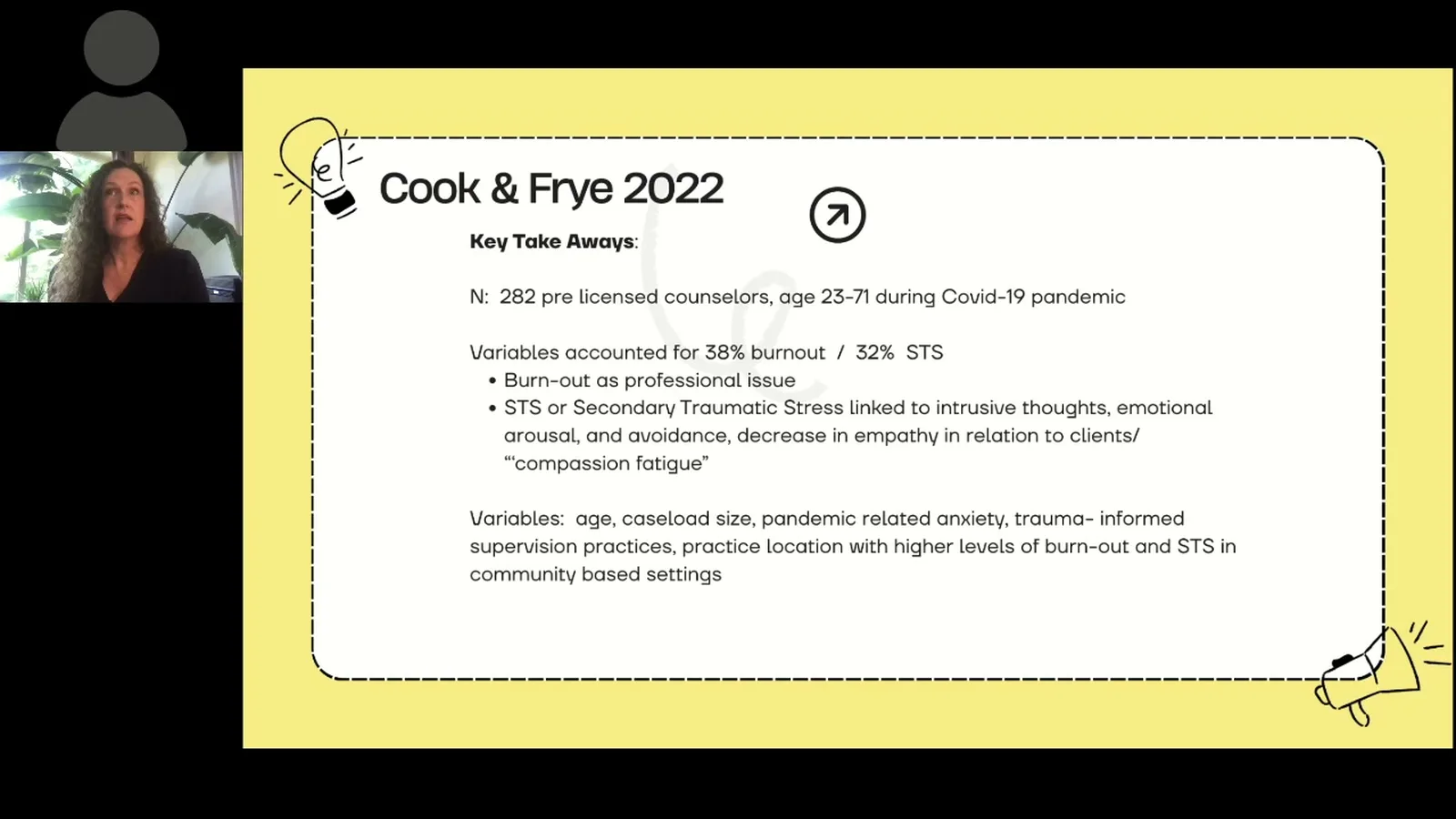
The anchor study was Cook and Fry (2022). It looked at 282 pre licensed counselors, ages 23 to 71, during the COVID-19 pandemic. Pre licensed means they could practice, but only under clinical supervision. Gray drew a parallel to candidates working toward board certification. She also pointed to brand new BCBAs (board certified behavior analysts) who still want oversight while they build independent judgment.
The study weighed age, caseload size, pandemic related anxiety, access to trauma informed supervision, and practice location. Together those variables accounted for 38 percent of burnout and 22 percent of secondary traumatic stress. One finding stood out. Burnout and secondary traumatic stress ran higher in community based settings. In a clinic, a hospital, or a classroom, other people are nearby, and that support acts as a buffer.
Burnout is defined as a professional issue. Burnout is not a personal issue.
From the talk — B. Kuereine Gray
Burnout Risk Factors in ABA Settings
The strains in that counseling study have close cousins in our field. Caseload math is the first one. A schedule gets built on how many hours a client is seen in person. It rarely counts the training, the follow up, or the caregiver communication. It also skips program design, reading, and the time spent getting clinical supervision in an area outside your strengths.
Gray listed more. There is the risk tied to dangerous behavior. There is ethical strain when an organization asks for more than a clinician can carry. Repeated emails from administrative staff may never state a penalty. The perception of one is still there, built on an old history of punishment. Add caregiver conflict, differences in values, documentation load, and shifting funder rules about what services are covered.
The bigger gap is systemic. We have no proactive way to spot burnout or secondary traumatic stress early. What we have is mostly punitive, and it sounds like a note about missing your numbers. Some organizations do pay bonuses for hitting targets. Far fewer tell a clinician that the insight they brought to case discussion was worth hearing.
It can be very isolating.
From the talk — B. Kuereine Gray
Why the Best Supervision Evidence Comes From Outside ABA
Gray named the barriers plainly. Research on reflective supervision inside ABA is limited, and so are the resources. Much of what exists leans on theory rather than on observable behavior. Our discomfort with mentalistic terms (words about private inner events) adds friction. So does a bias against validating work from psychology, social work, and other mental health fields.
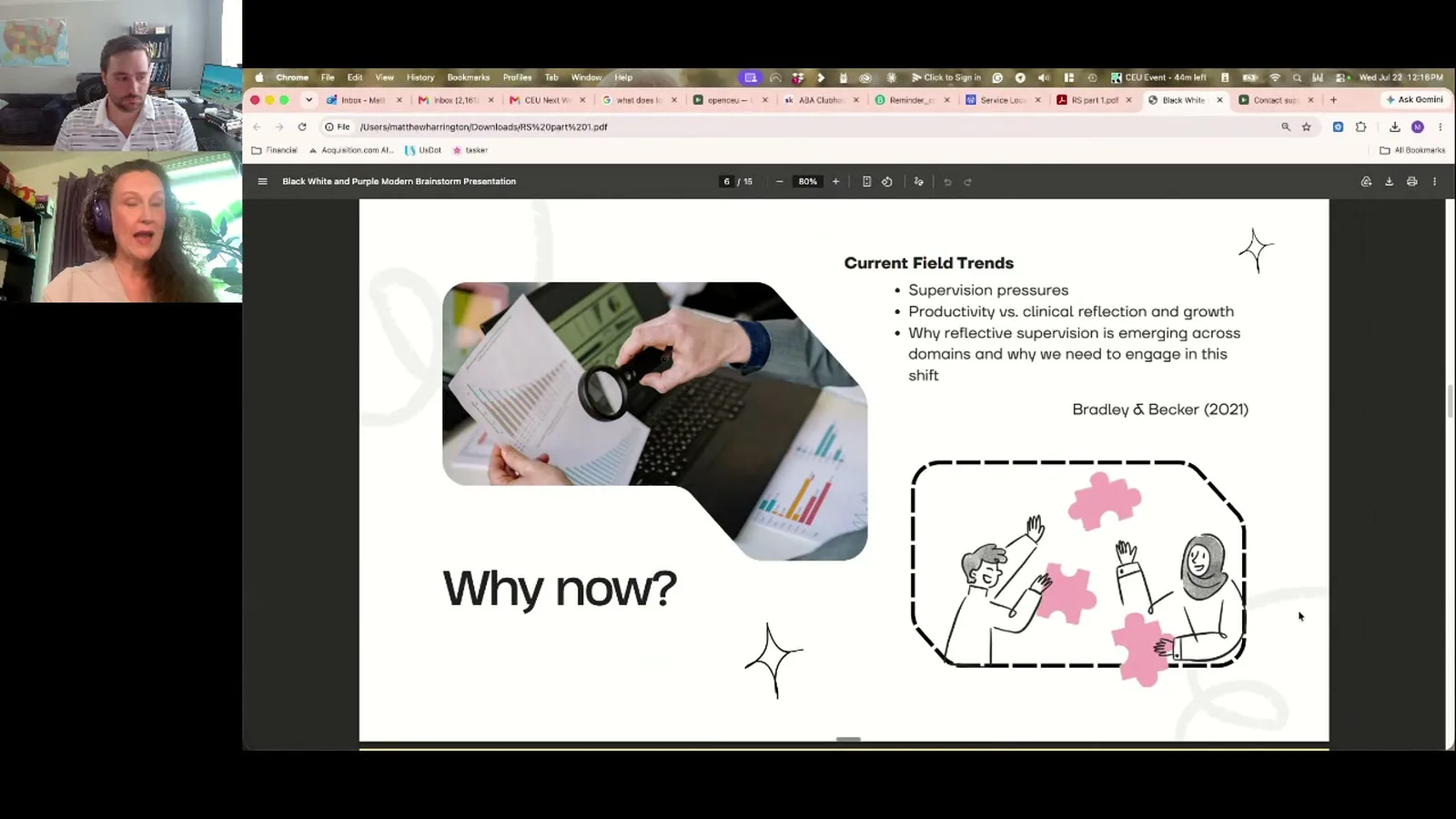
That bias has a cost. Our field is young compared with the fields next door. If we only read research produced inside ABA, we cut ourselves off. We miss decades of findings on what makes supervision work. Gray framed that as a limit on how fast the field can keep growing.
The second study came from social work. Wilkins (2019) reviewed 256 studies to ask what helps supervision work, what hinders it, and in what context. Work experience acted as a mediating factor. When supervision included critical thinking, supervisees built critical thinking skills. When supervision was clinically focused, they built clinical practice skills. Those skills trickle down into good practice, into feeling empowered to make independent decisions, and finally into quality of service.
And a lot of the research relies heavily on theoretical definitions of what should happen.
From the talk — B. Kuereine Gray
What Effective Supervision Has to Include
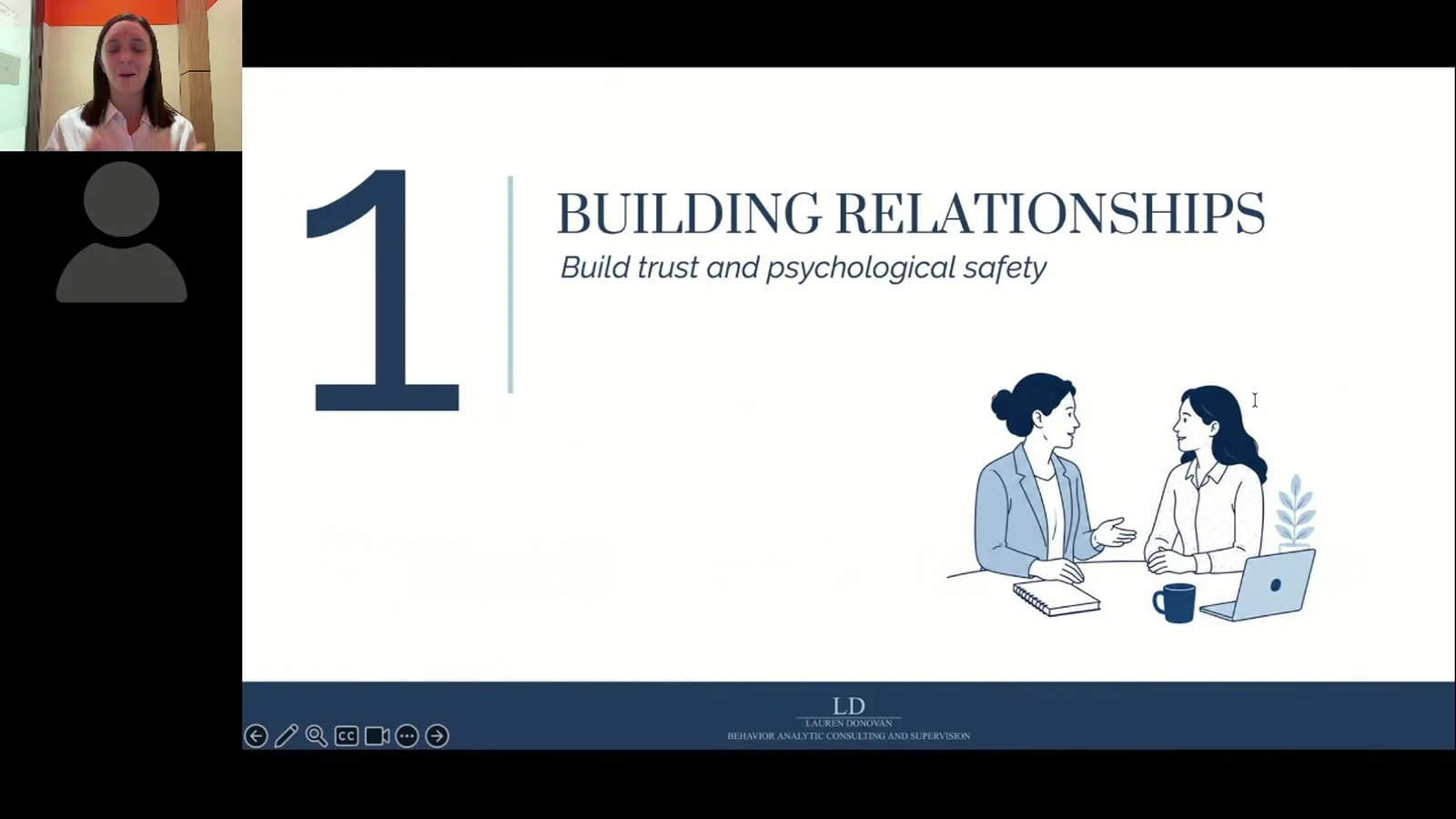
The Wilkins framework gives you a checklist. A working supervisory relationship has to be reliable, supportive, available, and knowledgeable. It also has to be trusted and respected. Those six build the base. Social and emotional support take four more pieces. You need clear structure. You need a real focus on the provider as a human being. You need scaffolded support (help that fades over time). And you need shared problem solving when things go wrong.
Gray kept returning to one phrase: do as I say, not as I do. For clients we accept the ground rules without argument. We build rapport and use pairing (building fun before making demands). We make expectations salient. We set clear reinforcement contingencies. We limit punishment. We use behavior skills training (teach, show, practice, then coach) with caregivers and staff.
Then we skip all of that with the people delivering the service. Supervisors hold authority because of knowledge and skill, though some organizations hand it out for time served. You cannot change a toxic supervisor, and you cannot change every dynamic above you. You can change what you choose to pass down.
Supervision had to be reliable.
From the talk — B. Kuereine Gray
A Reflective Dialogue, Step by Step
The most useful part of the session was a live simulation. A volunteer brought a frustrating case. A plan was working in the clinic. The caregiver was not following through at home. Behavior in the clinic seemed to be getting worse as a result. Gray did not hand over a fix. The first questions were about the relationship. How are your interactions with the caregiver? What do you think is going through their mind?
The volunteer guessed the caregiver was tired of being told what to do. Gray reflected the frustration back: the clinician was repeating the same words and not feeling heard either. The next question asked what strategy would help both sides feel heard. The clinician's first idea was to observe what was actually happening, instead of just asking why. Gray built on that. She suggested time for the clinician and caregiver to sit together without the client present, so both could feel heard. The clinician took it from there. Bring in an RBT (registered behavior technician) to cover the session, so that meeting could happen.
That is the whole move. The answer came from the supervisee, not from the supervisor. Gray also introduced parallel process (our own history shows up too). We carry our learning history into every session, and we cannot leave it at the door. One example came from Gray. After a hard moment in an assessment, the clinical work was holding a neutral face and a steady tone. That kept Gray from becoming a punisher (something that discourages the behavior) for that learner.
Sometimes we're not aware of our own behavior.
From the talk — B. Kuereine Gray
How Reflective Supervision Keeps Staff
Retention was the last thread, and the chain is short. Reflective supervision raises the perception of psychological safety (feeling safe to speak up). That raises the odds a clinician builds a professional identity. That raises engagement with both the caseload and the organization. Those things snowball into people staying.
Effective supervision also does three concrete jobs. It provides emotional support. It builds a positive learning history with supervision, which that person carries forward when they supervise someone else. It buffers against workload demands that are unreasonable or simply too large. Higher job satisfaction and lower turnover follow from there.
Gray closed with homework worth doing. Run one reflective dialogue in your next case discussion. Keep a note page and write down what changes in team behavior when the discussion shifts. Watch for moves toward independence, for rapport related behaviors, and for a sense of support across the team. Without that data you cannot call the change evidence based. Expect some slips too. The old administrative questions are deeply practiced. Put a note on your desk, your clipboard, or your hand to interrupt the pattern.
You're going to make mistakes.
From the talk — B. Kuereine Gray
Common questions
What is the difference between burnout and secondary traumatic stress?▾
Burnout is a professional issue that grows out of the work setting and affects care, the organization, and client outcomes. Secondary traumatic stress, also called compassion fatigue, is personal and follows you home. It looks like intrusive thoughts, emotional dysregulation, avoidance, less empathy, and loss of interest in things you used to enjoy.
How do you operationally define burnout in a clinical team?▾
Describe it as behavior you can observe and count. Attendees in this session named a lower rate of responding, task delay, cancellations, absences, irritability, and less capacity to multitask. Gray added a behavior analytic frame. What used to be reinforcing is no longer reinforcing, because contact with reinforcement has stopped.
Why does this talk rely on social work and counseling research?▾
Research on reflective supervision inside ABA is still limited. Much of it defines things in theory, rather than in observable behavior. Gray argued that refusing to read older, better studied fields limits our own growth. The two studies used here, Cook and Fry (2022) and Wilkins (2019), both come from outside ABA.
How do I start using reflective supervision without extra meeting time?▾
Change the questions inside a meeting you already hold. In your next case discussion, ask what the supervisee thinks is happening for the caregiver or client. Then ask what the situation is like for the supervisee. Let them produce the next step rather than handing it over. Then write down what changed in the team's behavior.
About the speaker
B. Kuereine Gray is a BCBA (board certified behavior analyst) and a small business owner. Gray is also an infant, early childhood, and family mental health specialist. Gray has worked in the disability field since 1997 and has been board certified since 2007. Gray has practiced across universities, schools, direct care, staff training, clinical trials, advocacy, and expert testimony. Gray also serves as an administrative supervisor and has completed coursework and supervision in reflective supervision.
This summary was generated from the recording’s transcript. Quotes are taken word for word from the talk.
What you'll learn
- 1-Identify burnout risk factors in ABA providers -Describe how reflective supervision reduces secondary traumatic stress -Explain how reflective dialogue improves clinical reasoning -Describe the role of reflective supervision in staff retention
Concepts in this CEU
Related talks
Talks that cover the same concepts
Foundations of Reflective Supervision in Behavior Analysis
The Behaviorist Bookclub

Reflective Supervision and Client Outcomes
The Behaviorist Bookclub

So You Think You Can Lead, Ten Self Reflection Questions for Leaders in ABA
Hickory Learning Group
Building a Supervision System That Actually Works
The Behaviorist Bookclub

Child Development for BCBAs- Age 9-11
The Behaviorist Bookclub
Supervision Articles Deep Dive
The Behaviorist Bookclub
More from The Behaviorist Bookclub
Supervising Beyond Technical Skills: Professionalism, Communication, and Clinical Judgment
The Behaviorist Bookclub
When the Foundations Are Right: Unlocking Advanced Verbal Repertoires
The Behaviorist Bookclub
Empowering Autonomy and Self-Management in ADHD Learners
The Behaviorist Bookclub
OpenCEU is supported by advertising from third-party sponsors. Sponsors are clearly labeled, have no influence over course content, instructors, or CEU decisions, and never appear on certificates. The BACB does not sponsor, approve, or endorse OpenCEU sponsors or their products.