Training RBTs in Crisis Response Without the Warrior Culture
BST, precursor drills, and how to train RBTs in crisis response without glorifying injuries or restraint, from a BCBA-led CEU.
Key takeaway
If you are a Board Certified Behavior Analyst (BCBA) supervising a Registered Behavior Technician (RBT) on a case with crisis risk, your training plan is the thing standing between a hard day and a hospital visit.
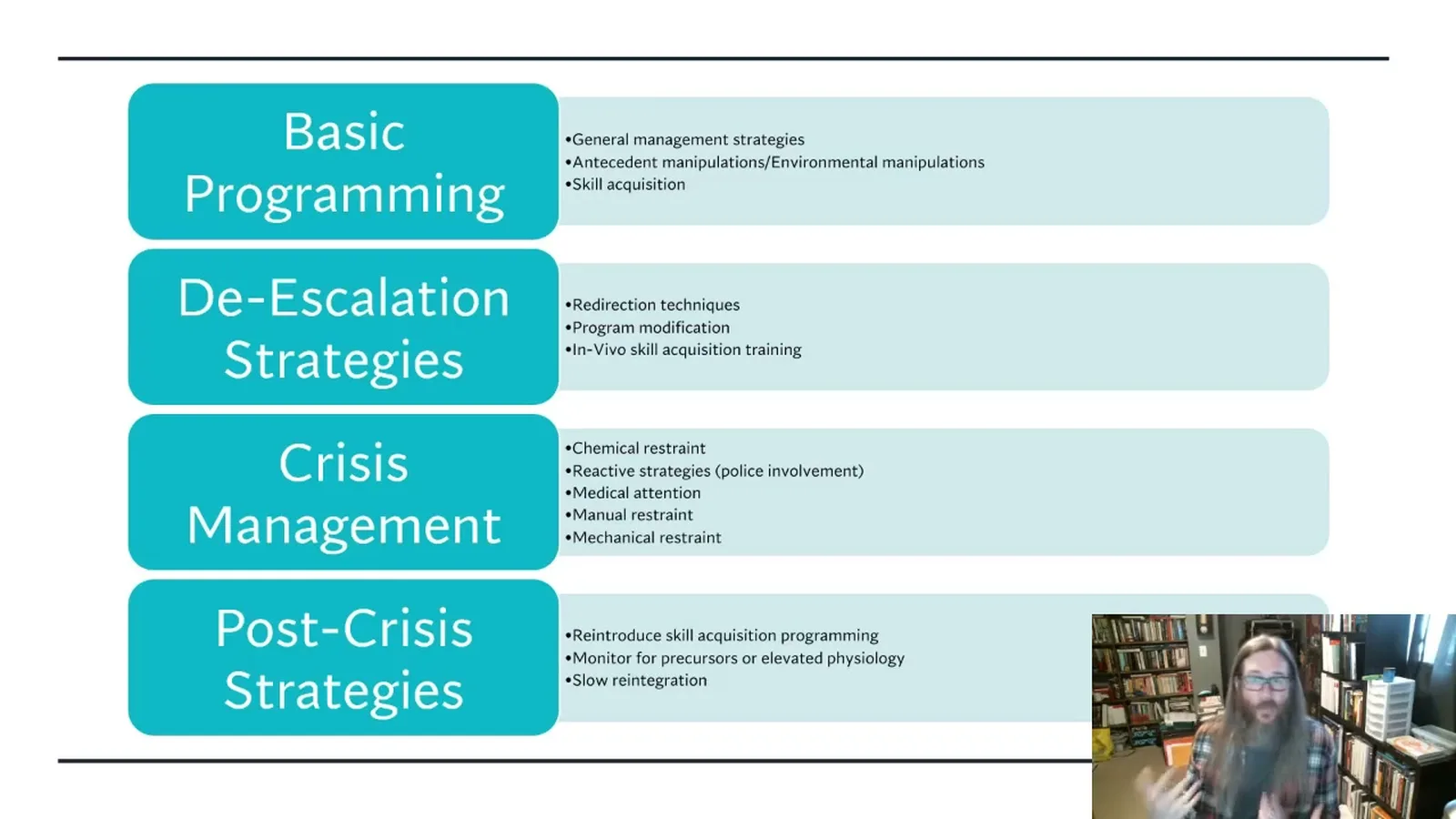
Crisis Management is a Crisis in Behavior Analysis - Applied 2022
On this page · 9 sections▾
If you are a Board Certified Behavior Analyst (BCBA) supervising a Registered Behavior Technician (RBT) on a case with crisis risk, your training plan is the thing standing between a hard day and a hospital visit. Morris and Hollands (2021) compared the warrior culture in our field to the warrior culture that drives police brutality, and that comparison should change how you talk in supervision tomorrow morning. This page is about how to train RBTs in crisis response so the restraint becomes the last resort it was always supposed to be.
The short answer: train the precursor catch, not the restraint#
If you only have one training hour with a new RBT, do not spend it on hold technique. Spend it on precursor detection.
The restraint is Plan Z. It is the thing you reach for when every other plan has already failed. If your training time goes mostly into Plan Z, you are training your RBT to expect failure.
Train the things that keep Plan Z on the shelf. That means antecedent control. That means environmental enrichment. That means the behavior program itself. The restraint procedure gets covered, but it is not the main course.
What BST actually looks like for crisis response#
Behavioral Skills Training (BST) is instructions, modeling, rehearsal, and feedback. For crisis work you want all four steps for every skill you train, not just the restraint hold.
Here is what a real BST sequence looks like for an RBT learning a new case:
- Instructions on the antecedent strategies in the plan. Read the plan together. Say out loud which conditions you are managing and why.
- Model the prevention pieces. Walk through a session. Show how you offer choice, how you pace demands, how you embed reinforcement.
- Rehearsal of the teaching procedures. The RBT runs trials with you playing the learner. You give the prompt levels. You make the errors.
- Feedback in vivo. You watch a real session. You score fidelity. You meet after.
Dr. Spiker is clear on what to put your hours into:
You want to spend time focusing on those major components of antecedents and environmental enrichment and behavior program and all that. That's where you want to focus. But you might have to train some other things too. You might have to train simple things like really good data collection or avoidance of restraints. From the talk — Dr. Shane Spiker
Notice what is missing from that list. The hold itself. The takedown. The mat work. Those get trained, but they are not where the hours go.
Drilling precursor detection in role-play#
Most crises that hit the RBT are not the crisis. They are the precursor that nobody caught.
A precursor is the small behavior that comes before the big one. It can be leaving the work area. It can be a flat tone of voice. It can be a learner playing with their hair more, or stimming more, or going quiet. Dr. Spiker shared one of his own in the talk: he gets quiet and his verbal responses get short. That is his tell. Your RBTs have tells too. Your learners definitely have tells.
Role-play this with your RBT. Pick three to five precursors from your learner's history. You play the learner. The RBT names what they see and says what they would do. Then switch. Run it five times. Run it again next week with new examples.
If your RBT can name the precursor out loud in a calm room, they have a chance of catching it in a hot one.
Killing warrior culture in your team#
The hard part of this work is not the technique. It is the locker-room talk after the session.
Warrior culture is the thing where staff swap injury stories like trading cards. The chipped tooth. The bite mark. The takedown that took four people. It feels like bonding. It is actually recruiting your team into a worldview where injury is the price of admission.
Stop glorifying injuries, stop glorifying crises, stop glorifying your scars and your battle wounds. Share those stories as cautionary tales, not as like a badge of honor. And a lot of times behavior analysts will do that. From the talk — Dr. Shane Spiker
You set the tone. If you walk into the office and lead with a war story, your RBTs learn that war stories earn status. If you walk in and ask what the data looked like this week, your RBTs learn that data earns status.
When a senior RBT starts a war story in front of a new hire, you have a choice. You can let it ride and lose the room. Or you can name it. A short, calm "let's tell that one as a cautionary tale" goes a long way. You are not shaming the storyteller. You are renaming the lesson.
Why the Morris and Hollands 2021 paper should change how you talk#
Morris and Hollands published a paper in 2021 that put a name on what a lot of us had been feeling.
Morris and Hollands in 2021 came out with a really great article that likened a warrior culture, which we talked about before, which is that idea of glamorizing injuries and glamorizing the fight and glamorizing the warrior piece. There are higher rates of warrior culture issues in police forces. From the talk — Dr. Shane Spiker
The parallel is uncomfortable on purpose. Police forces with strong warrior culture have higher rates of brutality. If our field carries the same culture, we are carrying the same risk to the people we serve.
Bring the paper into supervision. Hand your RBT the citation. Read one paragraph together. The paper does the heavy lifting that a single conversation cannot.
Burnout is a training problem, not a personal problem#
If your RBT is burned out, they cannot run the plan. If they cannot run the plan, you get more crises. More crises burn them out faster. The loop closes on itself.
Dr. Spiker points at the Mills and Rose work showing direct care staff burn out faster when their caseloads carry severe problem behavior. Crisis context speeds the slide. That is not a personality trait of the RBT. That is the job description.
Treat self-care as part of training, not as a perk. Build it into your weekly supervision agenda. Ask the same three questions every week. How are you sleeping. What sessions did you dread this week. What support do you need from me.
The point is not to play therapist. The point is to catch the slide early, the same way you would catch a precursor in a learner.
Building crisis analysis into weekly supervision#
The strongest tool you have as a BCBA is the recurring supervision hour. That is where the culture lives.
Embed crisis analysis into our supervision practice. We should be talking with our supervisees on how to do this, what to monitor for, why we monitor it. And we should really have that as part of our overall training opportunity. From the talk — Dr. Shane Spiker
Make crisis analysis a fixed slot on the agenda, even on weeks when nothing happened. A zero is data too. "We ran twelve sessions, zero restraints" is a sentence worth saying out loud. It builds the habit.
When something does happen, the agenda looks like this:
- Graph the event. Type, duration, what came before, what came after.
- Name the missed precursor. There almost always is one.
- Decide one antecedent change for next week.
- Decide one BST refresher topic for next week.
- Schedule the retrain. Put it on the calendar in the same meeting.
If you do not put the retrain on the calendar, the retrain does not happen. The crisis just becomes a story.
Frequently asked questions#
Can an RBT lead a debrief if a BCBA was not on site?
The RBT can capture the data and run the safety check. They can write down what happened, what came before, how long it lasted, and whether anyone needs medical attention. The clinical debrief, the part that decides what changes in the plan, that is a BCBA call. Set a timeline. Capture the event within the hour. Schedule the BCBA-led debrief within twenty-four hours.
How often should RBTs run through restraint procedures in training?
Run through them at the frequency your certification requires, and not more often than that. Overtraining the restraint sends the wrong signal about what the job is. Use the freed-up time to overtrain precursor detection, functional communication training, and antecedent control. The data on restraint use is the real measure. If restraints go down over the next quarter, your training balance is right.
What do I do if a senior RBT is the one telling war stories to new staff?
Talk to them in private first. Most of the time the senior RBT does not realize what they are teaching. Reframe the conversation. You are not asking them to stop telling stories. You are asking them to land the story on the lesson, not the injury. Give them a script. "Here is what I would do differently now." When they tell it that way, you praise it. Loud. In front of the team. The culture shifts when the new framing earns more status than the old one.
Train the catch, retire the badge#
The shortest version of this whole page: spend your training hours on the precursor catch, not the badge of honor. The RBTs you train this year will train the next class behind them. What you let stand becomes the culture.
Watch the full session for the data graphs, the BAR procedure walkthrough, and the rest of Dr. Spiker's framework on moving crisis management out of the treatment package and back into Plan Z.