Behavior Crisis De-escalation Strategies That Actually Hold Up
Real de-escalation work happens before the crisis. Precursors, antecedents, and the moves that keep you out of restraint, from a BCBA-led CEU.
Key takeaway
The real de-escalation work happens before anyone is in crisis. Dr.
Crisis Management is a Crisis in Behavior Analysis - Applied 2022
On this page · 9 sections▾
Behavior Crisis De-escalation Strategies That Actually Hold Up
The real de-escalation work happens before anyone is in crisis. Dr. Shane Spiker, a Board Certified Behavior Analyst (BCBA), says his own precursor is that he gets quiet and short in his verbal responses, and if you miss that, you miss the only easy window you had. He shares a harder case too: a learner who was a legally classified sex offender went six months without an incident because the team scrubbed every antecedent out of his day, and then the deprivation built a brand new motivating operation that ended in an assault on his roommate. Those two stories, one small and one severe, point at the same lesson. De-escalation is not a script you pull out when someone is already escalating. It is the work you do upstream so the curve never gets that high.
This page stays in that upstream space. The post-crisis debrief, the formal crisis plan, and Registered Behavior Technician (RBT) training all have their own pages. Here we focus on what a BCBA does in the moment, before restraint is even on the table.
The short answer: de-escalation work happens before the crisis#
If you only remember one thing, remember that. By the time a learner is mid-escalation, your options have already shrunk. You are no longer teaching. You are no longer running a treatment plan. You are managing risk, and Spiker is clear that risk management is not treatment.
Real de-escalation strategies live in three quiet places:
- The precursor you notice and respond to before anyone else sees a problem.
- The antecedent you allow to happen so you can teach a tolerance response in calm conditions.
- The plan you build so the next pre-crisis moment has a known move attached to it.
Everything else is just paperwork after the fact.
The four points on the escalation curve#
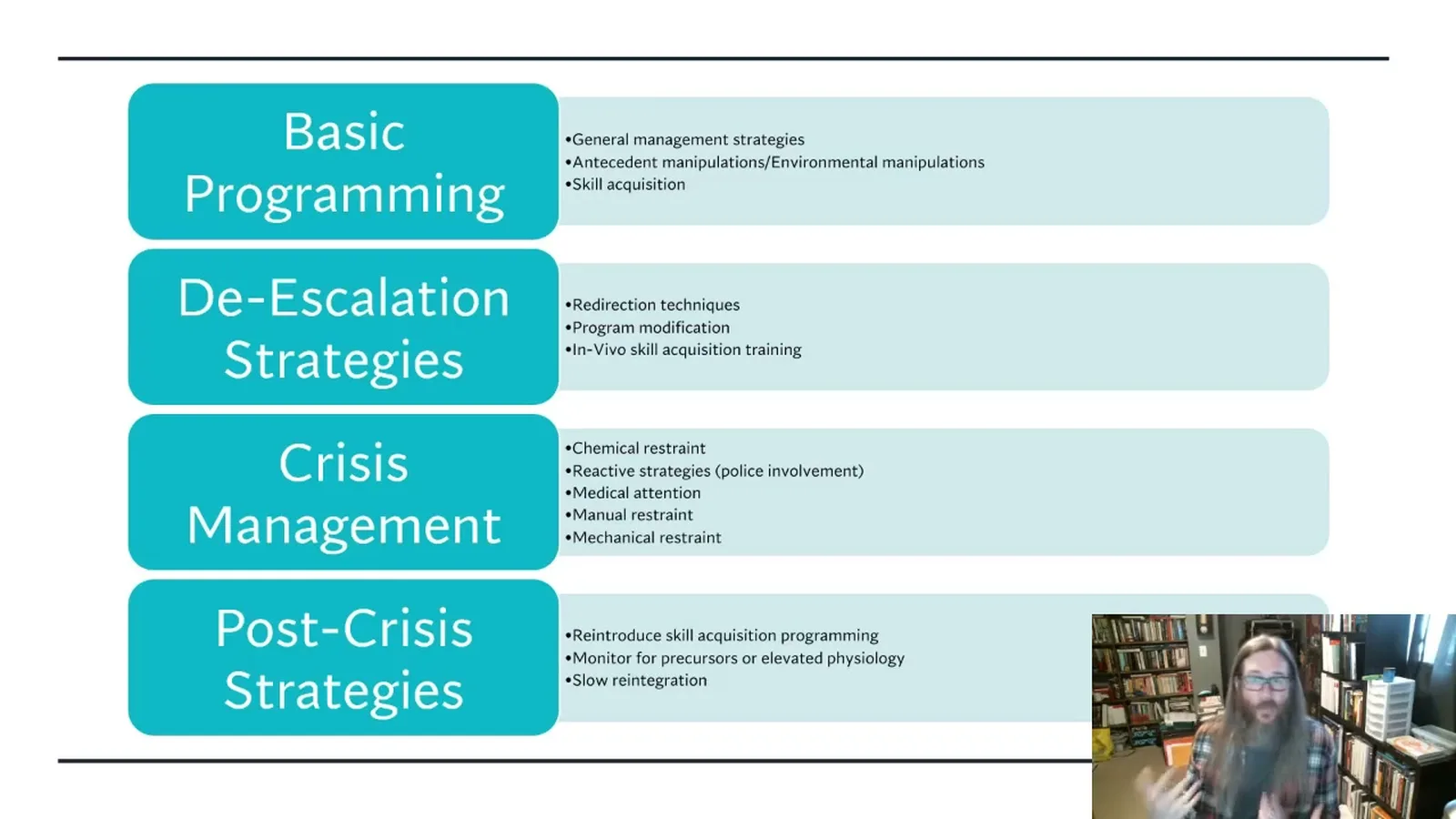
Spiker frames crisis work on a curve with four stages. Knowing the stage you are in tells you what move is even available.
Typically crisis management includes a stable responding deescalation levels where you've got somebody who's in pre-crisis crisis management, which are our systems. And then your post-crisis strategies, which are kind of reintroducing that person back into their world. From the talk — Dr. Shane Spiker
Stable responding is your home base. The learner is regulated, the team is teaching, and your prevent-teach-manage plan is doing its job. Pre-crisis is the window where precursors show up and where most de-escalation actually happens. Crisis is the risk-mitigation zone. Post-crisis is where the learner comes back into their day, and where teams trip over themselves more than they realize.
The trap is treating crisis like a single event. It is a curve, and each stage has a different job.
Spotting precursors (including the ones that look like nothing)#
A precursor is any behavior that reliably shows up before the problem behavior. The obvious ones are easy: leaving the work area, withdrawing assent, changing body language, flat refusal. The ones we miss are the quiet ones.
For me, a precursor, if I'm starting to get annoyed is I get really quiet, which is, you know, not really behavior. According to the dead man's test. I start getting quiet. And I start getting really short in my verbal responses. And that's a precursor for me. From the talk — Dr. Shane Spiker
Hold onto that. A BCBA telling on himself in a CEU is the whole lesson. The precursor was "less of something." Less talking. Less eye contact. More doodling. If you only chart loud behavior, you will never catch this kind.
A few practical moves:
- Ask the caregiver and the RBT what the learner looks like ten minutes before a bad day. Not five seconds before. Ten minutes.
- Write the precursor in observable terms, even if it is the absence of behavior. "Stops responding to greetings" counts. "Goes from 20 words per session to 5" counts.
- Pair every identified precursor with a known response. If you spot it and have no move ready, your team will default to whatever the loudest person in the room thinks should happen.
A precursor without a paired response is just a guess.
Why over-controlling antecedents makes the next crisis worse#
The most common mistake Spiker calls out is not under-managing. It is over-managing.
If we cleanse the world of those antecedents, if we bubble wrap our learners and we prevent those antecedents from ever occurring, we lose opportunities to teach. We lose MOs. We lose a lot of kind of things to do. And we also lose the opportunity to manage when things go wrong. From the talk — Dr. Shane Spiker
This is where the legally classified sex offender case lands. The team did a careful job. Every known antecedent was managed, every supervision rule was in place, and the learner went six months without an incident. Then the deprivation itself produced a new motivating operation in a direction no one had planned for, and he assaulted his roommate. The team had managed the front end of the contingency so completely that they never got to teach a response on the back end. They had no tolerance training, no programmed access, no plan for when the absence of the antecedent became its own problem.
Antecedent control is a tool. It is not a plan. If the only reason a learner is calm is that the world has been bubble-wrapped around them, you are renting calm, and the bill comes due later.
The fix is to let some antecedents through on purpose, in calm conditions, so you can teach a tolerance response while everyone has the bandwidth to learn.
What to actually do in pre-crisis#
Pre-crisis is your high-leverage window. The learner is not regulated, but they are not in crisis either. This is where a tolerance response, a functional communication response, or a quick environmental change can pull the curve back down.
A few things to have ready before you need them:
- A short list of approved redirections per learner, written down, that any RBT can run without calling you.
- A functional communication response the learner already owns at fluency. Spiker leans hard on omnibus mands like "my way" because the Ward et al. (2020) work shows they reduce problem behavior even when you later fade to more specific mands.
- A planned environmental tweak you can do without making it a whole thing. Shorter walk. Fewer peers in proximity. A second adult moving to a different sightline. Small changes.
- A tolerance response that has been practiced when the learner is calm, not invented when they are not.
The whole point of pre-crisis work is that the response is already chosen. You are not improvising. You are running a play.
Where we typically go wrong is in deescalation and post-crisis. When we start seeing somebody start to escalate, we're missing precursors... in post-crisis, we're also missing the fact that the EO was still present. And so what ends up happening is we actually send somebody back into a crisis. From the talk — Dr. Shane Spiker
Two failures, one curve. Missed precursors get you into a crisis. A missed motivating operation on the way out puts you right back in one.
The post-crisis trap most teams fall into#
The most common post-crisis mistake is treating the end of the loud part as the end of the event. The learner stopped hitting, so the team sends them back to the same task in the same room with the same demand. The motivating operation that started the whole thing is still sitting there, untouched. So the curve starts climbing again, and the team logs it as a new event instead of a continuation.
If you take nothing else from this section, take this. The motivating operation does not turn off because the behavior stopped. Plan the re-entry. Lower the demand. Stretch the time before the next request. Use the moment to teach a quiet tolerance response now that the learner is regulated enough to learn it. The post-crisis debrief page goes deeper here; this page just wants you to stop sending people back into the same conditions on autopilot.
Building this into your treatment plan, not your crisis plan#
This is the move most teams skip. De-escalation strategies do not belong in the crisis plan. They belong in the treatment plan.
Spiker calls the crisis plan Plan Z. Restraint, PRN medication, and protective equipment all live there. They are risk mitigation, not treatment. If your de-escalation strategy lives in the same document as your restraint procedures, your team will reach for it at the same time they reach for restraint, which is too late.
A few questions to ask your own plans:
- Does the prevent-teach-manage section list the precursor for each target behavior, in observable terms, and the response paired to it?
- Does the teach section include at least one functional communication response, an attention-getting response, a tolerance response, and an independent play repertoire? Spiker calls these the Big Four.
- Does the manage section name the motivating operations the team is allowed to let through on purpose, and the conditions for doing so?
- Does the plan say what the team does in the first ten minutes after a crisis ends, before the learner is back in their full routine?
If those four answers are in your treatment plan, your crisis plan can stay short, where it belongs.
Frequently asked questions#
How do I teach RBTs to spot a precursor that looks like withdrawal? Train it the same way you train any other discrimination. Give RBTs a written description in observable terms, model the precursor on video or in role-play, run behavioral skills training with feedback, and pair every spotted precursor with a specific approved response. "Less of something" is harder to see than "more of something," so spend more reps on it, not fewer.
Is telling a learner to take a deep breath a de-escalation strategy? Only if the learner already owns deep breathing as a fluent response under calm conditions and you have data showing it actually lowers arousal for them. Otherwise it is a hopeful instruction, not a strategy. Most learners cannot acquire a new coping response mid-escalation. Teach it upstream, then prompt it downstream.
What is the difference between a tolerance response and a de-escalation strategy? A tolerance response is something the learner does. Waiting. Accepting a denial. Sitting through a delay. A de-escalation strategy is something the team does. Adjusting the environment. Prompting a known response. Lowering the demand. They work together. The tolerance response gives the learner a way through the moment. The de-escalation strategy makes the moment surviveable while the response is still being built.
Where to go next#
Real de-escalation is upstream work. Notice the quiet precursor. Let some antecedents through on purpose so you can teach the tolerance response in calm. Plan the post-crisis re-entry instead of treating the end of the loud part as the end of the event. None of this lives in the crisis plan. It lives in the treatment plan you are writing this week.
If this is sitting on your desk because of a real case, watch the full talk. Spiker walks through the bar procedure graph for the headbanging learner, the Morris and Hollands (2021) work on warrior culture, and the data side of all of this in a way a written page cannot match.