Crisis Plan vs. Behavior Plan: Where the Line Actually Sits in ABA
A behavior plan is treatment. A crisis plan is risk mitigation. Spiker's Plan Z framing and how to keep them clean, from a BCBA-led CEU.
Key takeaway
A crisis plan and a behavior plan answer two different questions, and Dr.
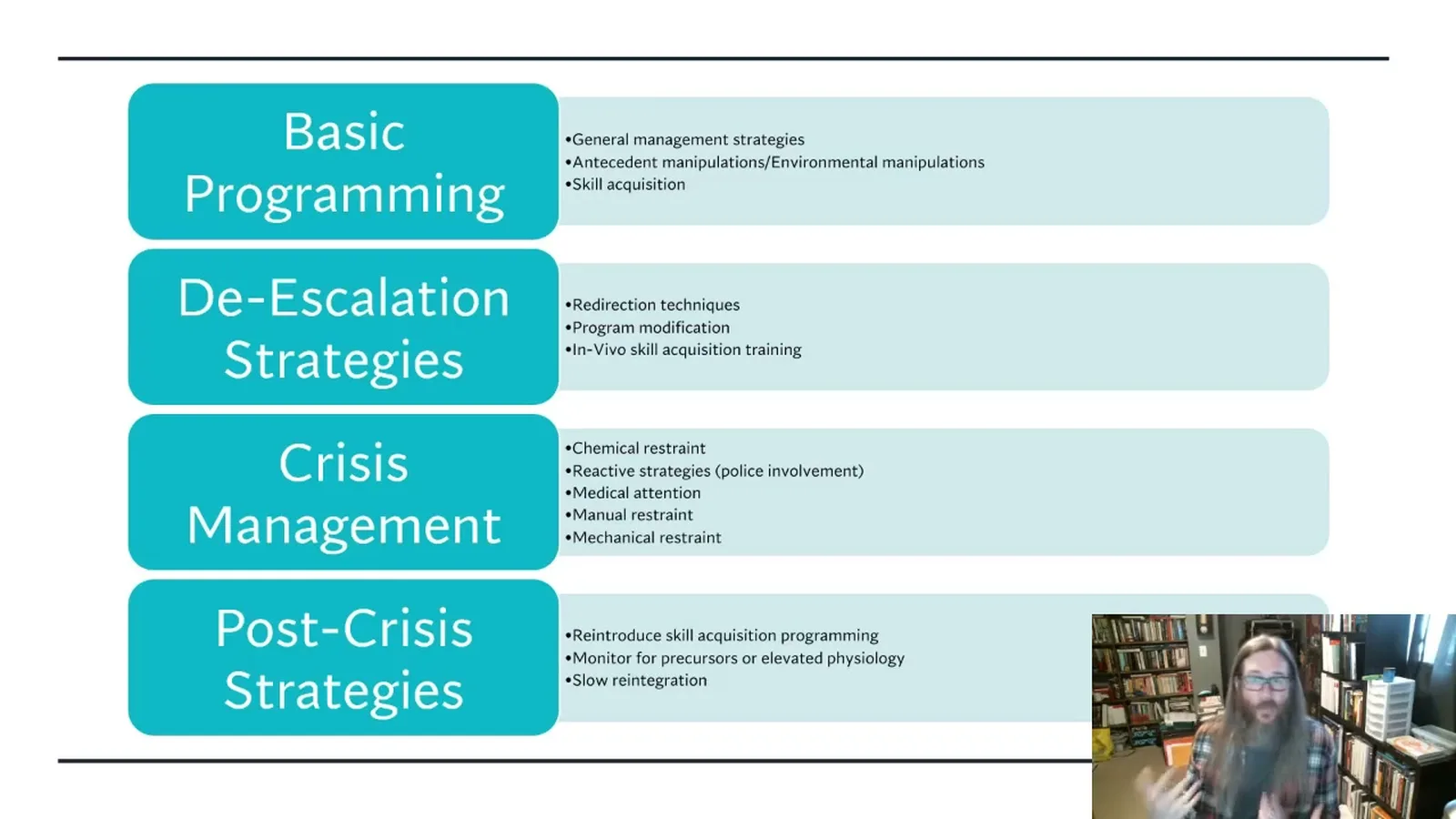
Crisis Management is a Crisis in Behavior Analysis - Applied 2022
On this page · 9 sections▾
A crisis plan and a behavior plan answer two different questions, and Dr. Shane Spiker's Plan Z framing is the cleanest way to keep them apart: the behavior plan is treatment, and the crisis plan is risk mitigation that you only reach when treatment has already run out of road. He says it flat out in the talk. Crisis management is management, not treatment. The behavior plan is what you do to teach, prevent, and arrange the world so the person can succeed. The crisis plan is what you do when the wheels come off and somebody could get hurt. If those two documents start to read like the same document, you have a problem. This page walks through where the line sits, what belongs on each side, and how to write both so a parent, a teacher, or an auditor can tell them apart at a glance.
The short answer: one is treatment, one is risk mitigation#
A Board Certified Behavior Analyst (BCBA) writes a behavior plan to change behavior. The Behavior Intervention Plan (BIP) sets up the room, teaches replacement skills, and manages reinforcement. A crisis plan does not do any of that. It tells staff what to do when a person is already in immediate risk to their own health, the health of others, or the surroundings. The two plans live in the same binder, but they are not the same kind of work.
Crisis management is not a treatment system. Crisis management is a management system. And a lot of times people get that mixed up. They show up in places and they're willing to use crisis management strategies as a treatment protocol. And it is not treatment. It is management. It is safety. It is risk mitigation. From the talk — Dr. Shane Spiker
That distinction is not a word game. When teams treat the crisis plan as treatment, they start to lean on restraint, protective equipment, or PRN medication as if those things teach the learner something. They do not. They keep people safe for the next ten minutes. The teaching happens somewhere else, in the behavior plan, where the work actually moves the needle.
What belongs in the behavior plan (Spiker's four parts)#
Spiker frames the behavior plan as four moving parts, often called Prevent, Teach, Manage (PTM). Each part has a job.
we arrange the environment. We set up prevention, teaching and management strategies that, that PTM, uh, process. And that's the majority of what our treatment plans are made up of those kind of four things. From the talk — Dr. Shane Spiker
Here is what each part holds:
- Environmental arrangement. Staffing ratios, room setup, lock and alarm decisions, schedule design. Anything you change in the world to make success more likely.
- Prevention strategies. Antecedent work. Reading precursors. Spotting the early signs that pressure is building so you can act before the person hits a wall.
- Teaching strategies. The Big Four: functional communication, attention-getting, tolerance for delays and denials, and independent play. This is where omnibus mands like "my way" live, along with specific mands the learner needs day to day.
- Management strategies. What you do with reinforcement when the behavior shows up anyway. Extinction work, differential reinforcement, redirection, and toleration training.
If a procedure changes behavior over time, it belongs here. If it only buys you safety for a moment, it does not.
What belongs in the crisis plan (the Plan Z stuff)#
The crisis plan starts where the behavior plan ends. It is the document you reach for when prevention failed, teaching has not landed yet, and management is not enough to keep the room safe.
the crisis part of this in a treatment paradigm is the last resort. It's the plan Z, not the A, not the B, not the C, all the, it's the plan Z. It's not supposed to be a treatment element. It's supposed to be a backup. From the talk — Dr. Shane Spiker
Plan Z means it is the last page you turn to, not the first. The crisis plan should hold:
- A behavioral definition of what counts as a crisis in this case (immediate risk to health or safety, not just non-compliance or a tough day).
- The exact de-escalation steps staff should run, in order, before any hands-on response.
- Which restraint procedure, if any, is approved, who is trained on it, and the maximum duration before a release attempt.
- Which protective equipment is allowed, when it goes on, and when it comes off.
- PRN medication parameters, if any, with the prescriber's name and the call-out criteria.
- Incident reporting, parent notification, and the timeline for a debrief.
- The graphing plan for restraint frequency, duration, and type, plus who reviews the graph and how often.
Notice what is not on that list: skill acquisition, replacement behavior teaching, reinforcement schedules. None of that lives in the crisis plan, because none of that is what the crisis plan is for.
Why restraint is not a behavior plan procedure#
This is the line teams cross most often. A learner gets restrained, the restraint correlates with a drop in the behavior in that moment, and somebody starts to write it up as if restraint were the intervention. Spiker pushes back hard on that.
we assume restraint is a, is a functional treatment and it's not a treatment. It's a management system. And I keep saying that because I want to hammer that home. We overuse this because we think that it's a functional treatment and it's not, it has an impact. There is a functional relation... but restraint procedures are not treatment options. From the talk — Dr. Shane Spiker
There is a functional relation. The behavior stops, at least in the short term. That does not make restraint a treatment any more than locking a door is a treatment for elopement. Both are management tools. Restraint may even reinforce the behavior in some cases, because the pressure, the attention, or the equipment is something the learner wants. That is a reason to track restraint data carefully, not a reason to call it a teaching procedure.
The simple test: if you removed the restraint protocol tomorrow, would the learner still have a path to a better life six months from now? If yes, restraint is not part of the treatment. It is risk mitigation that the team is working to fade.
Where teams blur the line and pay for it later#
There are a few classic ways the two plans get tangled. Each one has a cost.
- Listing restraint as an "intervention" in the behavior plan. Insurance auditors flag it. Parents read it and lose trust. Staff start to see restraint as a first-line tool instead of a last resort.
- Putting PRN medication in the teaching section. A PRN is a safety tool. It does not teach a new skill. If it is in the teaching section, the team has no plan to teach anything else.
- Writing the crisis plan as a de-escalation script with no risk threshold. Without a clear "this is when the crisis plan kicks in" line, staff use crisis procedures on tough days that were not actually crises. That is how restraint rates climb.
- Burying environmental fixes inside the crisis plan. Door locks, staffing ratios, and room redesign are prevention work. They belong in the behavior plan, where the team owns them and tracks the impact.
- Skipping the graph. If restraint data are not on a graph the supervisor reviews, the team cannot tell whether the crisis plan is shrinking or growing. Spiker is blunt that the absence of a graph is the absence of accountability.
How to write both so they read as different documents#
A few writing rules keep the two plans clean:
- Different headers. The behavior plan uses Prevent, Teach, Manage headers. The crisis plan uses De-escalation, Hands-on Response, Post-Crisis. No overlap.
- Different verbs. The behavior plan uses "teach," "reinforce," "shape." The crisis plan uses "block," "redirect with physical assist," "release," "report."
- Different success metrics. The behavior plan tracks acquisition of the Big Four, reduction in the target behavior, and progress on goals. The crisis plan tracks restraint frequency, restraint duration, and PRN use, all aimed at zero.
- Different review cadences. The behavior plan is reviewed at the regular team meeting. The crisis plan is reviewed after every event, with a debrief, and at least quarterly even when nothing happened.
- Different consent. Crisis procedures, especially restraint and PRN, get their own consent form with their own signature line. Do not bury them inside the behavior plan signature.
If a stakeholder can pick up the two documents and tell which is which in under a minute, the team has done it right.
What stakeholders should see in each plan#
Parents, teachers, and supervisors do not read these plans the same way. Build the document for the reader.
- Parents. The behavior plan shows what the team is teaching and how they will know it is working. The crisis plan shows what staff will do if their child is at immediate risk, in plain language, with the steps in order.
- Teachers and RBTs. The behavior plan gives the daily routine and the reinforcement plan. The crisis plan gives the precursor list, the de-escalation steps, the restraint criteria, and the call-for-help script.
- Supervisors and auditors. The behavior plan shows skill acquisition data and a fading plan for any prompts or supports. The crisis plan shows the restraint graph, the debrief notes, and the trend line.
When the line stays clean, the BIP can do what it is supposed to do, which is build a life the learner wants. The crisis plan can do what it is supposed to do, which is keep everyone safe on the worst day, and then shrink. Spiker's reminder is that we have to be careful before we ever treat crisis management as part of effective treatment, because it is not.
Frequently asked questions#
Can a PRN medication ever be part of the behavior plan?
No. A PRN is risk mitigation, not treatment. It belongs in the crisis plan with its own call-out criteria, its own consent, and its own data line. If the team wants medication to play a treatment role, that is a separate conversation with the prescriber about a scheduled medication, and even then the behavioral work is what changes behavior over time.
Does the crisis plan need its own consent and data system?
Yes. Restraint, protective equipment, and PRN use should each have a signed consent that names the procedure, who is trained on it, and the review cadence. Each one should have its own data sheet that feeds a graph the supervisor reviews. The goal is always to graph toward zero and to catch overuse early.
What do I do if my supervisor wants restraint listed as an intervention?
Push back in writing, and bring Spiker's framing with you. Restraint has a functional relation to the behavior, but it is not a teaching procedure. Ask where the skill acquisition target is. Ask what the fade plan looks like. If the answer is "we will keep restraining until the behavior goes away," that is a sign the team is missing a behavior plan, not a sign restraint belongs in it.
Keep the line clean, keep the work honest#
The behavior plan is where the change happens. The crisis plan is the airbag. You want a great airbag, and you want to never need it. Watch the full talk for Spiker's stories on precursor detection, the Plan Z framing in his own words, and how he graphed restraint down to zero on a real case.