What Is a Crisis in ABA? A BCBA's Working Definition
A crisis in ABA is an immediate risk to health or safety. Plain definition, what counts, and what does not, from a BCBA-led CEU.
Key takeaway
A crisis in ABA is a moment when a person loses rational and physical control of their own body and their own behavior, and that loss of control creates an immediate and serious risk to the person, the people near them, or the space around them.
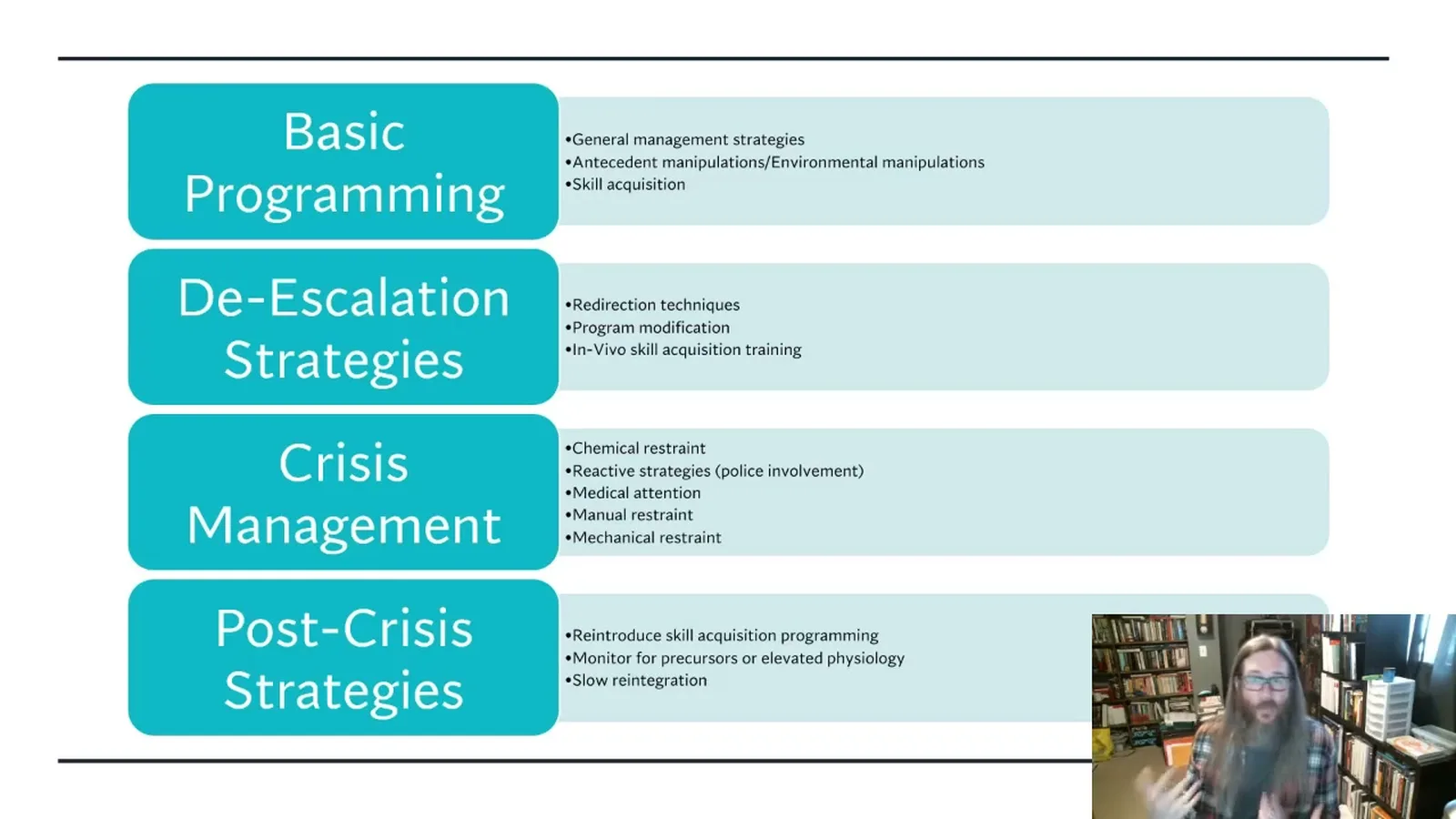
Crisis Management is a Crisis in Behavior Analysis - Applied 2022
On this page · 8 sections▾
A crisis in ABA is a moment when a person loses rational and physical control of their own body and their own behavior, and that loss of control creates an immediate and serious risk to the person, the people near them, or the space around them. That is the working definition Dr. Shane Spiker uses, and it sits on top of a stat that should bother every Board Certified Behavior Analyst (BCBA) in the field. Between 1999 and 2014, 1,367 autistic people died in the United States. CNN reports that autistic children are 40 times more likely to die from an injury than their peers. A crisis is not a strong word for a bad day. It is the label we use when the next minute could end badly.
The short answer: a crisis is an immediate risk to health or safety#
If you only remember one thing, remember this. A crisis is not "the kid had a hard session." A crisis is the moment when health and safety are on the line right now, for the learner, for the staff in the room, for a caregiver, or for someone in the community. Spiker keeps the test simple. Is somebody at risk in this exact moment? If yes, you are in a crisis. If no, you are in hard behavior, and hard behavior is a treatment problem, not a crisis problem.
That line matters because the two get mixed up all the time. A learner who screams and drops to the floor is not in a crisis just because the session feels rough. A learner who is headbanging hard enough to bruise tissue is. The first one needs better teaching. The second one needs a safety response.
Spiker's working definition (and what each word does)#
Spiker uses this definition in the talk:
An individual loses rational and physical control of their own body, their own behavior, resulting in an immediate serious and continuing risk to the person, others or surroundings. A crisis could include intense problem behavior, dangerous behavior, or even near misses like attempts to use weapons. From the talk — Dr. Shane Spiker
Each word is doing work. "Loses rational and physical control" rules out behavior that is purposeful and under the learner's control, even if it looks scary. "Immediate" rules out future risk and worry. "Serious and continuing" rules out one short outburst that resolves on its own. "Person, others or surroundings" reminds you that the risk does not have to be aimed at the learner to count. A learner who is throwing chairs is creating risk even if no chair has landed yet.
The "near miss" piece is the one most people skip. A learner who reaches for a knife in a kitchen and is stopped before they grab it was in a crisis. Nothing happened, and that is exactly the point. The risk was real. The outcome was lucky.
What counts as a crisis (and what does not)#
Spiker frames the test around health and safety in the moment:
The big consideration when we start talking about crisis is this idea of health and safety. We are looking at a situation or a circumstance where the health and safety of a learner or staff member or caregiver is at risk in that moment or the community at large. From the talk — Dr. Shane Spiker
So here is the working list.
Counts as a crisis:
- Severe self-injurious behavior that is causing or about to cause tissue damage (headbanging into hard surfaces, biting through skin, eye gouging).
- Aggression toward staff or peers that is causing injury or has a real chance of causing injury in the next moment.
- Property destruction that is putting people at risk (throwing heavy objects, breaking glass, knocking over shelves near other learners).
- Elopement into a dangerous space (parking lot, road, body of water).
- Near misses with weapons or with anything that could be used as one.
Does not count as a crisis:
- Loud verbal protest with no risk of harm.
- Refusing a task.
- Crying.
- Dropping to the floor in a safe space.
- A behavior plan (BIP) target that is hard to extinguish but not dangerous.
The cleaner you can keep this list in your head, the cleaner your decisions get in the moment.
Why the stakes are higher than most BCBAs assume#
Most BCBAs read the word "crisis" and think of one bad session. Spiker wants you to read it and think of the people we have lost.
Between 1999 and 2014, a total of 1367 deaths occurred for autistic folks in the US specifically. CNN actually reports that autistic children are 40 times more likely to die from injury. From the talk — Dr. Shane Spiker
That is the reason we treat crisis as its own category, with its own rules, instead of just turning the volume up on a regular session. The cost of getting it wrong is not "the data dipped." The cost is a learner in a hospital bed, or a Registered Behavior Technician (RBT) with a concussion, or worse.
This is also why Spiker keeps coming back to one phrase: a crisis response is Plan Z. Not Plan A. Not Plan B. Plan Z. It is the thing you reach for after everything else has failed. If your day is full of Plan Z, your Plan A through Y need work.
How a crisis is different from problem behavior#
Problem behavior is the thing your BIP is built to change. It has a function. It responds to teaching. You can shape it, replace it, fade it. Problem behavior lives inside the treatment plan.
A crisis lives outside the treatment plan. It is what happens when the treatment plan, the antecedent setup, the teaching schedule, the reinforcement system, and the staff fluency all fail at once and a person ends up in physical danger.
Spiker is blunt about this. Crisis management is not treatment. It is risk mitigation. The job of a crisis response is to keep everyone in the room alive and uninjured until the moment passes. That is it. A restraint, a Pro Re Nata (PRN) medication used as needed, a protective hold, none of those are teaching anything. They are buying you time.
The danger is when a team starts treating restraint or PRN like a treatment step. The data on that learner stops being about teaching and starts being about containment. The plan slowly turns into a containment plan with a teaching plan stapled to the front. That is the warning sign.
The other piece Spiker names is the gut signal:
It's one of those things where it's very difficult to describe or define, but you know what it is when you see it. The longer you spend time training in this, the more likely you're aware that, oh, things are about to go really wrong. From the talk — Dr. Shane Spiker
Trust that signal. Then go back later and figure out which precursor your eyes caught that your conscious mind did not.
How this definition changes what you put in a plan#
If a crisis is "immediate risk to health or safety," and crisis response is Plan Z, then a BIP and a crisis plan are two different documents.
Your BIP holds:
- The function of the target behavior.
- The replacement skills (functional communication, attention-getting, tolerance to delays and denials, and independent play, the "Big Four").
- The antecedent setup.
- The reinforcement system.
- The teaching steps.
- The data plan.
Your crisis plan holds:
- The specific behaviors that count as a crisis for this learner.
- The exact response sequence (who does what, in what order).
- The restraint or hold criteria, if any, and the stop criteria.
- The PRN protocol, if any.
- The post-crisis steps (how the learner is reintroduced to the environment without sending them right back into the same setting event).
- The data plan for restraint use, including frequency, duration, type, and a count of days with zero restraints.
- The debrief template.
When you write the BIP, you are designing the world the learner spends 99% of their time in. When you write the crisis plan, you are designing the 1% break-glass moment. Mixing the two is how teams end up using restraint as a teaching tool. That is the trap Spiker is asking the field to climb out of.
The other shift is the data. If the crisis plan does not have its own data sheet, the crisis is invisible. You cannot fade what you do not graph. Restraints, holds, PRNs, even days with zero events, all of it goes on a graph. That is how a learner Spiker describes in the talk went from a five-person bar-procedure restraint with 15-minute holds down to zero restraints across a school year. The team graphed it, looked at trends, retrained staff, and changed the environment until the crisis response was no longer needed.
Frequently asked questions#
Is self-injurious behavior always a crisis?
No. Self-injurious behavior is on a range. Light hand-mouthing that leaves no mark is not a crisis. It is a teaching target. Severe headbanging into a wall that is causing tissue damage is a crisis. The test is the immediate health and safety risk, not the topography. The same behavior can be a crisis in one moment and a teaching target in another.
Does a near miss count as a crisis if no one got hurt?
Yes. Spiker calls this out directly. A learner reaching for a weapon, a learner running toward a road, a learner swinging a heavy object near another person's head, all of these are crises whether or not contact was made. Outcome luck is not a safety plan. If the risk was immediate and real, you treat the event as a crisis, you debrief it, and you change the setup so the next near miss does not become a hit.
Who decides whether a moment is a crisis or just hard behavior?
The team decides ahead of time, in writing, in the crisis plan. The BCBA defines which behaviors and which intensity levels cross the line for this learner, and the RBTs and caregivers are trained to that definition before they ever see it happen. Deciding in the moment is how teams drift toward overusing restraint. Deciding in advance is how teams stay out of Plan Z.
Keep going#
If you want the full BCBA-led explanation, the stats, the bar-procedure restraint graph, and Spiker's full walkthrough of the prevent-teach-manage model, watch the recording on openceu.com.