The Post-Crisis Debrief: What BCBAs Actually Need to Capture
Debriefing is not paperwork. It is how you stop the next restraint. Spiker's graph, retrain steps, and what to log, from a BCBA-led CEU.
Key takeaway
The post-crisis debrief is a BAR (brief assisted required relaxation) brief assisted required relaxation graph of a headbanging learner with a five-person restraint pattern of 15, 2, 8, 8, and 19 minutes across one school day. That is the picture Dr.
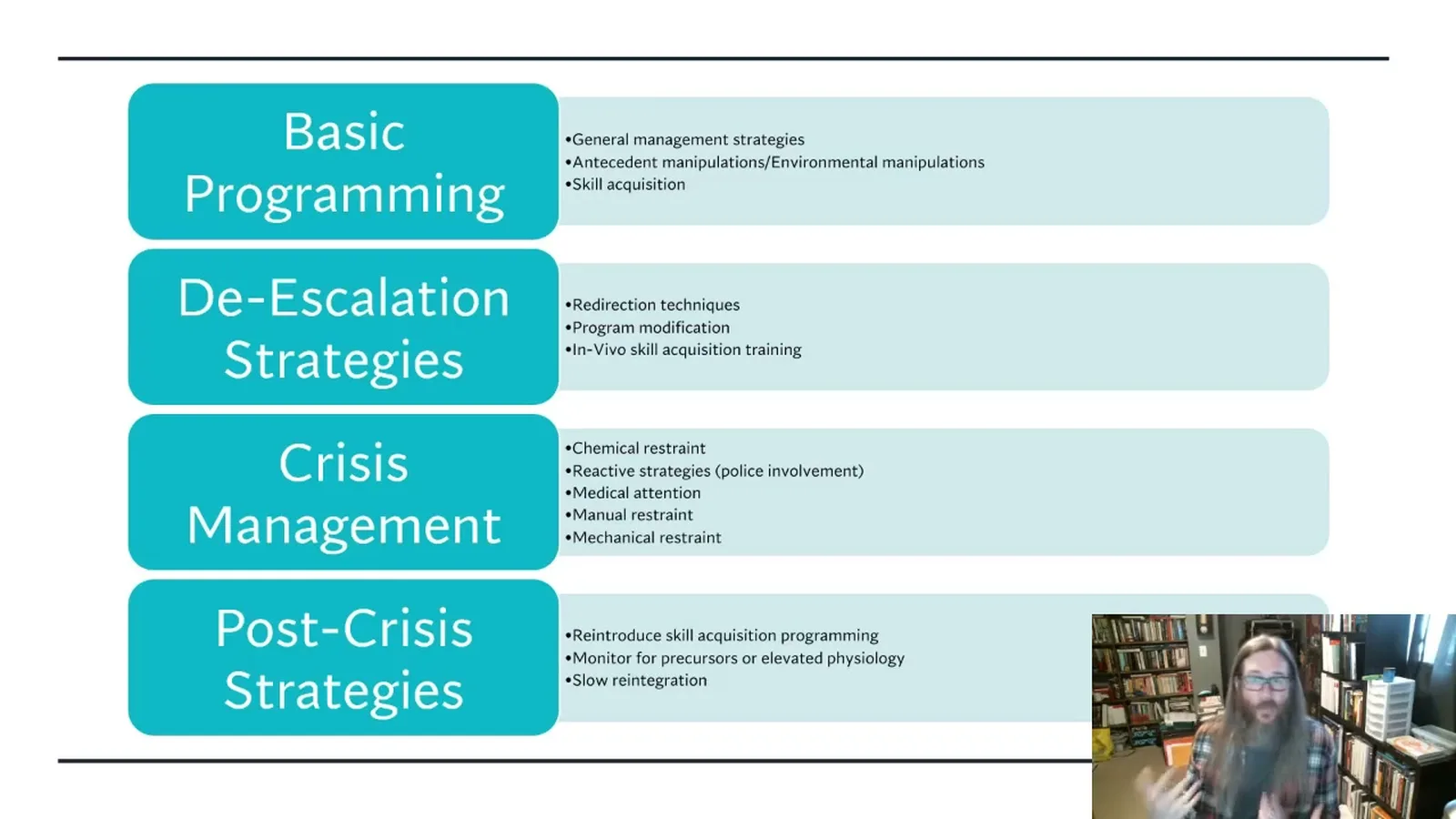
Crisis Management is a Crisis in Behavior Analysis - Applied 2022
On this page · 9 sections▾
The post-crisis debrief is a BAR (brief assisted required relaxation) brief assisted required relaxation graph of a headbanging learner with a five-person restraint pattern of 15, 2, 8, 8, and 19 minutes across one school day. That is the picture Dr. Shane Spiker walks through in his Applied 2022 talk, and it is the exact picture you want in your hands before you sit down with staff. The graph is the debrief. The debrief is how you stop the next restraint.
A debrief is not an incident report. An incident report tells the state something happened. A debrief tells your team why it happened and what changes before tomorrow morning. BCBAs (Board Certified Behavior Analysts) who skip this step keep running the same crisis on a loop. RBTs (Registered Behavior Technicians) who never see the data keep using the same response. The restraint becomes the routine.
The short answer: debrief is how you stop the next restraint#
Spiker is blunt about the gap. His words:
we don't do a debrief very often. We don't spend time with the staff to figure out what the hell went wrong so that we can avoid that. We don't have that retrain component where, okay, like I see that you're using this often. Let's go ahead and analyze why this is happening. From the talk — Dr. Shane Spiker
That is the whole page in two sentences. If you take nothing else from this, take that. A debrief without a retrain is a meeting. A retrain without data is a guess. You need both, and you need the data to drive the retrain.
The goal of the debrief is one thing: make the next crisis less likely. Not document the last one. Not protect the company. Reduce the next one. Every question you ask in the room should point at that.
What to log every time (type, duration, antecedent, staff present)#
The minimum data set for any restraint or PRN event:
- Type of restraint. Physical, mechanical, or chemical. Helmet, gloves, goggles, four-point hold, PRN medication. Spell it out.
- Duration. Start time and end time. Down to the minute. Stack them on a graph so the pattern shows.
- Antecedent. What happened in the five minutes before. Was there a demand, a denied request, a transition, a peer in the room.
- Precursor signals. What the learner did before the crisis. Spiker names his own precursor: he gets quiet and short with people. Each learner has their own. If you have not assessed precursors, you are starting blind.
- Staff present. Names, not initials. This is not about blame. It is so you can see if the same staff keep showing up in the data.
- Outcome. What ended the event. Did the learner stop on their own. Did the restraint release. Did a peer leave the room.
You also log the absence. A clean day is a data point.
even if you are not implementing some crisis management strategy, you can record the absence of that. And that is a zero. There were zero restraints today. And that is beautiful data as well. From the talk — Dr. Shane Spiker
Zero days build the trend line. Without them you only see the bad days, and you cannot tell if anything is working.
Reading the graph: what Spiker saw in the BAR data#
The graph Spiker walks through is one learner, one school year, one restraint procedure. The BAR procedure was used because the learner would bang their head hard enough to cause injury. The graph plots each restraint as a colored bar. The height of the bar is duration in minutes.
On the worst day, the bars stack: 15 minutes, then 2, then 8, then 8, then 19. Five restraints. One school day. That is the picture you want to hand to a team that thinks the program is working.
The graph starts in August. The trend climbs through October. Mid-October the team sits down with the school. They change the environment. They retrain the teachers on why the restraints keep firing. The graph dips. January 14, 2019, there is a spike, and the team meets again. By April the graph is at zero. Less than a year, no more restraints, learner is safe, learner is back at school.
The graph did that. Not the BCBA's gut. Not the staff report. The graph showed the trend, the trend forced the conversation, and the conversation produced the change.
When we don't graph those data and we don't analyze those data and we don't look at them in a really meaningful way, we miss really important information. We miss trends. We miss factors. We miss misuse. We miss overuse. From the talk — Dr. Shane Spiker
The zero day is data too#
This is the section most teams skip. They only chart the restraints. So the graph is a flat line of bad events with no context. You cannot see progress because progress looks like nothing.
Plot every day. The clean ones are zeros on the chart. Now you can show a parent, a school, or an insurance reviewer that the team is moving in the right direction. You can show staff that their work is producing safer days. You can spot the slow drift back up before it becomes a 19-minute restraint.
A zero day costs you one row in a spreadsheet. It buys you the only thing that matters in this work: a trend line.
When debrief data points at the staff, not the learner#
This is the hard one. Sometimes the graph does not point at the learner. It points at the people around the learner.
Maybe one staff member is always on shift when restraints happen. Maybe a learner does well in the morning room and falls apart in the afternoon room. Maybe a PRN gets used at the same time every shift, and that time is not when the learner is dysregulated. It is when the staff is tired.
Spiker says this part out loud, and most BCBAs will not:
Maybe you've got staff that really like restraining people and you find that that person... so now you're going to have to retrain that staff to figure out like, Hey, if you like restraining, get out. It's a problem like restraining. Let's figure out why you're doing it so much. From the talk — Dr. Shane Spiker
Restraint can be reinforcing for the staff. Attention from the team. Adrenaline. A break from the demand of teaching. A story to tell at the end of the shift. If your data shows the same staff at the center of the events, the next step is not another learner-side intervention. It is a staff-side conversation.
That conversation is not punitive. It starts with the question: what is the reinforcer for you in this moment, and how do we replace it.
Turning a debrief into a retrain (not a report)#
A retrain is a working session. Not a memo. Not a slide deck. The structure that works:
- Show the graph. Print it. Pull it up on a screen. Everyone in the room sees the same picture.
- Walk one event. Pick the worst one. Walk the antecedent, the precursor, the response, the outcome. Ask the staff who were there what they noticed.
- Name the gap. Was the precursor missed. Was the antecedent over-controlled so the EO (establishing operation) stacked up. Was the response a habit instead of a plan.
- Pick one change. One. Not five. Maybe it is a precursor checklist. Maybe it is a different staff rotation. Maybe it is a teaching target the learner has been asking for through behavior for weeks.
- Set the next check. Two weeks out. Same room, same graph, same people. Did the change move the line.
That last step is the one most teams forget. A retrain without a follow-up check is a one-time meeting. The graph will tell you in two weeks if you were right. Listen to it.
Closing the loop with school, OT, speech, and psychiatry#
Most crises do not live inside the ABA session. They live across school, OT, speech, psychiatry, the home, the bus. If your debrief stops at the ABA team, the retrain stops there too. The learner walks back into the same conditions that produced the crisis.
In Spiker's graph case, the team brought the school, the psychiatrist, the OT, and the speech-language pathologist into the conversation. Each of them changed something on their side. The graph moved because the whole environment moved.
You do not need a formal interdisciplinary meeting every time. You need a habit. Share the graph. Share the one change you are testing. Ask each team what they are seeing on their side. The point is not to run their session. The point is so the kid does not get five different responses to the same precursor.
Frequently asked questions#
How soon after a crisis should the debrief happen?
Same day if you can, next day at the latest. Memory degrades fast. Staff start to reshape the story. Wait a week and you are debriefing a story, not an event. If a same-day sit-down is not possible, at least have each staff member write down what they saw before they leave the shift.
Who should be in the room for a post-crisis debrief?
The BCBA, every staff member who was present, and the supervisor who oversees the team. If the crisis involved school staff or another provider, invite them too. Keep the room small enough that everyone talks. Five people is plenty. Ten is a meeting where half the room stays quiet.
What do I do if the parent does not want me to retrain the staff?
Ask why. Often the parent is worried the staff member will be punished or leave. Walk them through what a retrain actually is, which is a working session built on data, not a discipline meeting. Show them the graph. If they still say no, document the conversation and keep collecting data. The graph will keep telling the story, and most parents come back to the table once they see the trend.
Close the loop with the talk#
Spiker walks through the graph himself in the recording, including the school collaboration and the slow climb back to zero. The visual is worth seeing once.