How to Conduct a Functional Analysis in a School Setting
Schools have buy-in, staffing, and safety barriers a clinic doesn't. Why trial-based usually wins, from a BCBA-led CEU.
Key takeaway
Running a functional analysis (FA, the controlled test where you turn on and off the suspected reinforcers to find out what is keeping a behavior going) in a school is not the clinic version with a school sticker on it.
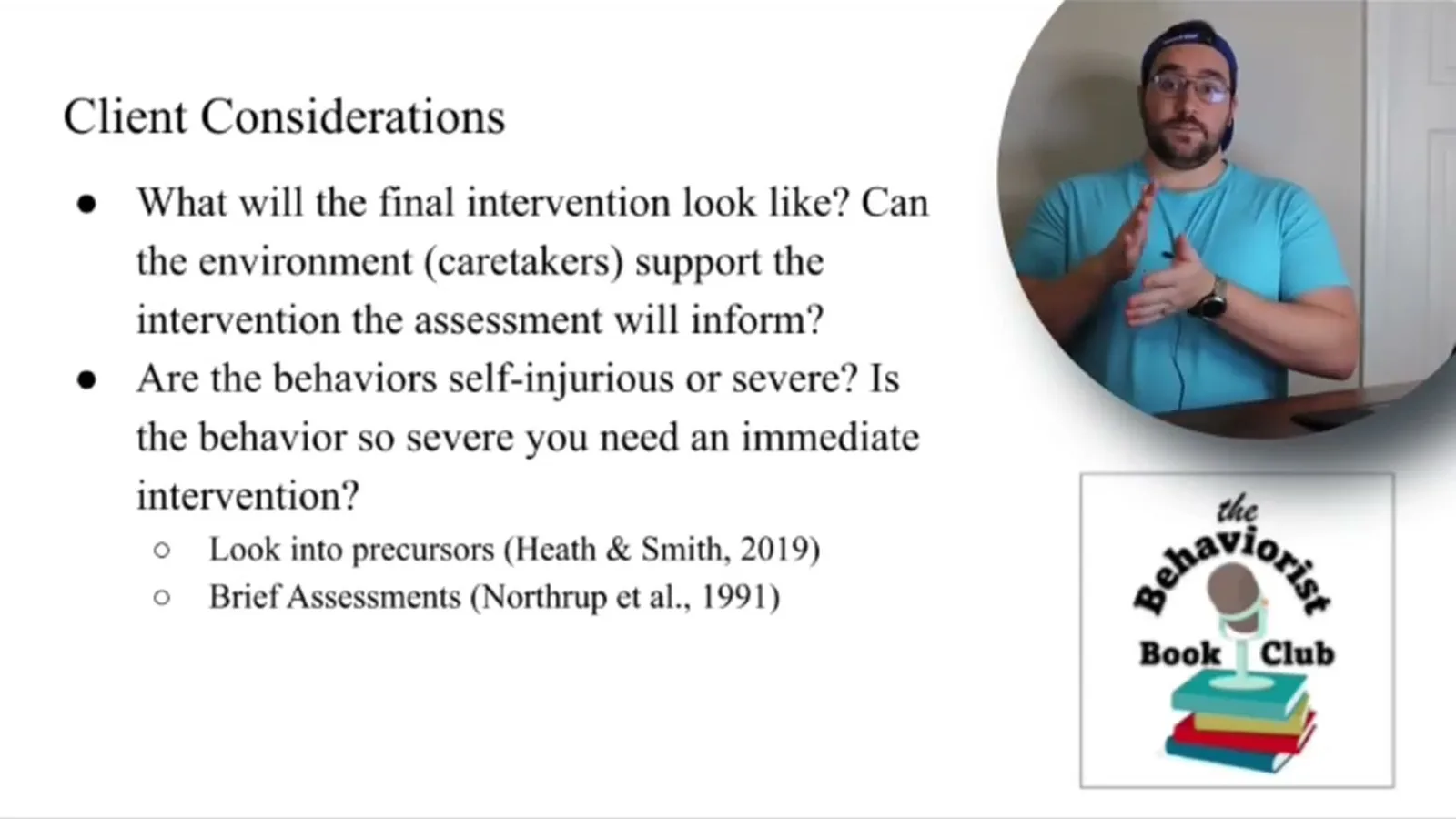
Confessions of a New Behavior Analyst in Functional Analysis
Free learning path on this topic
Child Development for Behavior Analysts
Typical development for behavior analysts. Kristen Byra's overview, then Kelly Brzak's deep dives on ages 2 to 5, 6 to 8, and 9 to 11, with milestones, common problem behaviors, and programming tips for each band.
On this page · 9 sections▾
Running a functional analysis (FA, the controlled test where you turn on and off the suspected reinforcers to find out what is keeping a behavior going) in a school is not the clinic version with a school sticker on it. There are three buy-in barriers waiting in the room before you start, the safety problem that other kids in the class are also people you cannot put at risk, and a real chance the data will be cleaner if you switch to trial-based and ride naturally occurring establishing operations (EOs, the conditions that make a reinforcer matter more in the moment, like the homework folder coming out or the group transition starting). You can pull the student to a separate office, but that costs you ecological relevance, and you have to decide whether the tradeoff is worth it for this case.
Why a school FA is harder than a clinic or home FA#
In a clinic, you control the room. You control the staff. You picked the table, the materials, the people. The EOs are the ones you set up because nothing else is happening. In a school, you walked into someone else's day. The teacher has a lesson plan and 10 other kids. The paraprofessional has a job description that does not say "run analog conditions for a behavior analyst." The student has friends at the next table who notice when something is different. The standard four-condition FA assumes a level of stimulus control over the room and a level of staff time you have not been given.
The three buy-in barriers (teacher, para, and the willing-but-stretched)#
Three flavors of barrier show up, and each one has a different fix. Confusing them is a fast way to spend a week wondering why nothing is moving.
Flavor one is the teacher who does not believe the FA will help. Sometimes the belief is that medication is the cause and everything else is noise. Sometimes the belief is that the student needs a different placement and an FA is a delay tactic. The conversation here is not technical. You explain in plain language that the FA tells you what the behavior is for, and the plan that comes out of it is the thing that earns or loses you the next conversation. You are not asking them to trust the procedure. You are asking them to wait for the data.
Flavor two is the paraprofessional who does not want to participate. Often this is the same root in a different uniform. They have seen behavior analysts come and go. They have seen plans that did not match what they live with every day. The fix is to make their job inside the FA smaller than they think it will be and to write it down. One role. One signal. One response. Run it past them before the session, not during it.
Flavor three is the one that hurts the most, because it is the willing teacher and the willing para who simply do not have the time. They want to help. You have nothing to push against, and that is the problem. The fix here is not buy-in. It is logistics. You shrink your ask. You stop pretending the standard analog session is the only option. You match the FA to the time you actually have.
The empathy line in the talk is the one to keep in your head while you do this work.
My wife was a special education teacher. She has a master's in special ed. And so I really do, I have a heart for those poor overworked teachers. And I would hate to be the behavior analyst who says, hey, I know you have 10 other kids in your class, let's get a little bit of more work on your plate. From the talk — Matt Harrington
If the plan you wrote requires the teacher to do extra work the teacher does not have, the plan will fail and it will look like the teacher's fault. It is not. It is a planning problem you can prevent.
The safety constraint other kids in the room create#
A clinic FA controls who is in the room. A school FA does not. If the target behavior is severe (aggression, elopement into a hallway, throwing materials), the room contains classmates who did not consent to be near a controlled escalation. This is a hard stop, not a soft preference.
If you're working with a severe behavior, then you need to be aware that severe behavior can be harmful for the other individuals in the class. Sometimes the severe behavior is actually targeted at other kids. So obviously there's an immediate dilemma there and the dilemma solved because you would never put other kids in danger just for your assessment. From the talk — Matt Harrington
The way that resolves in practice is to shrink the session window to a length where the response can be interrupted before it escalates, switch to a precursor-based version (where you turn off the trial the moment the early-warning behavior shows), or move the session to a different physical space. All three are legitimate. None of them is a clinic FA. That is fine.
Why trial-based usually wins in schools#
A trial-based FA breaks the standard analog FA into short trials you can start and stop quickly, with a one-or-two-minute test condition and a control. It was designed for the school problem. You do not need a 10-minute attention condition to learn that attention is reinforcing the behavior. You need three or four short trials at moments when attention naturally matters, with a control where it does not, and you compare.
Personally, I really like the trial-based functional analyses for the school setting because it has a little bit of flexibility with when you start and stop session and trials. So you're able to kind of take advantage of naturally occurring establishing operations and run a trial in the moment there. From the talk — Matt Harrington
The EO is already in the room. The homework folder is coming out. The group is about to start. The transition to recess is happening. You ride those moments. You do not stage them.
Riding naturally occurring EOs (homework, transitions, group time)#
Practical rules of thumb if you are going to do it this way:
- Pre-map the schedule with the teacher. Write down five or six moments in a typical day where the suspected EO is naturally going to be present. Homework passout, group instruction start, independent work, transition to specials, transition to lunch, end-of-day pack-up.
- Pick a signal between you and the staff that means "start the trial now." A short word, a tap on the desk, anything. The signal tells the para that for the next 60 to 90 seconds you are running a trial and they should deliver the planned response (attention, escape, tangible removal) in the way you agreed.
- Run no more than three or four trials in a single day. The FA is supposed to be additive on top of a day that is already happening, not the day's main event.
- Spread conditions across days, not within one block. You are not in a clinic. You do not need every condition in one morning.
- Keep the control trials. The whole point is the contrast. Without the control, you have a behavior count, not a function.
This is also where the data start to look clean in a way the team can read. The teacher sees the trial, sees the result, and you can show them the differentiation across conditions on a single chart by the end of the week. The buy-in problem from the first section often softens here, because the teacher is now looking at a graph that came out of moments they recognized.
When pulling the student to a separate office is worth the ecological relevance cost#
Sometimes the classroom is not the right room. Maybe the severity question from the safety section makes a classroom session unfair to the other students. Maybe staffing means the para genuinely cannot give you the few seconds you need. Maybe the district has an office and a 1:1 staffer who can come with you. The talk names the option and the tradeoff plainly: some people run the FA in a separate office with their own staff, and that can be really useful, but the moment you remove a child from their environment you lose some ecological relevance, so the room where you test has to match the room where the behavior actually happens.
The honest tradeoff is this. You gain control over the conditions, you can run longer sessions, you remove the safety problem for the other kids. You lose the part where the EOs in the classroom are the real EOs. A demand in the office is not the same demand as the demand in the classroom. An attention condition with one adult is not the same attention condition as the one with 22 peers around. If you go off-site, plan to validate the function with a brief return to the classroom, even if it is one or two trial-based trials, before you finalize the plan.
What to do when the teacher thinks meds are the cause#
This is the most common version of the disbelief barrier and the easiest one to turn around. Medication can absolutely affect behavior. So can the function the behavior serves. Both can be true at once. The FA does not have an opinion about the medication. It tells you what the behavior is currently maintained by. If the data come back showing the behavior is escape-maintained, that is true whether or not medication is contributing to escalation rate. The plan can recommend a consult with the prescriber and a function-based intervention at the same time. Frame it as "the FA gives us information we need either way" and let the data do the rest of the convincing.
Frequently asked questions#
Do you need IEP team consent to run a functional analysis at school?
Yes. An FA is an assessment, and assessments inside a school setting require informed written consent under IDEA and your state's special education regulations. The IEP team should agree on the assessment plan before you start. Document the procedure in plain language, name the conditions you intend to run, and explain that you will stop the session if the target behavior reaches a pre-defined intensity. Loop in the school psychologist and the special education director early. The consent step is also a buy-in step in disguise, so do not rush it.
Can a school BCBA run an FA on a student who is not on their caseload?
Not without being added to the team. The student needs to be referred for assessment through the school's process, the parents need to consent, and the BCBA needs to be named on the assessment plan. If you are an outside BCBA brought in by a district contract, the district adds you to the team. If you are the in-district BCBA but the student is on another analyst's caseload, the assignment has to be moved or you have to be added as a consulting analyst. The shortcut never ends well.
What if the teacher refuses to participate in the FA?
First, figure out which of the three buy-in flavors you are dealing with. If it is disbelief, schedule a short meeting and explain what the FA will and will not answer in plain language. If it is the para version where someone in the room does not see the point, write a one-page role description that makes their job inside the session very small. If it is the willing-but-stretched version, you do the work. You shrink the ask, switch to trial-based, ride the EOs that are already on the schedule, and you do not ask the teacher to add a single step to their day. A teacher who is not asked to do more is rarely a teacher who refuses to participate.
Watch the full hour for the case stories#
The CEU walks through the school cases in context, the precursor-based variation, and the part where the analyst has to tell the team the data are not what anyone expected. Watch the talk to hear how the procedure changes when the room changes.
Turn this topic into a CEU
You just studied this. Now get credit for it.
Watch Confessions of a New Behavior Analyst in Functional Analysis with Matt Harrington and earn 2.5 free BCBA CEUs. Detailed certificate, delivered the moment you finish.
Keep going with a free learning path
Child Development for Behavior Analysts
Typical development for behavior analysts. Kristen Byra's overview, then Kelly Brzak's deep dives on ages 2 to 5, 6 to 8, and 9 to 11, with milestones, common problem behaviors, and programming tips for each band.