Learner-Centered Skill Assessment in ABA: What It Means and How to Do It
Learner-centered skill assessment means picking targets that match the person's goals, not a normalized checklist. Here is how, from a BCBA-led CEU.
Key takeaway
The shift is simple to say and hard to do: stop comparing a learner to other eight-year-olds and start comparing them to the life they want, like overlaying a kid's goal of joining ballet class onto a VB-MAPP (Verbal Behavior Milestones Assessment and Placement Program) you already use.
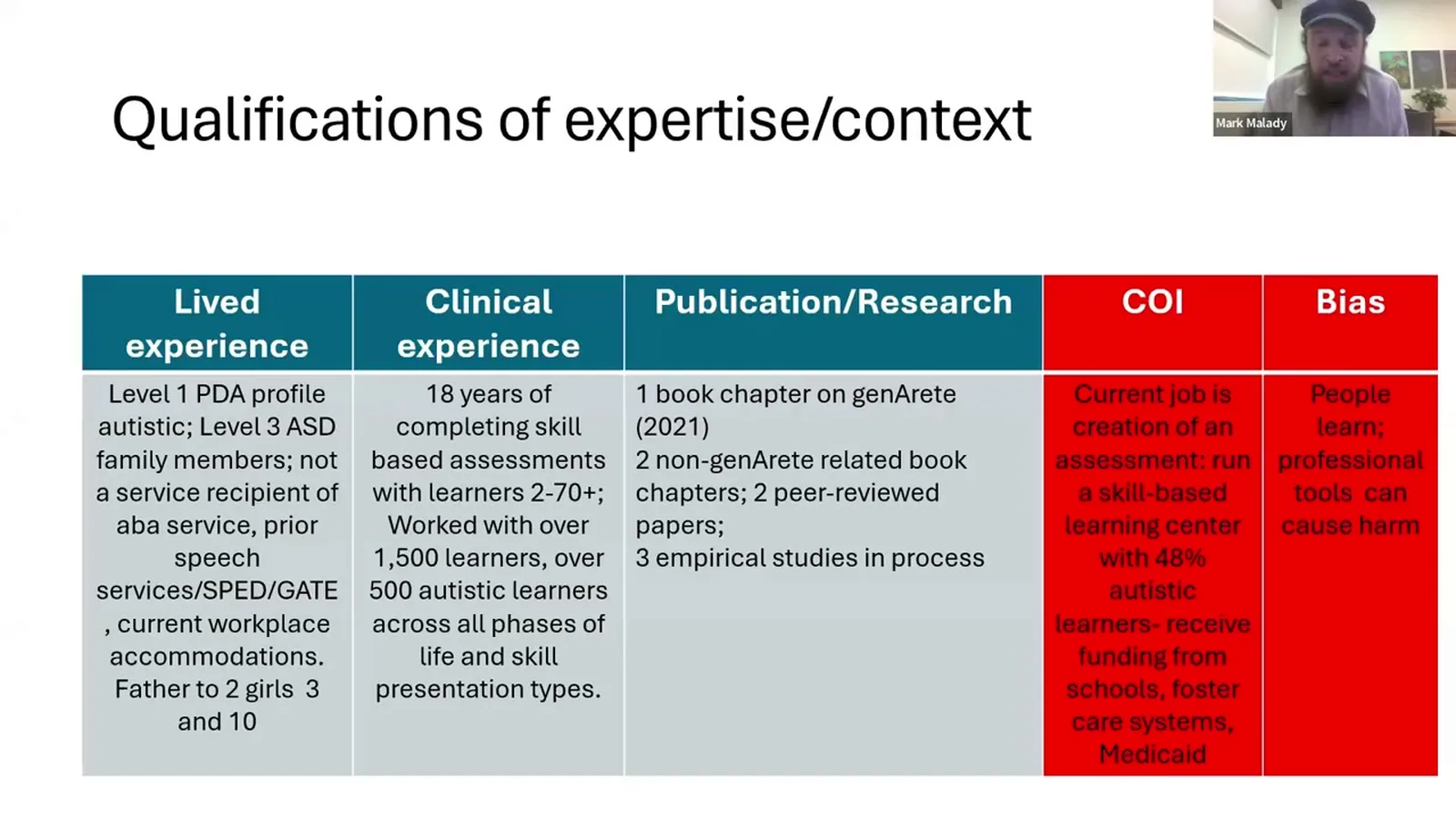
Generate: Learner Centered Skill Assessments
Free learning path on this topic
Child Development for Behavior Analysts
Typical development for behavior analysts. Kristen Byra's overview, then Kelly Brzak's deep dives on ages 2 to 5, 6 to 8, and 9 to 11, with milestones, common problem behaviors, and programming tips for each band.
On this page · 8 sections▾
The shift is simple to say and hard to do: stop comparing a learner to other eight-year-olds and start comparing them to the life they want, like overlaying a kid's goal of joining ballet class onto a VB-MAPP (Verbal Behavior Milestones Assessment and Placement Program) you already use. A learner-centered skill assessment means your targets come from the person in front of you, not from a checklist that was built to make every kid look the same. You can do this without throwing out your current tool. You just have to ask different questions before you open it.
What learner-centered actually means in skill assessment#
Learner-centered means the goals come from the learner and the people who love them. The assessment is the tool. The learner is the point.
A lot of skill assessments do the opposite. They start with a fixed list of items and ask, "How many of these can the kid do?" That tells you about the test. It does not tell you about the person.
A BCBA (Board Certified Behavior Analyst) doing learner-centered work flips the order. You start with a real outcome the learner cares about. Then you pick the items on the test that lead to that outcome. The test still has fidelity. Your targets just stop being random.
Norm-referenced vs learner-referenced: the practical difference#
Norm-referenced means you score the learner against a group of other people the same age. Learner-referenced means you score the learner against their own goals.
Relative evaluation skills are compared to the person's goals and values. So this is contrasted with normative comparison where we might look at, hey, this person is eight years old. What other eight year olds do? We're not comparing that person to something that is important to them. From the talk — Mark Malady
That switch sounds small. It is not. Norm-referenced thinking quietly pushes you toward "make this kid look like the other kids." Learner-referenced thinking pushes you toward "help this kid get where they want to go." Both can use the same instrument. Only one of them ends up writing programs the family actually wanted.
In practice, the test list is the menu, not the goal. You order from it. You do not eat everything on it.
The 5 outcomes a learner-centered assessment has to deliver#
A skill assessment is doing its job when it hits five outcomes:
- Accurate account of skills. It does not say the learner can do things they cannot. It does not say they cannot do things they can.
- A meaningful life from the learner's view. The skills picked up actually move the learner toward how they want to live.
- Real growth areas. Clear, specific routes forward. Not "fill in every box."
- Real strengths. What this person already brings that helps them move through the world.
- Areas of continued support. Some things should not be skill targets. They should be accommodations the learner uses for life. The assessment tells you which is which.
A skill based assessment should be looking at the skills in context, but it also should be providing the context of what is important to this learner and where are they trying to go and where are they trying to accomplish. From the talk — Mark Malady
If your assessment process does not produce all five, the report you hand the family is incomplete, even if every score is correct.
How to overlay learner goals on a standardized tool you already use#
This is the part most teams skip. You do not need a new instrument. You need an overlay step before you use the one you have.
Here is the move, in order:
- Interview first. A 30 to 45 minute semi-structured talk with the learner and caregivers. What does the learner want to do this year? Where do they get stuck? What do they already love?
- Pick the outcome. One specific milestone. Ballet class. Staying home alone for fifteen minutes. Starting kindergarten. Taking care of a pet.
- Sample the instrument for that outcome. Open your assessment and highlight only the items that map to the milestone. Ignore the rest for now.
- Score those highlighted items. Run the assessment with fidelity, but on a learner-relevant slice.
- Set comparison criteria from real performers. Find two or three people who already do the milestone well. Score them too. Their performance is your bar, not the test's default mastery line.
So here's an example of what you might do with the VB map where you have a learner who really wants to do ballet classes and you're looking and you're sampling. What are the skills inside of the VB map that are required for ballet class? From the talk — Mark Malady
You did not break the VB-MAPP. You used it. You just stopped pretending the box-fill picture on the cover is the goal.
How to talk about this with parents who are scared of ABA#
A lot of parents come in nervous. They have read posts that say ABA makes kids act like robots. They want help. They also want their kid to stay their kid.
Learner-centered assessment is the answer to that worry, but only if you can say it out loud. Try this:
- "We are not going to work on skills just because they show up on a test."
- "We are going to ask you what matters to your family and to your kid. Then we are going to pick the targets that get there."
- "Some things we are not going to teach as skills. We are going to support them with accommodations for life."
- "Here is the milestone we are aiming at. Here is the slice of the assessment that matters for it. Here is what we are skipping."
These sorts of questions can arm you for those conversations in a very practical way and can give you a way to talk about the features in your services that are differentiated from common concerns inside of our practice space. From the talk — Mark Malady
That conversation is not a sales pitch. It is the actual plan. Parents can tell the difference.
Documentation that proves you did it (for insurance and for ethics)#
Insurance reviewers read what you wrote, not what you meant. Ethics audits do the same. So your file has to show the work.
Put these in the assessment report:
- The interview record. Who you talked to, what they said the learner wants, and what the learner said for themselves when possible.
- The milestone. One sentence the family would recognize. "Goldie wants to take a community ballet class in the fall."
- The selected items. The exact items from the instrument you scored, and a short note on why each one ties to the milestone.
- The comparison criteria. Who you benchmarked against and what level of performance you used as the bar.
- The accommodations list. What is being supported instead of taught. This is a feature, not a gap.
- The graphical display. A picture that shows current skills vs the milestone bar, not "boxes filled vs total boxes."
Two things insurance reviewers will quietly accept that most teams do not know: many payer policies require only one validity study and one reliability study to fund an instrument, and you can almost always pair an emerging instrument with a legacy one if you ask first. Ask for the written policy. Pair the tools. Document the pairing.
Frequently asked questions#
Is learner-centered assessment the same as person-centered planning?
They are cousins. Person-centered planning is a broader process for life direction and supports, often led by a team across years. Learner-centered skill assessment is a tighter, ABA-specific version: you use the same value (the person drives the goals), but the output is a skill report and a teaching plan, not a life plan. You can do both. The skill assessment will be better when it sits inside person-centered planning.
Can I do learner-centered assessment with VB-MAPP?
Yes. The VB-MAPP is one of the most common places to start. Pick the milestone the learner cares about, sample the VB-MAPP items that lead to that milestone, score those with full fidelity, and use real performers as your comparison bar instead of the default age track. The instrument stays valid. Your targets stop being generic.
How do I document learner goals so insurance accepts them?
Write the goal in family-language first, then translate to clinical language. "Goldie wants to join a community ballet class" becomes a target list of motor imitation, group instruction-following, transitions, and peer interaction items pulled from the VB-MAPP. Cite the instrument. Cite at least one validity and one reliability study. Note that you used a learner-referenced criterion based on benchmarked performers. Most policies allow this. Many reviewers prefer it because it gives them something concrete to approve.
Where to take this next#
If this approach makes sense and you want to see one BCBA walk a real assessment through it, the full CEU is the place to start. Mark Malady builds out the model, shows the radial graphs that replace box-fill displays, and gives the exact scripts for the parent and insurance conversations.
Watch "Generate: Learner Centered Skill Assessments" on openceu.com
Turn this topic into a CEU
You just studied this. Now get credit for it.
Watch Generate: Learner Centered Skill Assessments with Mark Malady and earn 1 free BCBA CEU. Detailed certificate, delivered the moment you finish.
Keep going with a free learning path
Child Development for Behavior Analysts
Typical development for behavior analysts. Kristen Byra's overview, then Kelly Brzak's deep dives on ages 2 to 5, 6 to 8, and 9 to 11, with milestones, common problem behaviors, and programming tips for each band.