What a BCBA actually does in an IEP meeting
What BCBAs cover vs. what IEP advocates handle, how to collaborate, and how to keep clinical goals school-legal, from a BCBA-led CEU.
Key takeaway
The clinical Board Certified Behavior Analyst (BCBA) writes the plan; the school side has to make it survive a real classroom, and that gap is the whole job of the IEP advocate sitting next to you.
IEP Advocacy, Tier 1 Behavior Support, and Compassionate Behavior Change in Schools
On this page · 9 sections▾
The clinical Board Certified Behavior Analyst (BCBA) writes the plan; the school side has to make it survive a real classroom, and that gap is the whole job of the IEP advocate sitting next to you. The panel's IEP advocate, Grace, said it plainly: "we pick up what you say and put it into play" in the school setting. The example she kept coming back to was a calm-down-area chain (desk to in-room corner to hallway spot to a quieter office) that was clinically clean and basically perfect on paper. Then it hit one gen ed teacher with no extra body in the room, and the chain did not survive the first week. That is the meeting you are walking into. This page is a map of who owns what at the IEP table, what "educationally relevant" really means when it rewrites your goals, and what to do when the school says it cannot staff your plan as written.
What an IEP meeting actually is (and who's at the table)#
An Individualized Education Program (IEP) meeting is a legally scheduled team meeting where the school agrees, in writing, on what services a student will get and what goals they will be measured against for the next year. It is run under federal special education law, so the language and the timeline are not optional. The school has to be there. The parent has to be invited. Everyone else is in support of those two seats.
A normal IEP table has the parent, the case manager (often the special education teacher), a general education teacher, a district representative, a school psychologist or related service provider, and any specialists the student needs (speech, occupational therapy, physical therapy). If the family hired an IEP advocate, that person sits with the parent. If the family has an outside clinical BCBA running home or clinic Applied Behavior Analysis (ABA) hours, that BCBA may attend as an invited guest of the parent.
That last seat is the one this page is about. You are an invited guest. You are not the case manager. You are not a district employee. Your plan is not what gets implemented. What gets implemented is whatever the IEP team writes into the document and signs. Your job is to make sure the behavior section of that document is something a teacher can actually run on Tuesday morning.
Where the BCBA's job ends and the advocate's begins#
The cleanest definition of the split came straight from Grace on the panel. She said her job is to pick up the BCBA's clinical work and lay it into the school setting.
"When I have like BCBAs or other professionals and experts coming in, I take the pieces and put it all together where it should be. Because you guys, hands down, know all of the behavior side. And then I help us pick it up and put it into play in a school setting and an educational model." From the talk — the panel
Run that as your job description from now on. You own the behavior side. Operational definitions, function, replacement behavior, data system, criterion. The advocate owns the meeting itself. That is agenda, tone, what the law requires, what the district has to provide, and how the goal gets written into the document so it actually means something a year from now.
If you walk in trying to own both, two bad things happen. You overstep into legal and procedural territory you do not know as well as the advocate does. And you under-deliver on the only thing nobody else at the table can do, which is translating the Functional Behavior Assessment (FBA) and the Behavior Intervention Plan (BIP) into something a teacher can run with one body in the room.
Why 'educationally relevant' rewrites your clinical plan#
Here is the constraint nobody warns outside BCBAs about. The school is not legally required to implement your clinical plan. The school is legally required to provide a free and appropriate public education. The behavior support has to be tied to that.
"The only thing that they're legally required to do is it has to be educationally relevant and it has to fit within whatever that particular mold may be." From the talk — the panel
So when you bring in a goal like "Student will independently complete a token economy across 20 consecutive trials to gain access to preferred reinforcers," the school looks at it and says: tie that to reading, writing, math, or social participation, or it does not belong in the IEP. Token economy is a method, not a goal. The educationally relevant version is "Student will remain at task during independent reading for X minutes across Y of Z opportunities." Same kid. Same behavior. Different mold.
Build your draft goals in that voice before the meeting. If a goal cannot finish the sentence "and this matters for the student's access to the general education curriculum because…," it is going to get rewritten in the room. Better you rewrite it at your desk than watch it get cut down live.
How to brief an advocate before the meeting (15 minutes that saves an hour)#
Fifteen minutes on the phone with the advocate the day before the meeting will save you an hour of cross-talk in the meeting itself. Run this script.
- One sentence on the function of the target behavior. ("Behavior is maintained by escape from non-preferred academic demand, with secondary social attention.")
- One sentence on the replacement behavior the student is learning. ("Functional communication: handing a break card.")
- One sentence on intensity, because the advocate needs to know what the school is being asked to absorb. ("Three to five episodes per school day right now, average duration four minutes, no injuries in the last 30 days.")
- The one accommodation you are most worried about losing. ("If they will not give him the break card protocol, the whole plan falls apart.")
- The one accommodation you are willing to trade. ("I do not need them to do the token economy if they will do behavior-specific praise at a 4:1 ratio.")
That last one matters. Advocates know that an IEP meeting is a negotiation. If you walk in with five non-negotiables, you will lose three of them by surprise. If you walk in with two non-negotiables and three trade chips, you usually keep the two that matter.
"If you have a kiddo that has very high intensity behaviors that we're trying to work on and how you guys do it in like a clinic setting or in your ABA world. We have to tweak it and manage it to fit into the educational setting." From the talk — the panel
Two advocate styles you'll meet: matching T-shirts vs. minute-15 yelling#
You are going to meet two kinds of IEP advocates in your career, and the panel laid both out in the same minute. One advocate brings everyone matching T-shirts and runs the whole meeting like a team huddle. The other walks in like a courtroom and has three teachers crying and the principal yelling by minute 15. Same credential category. Completely different room.
Ask the parent before the meeting which one they hired. If it is the team-huddle advocate, your job is easy. Bring your behavior data, sit on the parent's side of the table, and let the advocate set the tone. If it is the courtroom advocate, your job changes. You become the calm clinical voice. You stick to operational definitions, data, and what the student needs. You let the advocate handle the procedural fight, and you stay out of the cross-fire so the clinical recommendations do not get dismissed as part of the noise.
Neither style is wrong. They get used for different families and different districts. But you cannot run the same playbook into both rooms.
What to say when the school can't staff your plan as written#
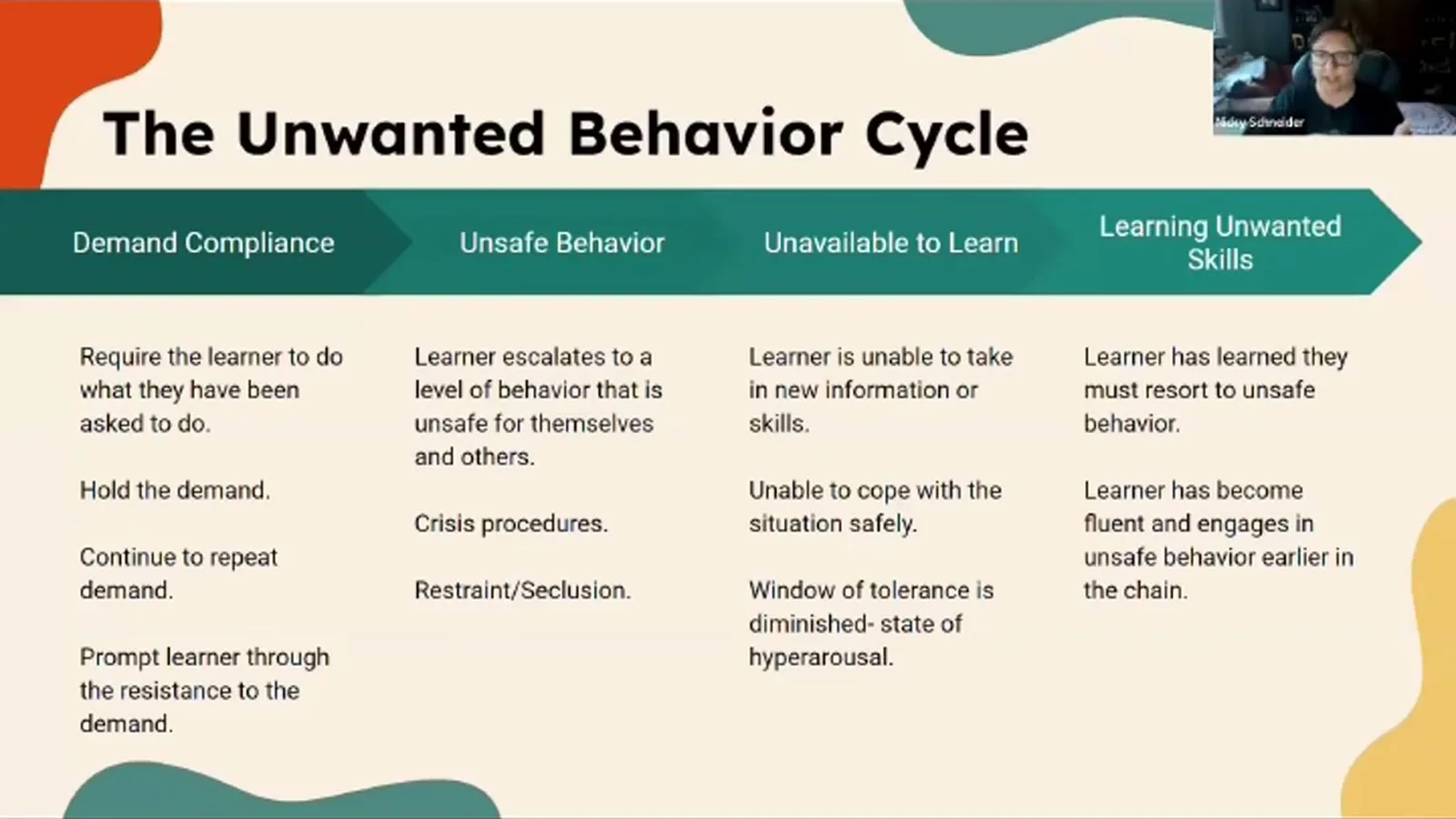
This is the moment that humbles every outside BCBA. You wrote a clean, clinically defensible plan. The school says they cannot do it. They are not being lazy. They have one teacher and 24 other kids and no extra body to walk a student through a four-step calm-down chain.
"We're going to take a kiddo from out of his desk to a calm down area within the classroom to a calm down area right outside the classroom to a calm down area down those stages. And that just wasn't feasible because they didn't have the people." From the talk — the panel
When you hear "we cannot staff that," do not push back on the principle. Push back on the resolution. Try this script: "I hear that the full four-step chain is not feasible with current staffing. Can we keep step one, the in-classroom calm-down area, as the daily protocol? And can we agree that if the student elopes from the classroom, that is the trigger to call an administrator?" You have just collapsed a four-step plan into a one-step plan plus an escalation rule. That is school-feasible. It also matches what a real classroom can actually deliver.
Document the collapsed version in the BIP. Note that the full chain is the clinical recommendation if staffing improves. That way the next IEP team has a written record of what the student would benefit from when the budget comes back.
Outside BCBA vs. district BCBA: same credential, different chair#
If the district has a BCBA on staff, you are not the BCBA in the room. They are. You are an invited clinical consultant. Treat them like the case manager treats the gen ed teacher: they are the one who has to live with the plan after you leave.
That means you defer to them on what the district has the budget and staffing to run. You bring your data, your function-based recommendations, and your operational definitions. You do not bring "well, in clinic we do…" as an argument. The school is not clinic. The district BCBA already knows that, and starting that sentence in their meeting is the fastest way to lose the room.
If there is no district BCBA, you are still not the case manager. You are still an invited guest. But your recommendations carry more weight by default, because nobody else at the table can read the FBA the way you can. Use that weight to push for educationally relevant goals and a feasible BIP, not to push for a clinic-style plan that the school will sign and then quietly never run.
Frequently asked questions#
Can a BCBA call for an IEP meeting if they're not on the school staff? No. Only the parent or the school can call an IEP meeting. As an outside BCBA you can recommend to the parent that one is needed, and you can write a letter the parent submits requesting the meeting. The legal request has to come from the parent's signature, not yours.
What do I do if the school's RBT-equivalent isn't trained to run my plan? Offer Behavior Skills Training (BST). Write the protocol, model it, let the school staff practice with feedback, and check fidelity in a follow-up visit. If the district will not let you train their staff, your fallback is to simplify the plan until it is something an untrained adult can run with a one-page cue card. Both options keep the student moving. Refusing to simplify the plan does not.
Do I have to be in the room, or can the IEP meeting happen without me? The meeting can absolutely happen without you. You are an invited guest, not a required member. If you cannot attend, send a written clinical recommendation in advance, ask the parent to bring it to the meeting, and request that it be attached to the IEP as a supporting document. Then schedule a follow-up call with the case manager and the advocate within five school days to walk through what the team actually signed.
Watch the full panel and bring one plan to your next IEP meeting#
The panel has more examples than this page can hold, including Grace's matching-T-shirt meeting, the executive functioning student with no clock or schedule in the room, and the kid who hid under the desk while a clinician drew Charizard until he came out. It is free and BACB-eligible.
Watch the full CEU on openceu.com
Then pick one IEP you have coming up and rewrite your draft goals through the educationally-relevant filter before you walk in. The teacher who has to run it on Tuesday will know the difference.