Compassionate behavior change in classrooms
How school-based BCBAs swap escalation for acquiesce, co-regulate, and re-approach, plus the line between assent and consent, from a BCBA-led CEU.
Key takeaway
Nikki, one of the panelists, asks teachers a question that resets the whole room: "are you going to die on that hill?" It is the gut-check before you push a kid who is already past the line.
IEP Advocacy, Tier 1 Behavior Support, and Compassionate Behavior Change in Schools
On this page · 10 sections▾
Compassionate behavior change in classrooms
Nikki, one of the panelists, asks teachers a question that resets the whole room: "are you going to die on that hill?" It is the gut-check before you push a kid who is already past the line. Most school-day power struggles fail this test. The worksheet does not matter that much. The lesson the kid takes home, that adults will keep pressing until something breaks, matters a lot.
This page is about the move that replaces the press. The panel calls it a loop with four steps. Acquiesce. Co-regulate. Reflect. Re-approach. You step back from the demand, you help the kid get their body back, you figure out what skill was missing, then you ask again in a way that can get a yes. It is not "give up." It is the part of the job that teaches a kid they can come back from a hard moment.
It also names a line almost every parent and tech gets wrong: assent vs. consent. Consent is what the parent signs at intake. Assent is what the student tells you with their body in the next ten seconds. The panel watches assent the way other people watch the clock.
The most useful example in the talk is a kid hiding under a desk. The adult does not haul him out. The adult sits on the floor and starts drawing a bad Charizard. The kid corrects the drawing. The kid takes the pencil. The kid is back. That is the panel shaping a kid back to the table, one small reinforcer at a time.
H2 outline#
- Why holding the demand teaches the wrong skill
- The four moves: acquiesce, co-regulate, reflect, re-approach
- "Are you going to die on that hill?" as the question that resets a teacher's reaction
- Assent vs. consent (and why you watch behavior, not signatures)
- What assent withdrawal looks like in a vocal vs. non-vocal student
- The window of tolerance and the "available to learn" zone
- How to re-approach without redoing the original ask
Why holding the demand teaches the wrong skill#
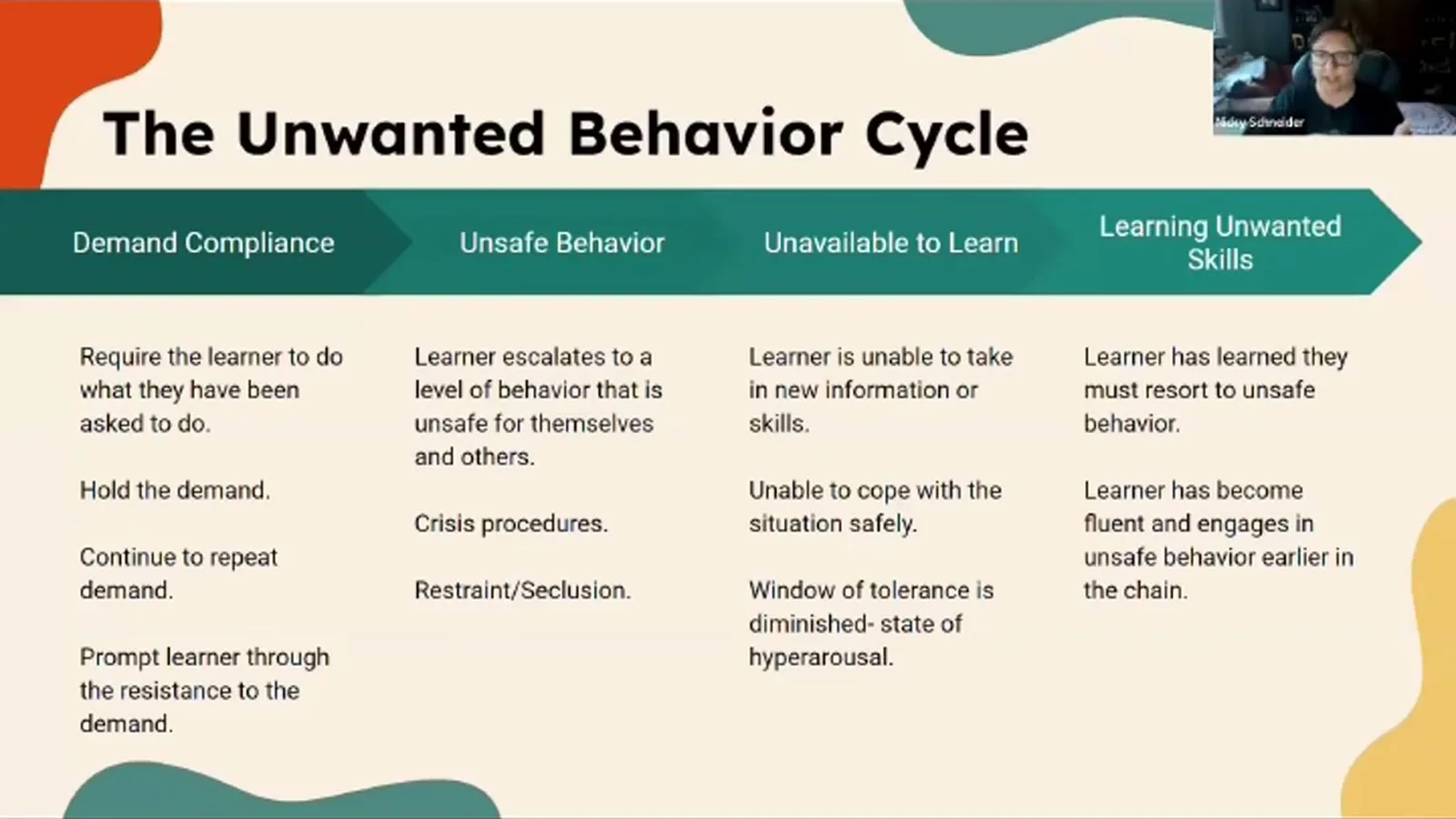
The old habit in the field was hold the demand. The kid pushes back, the adult holds. The kid escalates, the adult holds. The plan is to ride it out until the task gets done, because the worry is that backing off will reinforce the pushback.
The panel pushes back on that. They are not soft on demands. They are soft on the moment. A kid who is yelling, crying, or under the desk is not in a learning state. Pressing a kid in that state does not teach math. It teaches that the adult will not stop, which is the lesson that turns into school refusal a year later.
Holding the demand also teaches the staff the wrong skill. The teacher starts to see their job as "win the battle." That is the job description that burns teachers out. The panel offers a different one: get the kid back to the place where they can learn, then teach.
The four moves: acquiesce, co-regulate, reflect, re-approach#
The whole framework is four steps. Run them in order.
Acquiesce. Drop the demand. Not for the day. For the moment. The math worksheet still exists. It will come back. Right now, the ask is off the table so the kid can come back to baseline.
Are you going to die on that hill? Cause literally I will ask teachers that like, I don't think we're going to die on that hill today. From the talk — the panel
Co-regulate. A heightened kid cannot calm a heightened kid. The adult borrows their own calm to the student. That can be slowing your voice. It can be sitting on the floor next to them instead of standing over them. It can be drawing a bad Pokemon on the back of the worksheet. The job is to be the steady nervous system in the room.
Reflect. This is the step most people skip. Once the kid is back, you do not just move on. You ask what went wrong, not as a punishment, but as a behavior analyst. What was missing? Was it a transition warning? Was it a clock? Was it that the worksheet was three steps and the kid only had one of them?
Once that student is able to get back to a place that they're no longer heightened emotionally and responding in a heightened emotional way, what we need to look at is what went wrong, right? What was the skill the learner was missing that made the request hard to complete? From the talk — the panel
Re-approach. Bring the work back. Not the same way. A smaller version. A version with a model. A version with the part that was hard already done. You are shaping toward the original demand, not redoing the failed one.
"Are you going to die on that hill?" as the question that resets a teacher's reaction#
This is the line a teacher can use on themselves in real time. A kid refuses to start a worksheet. The teacher feels the heat rise. Before the heat picks the next move, the teacher asks the question. Am I going to die on this hill today?
Most days the answer is no. The worksheet will be there in twenty minutes. The relationship will not, if the next ten minutes turn into a fight. The question makes the teacher the calm one in the room, which is the prerequisite for everything else.
The panel is careful here. They are not saying never push. They are saying pick the hills on purpose, not by accident. Some hills are worth it, like the safety stuff. Most are not.
Assent vs. consent (and why you watch behavior, not signatures)#
Consent is the paperwork. A parent signs that the student can be part of services, that an FBA (a functional behavior assessment, where a BCBA, a board-certified behavior analyst, figures out what the behavior is for) can happen, that the BIP (the behavior intervention plan, the written set of strategies the team will use) is in place. Consent is a one-time legal yes.
Assent is moment-to-moment. It is the student telling you, with their body and their behavior, that they are still on board with what is happening. The panel watches assent every minute. If you only watch the signed form, you can run a session where the kid is technically allowed to be there but is no longer with you.
The bar for assent is not a big yes. It is a calm sure. A kid who sits down and picks up the pencil has given assent. A kid who turns their shoulder away, drops their head on the table, or starts scanning the door has just withdrawn it. The adult's job is to notice the second one as fast as the first one.
→ see the related page on this site
What assent withdrawal looks like in a vocal vs. non-vocal student#
A vocal student often withdraws assent out loud. "I don't want to." "This is stupid." "I'm done." Those are easy reads. The harder read is the quiet vocal student who goes silent. A kid who was talking through the problem and stops mid-sentence has voted no. A kid who answers in single words after a stretch of full sentences has voted no.
A non-vocal student withdraws assent the same way, just without the words. The body turns. The pace drops. The eyes go to the door, the window, or a preferred item. A precursor behavior, like a small vocalization, a rocking, a hand to the face, shows up before the big behavior does. The team that knows the kid knows these signals by name.
In both cases, the move is the same. You acquiesce on the current demand. You co-regulate. You reflect on what was missing. You re-approach with a smaller version. You do not wait for the big behavior to make the call. The early signal is the call.
The window of tolerance and the "available to learn" zone#
There is a state a kid has to be in to learn. The panel calls it being available. In trauma-informed work it is sometimes called the window of tolerance. The idea is what matters.
When a kid is in the window, they can hear you, they can think, they can take in the next instruction. Outside the window, in fight or flight or shutdown, the same instruction lands as a threat. The same words from the same adult get a different result, because the kid's nervous system is in a different state.
The four-step loop exists to get the kid back inside the window. Acquiesce takes the threat off the table. Co-regulate borrows your calm. Reflect finds the missing skill. Re-approach happens after the kid is back in the zone where learning is possible.
How to re-approach without redoing the original ask#
The re-approach is the part that protects the framework from looking like giving up. You are not deleting the demand. You are shaping the kid back toward it.
A kid under the desk, refusing math, is the panel's go-to example. The adult does not negotiate from above. The adult sits on the floor and starts drawing a Charizard, badly. The kid leans out to look. The kid corrects the drawing. The kid takes the pencil to fix it. Pencil in hand, the adult writes the first math problem on the corner of the same paper. The kid is back at the work, on a smaller, easier version, with a small win already on the page.
That is the whole move. You change something so the next yes is easier to give. You shrink the task. You add a model. You front-load the part the kid already has. The original demand still exists. The path back to it is the part you redesign.
You can't make kids do stuff, but you can create the environment that empowers them to try. From the talk — the panel
Frequently asked questions#
Doesn't acquiescing reinforce the behavior?
Only if you skip the rest of the loop. If the adult drops the demand, the kid calms down, and the day moves on with nothing changed, then yes, the next time the kid will push harder because pushing worked. The loop solves this. After you acquiesce you co-regulate, then you reflect on the missing skill, then you re-approach with a smaller version of the task. The kid still ends up at the work. The reinforcement is on coming back, not on the pushback.
What's the difference between acquiescing and giving in?
Giving in is the demand disappears for the day and nothing replaces it. Acquiescing is the demand pauses for a few minutes while the team gets the kid back to a state where they can do it, then a reshaped version comes back. Giving in is a one-step move. Acquiescing is step one of four. The other three steps are what make it teaching.
How do I read assent in a non-vocal student?
Watch the body, the eyes, the pace, and any precursor behaviors the kid uses. A non-vocal student gives assent by orienting toward the work, picking up materials, staying in their seat, and keeping a steady pace. They withdraw it by turning the body away, dropping the head, scanning for an exit, slowing the pace, or starting a small behavior that usually comes before a bigger one. The team that knows the specific student learns the specific signals. New staff should be trained on those signals by name before they run sessions alone.
Take the next hill on purpose#
The whole framework comes down to one question the panel hands to teachers, RBTs (registered behavior technicians, the staff who run sessions trial by trial), and BCBAs. Am I going to die on this hill today? Most days, the answer is no. That answer is not a loss. It is the first step in a loop that ends with the kid back at the work, with a small win already on the paper, and a relationship that survives the afternoon.
If you want to see the panel walk through the IEP advocacy piece, the Tier 1 supports, and a half-dozen more in-the-moment examples like the Charizard one, watch the full CEU. It runs a little over three hours and earns two credits.