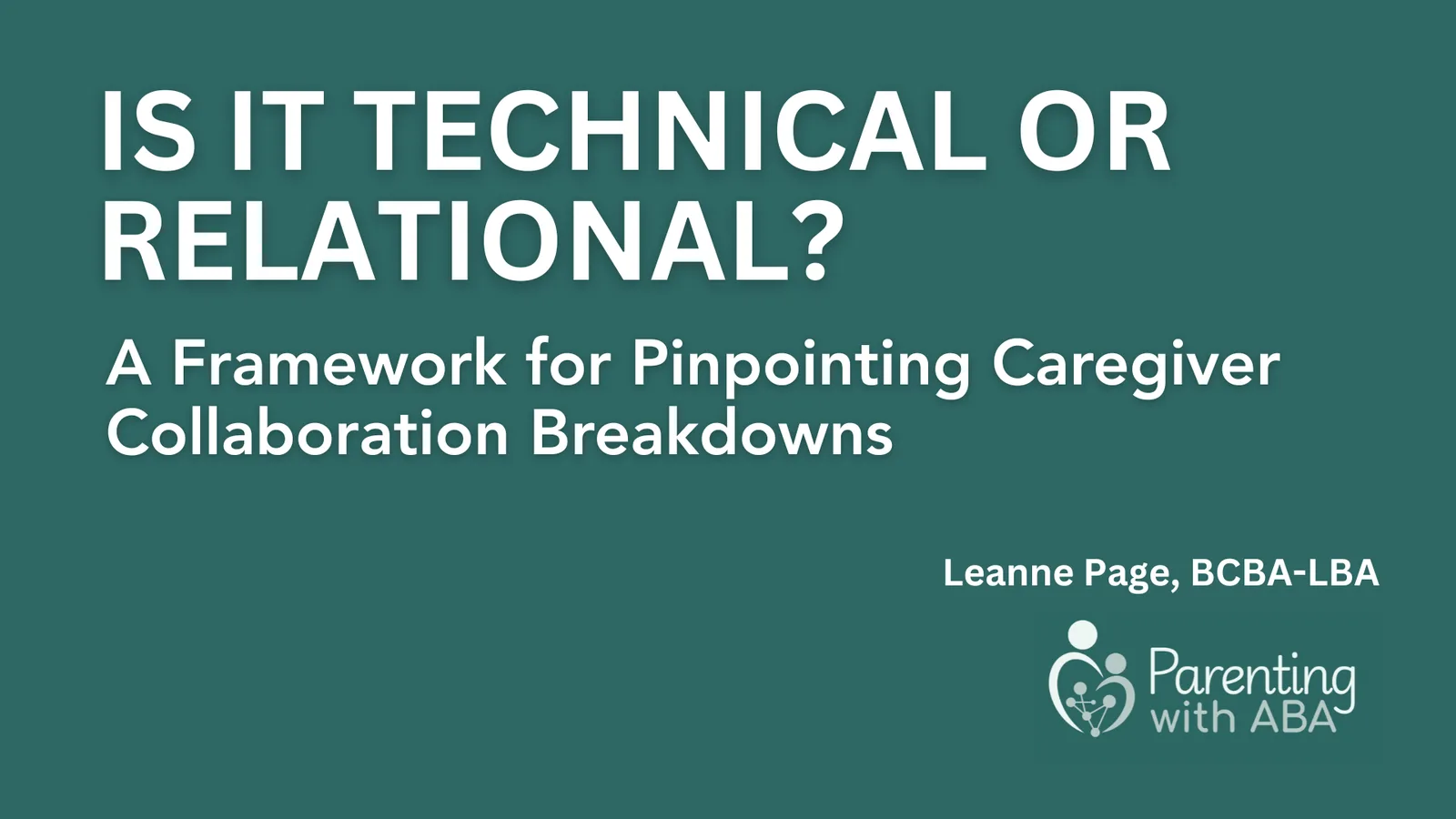
Is It Technical or Relational? A Framework for Pinpointing Caregiver Collaboration Breakdowns
Presented by Leanne Page
Caregiver treatment integrity remains one of the most persistent challenges in the delivery of applied behavior analysis (ABA) services, with follow-through breakdowns often attributed prematurely to skill deficits or insufficient caregiver training. This session presents a structured problem-solving framework designed to support behavior analysts in differentiating between technical barriers (e.g., skill acquisition deficits, environmental constraints) and relational barriers (e.g., caregiver buy-in, communication breakdowns, trust) that contribute to reduced caregiver follow-through. The framework guides practitioners through a systematic process for identifying the category of barrier present in a given case, selecting a response strategy aligned with that barrier type, and evaluating the social validity and feasibility of the proposed intervention for the family. Case studies representative of common caregiver collaboration scenarios are used to illustrate application of the framework across a range of presentations. Participants will leave with a replicable decision-making process for addressing caregiver follow-through challenges in a manner that is both clinically sound and responsive to family context.
Register free & watch nowCancel any time. Cert delivered to your inbox the moment you pass the quiz.
Learner ratings
from 82 learners
94% would recommend this CEU to other professionals in their field (82 responses)
About this CEU
When a caregiver isn't following through, the fix isn't always another reminder. This session gives BCBAs a framework for figuring out what's really behind the breakdown, technical or relational, so the response actually fits the problem.
From the talk
What was covered
A framework for telling technical caregiver barriers from relational ones. It matches each barrier to the right response.
- Replace "they don't follow through" with one question. Ask what is getting in the way for this caregiver right now.
- A plan that's too long, vague, or slow to pay off is a technical problem you control.
- Sort every follow-through breakdown into technical or relational before you pick a response. More training will not fix a trust problem.
- Open each caregiver session by naming the day's focus. Ask the caregiver to agree out loud.
- Build reinforcement (a reward that keeps behavior going) for the caregiver into the plan. A child's slow progress is rarely enough to keep an adult going.
- Give families a written, low-pressure way to say whether a plan is working. They should not have to say it to your face.
Why "They Don't Follow Through" Is a Dead End
Spend five minutes in any behavior analyst group online and the same line shows up. Parents don't follow through. Leanne Page opened this session by naming that habit directly, and then asking the field to quit it.
The complaint is not false. Caregivers really do struggle to follow a plan as written, and it happens often. The trouble is that "they don't follow through" is not an analysis. It is a label. It sounds like an answer, so the thinking stops right where it should start.
Page offered one question to put in its place. What is getting in the way for this caregiver right now? That swap does two useful things at once. It moves the problem off the caregiver's character. It also points you at something you can actually change. That something is your own behavior and your own plan.
Lack of follow-through, she said, is the tip of an iceberg. It is the part above the water. It is also the part we spend all our time complaining about.
What Counts as a Problem, in Behavior Analytic Terms
Page grounded the talk in Skinner's own writing on problem solving. Skinner wrote that behavior which solves a problem changes some other part of the solver's behavior. That behavior gets stronger when it does. He also wrote that a solution can come from direct shaping by contingencies (learning through rewards over time). Or it can come from rules built by the solver or by someone else.
She then quoted a 2018 article that put a sharper edge on the definition. A problem exists when there is an establishing operation (something that makes a reward matter right now). The current setting just does not pull out the behavior that earned that reward before.
Broken into plain parts, a real problem has three features. First, the target behavior (the behavior you're trying to change) is already in the person's repertoire (skills a person already has). Second, that behavior is scheduled for reinforcement: it does work, at least sometimes. Third, the stimuli in the current setting do not evoke it.
That third feature carries the whole talk. If the caregiver can do it, and doing it pays off sometimes, then the setting is the suspect, not the caregiver. You are not building a new skill here. You are trying to get a known skill to show up.
Four Places to Look Under the Iceberg
Page grouped the variables hiding under the water into four buckets. The list is not exhaustive, and she said so. It is there to get your wheels turning when a case is stuck.
Cognitive and emotional variables come first. Stress and burnout. Executive functioning (planning and follow-through skills) challenges. Statements of low self-efficacy (belief you can't do it), like "I can't do this" or "I'm not doing it right." A history of being blamed by professionals or by other family members. Caregivers may also be neurodivergent (having a differently wired brain) themselves, or carrying their own trauma history. We are careful about all of this for the kids. We are less careful about the adults.
Environmental and logistical variables are the easiest to spot. No routine or structure at home. Several children with competing needs. Work schedules. Plain time constraints.
Communication and relationship variables are quieter. Thin rapport. A language barrier. Discomfort asking questions. Page compared it to her own medical appointments. The doctor asks if she has questions, and she freezes. She thinks of all of them later, after she gets home. Plan-specific variables are the technical bucket: the plan is too complex, too slow to pay off, or unclear. She once had a graduate student bring her a caregiver behavior plan that ran 31 pages. She refused to read it. No parent was going to read it either.
There's just no structure. There's no routine.
From the talk — Leanne Page
Sorting the Barrier: Technical or Relational
All of those variables collapse into two piles. That split is the heart of the session.
Technical problems are skill problems. The plan is unclear. The caregiver is not fluent in the steps. Nobody ran behavior skills training (tell, show, practice, give feedback) with them. The next steps are ones our field is good at. Do more modeling. Run more reps together. Or change the plan itself: simplify it, change the prompting procedure (how you cue each step), or adjust what the child earns.
Relational problems are different. They sit in the therapeutic relationship (the working bond with a caregiver). Trust is thin. Buy-in was never really there. The caregiver does not feel safe telling you no. More training will not touch any of that, and repeating the plan louder makes it worse.
Page was blunt about why the second pile is harder for us. We were not trained in it. It is not on the test content outline. That does not make it optional. If you misread a relational problem as a technical one, you respond with more modeling. The caregiver nods again, and the data stay flat.
We're real good at the technical stuff.
From the talk — Leanne Page
Bond, Goals, and Tasks: The Relational Toolkit
Page kept the relationship content short but concrete. A therapeutic relationship has three parts: the bond, the goals, and the tasks. Each one gives you something to work on.
The bond is close to pairing (becoming linked with good things), but pointed at the adult. The therapist becomes a discriminative stimulus (a cue that signals reinforcement) for the client's behavior. So ask yourself a direct question. What do you want to be a signal for in caregiver sessions? When she asks that question in trainings, one answer she hears often is safety. She adds care, compassion, and partnership to that list too. Nobody says they want to signal a 31 page plan handed down from above.
Shared goals are the second part. Most parent training goals come from assessments and funding sources. That is reality. The work is turning them into something the caregiver actually cares about.
The third part is task agreement (agreeing on today's work together). It is the most portable idea in the talk. Page writes the session's focus on a sticky note and says it out loud at the start. We are here today to work on this. Do we agree? Sometimes the caregiver says yes. Sometimes they say yes, but the kid has not slept in a week, can we do that instead. Either answer is information. The note also gives you a kind way back when a session drifts. That includes topics outside your scope of practice (work your license covers).
I want to signal that this is a safe place.
From the talk — Leanne Page
The Five-Part Problem-Solving Framework
The framework itself has five parts. Page built it with her CE group about two years before this session and has used it across many cases. She was clear that it is a starting point, not a finished product.
Part one: pinpoint a target response (the specific behavior you want to increase). What caregiver behavior are you trying to increase? "Follow through" is not specific enough. Get nitpicky. Part two: hypothesize the contextual variables (things in the setting that might be driving this). What factors might be at play? This is a guess, and it is supposed to be. The four categories are there to seed it.
Part three: technical solutions. What in the plan do you control and can change? Treat it like a phase change (a planned shift you test on purpose) in a single case design (testing one change at a time). Then watch the data. Part four: relational solutions. What can you do to build trust, invite collaboration, or show empathy?
Part five: reinforcement for the caregiver. How will this adult contact reinforcement? The natural payoff is the child's progress. But progress is often slow. Small steps that thrill a behavior analyst looking at a graph may do nothing for a tired parent. Page also stressed that you do not have to work the list top to bottom. Start wherever something jumps out. Start at the shallow end.
This is not perfect. It is a start.
From the talk — Leanne Page
Four Cases, Four Very Different Fixes
Page ran four case studies through the framework. She disclosed up front that she wrote them with ChatGPT on purpose. She wanted the cases to stay far enough from the real families she has worked with. The disclosure is worth copying.
In the first, a team added a tacting goal (labeling things out loud) to play and mealtimes for a four year old in early intervention. The parents agreed, then stopped. At a check-in they said the child wakes for hours every night and they are in survival mode. The contextual variable is a flashing light: nobody is sleeping. The response is not more modeling. Put the tacting goal on hold, or shrink it. Work on the bedtime routine instead, and consider a referral. The new target response might be using a visual schedule (a picture chart of steps) at bedtime. Natural reinforcement for the caregiver is sleep.
In the second, a single mother working full time was asked to run a token board (a chart that earns rewards) during the morning routine. She forgets it, she is fielding work calls while dressing a toddler, and she apologizes for messing it up. The token system is fine. The timing is wrong. Keep the system, move it to another routine, and let her pick which one from a few options.
The third case is the clearest relational one. A grandmother raising her grandson nods along, says the plan is good, and keeps dressing him every morning. Asked gently, she explains herself. She raised four children and knows how to care for a child. Doing things for him is how she shows love, and she did not want to seem difficult. That is a values mismatch plus discomfort voicing disagreement. The fix starts with naming the shared goal. Ask her what being a good caregiver looks like to her. Then negotiate how long the wait should be, and how many steps it covers. In the fourth, a father who multitasks through sessions asks for short and sweet and admits he never looked at the sheet. Believe him. Cut the plan down.
The token system was a good idea. I'm so sorry I asked you to do it in the morning.
From the talk — Leanne Page
Giving Caregivers a Real Way to Say No
The last tool Page shared is a form she built for her own coaching. She has used it with behavior analysts for years. She calls it a good fit form, or social validity (does this fit the family) on the fly.
It lists the main variables that make plans hard, and gives three choices under each one. For time, the choices are: doable in the time I have, I need help finding the time, or there is no way I can find time for this. The caregiver checks a box. That is the whole design. It works on paper in the room, or as a form you send a few days later, once they have tried the plan.
The point is to replace the polite yes. We have all heard "got it, no questions" from someone who actually had questions. Or from someone who knew right then that the plan was never going to happen. Checking a box is easier than saying it to your face. Page framed it as the same thing we teach kids. Give them a way to ask for a break. Then they do not have to escalate to get one.
She tied it back to power. By the time a family reaches you, they have been through pediatricians, psychologists, therapists, schools, and maybe other providers. Their learning history may put professionals up high and parents down low. You may not be creating that dynamic, but you inherit it, so say the team part out loud.
You don't have to look me in the eyeball and tell me you don't have time.
From the talk — Leanne Page
Common questions
How do I tell if a caregiver problem is technical or relational?▾
Ask whether the caregiver could do the plan well if they wanted to and had the time. If the steps are unclear, unpracticed, or too long, that's technical. Training or a simpler plan is the answer. If they can do it but are not, look at trust and buy-in. Also check their values, and whether they ever really agreed to this goal.
What do I do when a caregiver keeps saying yes but nothing changes?▾
Treat the yes as unreliable data, not as agreement. Give them a written, low-pressure way to say a plan will not work. Use a checkbox form with options such as "I need help finding the time." Send it a few days after they have tried the plan, and ask what part to fix.
Is building a relationship with a caregiver just pairing?▾
Page's answer was yes, and more than that. You want your presence to be reinforcing, and you become a signal for what happens next in a session. Beyond that, the therapeutic relationship also has shared goals and task agreement, which pairing alone does not cover.
What if my hypothesis about the barrier is wrong?▾
That is expected, and it is why the step is called a hypothesis. You change one variable, then watch whether the caregiver's behavior moves. If nothing changes, stop pushing that path. Test a different one instead, the same way you would read a phase change in single case data.
How do I keep a parent coaching session on topic without shutting the caregiver down?▾
Start the session by naming the focus out loud. Ask the caregiver to agree, ideally with it written where you both can see it. When the conversation drifts, acknowledge what they raised. Point back to what you both agreed on, and offer to work the other issue another time. It also gives you a clean exit when a topic falls outside your scope.
About the speaker
Leanne Page is a BCBA who runs Parenting with ABA, where she provides continuing education and caregiver support resources for behavior analysts. She does private parent coaching now. Earlier she worked in clinic-based and in-home settings, after starting her career as a special education teacher. She is also an author, including the book Parenting with Science. She opens her sessions and coaching calls with a short present moment practice.
This summary was generated from the recording’s transcript. Quotes are taken word for word from the talk.
What you'll learn
- 11. Participants will be able to recognize the different types of barriers that drive caregiver follow-through struggles in ABA service delivery
- 22. Participants will be able to differentiate technical challenges from relational ones in caregiver collaboration, and match each to an appropriate response
- 33. Participants will be able to apply a structured problem-solving framework to case-based data to generate socially valid response strategies
Concepts in this CEU
Course materials
Related talks
Talks that cover the same concepts
Toward an Evidence-based Supervision Model: Training Students in Independent Fieldwork
Willow Mentorship & Consulting, LLC
Compliance to Commitment: Seven Habits of the Highly Effective Caregiver Trainer
The Behaviorist Bookclub

Supervising Beyond Technical Skills: Professionalism, Communication, and Clinical Judgment
The Behaviorist Bookclub

Press Pause: What the RBT 40-Hour Training Was Really Meant to Do
Bowsprit Consulting LLC
Shaping Behavior Change when ADHD is in the Picture
The Behaviorist Bookclub
From Hours to Competence: Assessing and Developing Supervisee Skills
The Behaviorist Bookclub
More from Parenting with ABA
OpenCEU is supported by advertising from third-party sponsors. Sponsors are clearly labeled, have no influence over course content, instructors, or CEU decisions, and never appear on certificates. The BACB does not sponsor, approve, or endorse OpenCEU sponsors or their products.