Compassionate Collaboration: Building Caregiver Buy-In, Not Compliance
Free · 1 Learning CEU · 4.8★ from 164 attendees
Caregiver non-participation in behavior intervention plans is frequently attributed to resistance or lack of motivation, yet growing evidence points to relational and communication-based variables as primary drivers of caregiver disengagement. This session presents a structured, evidence-informed framework, CARES (Check-in, Acknowledge, Reflect Together, Explore Options, Set the Next Step), for building caregiver collaboration grounded in the therapeutic relationship. Drawing on the behavioral conceptualization of the therapist as a discriminative stimulus for client behavior (Follette, Naugle, & Callaghan, 1996), the framework emphasizes that practitioner behavior directly influences caregiver responsiveness, positioning the therapeutic relationship as a mechanism of behavior change rather than a secondary consideration. Participants will examine how divergent stakeholder perspectives and the practitioner's own learning history can function as barriers to a strong working alliance, and will be introduced to the concept of task agreement, the explicit, ongoing clarification of roles, goals, and expectations between behavior analyst and caregiver, as a means of sustaining collaboration beyond the initial intake. The session also addresses practical strategies for adapting behavior plans to align with caregiver values, routines, and realistic capacity, with emphasis on evidence-based communication techniques that reduce caregiver defensiveness and promote active participation. Participants will leave with an applied framework for increasing caregiver buy-in and follow-through across diverse family contexts.
Claim your certificate as soon as you pass the quiz.
Presented by Leanne Page
Learner ratings
from 164 learners
99% would recommend this CEU to other professionals in their field (164 responses)
“I like the examples provided to think about how this could apply to my own parent collaboration meetings.”
— Kaygan N.“Great content- super helpful and useful!”
— Kelsey E.“Great material even though I had trouble with the playback. This is the second ceu through this platform that has had technical issues”
— Catherine L.“It was amazing! I love the compassionate side of ABA and enjoy hearing proffesionals explore that.”
— Tzippy P.
About this CEU
Behavior plans only work if caregivers actually use them, and too often the plan that looks perfect on paper falls apart at home. That's often because every caregiver is standing on a different part of the beach ball, seeing the situation from their own angle, and a plan that ignores that rarely survives contact with real life. This session introduces the CARES framework (Check-in, Acknowledge, Reflect Together, Explore Options, Set the Next Step), a five-step approach for building genuine caregiver buy-in instead of surface-level compliance. You'll learn evidence-based communication strategies that strengthen the caregiver relationship, plus how to adapt behavior plans to fit each family's real values, routines, and capacity, so collaboration actually sticks.
Abstract
Caregiver non-participation in behavior intervention plans is frequently attributed to resistance or lack of motivation, yet growing evidence points to relational and communication-based variables as primary drivers of caregiver disengagement. This session presents a structured, evidence-informed framework, CARES (Check-in, Acknowledge, Reflect Together, Explore Options, Set the Next Step), for building caregiver collaboration grounded in the therapeutic relationship. Drawing on the behavioral conceptualization of the therapist as a discriminative stimulus for client behavior (Follette, Naugle, & Callaghan, 1996), the framework emphasizes that practitioner behavior directly influences caregiver responsiveness, positioning the therapeutic relationship as a mechanism of behavior change rather than a secondary consideration. Participants will examine how divergent stakeholder perspectives and the practitioner's own learning history can function as barriers to a strong working alliance, and will be introduced to the concept of task agreement, the explicit, ongoing clarification of roles, goals, and expectations between behavior analyst and caregiver, as a means of sustaining collaboration beyond the initial intake. The session also addresses practical strategies for adapting behavior plans to align with caregiver values, routines, and realistic capacity, with emphasis on evidence-based communication techniques that reduce caregiver defensiveness and promote active participation. Participants will leave with an applied framework for increasing caregiver buy-in and follow-through across diverse family contexts.
Credits
1 CEU · 50 min
From the talk
What was covered
The CARES framework for real caregiver buy-in: check in, acknowledge, reflect together, explore options, set the next step.
- Trade the word compliance for treatment adherence, then look at the relationship instead of the family's motivation.
- Open every session person to person. Ask how the caregiver is doing, and ask again if they answer about the child instead.
- Thank caregivers when the homework did not happen. That honesty is the best data you will get.
- Walk in with one goal and two pathways instead of a finished plan. Let the caregiver pick the path.
- Give caregivers a written way to say no thank you. Then find out which part of the plan the no is about.
- Close with one small action step and a one to ten confidence check before you leave the room.
Why Caregiver Follow-Through Breaks Down
Open almost any online group for behavior analysts and you will find the same post. Parents are not following through. Parents are not doing what they agreed to do. Leanne Page named that pattern early, then set it aside. She is not interested in compliance (doing what you are told). She is interested in treatment adherence (actually using the plan at home). The word swap matters. It changes where you look for the problem.
She borrowed an image from the book Fierce Conversations. Picture a beach ball with colored stripes. Everyone in the meeting came for the same child. That group might include the BCBA (board certified behavior analyst), both parents, the grandma, the nanny, and the techs on the case. But each person stands on a different stripe. The view from the red stripe is not the view from the green stripe. No one is wrong. They are just looking from somewhere else.
Page uses the beach ball as a visual prompt for herself. Before she talks, she pauses and asks which stripe this caregiver is standing on. A plan written from one stripe only rarely survives a real Tuesday morning. She also said she prefers parent coaching or caregiver support over parent training. Funding sources still use the older term. The words we pick shape how a parent hears us.
We are all standing on our own stripe of a beach ball.
From the talk — Leanne Page
The Therapeutic Relationship as a Mechanism of Change
Page drew on a 1996 paper by Follette, Naugle, and Callaghan for this idea. Their point is that the relationship is not a nice extra. It is part of how behavior changes. Your behavior as the practitioner shapes how the caregiver responds. Their behavior shapes yours right back. The session is a context both people build together.
That paper describes the therapist as a discriminative stimulus (a cue that signals what comes next) for client behavior. So Page asked the room a blunt question. What do you want to be a cue for? When you sit down at that kitchen table, what does your arrival signal? Attendees filled the chat with words like relief, support, hope, safe space, and acceptance of their child. Then she flipped it around. Picture the parent on the other stripe of the beach ball feeling that.
This idea sets up everything after it. If your presence predicts judgment and a long list of demands, follow-through gets harder. If your presence predicts relief and help, the plan has a real chance.
A Therapeutic Relationship is a two way street.
From the talk — Leanne Page
Two Learning Histories Sit in Every Meeting
Page named two barriers to a strong working alliance (a solid working bond with someone). The first is your own learning history (everything you have lived through before now). Caregiver support is not on the exam content list. It is not required in many supervision programs. Whether you were trained well often depends on who signed your hours. Many of us also carry hard moments. Page described walking into a district that families were already suing, during her first year as a teacher. She also described a parent who thought she was the secretary. That parent let her have it when she tried to talk about the case. Those reps follow you into the next meeting.
The second history belongs to the caregiver. Think about what it took to reach your session. A diagnosis. Probably a wait list. Pages of reports about what their child cannot do. Insurance funded services often run on a deficit based model (you must prove what is wrong to get help). Many families have also cycled through school meetings, occupational therapy, physical therapy, and speech. By the time they sit with you, almost every meeting has started with data on deficits.
Page also pointed to data from the BACB (Behavior Analyst Certification Board) on ethics complaints. She flagged that she wanted to double check the exact numbers. Her read was that complaints are more likely to come from stakeholders like parents and schools than from other certificants (other certified behavior analysts). She quoted Carnegie on the fix.
It is more important to be interested.
From the talk — Leanne Page
CARES Steps One and Two: Check In and Acknowledge
CARES stands for Check-in, Acknowledge, Reflect Together, Explore Options, and Set the Next Step. Page uses it as the actual structure of a coaching session. She was honest about why she built it. As a new BCBA she taught, taught, and taught some more. She poured out every bit of jargon she had just studied. Notice where teaching sits in CARES. It does not start until the E.
Check-in means connecting as one human to another, not as an expert on a pedestal. Ask open questions. How was your week? What is one small win, even a tiny one? Page told a story about a mom she had coached for months. She asked how things were going. The mom talked about the child. Then the other kids. Then the rest of the family. Page had to use her name and ask again. How are you? The mom said no professional had ever asked her that.
She also builds a topic bridge into check-in. For a session on routines, she asks which part of the day feels like the same argument every time. That is a warm question and a data gathering question at once. Acknowledge comes next. Reinforce the fact that this caregiver showed up at all. If they say the homework did not happen, thank them for telling you. Now you can adjust. Page keeps validation stems handy too: that makes sense, given this. You are clearly putting a lot of thought into this.
I want to praise the effort, not the outcome.
From the talk — Leanne Page
Reflect Together: OARS, the WAIT Reminder, and Jargon
Reflect Together is where Page spends most of her session time. The move is problem solving with the caregiver instead of handing over a finished plan. Almost every prompt on her slides was a question. What parts of the plan feel doable? What parts do not? If you could change one thing, what would it be? Walk me through that part of the day like I am watching a video.
She borrowed OARS from motivational interviewing (a way of talking that builds willingness to change). O is open-ended questions. Asking if someone had a good week gets you a shrug. Asking for the highs and lows gets you information. A is affirmations, including small concrete ones. I noticed your child looked right at you when you walked in. R is reflections, or reflective listening (saying back what you heard). It sounds like after school is different every day, and that is when the meltdowns hit. Is that right? S is summarizing. Pull the threads together before you move on.
Reflecting also fixes a listening problem. When a conversation feels high stakes, our brain races ahead to what we will say next. Page keeps a note on her laptop that reads WAIT, for why am I talking. She also built a replacement behavior (a new habit to replace the old one) for filling silence. She takes a drink from a cup, often an empty one. A spoken prompt works too: let me think. Long silences are fine. That is when the caregiver thinks.
On language, Page said the research cuts both ways. Jargon (technical words from our field) belongs in treatment planning and in talking with each other. It belongs much less at a kitchen table. She showed a chart from a 2016 study. It asked the general public to rate words as pleasant or unpleasant, and motivating or not. General science and psychology terms landed in the pleasant and motivating quadrant. Behavior analytic terms had nothing there. She also quoted the book Ask Powerful Questions.
What if we started speaking less in periods?
From the talk — Leanne Page
Explore Options: Two Pathways Instead of a 30-Page Plan
Only here does teaching begin. Page was clear that she is not telling you to wing it. She comes prepared. But she has also seen a 30 page plan written for a parent. She came back to that example more than once. Her middle ground is one overarching goal with two pathways that get there.
Then you offer the choice out loud. I have two approaches that I think would work for your family. Here is what each one looks like. Which feels more natural to you? What do you want to try first? If neither fits what you heard during check-in and reflection, build a third. Choice is not a courtesy. It is how a plan gets small enough to actually happen.
Her routines toolkit shows the shape of this step. It walks through behavior skills training (explain, model, practice, give feedback) for teaching a routine to a caregiver. Then it hands the caregiver real decisions. Which time of day? Two steps or three? With a song or with pictures? Do we bring the kids into planning it? Many small choices, all inside the same goal.
Instead of prescribing a fix, offer choice.
From the talk — Leanne Page
Fitting the Plan to Caregiver Values and Real Capacity
Page shares a tool she calls the Good Fit Questionnaire. She sends it as a simple form. It has six categories, and each one gives the caregiver three answers. On time: this feels doable, I need help finding the time, or there is no way. On comfort: I feel good, the training was unclear, or this makes no sense and we need something else. The purpose is to give the parent a way to say no thank you. Not while sitting across from you, nodding.
She compared it to a doctor asking if you have any questions. You are overwhelmed, so you say it sounds good. Then you get home and all the questions arrive. An attendee asked the practical follow-up. What do you do when the answer is no? Page said find out what the no is about. If it is comfort, you owe them modeling and reps. If it is time, you shrink the plan. Three steps becomes one step this week. Then you shape it up (reinforce small steps toward the goal).
Values are the other half of fit. Page described values as qualities that matter to a person in a way that is basic to who they are. One definition she shared calls them freely chosen, verbally constructed, dynamic and evolving, and intrinsically reinforcing. She noted that Skinner wrote about values too. Her favorite way to surface them is the three wishes question. What are three wishes you have for your child? For your family? For yourself? Practitioners she works with use it on intake forms and in quarterly planning.
She then walked a made-up case to show how fast this can work. One paragraph described a parent who reads widely about gentle parenting and nervous system regulation. That parent tenses up when staff say compliance or report on instructions followed. The plan goals were not bad goals. Follow one step instructions with 80 percent accuracy. Sit in a group for five minutes. The mismatch was still obvious. Page reworded them. The new version read: following familiar adult guidance in safe, low demand moments. Another goal became helping the child feel confident responding to people they trust. Same skills. Different frame. She did not even need the three wishes form to see it.
Values are qualities that are meaningful and important.
From the talk — Leanne Page
Set the Next Step So the Week Actually Starts
Do not end a session with goodbye. End with one clear action step the caregiver agreed to. Page uses three questions. What is one small thing you will try this week? How will you know it went well? How would you like me to check in? You agreed at the start on what you were there to do. Agree at the end on what happens next.
She writes action steps in three sizes: small, medium, and stretch. You pick based on what you heard about capacity. A stretch step might be planning a three step routine with the child and running it most days. A small step might be one mini routine, like washing hands before dinner. Then she runs a confidence check. How doable does this feel, one to ten? If the answer is a four, fix it before you walk out the door. Not next week.
Near the close, Page brought in the medical literature from the book Compassionomics. She shared one study by Harvard and Stanford researchers. It looked at the functional status (what people can do for themselves) of older hospitalized patients. The physicians said the same words and gave the same treatment. What changed was nonverbal behavior: leaning toward the patient, less distance, eye contact instead of typing, smiling and nodding. Outcomes improved. How you sit in the room counts. She left the group with one line: listen with the same passion you want to be heard with.
What's one small thing you're going to try this week.
From the talk — Leanne Page
Common questions
What does the CARES framework stand for?▾
CARES is Check-in, Acknowledge, Reflect Together, Explore Options, and Set the Next Step. Leanne Page uses it to structure every caregiver coaching session, not just a first intake. Teaching does not start until the E, after you have built the relationship.
How is caregiver buy-in different from compliance?▾
Compliance means a caregiver does what you told them to do. Buy-in means the plan fits their values, routines, and capacity, so they keep using it when you are not there. Page frames the goal as treatment adherence that grows out of partnership, not pressure.
What is the Good Fit Questionnaire?▾
It is a short form Page sends to caregivers, with six categories like time and comfort. Each category offers three answers, including a clear no. The point is to give caregivers a safe way to say a plan will not work. Otherwise they may nod along in a meeting and never use the plan.
What do I do when a caregiver says the plan will not work?▾
Find out which part the no is about. If it is comfort, you need modeling and practice reps with feedback. If it is time, cut the plan down, even to one step this week. Build back up from there.
Should I avoid ABA jargon with parents?▾
Page noted the research supports both sides, so there is no simple rule. Technical language has a place in treatment planning and in talking with other analysts. With caregivers, it is different. She showed a 2016 study where the public rated behavior analytic terms as neither pleasant nor motivating. That is a strong reason to translate your language.
How do I stop talking so much in coaching sessions?▾
Page keeps a visible note that says WAIT, meaning why am I talking. She also uses a replacement behavior (a new habit to replace the old one) for filling silence, like taking a sip from a cup. A spoken prompt works too, such as let me think. Silence gives the caregiver room to think and answer.
About the speaker
Leanne Page is a BCBA (board certified behavior analyst), an author, and the founder of Parenting with ABA. She provides private pay parent coaching there. Page has been certified for about fifteen years. She has also been an ACE (approved continuing education) provider for ten years. She started her career as a special education teacher. From there she moved into clinical and director level roles. In this session she taught the CARES framework she uses to structure her own caregiver coaching sessions. She also covered the communication tools and fit questions behind it.
This summary was generated from the recording’s transcript. Quotes are taken word for word from the talk.
What you'll learn
- 1Participants will describe evidence-based communication strategies that promote collaboration with caregivers.
- 2Participants will demonstrate how to adapt behavior plans to align with caregiver values, routines, and realistic capacity.
Concepts in this CEU
Course materials
Sign in and register for this course to download these files.
Related talks
Talks that cover the same concepts

From Parent Training to Parent Coaching: A Coaching Curriculum for BCBAs Who Want to Work With Families
The ABA Collective, LLC.
Compliance to Commitment: Seven Habits of the Highly Effective Caregiver Trainer
The Behaviorist Bookclub

Beyond the Caseload: Ethics of Coaching, Consulting, and Private Services
The ABA Collective, LLC.

From Expert to Guide: Motivational Interviewing Skills for BCBA Coaches
The ABA Collective, LLC.

Building Rapport: A Listen Goes a Long Way
Rooted Consultation, LLC
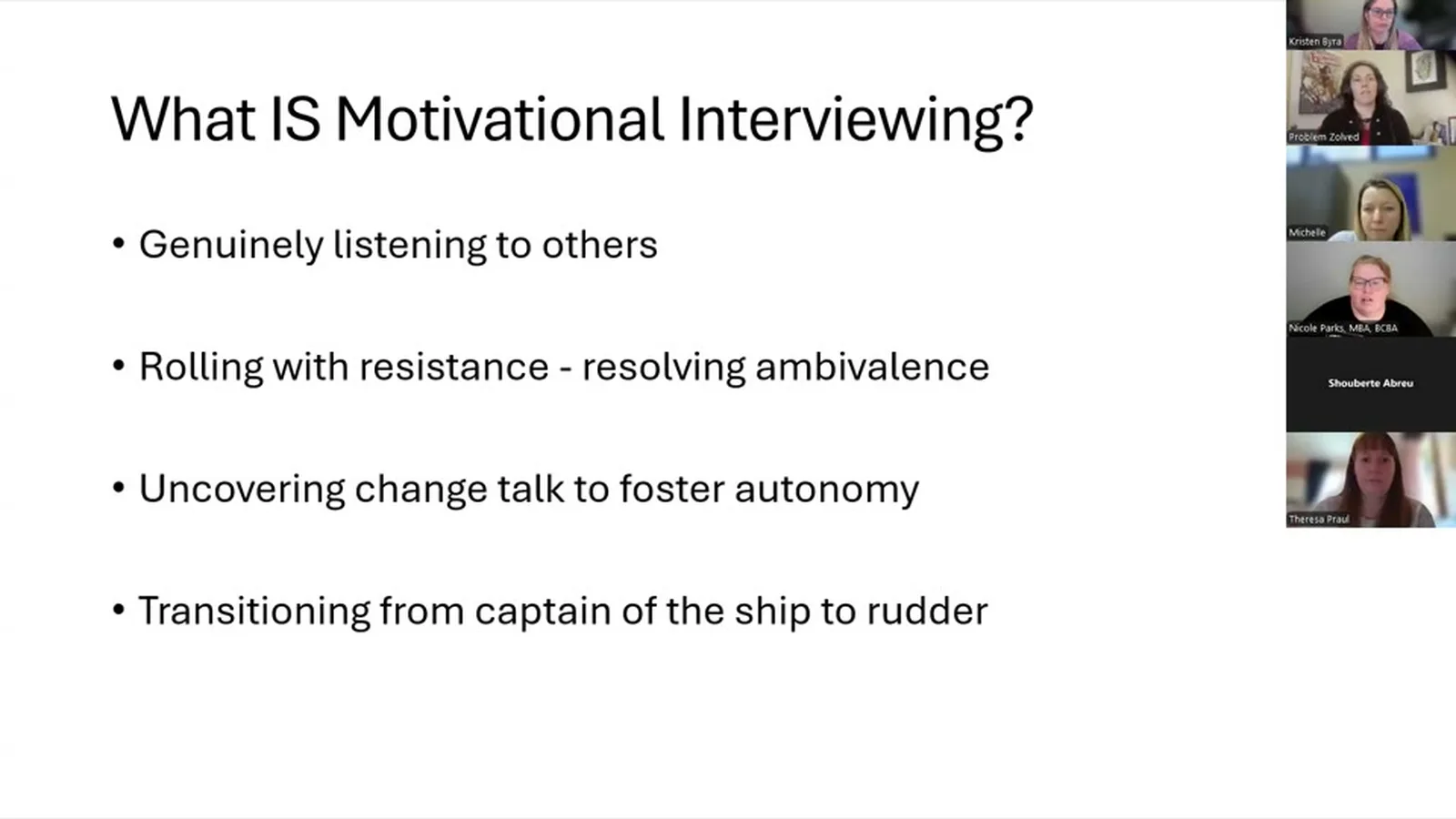
Motivational Interviewing Across Treatment Team Members
Upskill ABA
More from Parenting with ABA
OpenCEU is supported by advertising from third-party sponsors. Sponsors are clearly labeled, have no influence over course content, instructors, or CEU decisions, and never appear on certificates. The BACB does not sponsor, approve, or endorse OpenCEU sponsors or their products.