Open the Door: Low Dosage ABA as an option
Presented by Nicole L. Stewart
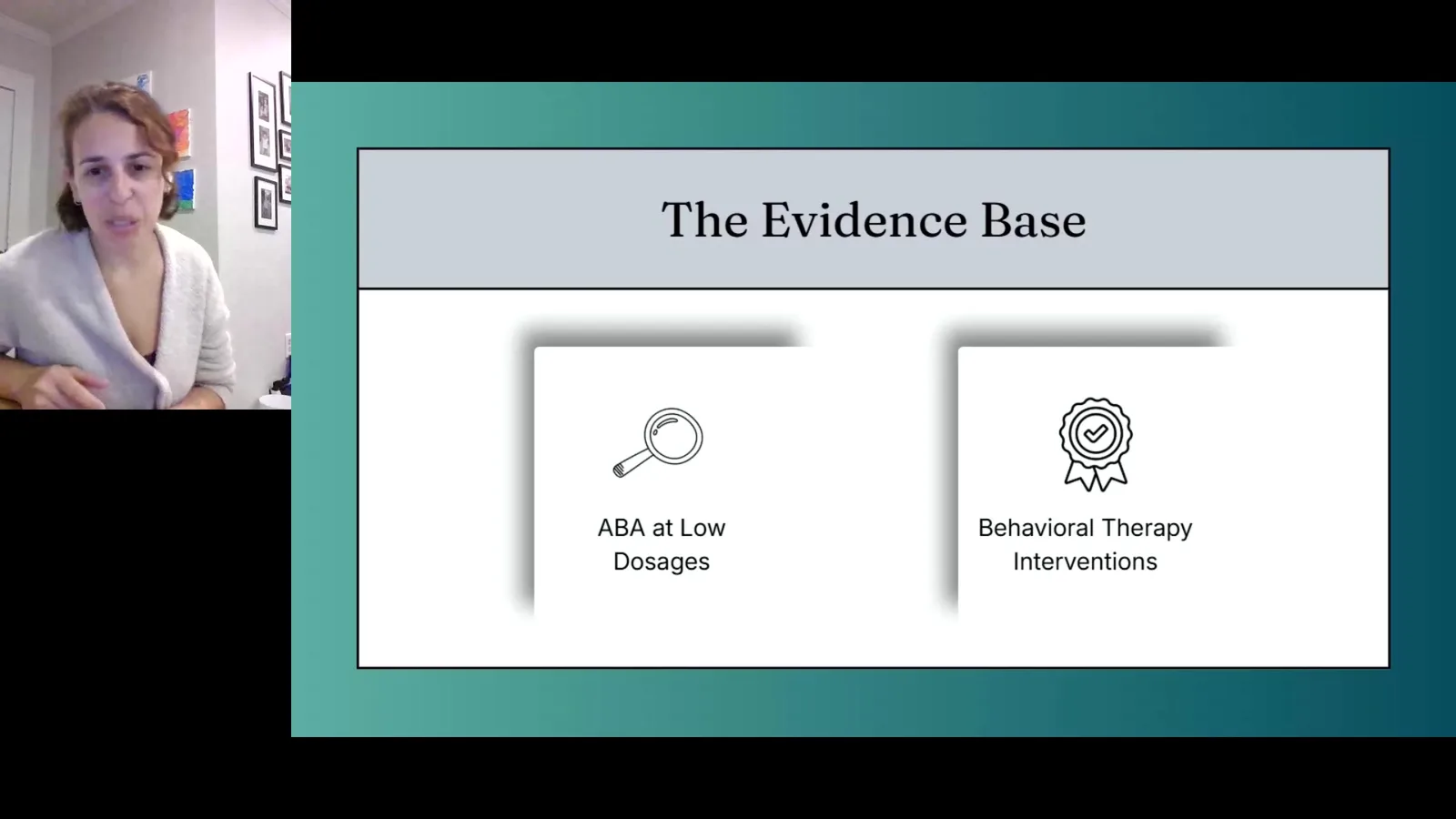
I used to believe that ABA was something that needed to be done in high quantities. I worked in educational settings where ABA equaled school for the kids who really needed it. Then, when I veered into the medical model, I found a lot of struggles that made me question the established truth: Does ABA always have to be at least 10 hours per week in order to be effective? My own private practice showed me proof otherwise. A 4 year old who could carry on a full conversation after 6 months of 30 minutes a week of ABA therapy with me, over Zoom. A family who could take their child out to dinner with a plan to circumvent meltdowns in the restaurant following biweekly parent coaching. A 10 year old who could break down social miscues and take perspective, along with alternative solutions, after months of 1 hour a week of behavioral therapy. So what if everything we thought we knew was not the full picture? This session goes into what the dosage research really says, why the field's numbers don't hold up the way we've been told, and why it's worth considering a practice built around lower hours, without cutting corners. High intensity ABA is still the right choice for many kids and many ABA professionals. But if you've ever wondered about the people it leaves out, this session is for you. And if you've ever wondered why the "right" number of hours always seems to match what insurance will reimburse, you're not imagining it. Disclosure statement: I will mention my ABA Private Practice Masterclass during this presentation.
Sign in to buy — $12One-time purchase, permanent access. Cert delivered to your inbox the moment you pass the quiz.
About this CEU
I used to believe that ABA was something that needed to be done in high quantities. I worked in educational settings where ABA equaled school for the kids who really needed it. Then, when I veered into the medical model, I found a lot of struggles that made me question the established truth: Does ABA always have to be at least 10 hours per week in order to be effective? My own private practice showed me proof otherwise. A 4 year old who could carry on a full conversation after 6 months of 30 minutes a week of ABA therapy with me, over Zoom. A family who could take their child out to dinner with a plan to circumvent meltdowns in the restaurant following biweekly parent coaching. A 10 year old who could break down social miscues and take perspective, along with alternative solutions, after months of 1 hour a week of behavioral therapy. So what if everything we thought we knew was not the full picture? This session goes into what the dosage research really says, why the field's numbers don't hold up the way we've been told, and why it's worth considering a practice built around lower hours, without cutting corners. High intensity ABA is still the right choice for many kids and many ABA professionals. But if you've ever wondered about the people it leaves out, this session is for you. And if you've ever wondered why the "right" number of hours always seems to match what insurance will reimburse, you're not imagining it. Disclosure statement: I will mention my ABA Private Practice Masterclass during this presentation.
From the talk
What was covered
Why ABA defaulted to high hours, what the dosage research really shows, and how a low hours practice can work.
- Check whether your agency's 10 hour minimum comes from the funder or from your own business model. Insurers do not set that floor.
- When you read a dosage study, separate gains on scored tests from gains in curriculum steps completed. More hours mostly buys more steps.
- Screen your referral list for children who were turned away for wanting fewer hours. Think through what it would take to serve them directly.
- Measure generalization (using a skill outside the session) and family reports, not just mastery during the session, since time is short.
- Drop the tiered model (a BCBA supervising technicians who see clients) for low hour cases. A technician seen 45 minutes a week still needs full supervision.
- Name the research gap out loud. No published study tests a one hour per week ABA package. Many single tactics do have support on their own.
How High Hours Became the Default Dose in ABA
ABA did not start as autism treatment. Skinner published The Behavior of Organisms, and the field began naming the principles of behavior. In the 1960s the first applied programs ran in inner city community spaces. One was the Juniper Gardens Children's Project. It worked with families in low income neighborhoods. Staff taught parents to use reinforcement (adding something good after a behavior) instead of punishment. They taught teachers antecedent modification (changing things before behavior starts), such as shortening transitions between activities. Fewer gaps meant fewer chances for problem behavior. They also used peer tutoring to help with school work.
None of that was autism only. None of it used high dosage (many therapy hours each week). None of it used a tiered model. In 1968 the first issue of the Journal of Applied Behavior Analysis appeared. It gave the field its seven dimensions. Not one dimension names an hour count. Stewart counted the articles in that first issue. Ten ran, and one mentioned autism. Autism was not a formal diagnosis until 1980.
She then sampled one issue of the journal per decade and read who the participants were. For about forty years, autism participants sat between zero and twenty percent. Between the 2006 and 2016 issues, that share jumped to fifty or sixty percent. As she put it, if that were a client graph you would ask what changed. What changed was funding. In 2007 Ryan's Law passed in South Carolina. It required insurers to cover behavioral therapy for children diagnosed with autism by age eight. Other states copied the template.
By 2014, Medicaid had to cover autism treatment, naming ABA explicitly. The DSM had already widened the autism definition in 2013. Around the same time, the BACB released early treatment guidelines. Those guidelines were written to protect consumers from insurers cutting supervision and training. Over time, people read them as a description of how ABA must be practiced. Research followed the funding, and the funding followed the diagnosis.
Many early ABA programs looked more like educational models and training models to implement the principles of behavior.
From the talk — Nicole L. Stewart
What the Dosage Studies Actually Measured
The 1987 Lovaas study is the one everyone cites. It used three groups: 40 hours of ABA, 10 hours, and no one to one ABA. All the children had an autism diagnosis and were preschool age. Forty seven percent of the 40 hour group reached what the study called normal functioning. The study defined that by IQ and school placement. The 10 hour group hit zero percent. The group with no one to one ABA hit two percent. Each group held about 19 children, so those percentages describe very few kids.
There are bigger problems. The 40 hour group included aversives (painful or unpleasant consequences) and physical punishment. The other groups did not. We do not know how the 10 hour group would have scored under the same conditions. The sessions were run by highly trained clinicians, not by a tiered staff. Treatment integrity (how closely a session follows the plan) was high in a way most agencies cannot match today. So the study does not describe the model it is used to defend.
A later meta analysis (a study that pools other studies) looked at 341 children receiving five to 40 hours a week. More hours produced better scores on every measure used. Stewart's reaction was that this is obvious. Practice golf for ten hours a day and you will beat your old self. The real question is what the scores counted. A 2020 study compared about 10.5 hours a week with about 5.5 hours. The higher hours group moved further through the curriculum. Adaptive functioning (daily life skills a person uses) showed no difference.
The more time you spend on something, the more things you're going to check off.
From the talk — Nicole L. Stewart
The Business Math That Keeps Low Hours Off the Table
Dose is not only a clinical choice. It is a revenue choice. A 20 hour client funds a practice in a way a one hour client cannot. To replace one 20 hour client you need twenty clients at an hour each. Fixed overhead does not shrink with the hours. Twenty short cases mean more scheduling, more paperwork, more intakes, and more families to bill. A canceled Monday cannot slide to Tuesday when Tuesday is already full.
The staffing math is worse. Most agencies break even on BCBA time and earn on technician hours. Short sessions do not suit that structure. If a session is 45 minutes, every minute has to land. That means a technician needs as much training as before, or more, spread over many more cases. Stewart was blunt that supervising a caseload like that would be hard, slow work. The tiered model is not built for it.
Here is the part worth repeating to your leadership team. Insurers do not require ten hours a week. They track utilization (how many approved hours get used), and they prefer to pay less. Ten hour minimums come from agency policy, not from the funder. Stewart does not call that wrong. She asks agencies to attract the families who actually need that level, instead of fitting every referral into one model. A family pushed into hours they did not want is a family that disengages.
Our behavior goes where reinforcement flows.
From the talk — Nicole L. Stewart
Who Gets Left Out When High Hours Are the Only Door
A study by Choi and colleagues followed about 4,100 children. Only 28 percent received the full recommended dose. Two thirds stayed in ABA for twelve months, meaning a third left inside the first year. Of those who left, only 14 percent left because they met their goals. Fewer than half stayed two years, and only 21 percent of those exits were goal related. The rest were money, logistics, or families deciding to stop. A separate study in North Carolina and Northern California found only 15 percent got their full dose.
Thirty percent of children with autism receive no therapeutic services at all. Access is also geographic. Research by Yingling and colleagues found that as of 2021, 46 counties in the United States had zero BCBAs. Families also face copays, deductibles, and travel. A single parent with other children cannot always host someone in the home for twenty hours. Some families hold cultural beliefs that do not fit a long weekly program. Some simply want their kid to play baseball.
Then there are the children who never qualify. A child can score as adaptive on a standardized measure (a scored test that compares children) and still melt down nightly. Children with ADHD, anxiety, or no diagnosis at all rarely get behavioral support. Those families do not stop looking. They hire coaches with little or no training, or they get services that do not match the need. Stewart frames that as the ethics problem. It is about benefit, dignity, and advocating for appropriate services, not just caseload design.
families are not accessing ABA when their only option is high hours.
From the talk — Nicole L. Stewart
What the Evidence for Lower Hours Inside ABA Says
A 2022 study by Ostrovsky reviewed one organization's own records. It covered 178 clients, ages three to seventeen, receiving between four and 40 hours a week. The team compared scores on the Vineland (a standardized scale of daily living skills) taken every six to twelve months. They found no statistical difference in gains between lower and higher doses. That matters because this was a regular ABA agency using a tiered model, not a boutique practice.
A 2010 study by Peter Sheffers and colleagues looked at a 6.5 hour program for preschoolers. Children attended preschool and then received a little over an hour a day of one to one ABA. The comparison group received no treatment. Progress was tracked with the Vineland and the Bayley scales (a test of early child development) in two month blocks. The treatment group showed significant gains across dimensions. The 2020 comparison of 10.5 and 5.5 hours fits the same pattern: more hours moved curriculum, not adaptive scores.
Stewart is careful about the limit here. Most of her own clients see her about an hour a week, and no study tested that package. What the field does have is strong evidence for the parts. We have research showing a parent trained to use a token board (a chart for tracking earned rewards) uses it. We have a 1986 article on a short parent training program that got a child flossing. We have decades of work showing individual tactics teach skills. Honesty about this gap is stronger than overclaiming.
We don't have any research that shows that it's effective at one hour a week.
From the talk — Nicole L. Stewart
What Behavioral Therapy Outside ABA Adds to the Case
Our science shows up in other fields under other names. Margaret Sibley, a PhD researcher, built a program called STAND. It runs ten weeks, one hour per week, with caregivers and teenagers. The content is behavioral parent training and operant strategies (using consequences to change behavior). It includes contingency management (rewards tied to target behavior) and monitoring of target behaviors. It adds motivational interviewing (talk that builds willingness to change) to get teens engaged. Teens build their own plans, rewards, and self management systems.
The solutions teens reported look familiar. Putting assignment notes at the front of a folder lowers response effort (how hard a task feels to start). Teaching parents a different response cuts prompt dependency (waiting for help before acting). Four years later, 81 percent of teens said they were more organized than they felt before. Seventy six percent reported more knowledge. Both motivation for self management and self acceptance rose by 57.1 percent. Ask yourself how many ABA studies measure self acceptance.
In 2026 a government funded review examined behavioral therapy for children with disruptive behaviors. It pooled 64 randomized controlled trials (people assigned to groups by chance) covering more than 7,500 preschool and school age children. Short structured parent programs showed moderate strength evidence of real improvement. Programs where parent and child were coached together, such as PCIT, produced the largest effect in the whole review. Children with symptoms but no formal diagnosis improved as much as diagnosed children. That field never treated more hours as the default path.
We are positioned to provide support to so many people who are not yet receiving it.
From the talk — Nicole L. Stewart
Funding, Assessment, and Data in a Low Hours Practice
Most low hours work is private pay. That removes the red tape around which goals count as medically necessary. It also opens the door to clients with ADHD, anxiety, or no diagnosis yet. Rates tend to sit near what other private providers in your area charge. Grants are an option. So are school based roles where a BCBA does direct work on regulation and coping, not just consultation. Insurance is possible too. Stewart reports that low hour requests draw fewer peer reviews than requests for 30 or 40 hours.
Assessment should narrow, not sprawl. If you bill insurance, you will need a standardized tool, and she uses the Vineland. Outside of that, pick assessments that target the actual deficit: executive function, social skills, or emotional regulation. The BRIEF (a questionnaire that rates executive function) and the Parenting Stress Index both come up in her work. Add informal baselines, parent and teacher interviews, and stress indicators. For children with ADHD, ODD, or demand avoidant profiles, she points to Ross Greene's collaborative and proactive solutions (solving behavior problems together with the child).
Data should get simpler, not heavier. Trial by trial sheets fit a dense program, not a 45 minute week. A cumulative record (a running count that only goes up) of parent reported wins is often the better tool. Track whether bedtime went well, again, and again. Build social validity (does this matter to the family) into your measures. Mastery is not the skill in session. It is the skill used at home when the child is upset, with the parent in the room.
I want to see that they are using it with their family.
From the talk — Nicole L. Stewart
Choosing Tactics and Deciding Who Runs the Session
Any ABA tactic can fit a short session. Discrete trial teaching (short drills repeated many times) is one option. Task analysis (breaking a skill into small steps) and token economies (earning tokens to trade for rewards) are two more. The filter is time cost. If a child hates drills, spending the hour building tolerance for drills is a bad trade. Stewart treats these sessions like batting practice for the real game. She leans on pairing (making yourself worth working with) and shaping (reinforcing small steps toward a goal). Natural environment teaching (teaching skills during normal play), games, and client choice carry a lot of the work.
Narrow the target list. Two or three goals per week, worked hard, beats a forty goal program delivered in pieces. Skills get recycled and leveled up rather than retired. Identifying an emotion this week becomes naming its cause next week. Because the clock is short, planning matters more and improvising matters more.
This is also why she runs sessions herself. Skills move fast and demand in the moment decisions that technicians are not trained to make yet. A technician seeing a child 45 minutes a week would still need full supervision, which erases the savings. Direct BCBA work puts behavior analysts in the same lane as speech, occupational therapy, physical therapy, and social work. The tiered model stays valid for the families who need it. Not every behavior analyst has to supervise to practice.
you really have to pick the tactics that are going to match the child and match the goals.
From the talk — Nicole L. Stewart
Common questions
Do insurance companies require at least 10 hours of ABA per week?▾
No. Insurers do not set an hours floor, and they generally prefer to pay for less. Ten hour minimums are agency policies, often set so the business model works. Insurers do track utilization, which is why agencies tend to request on the high side.
Is there research showing one hour a week of ABA works?▾
Not for a full one hour per week treatment package. The closest evidence compares doses like 5.5 versus 10.5 hours, or four versus 40 hours. Gains in adaptive functioning come out similar either way. Individual tactics, like parent training on a specific routine, do have support at low hours. Be honest with families about where the line sits.
Does more ABA always produce better outcomes?▾
More hours reliably produce more progress through a curriculum, which makes sense. The picture is weaker for daily life skills and quality of life. One organization's review of 178 clients found no statistical difference in Vineland gains between low and high doses. The measure you choose shapes the answer you get.
Why can't an existing ABA agency just add low dosage clients?▾
The economics do not transfer. Twenty one hour clients require far more scheduling, billing, and intake work than one twenty hour client. Overhead does not shrink to match. Short sessions also need heavily trained staff, while most agencies rely on technician hours for margin. It is usually a different business, not an add on service line.
Who is a good fit for a low dosage ABA practice?▾
Clinicians who want to do the direct work themselves rather than supervise. It suits people with an entrepreneurial streak and often a niche, such as sleep, toilet training, or executive functioning. It also fits settings where high hours are not available at all, including counties with no BCBAs.
About the speaker
Nicole L. Stewart is a behavior analyst who has worked in the field since 2006, with a teaching background and experience that predates insurance mandates for ABA. She runs a private practice outside New York City where she delivers direct behavioral therapy herself, often around an hour a week, to children with autism, ADHD, and no diagnosis at all. She studies the dosage literature closely and teaches other behavior analysts how to build practices outside the high hours medical model.
This summary was generated from the recording’s transcript. Quotes are taken word for word from the talk.
What you'll learn
- 1Identify the historical, regulatory, and economic factors that established high-intensity treatment as the assumed default dosage model in ABA, independent of clinical necessity. Evaluate the strength of evidence behind lower-dosage ABA, distinguishing outcomes on standardized measures from outcomes measured by curriculum completion. Apply behavior-analytic principles and low-dosage research to service design decisions for building or restructuring an independent ABA practice.
Related talks
Talks that cover the same concepts

Article Club: Cultural Awareness for Behavior Analysts
Achieve Behavior Partners

Rad N Bad: The Healthcare Fortress — Interdisciplinary Integration, Rational Therapeutics, and Ethics in ABA
Hickory Learning Group

Rad N Bad: The Other Side of the Table — Ethical Failures, Compassionate Care, and Consumer Realities in ABA
Hickory Learning Group

Rad N Bad: The Dosage Dilemma — Contingency, Evidence, and Ethics in ABA Treatment Intensity
Hickory Learning Group

Harm Reduction Within ABA Practice
The Behaviorist Bookclub

Roadmapping: A Guide to Lasting Independence
Hickory Learning Group
OpenCEU is supported by advertising from third-party sponsors. Sponsors are clearly labeled, have no influence over course content, instructors, or CEU decisions, and never appear on certificates. The BACB does not sponsor, approve, or endorse OpenCEU sponsors or their products.