Motivational Interviewing Across Treatment Team Members
Presented by Kelly Brzak, BCBA
Motivational Interviewing is a very effective practice for addiction cessation, weight loss, and other types of behavior change. It is an excellent catalyst for increased caregiver buy-in. Correctly used, motivational interviewing takes the guessing out of naturally occurring reinforcement contingencies, leading to more effective skill generalization for your clients.
Register free & watch nowCancel any time. Cert delivered to your inbox the moment you pass the quiz.
About this CEU
Motivational Interviewing is a very effective practice for addiction cessation, weight loss, and other types of behavior change. It is an excellent catalyst for increased caregiver buy-in. Correctly used, motivational interviewing takes the guessing out of naturally occurring reinforcement contingencies, leading to more effective skill generalization for your clients.
Credits
1 CEU · 59 min
From the talk
What was covered
A BCBA's guide to motivational interviewing with caregivers, techs, and teachers: draining the swamp, change talk, and ORS scripts.
- Offer closed-off caregivers 15 minutes once a week instead of a long meeting once a month. Then show up every single week.
- Use ORS (open questions, affirmations, reflections, and summarizing) to keep people talking until patterns and themes show up.
- Drop "I think" from your statements and start with "you" so the focus stays on the other person's situation.
- Ask caregivers to rate their motivation for a goal from one to three. Do this before you write the goal into the plan.
- Stop writing generic caregiver goals and write what the family actually named as their biggest problem.
- Be ready for what surfaces: trauma, abuse, or suicidal talk means you refer out or make the mandated report.
What Motivational Interviewing Is, and Where It Came From
Motivational interviewing (talk that builds a person's own reasons to change) did not start in our field. It grew out of work on addiction cessation (helping people quit), weight loss, and health goals. Kelly Brzak, BCBA, first learned it at a workshop soon after she became an analyst. The trainer there framed it as a tool for quitting smoking and for eating better.
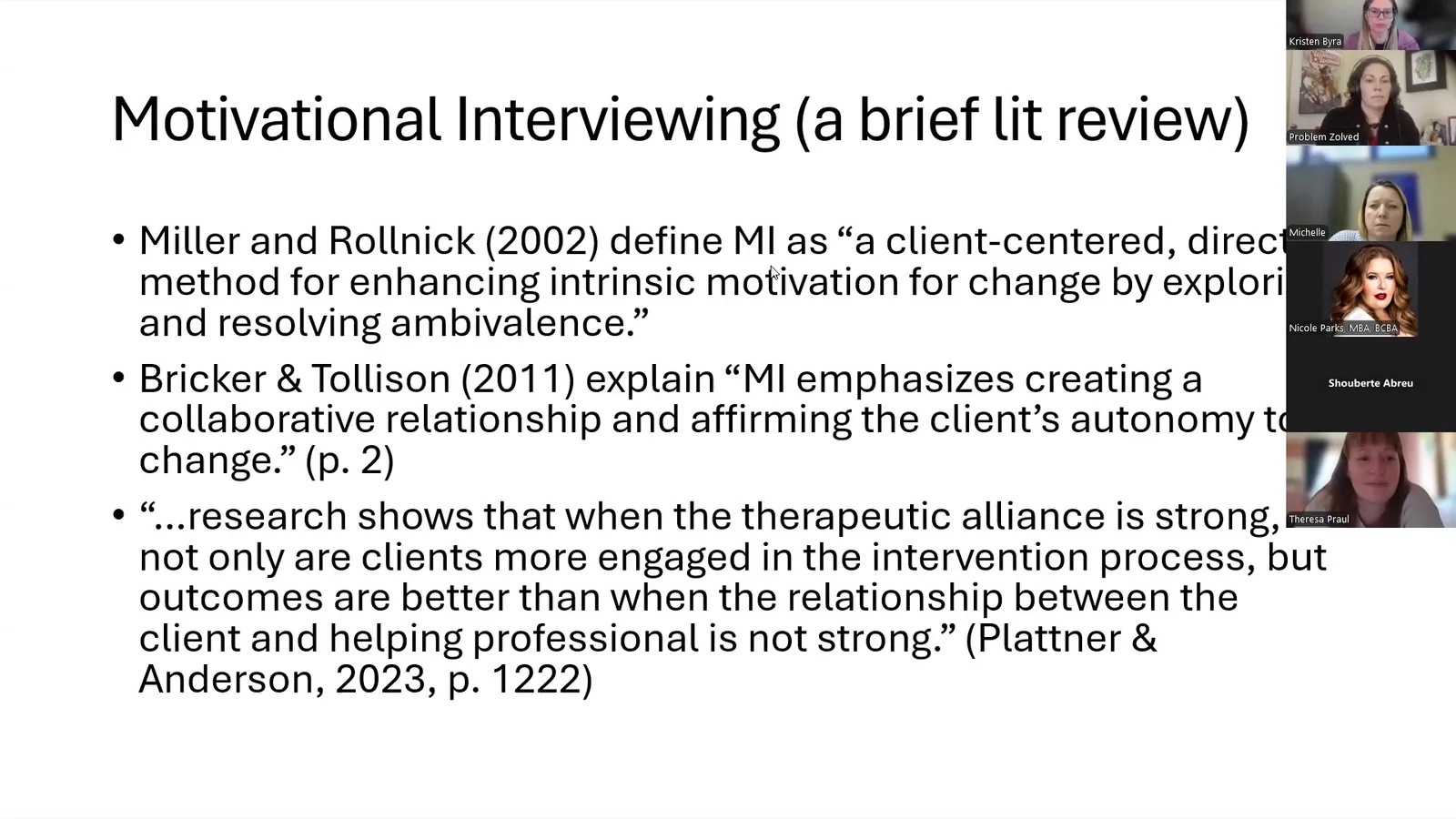
The definition she shared is short. It is a client centered method for enhancing intrinsic motivation (a person's own drive) for change. It rests on a working, shared relationship. It also protects the person's autonomy (their right to choose). Kelly noted that research is clear on one point. When the therapeutic alliance (the trust between you and them) is strong, people engage more and outcomes are better.
The core skills fit into one short word: ORS. That stands for open questions, affirmations, reflections, and summarizing. The stance behind those skills is the hard part. You roll with resistance instead of pushing back with what you think is clinically needed. You sit with ambivalence (mixed feelings about changing) instead of arguing it away. You go looking for the person's why.
Kelly used a boat image to make it land. Stop acting like the captain of the ship. Be the rudder. The caregiver steers. Your job is to find where their motivation already points, then help aim it.
Motivational interviewing is genuinely listening to others.
From the talk — Kelly Brzak, BCBA
Why MI Belongs in a Behavior Analyst's Toolkit
Some people think behavior analysis and motivational interviewing are a poor match. Kelly disagreed and pointed to an article that links the two directly. She also pointed to recent writing by Plattner and Anderson. Their argument is that adding MI to graduate coursework could help fix gaps in the field. Right now, most of us are not explicitly trained in it.
The clinical payoff is easy to name. MI helps you line up family values with your treatment goals. It helps you pinpoint how motivated a caregiver really is to work on a goal. It helps you spot resistance to change before it quietly sinks a plan. Kelly said it also helped her pair better with clients.
There is a bigger reason it matters to our work. Draining out a family's story exposes naturally occurring reinforcement contingencies (rewards already built into daily life). Once you know what the family cares about, you stop guessing. You can pick goals that daily life will keep reinforcing after you drive away. That is how you get real generalization (skills that hold up in new places and with new people).
What's the point of beautiful treatment goals if nobody's working on them when you're not there?
From the talk — Kelly Brzak, BCBA
Draining the Swamp: How to Get Caregivers Talking
Draining the swamp is Kelly's name for the main move in MI. You get the other person talking, then you keep them talking. Ask an open question. Affirm what they say. Reflect it back. Summarize it. Then let them keep going. This does not happen in one meeting. You will see these people again, so spread it out.
Take notes while they talk. Notes keep you engaged, and they tell the person that their words matter. Expect the story to wander. A caregiver may bring up last week's lunch date. They might mention a nightmare from earlier in the week or a vacation they're looking forward to. Listen for patterns, current themes, and statements that keep coming back.
Not everyone talks easily. Kelly said the most closed off people often need this the most. Some are hiding behind trauma. Some want to give up. Some are used to being alone with it, and some do not trust the system. Her advice is to meet them where they are at. Offer 15 minutes once a week, then show up. Shelve your agenda. If you sit there reading six clinical bullet points, that person shuts down further.
For quiet caregivers, use a set rotation of questions. What was the best part of your week? What was the worst part? Is there anything you want to talk about today? Then walk through a short list: school, arriving on time, and doctor appointments. Ask about sleep, diet, other therapies, toileting accidents, the new puppy, and the new bike. Write the list out. It can easily fill the whole 15 minutes.
Draining the Swamp works to help caregivers experience being heard.
From the talk — Kelly Brzak, BCBA
Listening for Change Talk, and What Else Comes Up
Once people talk, you start to hear change talk (words that show a person is ready for something different). Kelly shared the kinds of lines to listen for. "I'm at my wit's end." "Something has to go." "Our family isn't going to make it." "I feel like giving up." "I need to yell less." "My life would be better if." Each one is a door. Each one can point your plan in a better direction.
Trust has to come first. Kelly called it the antecedent (the thing that has to happen first) for this kind of talk. People do not walk up to a new analyst and share the heaviest parts of their history. You have to show that you actually care, and that takes repeat visits.
Draining the swamp is a double edged sword. You may uncover trauma. You may uncover abuse. You may hear something that means you call a mandated reporting agency. Treat your role as a mandated reporter (your legal duty to report harm) seriously. If a caregiver talks about suicide or suicidal ideation (thoughts of suicide), refer them out at that moment.
You will also learn why your old advice never stuck. Say a caregiver does not trust the system. If six months of goals have gone nowhere, that distrust may be the whole answer. Better to find out in week two than in month eight.
If you look and listen closely enough, you will find the key to ultimate skill generalization.
From the talk — Kelly Brzak, BCBA
What Motivational Interviewing Is Not
Kelly drew a hard line around what does not count. It is not telling people your opinion. It is not telling them how it should be. It is not gossiping about a caregiver or teacher who does not follow through. It is not blaming your technician for slow skill acquisition. And it is not judging a family because their cultural values differ from yours.
She also warned against assuming you already know someone's culture or values. Those values may not match what you were taught is best practice. That is uncomfortable, and it still has to be respected when you are working inside someone's home.
MI is also not ACT (a therapy based on acceptance and values). Kelly called the two together the sweet spot of values-based care. Her clearest warning came from that first workshop. The trainer described a man who went to a doctor for help with his health. The doctor was so curt and judgy that the visit had the opposite effect. The man was less able to help himself. Judgment has to go out the window.
It is not explaining yourself again, but in a different way.
From the talk — Kelly Brzak, BCBA
ORS Scripts You Can Use This Week
Open questions do the heavy lifting. Kelly offered plain ones you can ask a teacher, a parent, a sibling, or a client. "What is your favorite or least favorite part of your job?" "How many students do you have?" "What do you do for fun?" "What do you like to do with your brother or sister?" "Do you like therapy?" With a very stressed caregiver, she sometimes asks, "What do you do for yourself?" That one often gets a laugh, and the laugh breaks the ice.
Affirmations can be short and obvious. "You work really hard." "I can tell you care about what you do." "You seem very passionate." "You're a very kind big brother." Practice them first so they sound genuine instead of flat.
Reflections name the other person's reality. "Your job is very demanding." "Wow, there are a lot of kids in this class." For a related service provider with 30 minutes a week, try: that's got to feel tight. For a sibling: being a big sister sounds stressful. Notice what these lines leave out. None of them start with "I think" or "I just want you to know." Start with you and their situation instead.
Then summarize what you heard. "It sounds like you're really stressed out." "It sounds like some things are working and some are not." Take a risk and name the elephant. Say something like: I think you're saying that maybe ABA is not a good fit for your family. If someone pushes back and says the job is easy, that is not a loss. Kelly called it a call and response. Offer another line and keep going.
Sometimes stating the obvious is helpful.
From the talk — Kelly Brzak, BCBA
The 97156 Problem: You Cannot Interview Someone You Never Meet
Kelly built her case on one number. She cited the Central Reach autism and IDD report. It showed that only 20% of authorized 97156 hours (the billing code for caregiver guidance) were used at the start of last year. That left more than 800,000 hours unused. She said she had to sit in silence for a while after reading it. No MI strategy helps a caregiver you never sit down with.
Her scheduling advice is simple. Ask for 15 minutes. She has heard that an hour a month is the ideal, but she prefers a short, steady weekly check-in. Build the habit first. Then stretch the time later. Ask who else could join: an aunt, a grandma, dad, an older sibling.
If scheduling is hard, go harder. Otherwise the caregiver's pattern of not scheduling becomes escape maintained (behavior that gets someone out of something). Kelly was honest that this stings. She has been stood up. She has been ghosted. She still presses and tries again. One provider on the call shared a story about a staff member. That person valued her most for one plain reason: she came every single week. Showing up is the intervention people notice.
I've found the most success with parents that say they're too busy by just asking for 15 minutes.
From the talk — Kelly Brzak, BCBA
Writing Caregiver Goals Families Will Actually Do
This is where MI changes your paperwork. Kelly and the host both pushed back on the generic caregiver goal. One example is having a parent learn the key principles of ABA. When you ask why it is in the plan, the answer is often the same: that is just what we always do. Nobody buys into a goal that is not important to them. One fast fix: ask the caregiver how motivated they are on a scale of one to three. One means not really. Three means they wanted to start last week. That score gives you a baseline before you pick targets.
Then put what they named into the plan, in their words. Confirm it out loud later. Did I get this wrong? This was our goal, right? Kelly said that humility is what keeps the relationship real. Ask what the family wants to start first, and trade commitments instead of assigning homework.
One attendee described a stronger version of informed consent. Lay out three options for a problem. For each option, state what the family would be committing to. Note what it would change in their schedule, and what outcome is likely. Add your recommendation, then let them choose. Compare that to a plan a parent signs without reading. Kelly's toilet training example makes the stakes clear. Say a six year old needs toilet training, but nobody will run it when you are gone. You need to know that before you spend your technician's hours on it.
Kelly also checks her own blind spots with short surveys for caregivers and technicians. She asks whether her BCBA considers family values and preferences. She asks whether they could tell her they disagree with a goal. She asks whether they feel heard and valued. She has used surveys like these for about eight years. One catch she named: a family cannot disagree with goals they were never shown. Make sure everyone knows the goals, then ask for their vote.
So whatever you can do to get additional input about motivation before you start treatment goals, that part is very important.
From the talk — Kelly Brzak, BCBA
Common questions
What is motivational interviewing in ABA?▾
It is a client centered way of talking that builds a person's own motivation to change. In ABA, it is most often used with caregivers, technicians, teachers, and sometimes older clients. The core skills are open questions, affirmations, reflections, and summarizing. The goal is to find what already matters to the person and connect your treatment goals to it.
What does "draining the swamp" mean in motivational interviewing?▾
It means getting someone to talk freely and then keeping them talking across many short meetings. You ask open questions, affirm, reflect, and summarize so they keep going. While they talk, you listen for patterns, repeated phrases, and recurring themes. Those patterns point to the values and daily rewards that will support a goal after you leave.
How do I use MI with a caregiver who barely talks?▾
Meet them where they are at and keep it short. Kelly suggested offering 15 minutes once a week and then showing up consistently. Shelve your clinical agenda for that meeting, because reading off bullet points makes a guarded person shut down more. Work through a steady list of simple topics: school, sleep, diet, appointments, other therapies, and anything new at home.
What is change talk and what does it sound like?▾
Change talk is any statement that shows the person is ready for something different. Lines like "I'm at my wit's end," "something has to go," or "I need to yell less" all count. Trust usually has to come first, because people do not share this at a first meeting. When you hear it, use it to pick and prioritize goals.
Is motivational interviewing the same as ACT?▾
No. Kelly described them as different approaches that work well side by side. She called the two of them together the sweet spot of values-based care. MI focuses on drawing out a person's own motivation to change.
How does MI connect to 97156 utilization?▾
MI only works if you actually meet with caregivers, and those meetings are usually billed under 97156. Kelly cited a Central Reach report. It showed that only 20% of authorized 97156 hours were used at the start of last year. That left over 800,000 hours unused. Her fix is to ask for short, steady meetings, invite other family members, and keep rescheduling when people cancel.
About the speaker
Kelly Brzak, BCBA, owns Problem Solved, a consultation and training company. She came to behavior analysis from education and psychology, and she taught general education plus reading and math intervention before this work. In this talk she shared how motivational interviewing changed her pairing, her caregiver meetings, and the way she writes caregiver goals, drawing on about eight years of using feedback surveys with families and technicians.
This summary was generated from the recording’s transcript. Quotes are taken word for word from the talk.
What you'll learn
- 11) Gain insight about premise and practice of motivational interviewing 2) Determine whether MI is relevant to your BA practice 3) Review practical application strategies for technicians, caregivers, and multi-disciplinary collaborators
Related talks
Talks that cover the same concepts
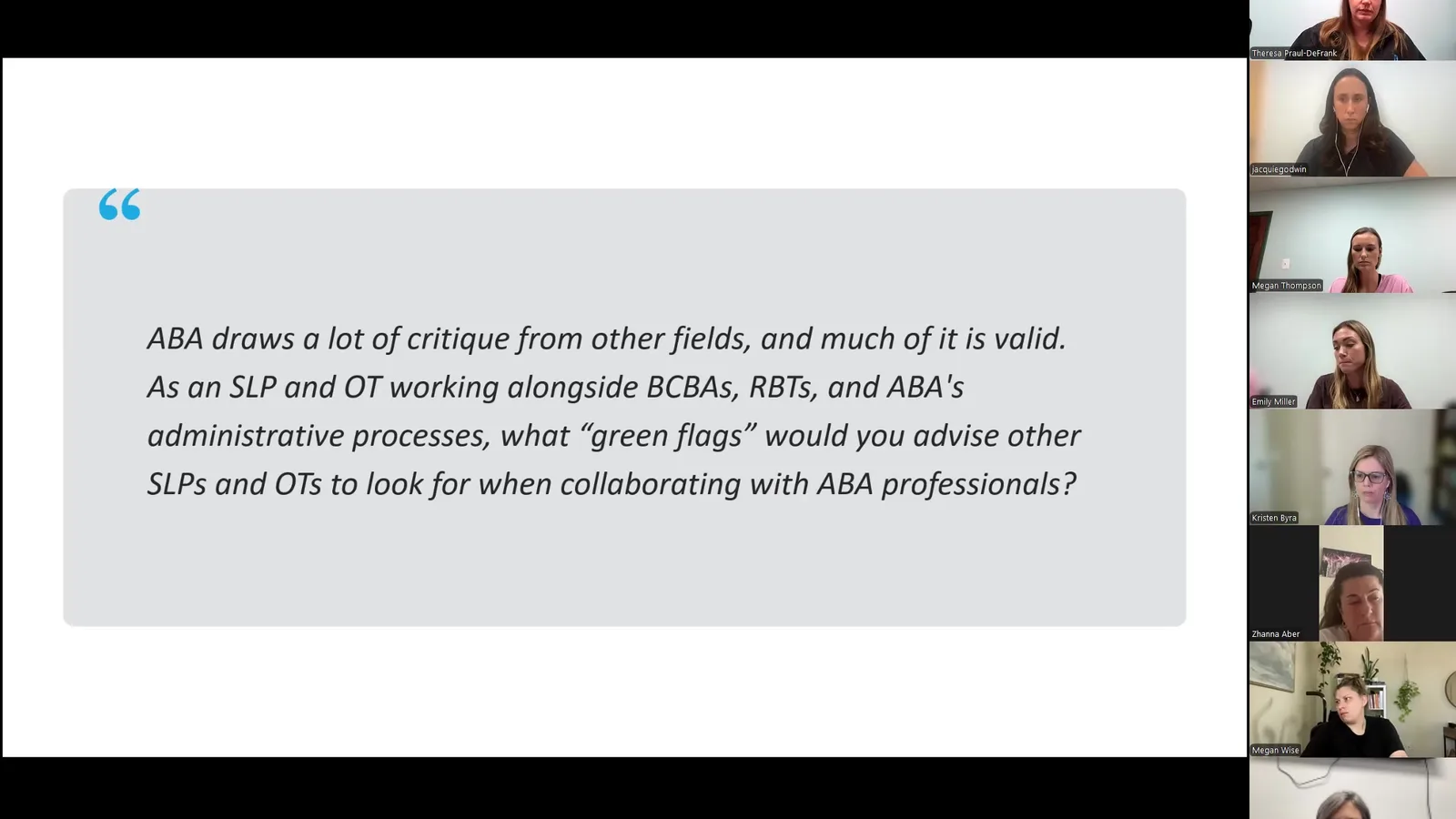
A Panel on Collaboration in Practice: SLP, OT & ABA Services
Upskill ABA
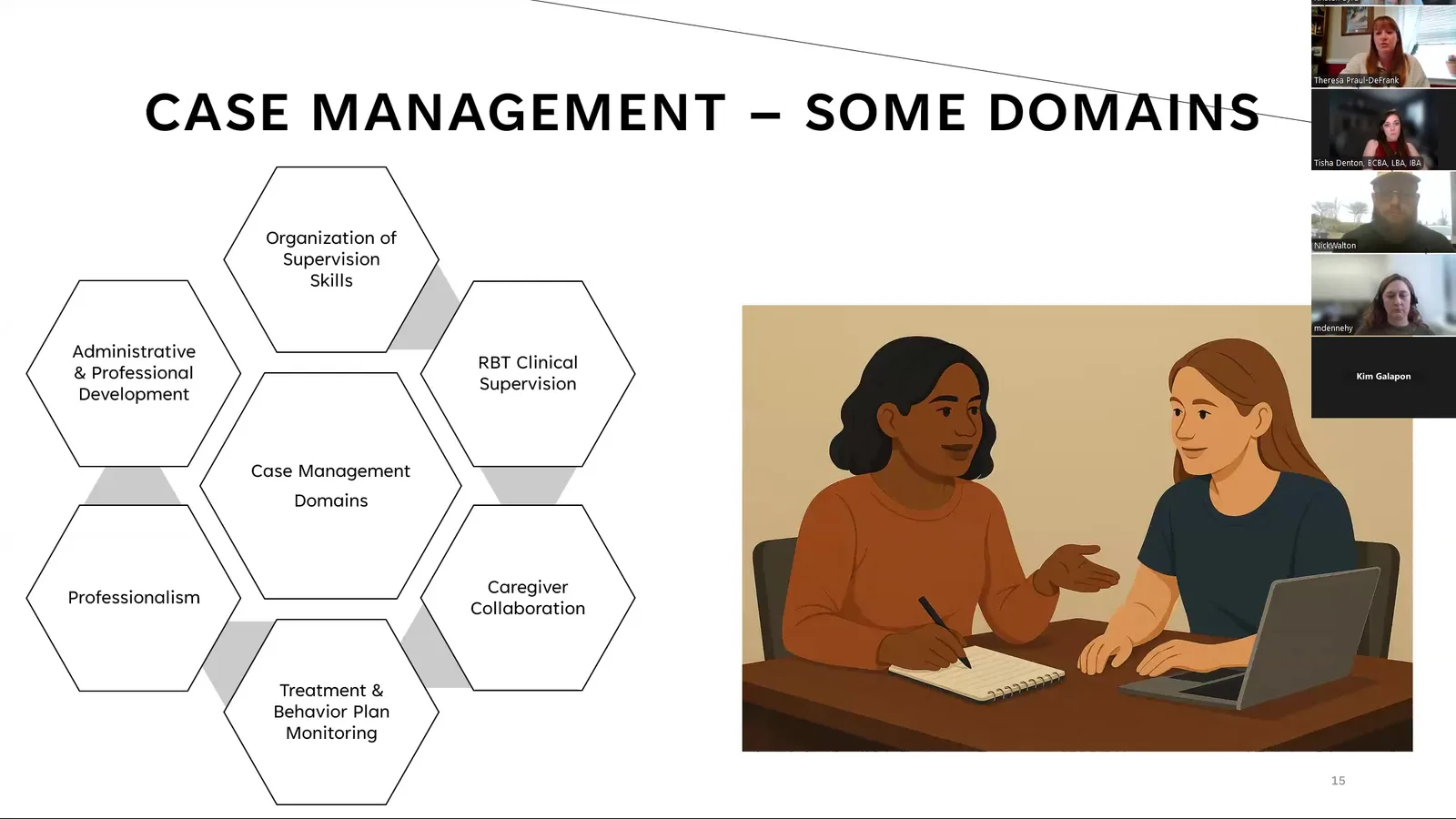
From Peer to Professional: Becoming & Supporting Early Career Behavior Analysts
Upskill ABA
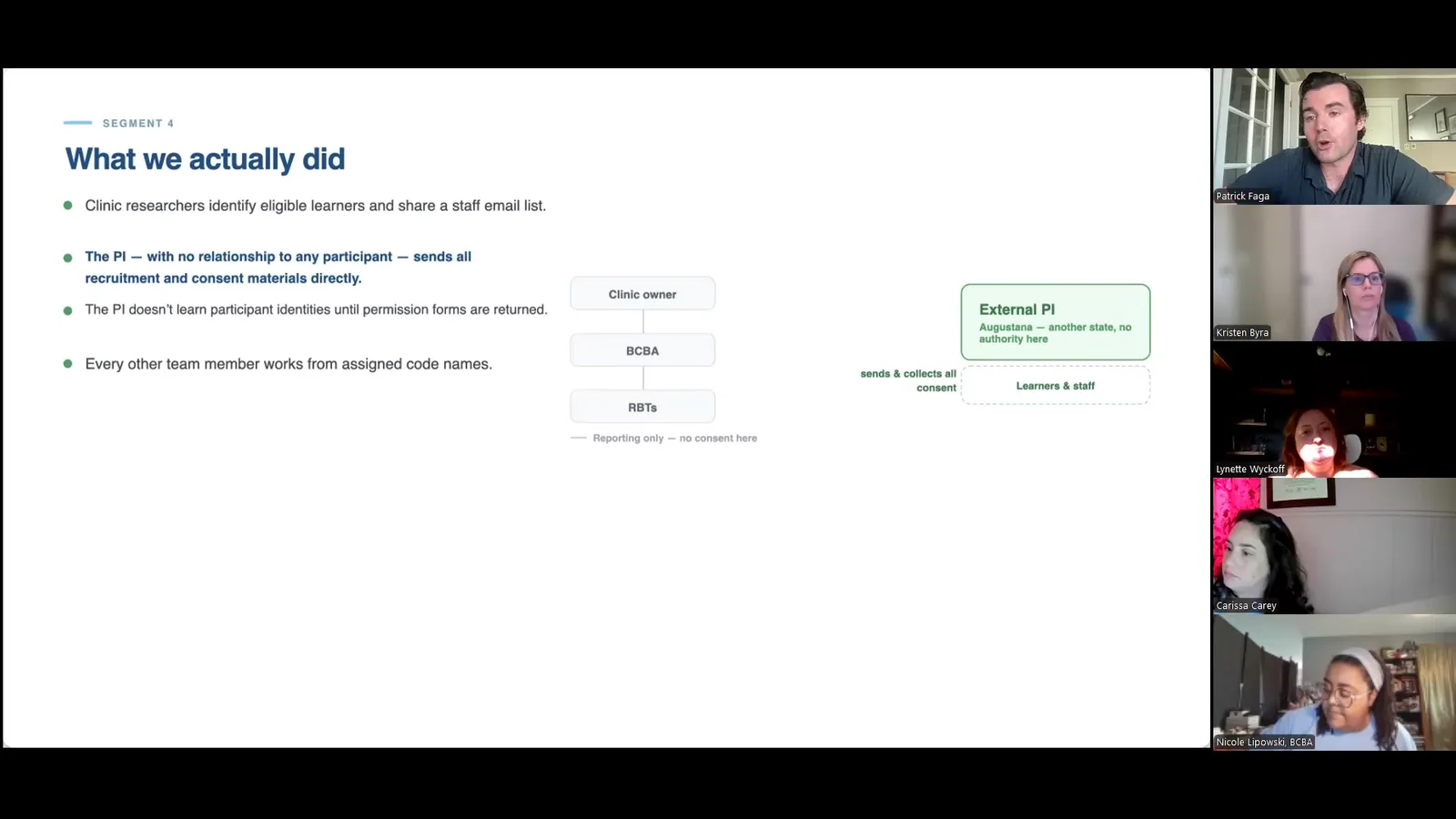
From Idea to IRB: Conducting Research in Your ABA Practice
Upskill ABA
Quality Without Measurement is Just Marketing: A Critical Analysis of Quality Service Delivery
Upskill ABA
Practical RFT
Upskill ABA
Assent and Compassionate Care: Ethical Issues and Considerations for Practice
Upskill ABA
More from Upskill ABA
OpenCEU is supported by advertising from third-party sponsors. Sponsors are clearly labeled, have no influence over course content, instructors, or CEU decisions, and never appear on certificates. The BACB does not sponsor, approve, or endorse OpenCEU sponsors or their products.