From Peer to Professional: Becoming & Supporting Early Career Behavior Analysts
Presented by Theresa Praul-DeFrank, M.A., BCBA
Early-career behavior analysts face one of the steepest professional transitions in healthcare: moving from RBT and peer to clinical decision-maker, supervisor, and team leader—often overnight. Without structured support, this transition can lead to burnout, ethical drift, imposter syndrome, and rapid turnover. This interactive CE equips supervisors and leaders with practical tools to guide new BCBAs through identity shifts, build real-world case management competence, develop soft skills critical to long-term success, protect against overload and burnout, and foster a culture of continuous, intentional learning.
Register free & watch nowCancel any time. Cert delivered to your inbox the moment you pass the quiz.
About this CEU
Early-career behavior analysts face one of the steepest professional transitions in healthcare: moving from RBT and peer to clinical decision-maker, supervisor, and team leader—often overnight. Without structured support, this transition can lead to burnout, ethical drift, imposter syndrome, and rapid turnover. This interactive CE equips supervisors and leaders with practical tools to guide new BCBAs through identity shifts, build real-world case management competence, develop soft skills critical to long-term success, protect against overload and burnout, and foster a culture of continuous, intentional learning.
Credits
1 CEU · 56 min
From the talk
What was covered
How supervisors can guide new BCBAs (newly certified behavior analysts) through identity shifts, paced caseloads, soft skills, and burnout risk. Practical tools from the talk.
- Expect new BCBAs to supervise former peers within six months, and rehearse those conversations before they happen.
- Build caseloads in stages, and tie each step to a competency check instead of a start date.
- Score growth every 90 days across set domains so support fades based on data, not guesswork.
- Follow up after you give corrective feedback, then check whether your own supervision actually worked.
- Teach soft skills on purpose: problem solving, rapport, and taking feedback well all drive promotion.
- Name imposter syndrome out loud so mentees stop reading it as proof they are failing.
Why the RBT to BCBA Jump Is So Steep Right Now
The field is young on paper. Theresa Praul-DeFrank opened with a familiar slide from the BACB (the board that certifies BCBAs). It tracks new BCBA certificates year over year. The line climbs from about 2012 to 2017. Then it gets much steeper from 2018 to 2025. Nearly 59% of BCBAs meet the definition of early career. That means they were certified in the last five years.
Exam data adds more pressure. Only 51% of first-time test takers pass. Among retakers, the number is 23%. She did not treat that as old news. She used it to ask a harder question. If the field is falling short on exam prep, where else is it falling short in preparing new analysts?
Then day one arrives. The caseload shows up. So does a team of RBTs (staff who run daily sessions). New BCBAs make clinical calls with little guidance. They coach caregivers with little practice. They pick up billing, notes, and deadlines within days or weeks. Her mentees name the same struggles again and again. Setting limits with friends. Giving feedback while fearing pushback. Not knowing which program to choose. Not wanting to ask for help.
Supervising People Who Were Your Peers Last Month
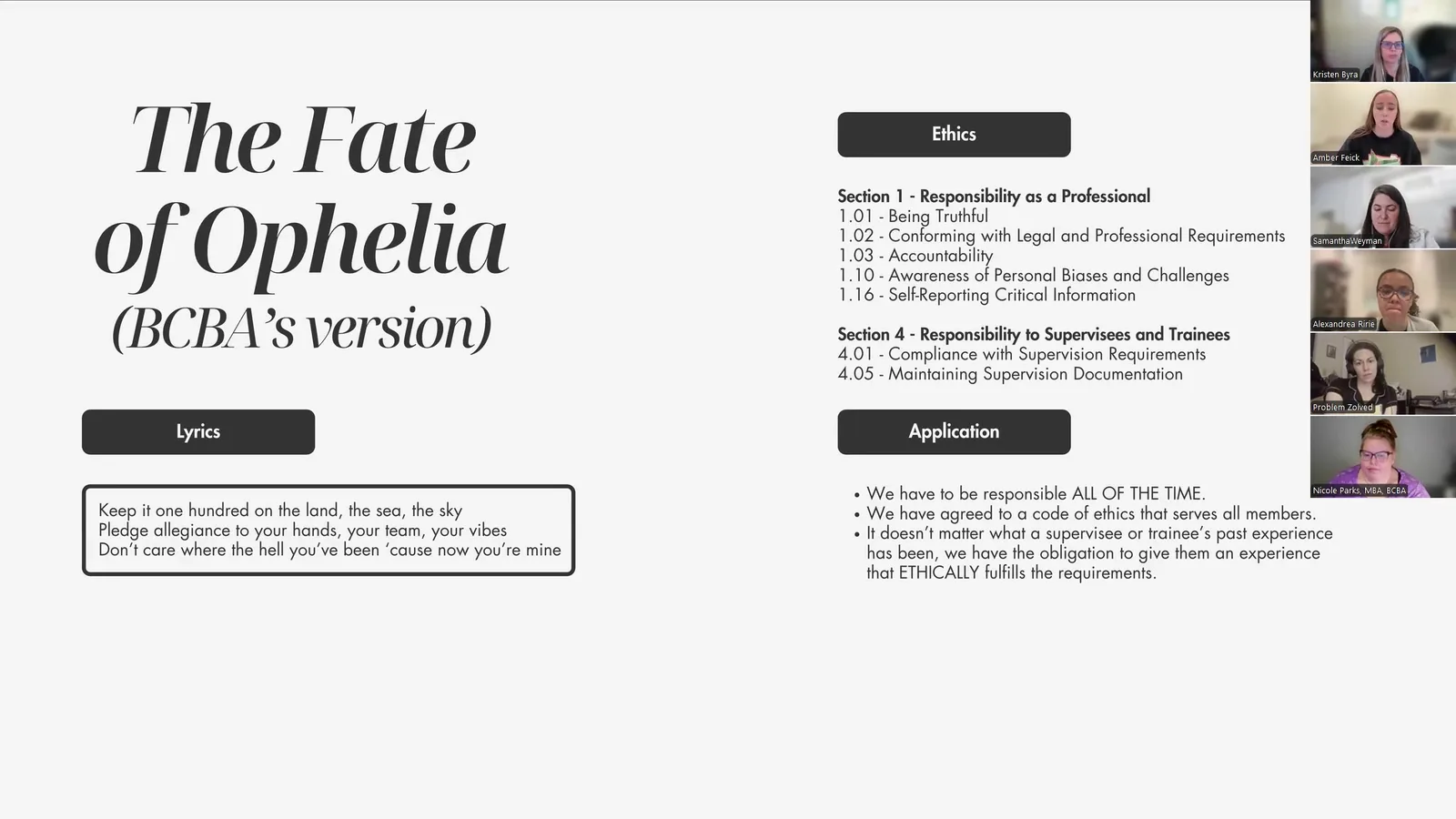
This is the piece she sees break people first. You build real friendships on the floor. That is especially true in clinics, schools, and group homes. Then the schedule flips. You work beside someone on Monday. You supervise them on Thursday. The ethics code speaks to this in 1.11, multiple relationships. It warns against dual roles (two roles with one person). The warning does not make the discomfort go away.
Her live poll confirmed how normal this is. Almost everyone on the call had supervised a former peer within their first six months as a BCBA. Her organization has a 97% retention rate, so RBTs often stay for years. That makes it very likely a new supervisor will oversee a case they once ran themselves.
Her fix starts long before certification. It starts with company culture, where current leaders model boundaries with coworkers. It needs feedback channels, including an anonymous option at both the company and individual level. Expectations get reviewed and agreed to at interview or orientation, for every role. During fieldwork, supervisors model, teach, and rehearse supervisor-to-peer behavior. Her team also uses reverse shadowing (a peer visits to problem solve). An experienced therapist observes a newer therapist, but not as a supervisor. The goal is practical help: here is how I would handle this, here is how I juggle data collection. New supervisors then get coached on how to coach a friend, and they bring those feelings to supervision.
Supervising your peers is one of the biggest challenges that new behavior analysts have worked through in my time mentoring them.
From the talk — Theresa Praul-DeFrank, M.A., BCBA
Imposter Syndrome Is Predictable in Early Career Analysts
She pointed to a study published in BMC Psychology last year. It pulled together 30 healthcare studies from around the world. Across them, 62% of people reported imposter syndrome (feeling like a fraud at work). Several risk factors stood out. Gender was a strong one, and behavior analysis is a heavily woman dominated field. Training stage mattered too, with higher rates in early career trainees and students. Workload, weak mentorship, and poor professional belonging also raised risk.
The downstream effects should worry any supervisor. The research linked imposter feelings to lower professional confidence. People avoided learning opportunities. Psychological distress and burnout risk went up. Clinical decision making suffered. Job satisfaction and well-being dropped.
The suggested supports are things a leader can actually build. Structured mentorship. Access to mental health support. A workplace culture where people belong. Targeted work on stress, burnout, and self-esteem. She also made a point of saying the quiet part out loud, because mentees rarely hear it from anyone.
imposter syndrome is common and experiencing it does not mean that you are failing
From the talk — Theresa Praul-DeFrank, M.A., BCBA
Retire the "Pass the Exam, Here Is a Full Caseload" Model
She named the real danger plainly. It is the jump from passing the exam straight to a full caseload. Her alternative is a gradual caseload building model. Confidence gets shaped, not assumed. Mentors and leaders are held responsible for pacing, not just for coverage.
A few specific moves came with that. Balance teaching hard skills and soft skills instead of defaulting to clinical content. Tie ethical obligations to capacity, since an overloaded analyst cannot practice well. Use competency-based evaluations (proof of skill before independence) before anyone consults fully on their own. Repeat these checks again as the caseload grows. Support case management tasks directly, including clinical quality, documentation, caregiver communication, and staff needs.
Structure is the point. She wants new BCBAs taught systems thinking, not chaos management. That means heading off the everything is urgent mindset before it sets in, because that mindset reliably ends in burnout. Mentees should walk away with strategies that protect two groups at once: their clients and their RBTs.
Slow supported growth isn't a luxury, it's an ethical obligation, and mentees should leave with skills and strategies to protect their own clients and their RBTs.
From the talk — Theresa Praul-DeFrank, M.A., BCBA
What the Burnout Research Says About Workload and Supervision
Burnout in this field is not a vibe. She cited a recent survey by Blackman and colleagues of 476 BCBAs. Of those, 59.8% reported burnout and left a position. Many moved to another company. Some left the field entirely. Workload came up often: 70% reported working more than 41 hours per week. Caseload was tied in too, with many holding 6 to 15 clients.
The day-to-day drivers were specific. Unreasonable workload expectations. Excessive travel. Poor leadership and a lack of support. Exposure to injury. Culture showed up as well. Relationships were a turnover factor, along with hostile or uncomfortable work environments and organizations that expected too much.
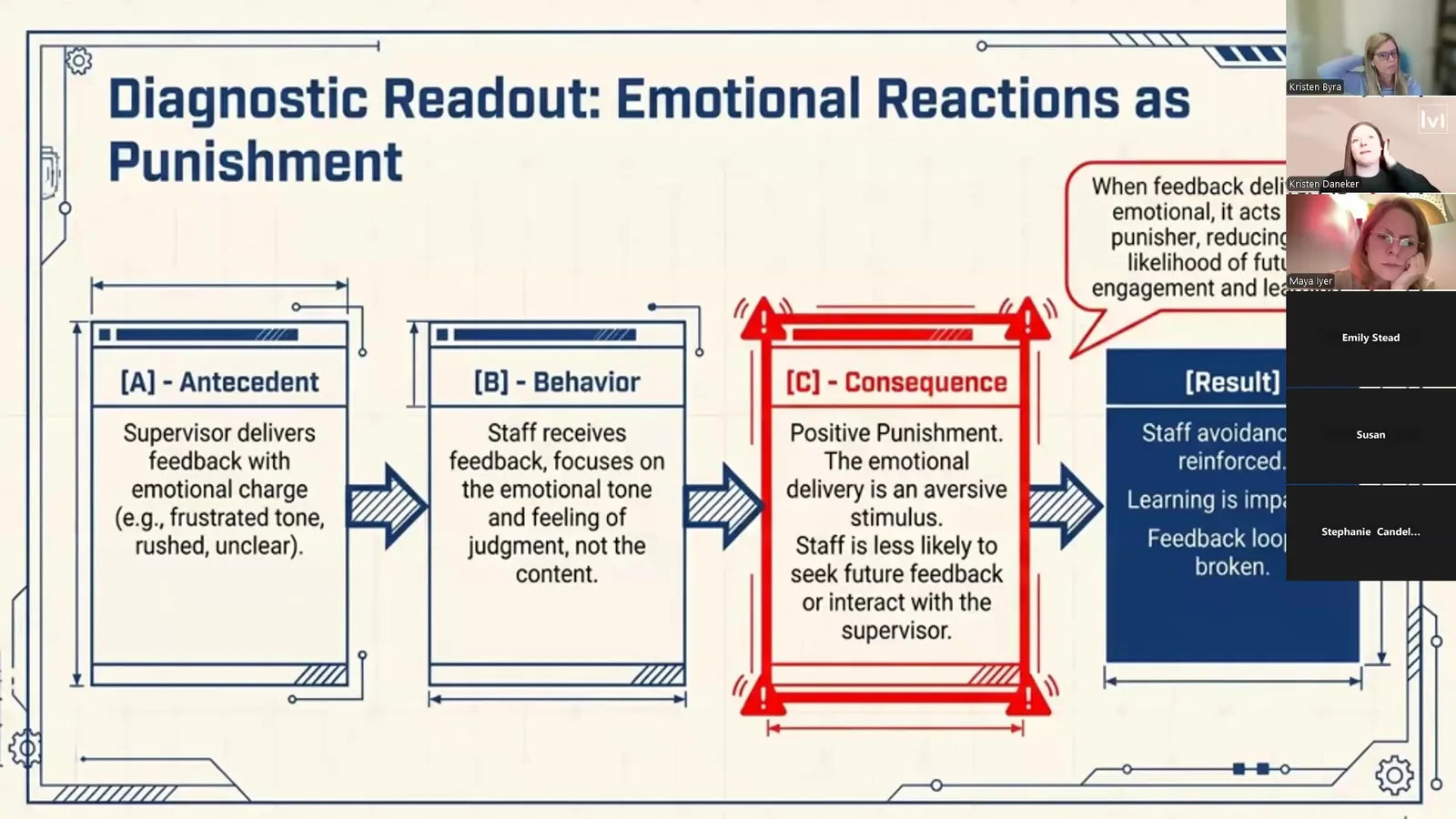
Supervision was its own cluster of problems, and this is the part leaders can act on fastest. BCBAs were not getting best practice supervision themselves. Corrective feedback came with no follow-up coaching. Supervisors were not checking whether their own supervision worked. Her challenge was blunt. Do not check back six months later, shrug, and decide the person just does not do that thing.
Maybe you should check to see if your own self is effective.
From the talk — Theresa Praul-DeFrank, M.A., BCBA
Inside a Transitional Role: Six Domains and Three Levels of Support
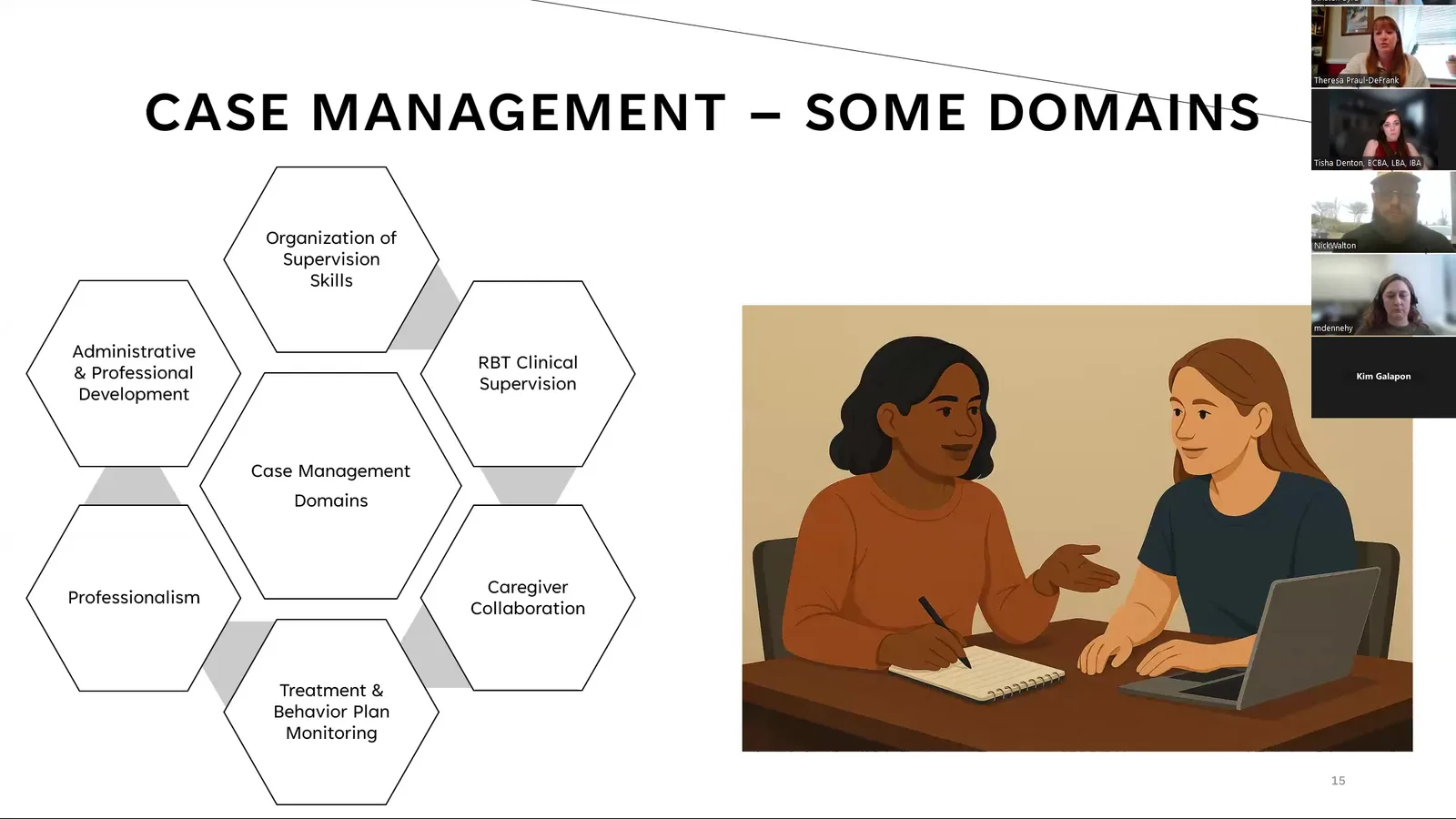
Her organization structures the first year, or longer if needed, as a transitional role. New consultants work from a competency-based checklist built on six domains. The first is organization of supervision skills. This covers goals, targets, and instructional notes. It also covers data sheets, regular data analysis, and timely changes when data go flat or stay variable. Materials need to be on hand, and team communication needs to stay strong. The second domain is RBT clinical supervision. This means clear communication on the floor and use of behavior skills training (tell, show, practice, then feedback). It also means immediate and supportive feedback. Supervisors run IOA checks (two people score one session) and fidelity checks (did staff run it right). She wants them comfortable doing those checks, and comfortable receiving feedback too.
The remaining areas cover the work that quietly sinks new BCBAs. Caregiver collaboration and parent training covers regular contact, confident communication, trainings scheduled as prescribed, and caregiver data collected and analyzed. Treatment and behavior plan monitoring covers detailed plans and staff and caregiver training. It also covers appropriate assessment tools, tracked goals, and edits submitted by funder deadlines. She was firm that a treatment plan is a living and breathing document. It does not get dusted off only before the next authorization period (the window a funder approves). Then come three more areas: professionalism, the mentor and mentee relationship, and administrative and professional development. This last area covers scheduling, session notes with full funder details, and seeking out learning.
Support fades in three stages. Level one is facilitated, where a mentoring BCBA co-consults on the case. They write programs together, attend supervision together, and the experienced BCBA usually leads parent training while the mentee joins. Level two is supported, where help thins out but check-ins continue. Level three is independent, where the mentee carries cases but still meets with a mentor and still gets domain checks. Scores are probed every 90 days against a rubric, which decides when someone advances. They have run the checklist for about a year and three months. When she aggregated the scores, the biggest growth showed up in the facilitated phase and again at independence. One tradeoff is honest and worth naming: because the caseload builds gradually, compensation tracks that ramp. Even so, RBTs and students from other organizations have sought them out for it.
case management is explicitly taught, it's not assumed
From the talk — Theresa Praul-DeFrank, M.A., BCBA
The Soft Skills That Actually Move Careers Forward
Hard skills are the ones on the task list and the job posting. Running functional assessments. Designing and implementing interventions. Teaching functional skills. Reducing challenging behavior. She noted that a functional assessment is a hard skill, full stop. Soft skills are different. They cover interpersonal, communication, and organizational ability with colleagues, clients, and caregivers. They include prioritizing well, giving and taking feedback, showing empathy, and solving problems on your own.
A 2024 study by Sion and Kodak looked at which professional skills led to promotion in behavior analysis. Hard skills ranked first, so the clinical work still has to be solid. Independent problem solving came second. Building and keeping positive relationships came third. Solution-based problem identification was fourth. Giving and accepting feedback well was fifth. She also noted that many university programs no longer cover this material, so it falls to supervisors.
Her action list is small enough to start this week. Practice time management and organization systems with a mentee. Work on building RBT rapport while holding accountability. Work on caregiver rapport without overpromising or over-functioning. Rehearse feedback delivery and tough conversations. Mentees can ask for extra supervision time and a scheduled observation of their own supervision. They can also ask for a review of their programming targets, coaching during parent training, or help with organizational systems. She modeled the self-assessment too, naming flexibility as her own hard spot.
developing their soft skills is just as important as developing their hard skills
From the talk — Theresa Praul-DeFrank, M.A., BCBA
What Early Career BCBAs Are Asking For
A 2025 study by Brown and colleagues surveyed 135 BCBAs within five years of certification. Only 47% reported receiving ongoing supervision. The group under one year was most likely to get it, at 68%. She suspects that is partly because the requirement pushes it. She called 47% a hard number to sit with.
The second half of that data was more hopeful. Interest in professional development stayed high across all three experience groups. That includes analysts with under one year, one to two years, and three to five years of experience. They wanted self-management, delegating tasks, communication, and collaborating with others. They wanted business essentials too, like navigating insurance requirements, writing treatment plans, and providing effective supervision. And 62.54% agreed or strongly agreed that supervision has helped or would help reduce burnout.
She has heard the pushback from leaders: you can offer training, but they will not show up. Her experience says otherwise. She closed with three prompts worth taking into next week. Name one supervision practice to stop. Name one support system to build. Name one boundary to protect.
And so many people have come, so offer it.
From the talk — Theresa Praul-DeFrank, M.A., BCBA
Common questions
How soon should a new BCBA take on a full caseload?▾
In the model Praul-DeFrank described, not right away. Her organization structures the first year, or longer if needed, as a transitional role with a gradual caseload build. Movement happens through three levels of support, with competency scores probed every 90 days against a rubric. Independence is earned on data, not on a start date.
Is it a problem to supervise someone who used to be my coworker and friend?▾
It is extremely common and it does carry risk. The ethics code addresses it in 1.11, multiple relationships, which cautions against dual roles. Her poll showed almost every attendee supervised a former peer within six months of certification. The answer is preparation. Model boundaries, rehearse feedback conversations, and bring the discomfort to your own supervision instead of handling it alone.
What is reverse shadowing?▾
It flips the usual onboarding setup, where a new hire shadows a veteran. Instead, an experienced therapist goes in and observes a less experienced therapist who already has a caseload. The visit is for problem solving, not supervision. The help sounds like this: here is how I juggle data collection during this part. Her team also builds it into BCBA student assignments so practice giving and receiving feedback starts early.
Which skills are most likely to get a behavior analyst promoted?▾
The 2024 Sion and Kodak study found hard skills ranked first, so clinical competence is the baseline. After that came independent problem solving, then building and maintaining positive relationships. Next came solution-based problem identification, then giving and accepting feedback well. Four of the top five are soft skills.
How common is burnout among BCBAs?▾
In the Blackman and colleagues survey of 476 BCBAs, 59.8% reported burnout and leaving a position. Some moved companies and some left the field. Workload was a major driver, with 70% working more than 41 hours per week. Supervision gaps, poor leadership, and culture problems also showed up as factors.
Do mentoring BCBAs need to drop their caseloads to make this work?▾
In her organization the mentors carry reduced caseloads rather than none. Clinical directors, senior clinicians, and the CEO do the mentoring, with the lightest caseloads at the top. She sees staying on the floor as important, not optional.
About the speaker
Theresa Praul-DeFrank, M.A., BCBA has worked in the field since January 2012 and has been certified since August 2016. She holds a 60 credit master's in clinical counseling psychology with a concentration in applied behavior analysis from Eastern University, and she credits that counseling training for much of her mentorship approach. She began supervising students in November 2017, served as a clinical director from 2018 to 2022, and is now director of quality and training at Beyond Autism Services.
This summary was generated from the recording’s transcript. Quotes are taken word for word from the talk.
What you'll learn
- 11) Guide new BCBAs through identity shifts 2) Build real-world case management competence 3) Develop soft skills critical to long-term success 4) Protect against overload and burnout 5) Foster a culture of continuous, intentional learning
Related talks
Talks that cover the same concepts
A Panel on Collaboration in Practice: SLP, OT & ABA Services
Upskill ABA
From Idea to IRB: Conducting Research in Your ABA Practice
Upskill ABA
Quality Without Measurement is Just Marketing: A Critical Analysis of Quality Service Delivery
Upskill ABA
Practical RFT
Upskill ABA
Assent and Compassionate Care: Ethical Issues and Considerations for Practice
Upskill ABA
Language Changes the Game (Part 2)
Upskill ABA
More from Upskill ABA
OpenCEU is supported by advertising from third-party sponsors. Sponsors are clearly labeled, have no influence over course content, instructors, or CEU decisions, and never appear on certificates. The BACB does not sponsor, approve, or endorse OpenCEU sponsors or their products.