De-Coding Updates to BACB Supervision Requirements
Presented by Kindra Coleman, M.Ed., BCBA, LBA
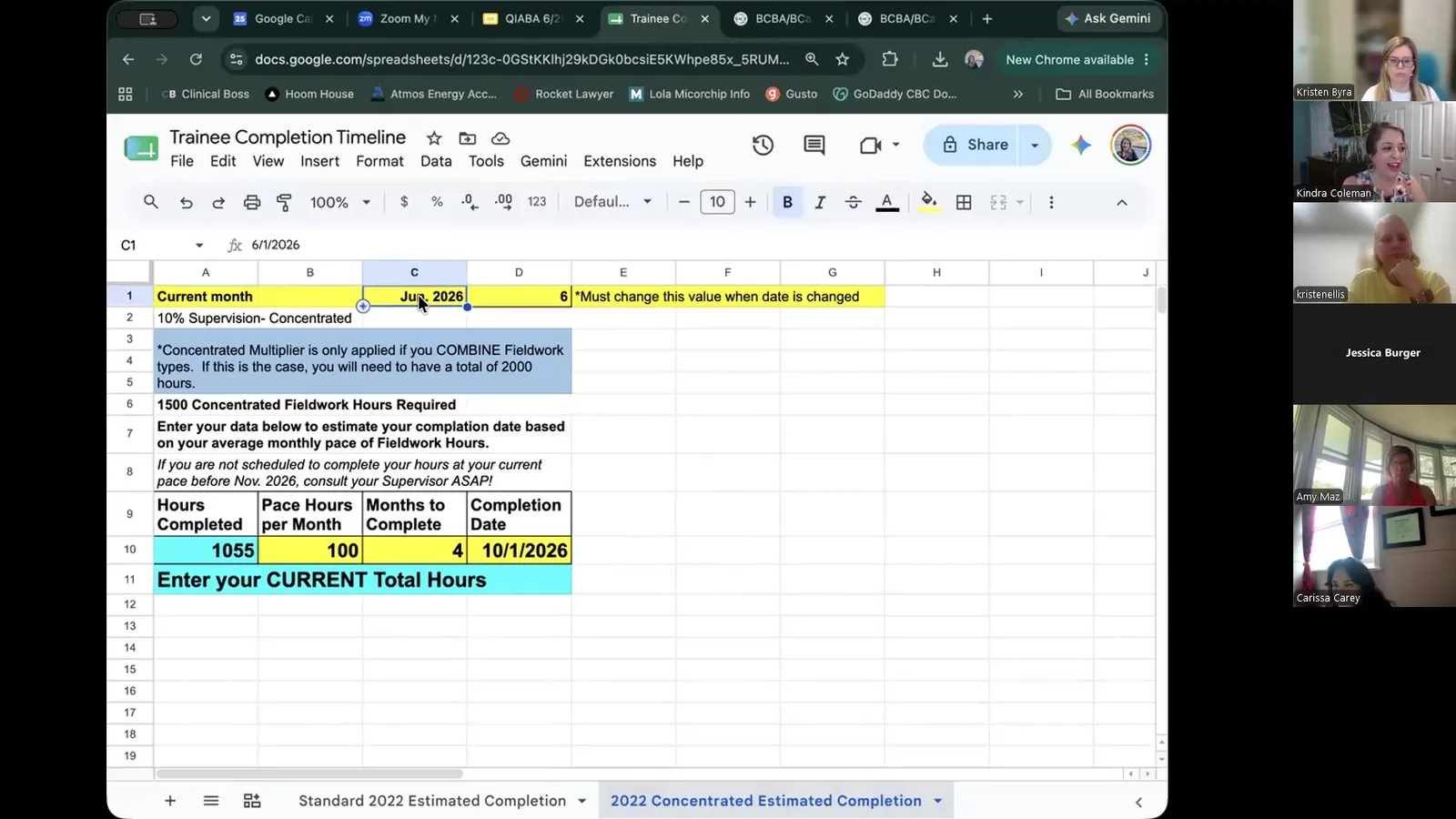
This presentation provides a comprehensive review of recent and upcoming changes impacting the supervision of Fieldwork Candidates and Registered Behavior Technicians (RBTs). Attendees will gain clarity on the 2027 BACB Fieldwork Requirements, transition planning for trainees, and the implications of revised BACB Handbook standards on fieldwork hours and activities. The session also addresses critical updates to RBT competency assessments, recertification processes, and the new Professional Development Unit (PDU) requirements. By examining relevant Ethics Code items and common supervisory challenges, participants will leave with practical tools and resources to navigate these regulatory shifts and ensure ongoing compliance in their practice.
Register free & watch nowCancel any time. Cert delivered to your inbox the moment you pass the quiz.
About this CEU
This presentation provides a comprehensive review of recent and upcoming changes impacting the supervision of Fieldwork Candidates and Registered Behavior Technicians (RBTs). Attendees will gain clarity on the 2027 BACB Fieldwork Requirements, transition planning for trainees, and the implications of revised BACB Handbook standards on fieldwork hours and activities. The session also addresses critical updates to RBT competency assessments, recertification processes, and the new Professional Development Unit (PDU) requirements. By examining relevant Ethics Code items and common supervisory challenges, participants will leave with practical tools and resources to navigate these regulatory shifts and ensure ongoing compliance in their practice.
Credits
1 ethics CEU · 59 min
From the talk
What was covered
What changes for BCBA (certified behavior analyst) fieldwork supervisors in 2027, the new rule requiring real clients, and the updated RBT (registered behavior technician) competency and PDU (professional development unit) requirements.
- Check your trainee's application date, not their start date: anyone applying after January 1, 2027 must have every hour meet the new standards.
- Start documenting client observations by duration now, because the old checkbox approach will not transfer to the 2027 forms.
- Every fieldwork activity, including unrestricted hours (time spent on things like assessments and paperwork, not direct sessions), must connect to a real active client, so mock clients and generic projects no longer count.
- Confirm you have a formal, documented relationship with each trainee's client through one of the three allowed routes in the handbook.
- Plan RBT competency assessments in person and inside one organization, since the assessor, supervisor, and RBT must share an employer.
- Build a PDU plan for every RBT: 12 hours per two-year cycle, from RBT-specific events, qualified in-services, or university coursework.
What Changes in the 2027 BACB Fieldwork Requirements
The 2027 standards follow the application date, not the start date. BACB is the board that certifies behavior analysts. If a trainee applies after January 1, 2027, every fieldwork hour must meet the new rules, even hours already logged. Coleman opened with this point because it changes how supervisors plan.
Four changes matter most for supervisors. Verification forms are being replaced. The required number of monthly contacts goes away. Observations must be documented by duration instead of a checkbox. The percentage for concentrated supervision (a faster, higher contact track) drops from 10% to 7.5%. Trainees can also count up to 160 fieldwork hours per month, a higher ceiling than most supervisors are used to.
The duration rule is the one that catches remote supervisors. A clinic-based trainee usually gets an hour of direct supervision with a client. That hour still has to be written down as a duration of observation overlap. Coleman urged supervisors to start recording it now, even for trainees who should finish under the current standards.
She also flagged a date further out. The BACB has signaled that in 2032, Pathway One becomes the only eligibility route. That is the full master's program in behavior analysis. Coleman suggested watching for smaller shifts between now and then that move the field toward that single pathway.
No longer the check the box, my supervisor was here for a session, but we actually have to record the duration of client observation overlap and meet some new criterias.
From the talk — Kindra Coleman, M.Ed., BCBA, LBA
Transition Planning for Trainees Who Will Not Finish by December 2026
There are two clean paths, and both need a calendar. Path one is to finish coursework, hours, and the application, and get it approved before the end of 2026. Approval is the trigger, not the exam. Coleman was clear that an application approved on the last day of 2026 still counts. The test content is not changing either, since the sixth edition is already in place.
Path two is to assume the trainee applies in 2027 and rebuild the paper trail. Every form submitted after the transition must use the new format. The BACB advises keeping the originally signed form with its original date. Then create a duplicate of that same month on the 2027 form. If a trainee is near the line, the BACB recommends completing both versions of the form.
Degree conferral dates are the quiet risk. A program can end in December while the degree posts in January. Coleman told supervisors to ask the academic advisor for the actual conferral date. For any trainee near the boundary, she recommends a thorough records review. Pay special attention to observation duration on past months.
Two housekeeping items round this out. Trainees who finished coursework before starting fieldwork should contact their verified course sequence instructor. That is the university program that approved their coursework in applied behavior analysis (ABA). The curriculum and the required attestation (a signed statement about coursework) both changed, and the BACB posts the form. Trainees who worked with earlier supervisors should collect current contact information now. They may need old forms reissued.
I will say that if your application has been approved in 2026, even if it's December 31st, 2026, you're good to go.
From the talk — Kindra Coleman, M.Ed., BCBA, LBA
The Handbook Rule That Fieldwork Must Involve Real Clients
Standards changes get announced. Handbook edits often do not. Coleman warned that the BACB can change the handbook at any time. The change might be small wording or a major standard. The board only publicizes the bigger changes. Tracking the rest is the supervisor's job.
The edit with the biggest practical bite landed early this year. Every fieldwork activity now has to connect to time spent with an actual client. Not role plays. Not podcasts. Not mock clients or cases invented for teaching. That restriction covers restricted hours (direct therapy time with a client) and unrestricted hours (assessment, planning, and analysis work) alike.
Coleman did not pretend to like it. She said the rule has changed how she delivers fieldwork, and not in the best way. Supervisors are now limited to the settings and caseloads their trainees already have. Building breadth outside that caseload has gotten much harder, especially for trainees in narrow placements.
The BACB has the right to change the handbook, whether that's a small change in wording or a larger change in standards at any time.
From the talk — Kindra Coleman, M.Ed., BCBA, LBA
Three Ways to Document a Formal Client Relationship
New language on page 16 of the handbook redefines who counts as a client. A client is no longer simply a person who needs behavior analytic services. There must be a formal professional relationship among three parties. They are the client, the trainee, and the BCBA (a certified behavior analyst) supervisor. Coleman walked through the three ways to show it.
The first route is shared employment. If the trainee and the supervisor both work for the same third-party organization, that works. If the supervisor is the trainee's employer, that does not. The second route is a service contract. The trainee and the supervisor each hold their own contract with that specific client. Coleman noted the tension here. That arrangement implies the supervisor is also treating the client, which is often not true.
The third route is an organizational contract. The trainee works for an organization that serves the client. The supervisor holds a contract with that organization granting permission to supervise the trainee and the client. This route matters most for school-based work and for anyone operating as an independent practitioner.
Coleman asked the BACB for sample contracts and was turned down. She was told the board provides a supervision contract. Everything else is the responsibility of the supervisor and the trainee. So she built her own interim client service agreement. It names all three parties. It defines the purpose as educational for the trainee. It also states plainly that she is not making treatment decisions for that client. She shared it as a working example, not as anything the BACB has endorsed.
If your BCBA supervisor is your employer, that is not okay.
From the talk — Kindra Coleman, M.Ed., BCBA, LBA
Role Plays, Group Supervision, and Separate Consent for Fieldwork
Role play did not disappear. It moved. Behavioral skills training (teach, model, practice, then give feedback) is still sound practice. The skill being rehearsed now needs to belong to a current, active fieldwork client. Rehearsing a preference assessment with a trainee before they run it with their own client fits. Rehearsing for a hypothetical client does not count toward independent hours (unrestricted work trainees log on their own).
Ethics content works the same way. General teaching on confidentiality, service contracts, and multiple relationships still belongs in supervision sessions. Coleman draws the line at independent work. If a trainee completes a project and logs it as unrestricted time, that project needs a real client attached. Reviewing another clinician's case profile during a supervision meeting still meets the supervision requirement, just not the independent hours requirement.
Group supervision has the least guidance. Coleman said she has not received a clear answer from the BACB. Her approach is to teach a general task list topic. Then she asks each trainee for an example from their own caseload. Any follow-up assignment stays client specific.
Consent came up repeatedly. A family consenting to treatment has not automatically consented to fieldwork. Coleman treats fieldwork participation as a separate purpose. It needs its own consent, even inside a clinic where everyone shares an employer. Trainees often take on duties an RBT would not, such as modifying protocols or recording sessions. She errs on the side of asking for consent up front.
I think the BACB is more concerned about the independent hours that the trainees are counting.
From the talk — Kindra Coleman, M.Ed., BCBA, LBA
RBT Training Changes and the Revised Competency Assessment
The 2026 RBT changes start at the front door. There is a new 40-hour training curriculum and a new task list. The third edition content outline adds material on professionalism and ethics. It also draws a cleaner line between what an RBT (a certified behavior technician) owns and what the analyst owns. If your organization buys prepackaged modules, confirm the vendor has updated to the new content.
The initial competency assessment (a hands-on check of job skills) changed in who can run it and how. The BACB added an organizational rule. The RBT, the supervisor, and the assessor must all be employed by the same organization. That effectively ends remote RBT competency assessment.
Training itself does not carry that restriction. A person can finish the 40-hour training through an outside provider before being hired. Employment matters at the assessment. Coleman named independent contractors as the hardest case. She told attendees to ask their training coordinator how the organization is handling it. State license rules sit on top of all of this, and both sets of requirements have to be met.
She also pushed supervisors to look at outcome data. The BACB publishes RBT examination pass rates by training provider. In the 2022 report, two of the largest commercial providers landed near 80% and 82%. The strongest pass rates came from providers that built their own internal curriculum. Coleman said that pattern shows up in more than exam scores. It also tracks with renewal rates, performance quality, and ethical violations.
This is very specific from the BACB that the supervisor, the assessor does have to be employed by the same organization as that RBT.
From the talk — Kindra Coleman, M.Ed., BCBA, LBA
RBT Recertification and the 12-Hour PDU Requirement
Recertification moved to a two-year cycle. The annual competency assessment is gone. RBTs do not retake the exam. In its place, each RBT needs 12 hours of professional development units (short trainings tied to RBT content). They need this every two years. One PDU equals one hour, and partial credit is allowed, down to short 15-minute trainings. The BACB has posted a PDU FAQ page and transition guidance for RBTs caught mid-cycle.
There are three ways to earn them. The first is an employer-led in-service. A qualified BCBA must design, lead, and present it. That BCBA does not need to be a continuing education provider. The training does need active learning, and the supervisor must complete an RBT PDU in-service event form. Coleman's concern here was blunt. A staff meeting or an admin update is not professional development. A quick coaching moment on prompting (giving a cue to help a learner respond) does not count. You need to formalize it with the required form.
The second route is an ACE provider event (an approved continuing education provider). The event has to be built specifically for RBTs. The third route is university coursework, including bachelor's level behavior analytic courses. These can double count for staff who are also working toward BCBA certification.
One contrast is worth holding onto. Fieldwork content got more client specific. PDU content went the other direction. In-services should map to the third edition task list and stay general enough to transfer across cases. Coleman also noted that many RBTs are seeking PDUs in ethics and professionalism, not new teaching procedures. She encouraged supervisors to build in-services in that direction.
RBT cannot attend a BACB, CEU, or workshop and count those as PDU hours.
From the talk — Kindra Coleman, M.Ed., BCBA, LBA
Ethics Code Items and the Supervision Errors That Trigger Audits
Supervision is one of the most common reasons ethics complaints get filed with the board. Coleman built her closing section around that fact. A few code areas come up again and again. One is scope of competence (only teaching what you are trained in). Another is capacity to take on supervision at all. A third is accurate documentation. The last is multiple relationships (holding two roles with one person).
Misclassification is the error she sees most. Trainees log unrestricted hours they cannot defend. Supervisors sign at the end of the month without checking. Form errors are a leading trigger for BACB audits. The trainee usually absorbs the consequences of a prior supervisor's mistake.
Capacity is the second theme. Supervision is not just being present while a trainee works with your client. It means assessing what the trainee knows across the test content areas and whether they can apply it. Coleman also named gatekeeping in both directions. One form blocks people from fieldwork until they clear some informal bar. The other over-endorses hours to avoid a hard conversation. She added that good supervision models cultural humility and compassionate communication. It also models assent-based practice (treatment the client agrees to), not only with clients but with trainees too.
She closed with a call to action. Several questions in the session had no clear answer. That gray area is itself the finding. Coleman asked attendees to send their questions to the BACB in writing. She noted that more than ninety people attended the session. If many share the same confusion, that points to a gap in the guidance, not one person's mistake.
Errors on forms are one of the major triggers of audits for the BACB, and unfortunately, a lot of those trainees end up bearing the burden of mistakes made by previous supervisors.
From the talk — Kindra Coleman, M.Ed., BCBA, LBA
Common questions
Do the 2027 fieldwork standards apply to hours my trainee earned in 2025?▾
Yes, if the trainee applies for certification after January 1, 2027. The standards follow the application date, not the date the hours were earned. That means older months have to meet the new requirements, including observation duration. Review those past records now rather than at submission.
Does my trainee have to pass the exam before the end of 2026 to stay under the current standards?▾
No. The trigger is an approved application, not a passing score. Coleman said an application approved as late as December 31, 2026 is fine. The exam content is also staying on the sixth edition, so the test itself is not changing.
Do I need to redo old verification forms on the 2027 format?▾
If the application goes in after the transition, every form must be on the new format. The BACB advises keeping the originally signed form with its original signature date. Then create a duplicate of that month using the 2027 form. For trainees near the cutoff, executing both versions is the safer move.
Can trainees still count role plays and mock client activities?▾
Not toward independent hours. All fieldwork activities now have to connect to a real, active client. You can still role play a skill during a supervision session. It just has to target a skill one of the trainee's current clients needs. General teaching still belongs in supervision. It just cannot be logged as independent hours.
Can I run an RBT initial competency assessment remotely?▾
No. The new organizational rule requires the RBT, the supervisor, and the assessor to be employed by the same organization. That rules out remote assessment by an outside supervisor. The 40-hour training can still come from an outside provider before the person is hired.
How many PDUs do RBTs need, and can they attend a BCBA CEU event?▾
RBTs need 12 hours of professional development units per two-year recertification cycle. A BCBA continuing education event does not count. PDUs must come from an RBT-specific ACE provider event, a qualifying employer-led in-service, or university coursework. One PDU equals one hour, and partial credit is allowed.
Does my state license change any of these requirements?▾
State licensure rules are separate from BACB rules, and you have to meet both. In some states, license requirements may be stricter than BACB rules. This can apply to supervision or to who can work with certain populations. Losing a license can also affect your certification. Check your own state board before applying any of this guidance.
About the speaker
Kindra Coleman, M.Ed., BCBA, LBA, is a licensed behavior analyst in Austin, Texas. She has 15 years of experience across ABA practice, from early intervention to clinic-based systems. She now focuses on fieldwork supervision and BCBA mentorship, and is the founder of Collaborative Behavior Consulting. In this session, she covered the 2027 fieldwork standards and recent BACB handbook changes. She also walked through RBT competency and recertification updates, along with the ethics issues that come with supervising others.
This summary was generated from the recording’s transcript. Quotes are taken word for word from the talk.
What you'll learn
- 11) Understand changes to BACB Fieldwork Requirements coming in 2027 and how this will impact current Trainees and Fieldwork Candidates. 2) Discuss transition planning for Trainees and Fieldwork Candidates that will not complete hours by the end of 2026. 3) Understand how recent changes to the BACB Handbook impact Trainee’s Clients, Fieldwork Hours and Appropriate Activities. 4) Review BACB Standards changes impacting supervision of RBTs and the revised RBT Competency Assessment. 5) Discuss changes to RBT Re-Certification and how to meet the new Professional Development Units (PDU) requirement for RBT Supervisees. 6) Review Ethics Code Items and common Ethical Concerns that arise when providing supervision to RBTs or Trainees and Fieldwork Candidates.
Related talks
Talks that cover the same concepts

Crash Course in Behavior Analytic Toilet Training: Translating Research to Practice
Copper Consulting Group
Open the Door: Low Dosage ABA as an option
Nicole L. Stewart LLC

Rad N Bad: The Other Side of the Table — Ethical Failures, Compassionate Care, and Consumer Realities in ABA
Hickory Learning Group

Rad N Bad: Dosage by Tradition: What the Research Actually Says About ABA Hours, and the Contingencies Behind Them
Hickory Learning Group

Harm Reduction Within ABA Practice
The Behaviorist Bookclub

Roadmapping: A Guide to Lasting Independence
Hickory Learning Group
More from Upskill ABA
A Panel on Collaboration in Practice: SLP, OT & ABA Services
Upskill ABA
From Peer to Professional: Becoming & Supporting Early Career Behavior Analysts
Upskill ABA
From Idea to IRB: Conducting Research in Your ABA Practice
Upskill ABA
OpenCEU is supported by advertising from third-party sponsors. Sponsors are clearly labeled, have no influence over course content, instructors, or CEU decisions, and never appear on certificates. The BACB does not sponsor, approve, or endorse OpenCEU sponsors or their products.