From Idea to IRB: Conducting Research in Your ABA Practice
Presented by Lynette Wyckoff, BCBA
Most BCBAs generate clinically meaningful data every day and never publish a line of it. The barriers are rarely conceptual. They are procedural. Where does a research question come from? Do you need an IRB if you don't work at a university? How do you protect a learner and an employee who are both participants? How do you navigate research goals and your primary commitments to your caseload? This event walks the full arc of conducting research inside a working clinic, using a completed single-case study as a running case example. Conducted through a partnership between an ABA provider and a university, the study examined receptive-identification acquisition under a multiple-baseline design and was presented at ABAI 2025. Attendees will follow it from the initial clinical question through IRB submission, implementation, mid-study modification, and dissemination, including the parts that did not go according to protocol. Participants will leave with a research question worksheet, an IRB readiness checklist, a single-case design decision tree, and consent and assent templates for learners and staff.
Register free & watch nowCancel any time. Cert delivered to your inbox the moment you pass the quiz.
About this CEU
Most BCBAs generate clinically meaningful data every day and never publish a line of it. The barriers are rarely conceptual. They are procedural. Where does a research question come from? Do you need an IRB if you don't work at a university? How do you protect a learner and an employee who are both participants? How do you navigate research goals and your primary commitments to your caseload? This event walks the full arc of conducting research inside a working clinic, using a completed single-case study as a running case example. Conducted through a partnership between an ABA provider and a university, the study examined receptive-identification acquisition under a multiple-baseline design and was presented at ABAI 2025. Attendees will follow it from the initial clinical question through IRB submission, implementation, mid-study modification, and dissemination, including the parts that did not go according to protocol. Participants will leave with a research question worksheet, an IRB readiness checklist, a single-case design decision tree, and consent and assent templates for learners and staff.
Credits
1 CEU · 63 min
From the talk
What was covered
A BCBA walks one real clinic study from first question to conference poster, covering question frameworks, IRB pathways, consent, assent, and design calls.
- Pull your research question from one of three wells. Look for the problem that keeps returning, the variability you cannot explain, or the change you made and never documented.
- Climb the specificity ladder until another BCBA could read your question and know exactly what to observe, manipulate, and measure.
- Ethics review is required to answer a new question using people. You do not need it to improve a program with research that already exists.
- Write your stopping and dissent rules before you collect any data. Make them specific enough to score.
- Put the furthest possible distance between the person recruiting participants and the person who supervises or employs them.
- Record small deviations as they happen. Submit real modifications, and report any harm or serious surprise to your board right away.
Three Wells: Where a Clinical Research Question Actually Comes From
Most BCBAs make small changes every week that work. Almost none of that leaves the building. The barrier is rarely the idea. It is not knowing where a question starts. Lynette Wyckoff offered a simple frame: the three wells. Each well is a normal part of clinical life.
The first well is the problem that keeps coming back. You catch yourself thinking there has to be a better way. That thought is often a question in disguise. The second well is variability you cannot explain. The same plan works for one learner and stalls for another. Two learners get the same social skills program. Only one uses the skill with peers. That gap is worth studying. Does peer mediated practice (peers helping run the teaching) improve generalization (using a skill in new places)?
The third well is the undocumented change. You adjusted something on the fly and the data improved. Then nobody wrote down what changed. Those adjustments happen constantly in real clinics. Documentation is what turns a hunch into evidence. Questions do not always start with what should I study. Many start with why does this keep happening.
Variability becomes an opportunity to investigate.
From the talk — Lynette Wyckoff, BCBA
The Specificity Ladder: Turning a Vague Question Into a Testable One
The team's own question started rough. Does delivering DTT (short, repeated teaching trials) on a tablet work better than cards? That version is unusable. There is no population, no dependent variable (the thing you count), and no definition of better. The fix is the specificity ladder. You add one detail per rung.
Rung one is pure curiosity: does the app work? Rung two names the skill: does the app teach receptive ID (pointing to a named item)? Rung three adds the measure: does it teach receptive ID faster than cards? The top rung adds the how and the comparison. Take a learner with limited discrimination. The top rung question names the method: DTT delivered by app, with automated error correction built in. It asks how that affects trials to criteria (trials needed to master a target). It also asks how it affects response latency (how fast the learner answers) on novel receptive ID targets.
A second example tracks the same climb. Do visual schedules help with transitions becomes something much tighter, step by step. Picture a six year old with limited vocal language. The first add is where and when: this child protests during classroom to therapy room transitions. The intervention comes next: a five step photographic visual schedule, reviewed right before each transition. The measure is latency (how long it takes to arrive). The comparison is a verbal two minute warning alone. Put together, the full question reads this way. For this child, does the photographic schedule reduce mean latency to arrive, compared with a verbal warning alone? Here is the test for being finished. Could another BCBA read your question and know what to observe, manipulate, and measure? One more tip from Lynette: write the question first, then find the learners who fit it. Building the question around one learner limits you later.
Your goal is to just keep climbing it until that question tells you what data you would need to collect.
From the talk — Lynette Wyckoff, BCBA
Practice, Quality Improvement, or Research? Four IRB Pathways
Most of what you do all day is professional practice. You make meaningful changes with learners and move on. Research differs in purpose, not in value. Research means systematically manipulating what you do with the intent to share it. Quality improvement (fixing how your own clinic works) sits on the practice side of that line.
The line matters because it decides whether you need review. You do not need an IRB (a board that reviews research ethics) to change a program based on existing research. You do need one to answer a new question using people. Human subjects research (studying people to answer new questions) requires ethics review in nearly every case.
Patrick Baga walked through four pathways. One, partner with a university. You attended one, so you likely know someone who can connect you to its board. That route usually brings methods help with it. Two, use an independent or commercial board. These can start quickly and need no academic partner. Some charge for the service, and some require a PhD level PI (the lead researcher of record).
Three, help form a committee. Professional groups are the usual home for this, and it is not a solo project. Four, decide you do not need human subjects research at all. Answer the question for your own clinic and act on it. The tradeoff is simple. You cannot disseminate it the same way.
So you're going to need an IRB if you want to do research.
From the talk — Patrick Baga, First Work
Inside the IRB Submission: 14 Parts and a Real Timeline
Their submission had 14 parts. Objectives and design. Investigator qualifications. Procedure. Participants and recruitment. Informed consent (a clear yes after full details). Compensation. Benefits. Risks, and what you do to reduce them. Deception. Confidentiality. Other approvals. Most of it flows straight from your research question.
Two parts deserve extra thought. Eligibility should favor learners who stand to benefit. If a current protocol is working well, swapping in something novel rarely makes sense. Risk language should be plain. Participants need to hear that the time spent may not produce the outcome everyone wants.
All of this happens before a single data point. Consent forms go out, then come back. Boards send questions. This study went through two rounds of revisions on small design points. One early version had blanks where the stopping criteria (rules for when to end) belonged. None of that is failure. It is the service the board provides.
it's best to try to keep the plane on the ground, get your research approval, then you, the pilot, can pop in the plane and we can go where we're going
From the talk — Patrick Baga, First Work
The Dual Role: When the Clinician and the Investigator Disagree
The ethics code is blunt about this setting. Research activities must be arranged so client services and welfare come first. Lynette's reading is practical. Do not delay, withhold, or stretch an ineffective intervention to get cleaner data. Ask yourself one check question. Would this still be clinically appropriate if I were not collecting data?
Experimental control has limits. A reversal or a long baseline may strengthen a design. That strength does not justify extra risk or lost benefit for a client. If the clinician wants the session to end, the session ends. The clinical role wins every time.
Boards now expect assent (the learner's willingness to take part) to be operationally defined (written so anyone could measure it). Their approved protocol listed dissent (signs the learner wants to stop) in detail. Vocal or verbal refusal. Refusal through a communication device. Turning the head or body from the materials. Discarding the iPad. Any other sign of distress. The session stopped there. It could be offered again later that day. A second dissent ended sessions for the day. Dissent across three days in a row removed the learner from the study.
So it turns assent from that judgment call into a measured variable.
From the talk — Lynette Wyckoff, BCBA
Staff as Participants and Conflicts You Have to Disclose
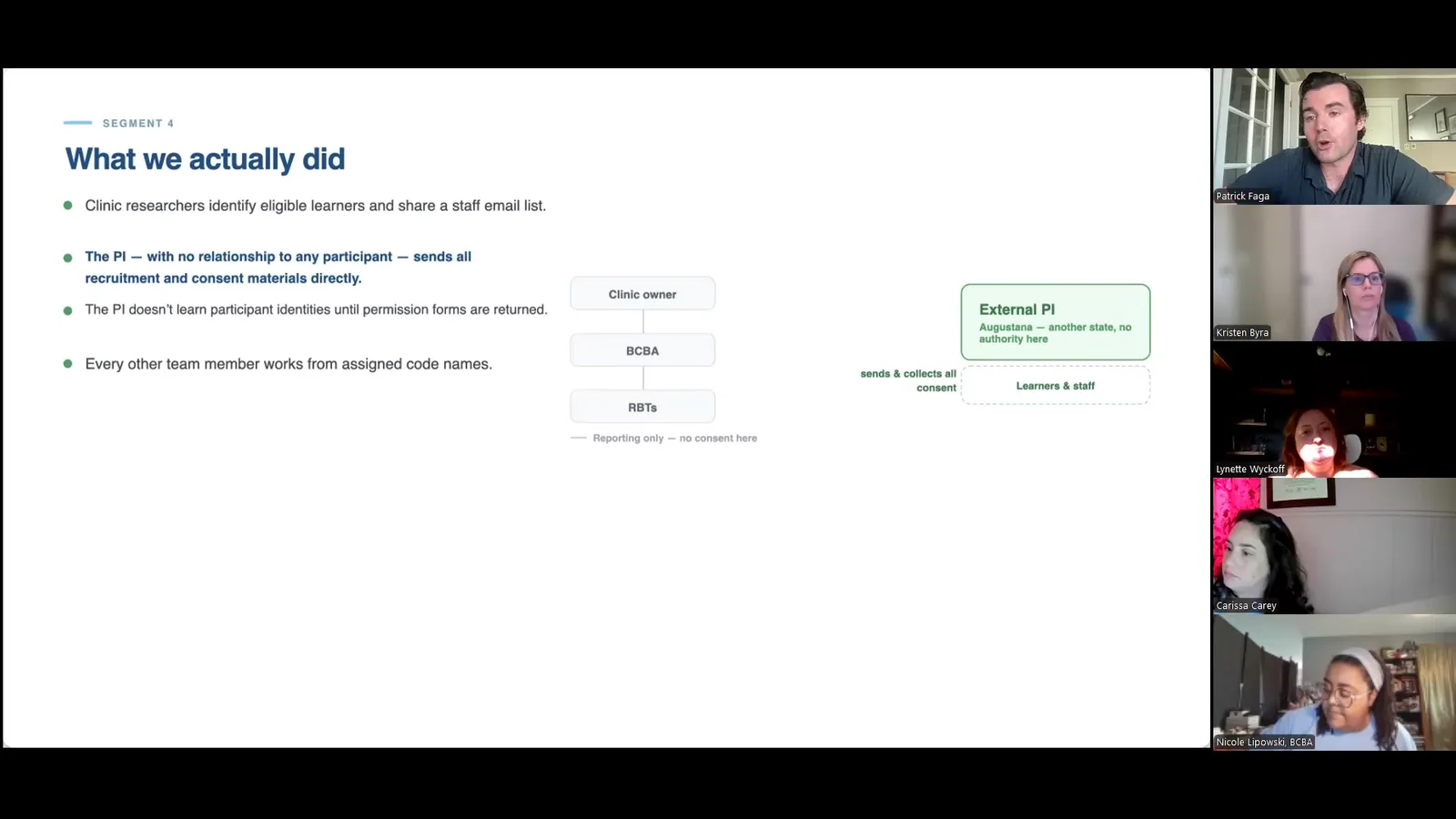
RBTs (the technicians running daily sessions) are employees and implementers at once. Asking your own supervisee to join your study pulls hard on that relationship. The cleanest fix is distance. An external PI handled recruitment for both staff and learners in this study.
In practice it looked ordinary. The clinic identified which technicians worked with eligible learners. The PI reached out from a separate email. Staff could ask questions and could say no. It was made clear that none of it touched their job at the clinic. If you cannot get that distance, a larger organization may have a research director who sits outside daily operations. If you are both owner and PI, state plainly in writing that taking part has nothing to do with employment.
Conflicts get disclosed, then constrained. The platform's founder consulted on what the app could do. That role was listed in the protocol, the consent forms, and the poster. He had no control over the analysis and could not withhold unfavorable results. Clinic staff were kept out of consent, data collection, and withdrawal decisions. Name the conflict (a personal stake in results), then show a reader exactly what you did about it.
This is not a PR piece for first work.
From the talk — Patrick Baga, First Work
When the Protocol Meets the Caseload: Deviations, Modifications, and Session Time
The design was a multiple baseline (staggered starts across several targets). The proposal was ambitious. Multiple sites. A wide range of targets. Several learners. The study that actually ran was smaller. One learner. Three targets. One clinic. Prerequisite skills and exclusion criteria (who does not fit the study) narrowed the pool. Expect that. Clinical practice is more dynamic than a written proposal.
Measurement ran three ways. Goals were drawn from an assessment. Card probes were run in person with an array of three. The app recorded every trial automatically. Baseline sat near zero, with one exception. The learner picked up bus from singing at circle time. That is maturation (learning the skill somewhere else), and it shows in the graph. After the app went in, acquisition moved quickly. The fastest target was mastered in as few as 60 trials across 6.3 minutes of instructional time.
Three event types need different handling. A deviation (a small unplanned change) gets recorded, not submitted. One session happened on a swing. That is a deviation. A modification changes the approved plan and must be submitted. Theirs widened the age range, added an assessment, revised the assent form for older participants, and added academic skills. An adverse event (harm or a serious surprise) gets a prompt written report. Fidelity (how closely the plan was followed) needs a tracking method, often an IOA (two people scoring the same thing) step.
Boards also ask for a time estimate. Study sessions ran about 10 minutes of a learner's day. That time was split across two or three short sessions, plus pre and post assessment. Over the study that came to roughly 5 hours and 10 minutes of study specific time. Real sessions ran closer to 7.75 minutes. That number matters at the eight minute mark for a billable unit (time you can charge to funding). This learner's target also sat in the treatment plan, with data in the clinic's usual system. When research time is not service, keep it out of billing.
There are three main things that you need to look out for.
From the talk — Patrick Baga, First Work
Dissemination: Start With a Poster, Then Expand Under the Same Approval
This began as a pilot with a poster as the goal. It was presented at ABAI (a national conference for behavior analysts) in 2025. The poster and a fuller write up are hosted on First Work's research page. A larger version is running now under the same IRB approval, with a journal as the target. Data collection there is still in progress.
That sequence is worth copying. A small pilot is a real contribution to the field. One approval can often cover the expansion that follows. Start where your sample size and your time actually are, not where you wish they were.
One last piece of housekeeping. Settle authorship before anything begins. Order matters to people, and it causes real friction later. For a Monday step, write your clinical question in one sentence. Climb the ladder until it tells you what data to collect. Then contact someone who could sit in the PI seat.
You don't have to do a journal for it to be legitimate research.
From the talk — Patrick Baga, First Work
Common questions
Do I need an IRB if I don't work at a university?▾
Yes, review is required if you are answering a new question using people. You have four options. Partner with a university. Use an independent or commercial board. Help form a committee through a professional group. Or keep the work as internal quality improvement. Most clinic based researchers start with the university they attended, since the connection is already there.
What counts as quality improvement instead of research?▾
Changing a program for a specific learner based on research that already exists is practice. You are applying known findings, not testing a new question. That work does not need ethics review. The tradeoff is that you cannot disseminate it the same way.
Can my own clients be participants in my study?▾
They can, but the dual role has to be managed openly. Clinical needs come first, so you never delay or prolong an ineffective intervention for cleaner data. The strongest safeguard is having someone outside your clinic handle consent and withdrawal decisions. Write your dissent and stopping rules before you start.
How do I ask my own RBTs to participate without pressuring them?▾
Put as much distance as possible between the person recruiting and the person who supervises or employs them. In this study, an external PI emailed eligible technicians separately. The PI answered their questions and made clear that participation had nothing to do with their job. If that separation is not possible, state it plainly in writing during recruitment.
What is the difference between a deviation and a modification?▾
A deviation is a small unplanned change you record but do not submit. One example: running a session in an unexpected spot. A modification changes the approved plan and must be submitted to the board. Examples include widening the age range or revising an assent form. Anything serious, unexpected, or harm related is an adverse event and needs a prompt written report.
Can I bill for sessions that are part of a study?▾
Track the study specific time carefully, because boards will ask for an estimate anyway. In this study, sessions ran about 7.75 minutes, which sits under the eight minute mark for a unit. The learner's target was also written into the treatment plan with data in the clinic's usual system. When research time is not service, keep it out of billing and follow your funder's rules.
About the speaker
Lynette Wyckoff is a board certified behavior analyst and the director of program development at Possibilities ABA. She also serves as a practicum supervisor at Augustana University, and her work spans clinical leadership, program development, staff and RBT training, and supervision of BCBA trainees. She led the clinical side of the single case study described in this talk, which was presented as a poster at ABAI 2025.
This summary was generated from the recording’s transcript. Quotes are taken word for word from the talk.
What you'll learn
- 11) Identify three sources of viable research questions within routine clinical practice, and restate a broad clinical observation as an operationally defined research question with a measurable dependent variable. 2) Describe the criteria that distinguish clinical practice and quality improvement from human subjects research requiring ethics review, and list the IRB pathways available to a clinic without university affiliation. 3) Apply the research responsibilities described in Section 6 of the BACB Ethics Code for Behavior Analysts to the dual role of clinician-researcher, including consent, withdrawal authority, conflict-of-interest disclosure, and the safeguards required when clinic staff serve as participants. 4) Select an appropriate single-case design given a stated clinical question, caseload size, and measurement constraints, and differentiate protocol deviations, modifications, and reportable adverse events.
Related talks
Talks that cover the same concepts
A Panel on Collaboration in Practice: SLP, OT & ABA Services
Upskill ABA
From Peer to Professional: Becoming & Supporting Early Career Behavior Analysts
Upskill ABA
Quality Without Measurement is Just Marketing: A Critical Analysis of Quality Service Delivery
Upskill ABA
Practical RFT
Upskill ABA
Assent and Compassionate Care: Ethical Issues and Considerations for Practice
Upskill ABA
Language Changes the Game (Part 2)
Upskill ABA
More from Upskill ABA
OpenCEU is supported by advertising from third-party sponsors. Sponsors are clearly labeled, have no influence over course content, instructors, or CEU decisions, and never appear on certificates. The BACB does not sponsor, approve, or endorse OpenCEU sponsors or their products.