Reflective Supervision and Client Outcomes
Presented by B. Kuereine Gray

Cancel any time. Cert delivered to your inbox the moment you pass the quiz.
Learner ratings
from 153 learners
92% would recommend this CEU to other professionals in their field (153 responses)
“good”
— Hongjun J.“Great stuff”
— Cynthia G.“good”
— Berenice R.“It presented some interesting ideas to reflect upon.”
— Diane B.“Could have been more interactive. Also, a good bit of technical difficulties.”
— Michelle K.“was a useful session and we do notice an impact with improved growth and continuous learning cycle for the supervisees”
— Krishna R.
About this CEU
This session connects reflective supervision to client outcomes in ABA service delivery. Attendees will explore the link between provider functioning and client outcomes, and how reflective supervision relates to treatment fidelity and clinical quality. The session closes with approaches for integrating reflective supervision across service models.
From the talk
What was covered
Reflective supervision, treatment fidelity, and client outcomes: the research, the honest gaps, and a protocol you can run with your own team.
- Open every session by naming the rules. This is a no judgment space, not an advice hour or an hours check.
- Start with five minutes of centering. Offer a movement option so people who do not settle by sitting still can take part.
- Bring one real case and follow HIPAA and FERPA rules (privacy protections for health and school records). Ask what has not been considered instead of handing out fixes.
- Check your own bias and your environmental barriers before the treatment plan is written, not after the plan stalls.
- Build follow up into the next session, and ask whether the provider, parent, teacher, and caregiver felt successful.
- Watch fidelity (how closely staff follow the plan), call outs, and staff turnover. These are practical signals that your supervision model is doing something.
Provider Functioning and Client Outcomes Move in a Loop
Gray built this whole talk on one shape: a circle. How a provider is doing affects how their clients do. How those clients do then feeds straight back to the provider. Reflective supervision (a guided talk about clinical thinking) sits inside that circle rather than off to the side.
She walked the room through a map of the loop. The provider sits on the left, taking in support, scaffolding, and room to grow clinical skill. Client outcomes sit on the right. In between run many paths, not one. Those paths carry treatment fidelity (doing the plan as written), curiosity, treatment quality, compassion, and day to day implementation.
The arrows on her map swirl instead of running straight, and that was on purpose. Clients at the end of those paths get steadier support, better learning chances, and affirming care. Those wins then feed the provider again. Gray called client success our reinforcement (something that makes a behavior more likely to happen again). It is the thing that keeps people doing the hard work. Hard cases stop being setbacks. They turn into the next thing worth thinking about.
And that is because everyone's journey is different.
From the talk — B. Kuereine Gray
What Reflective Supervision Is, and What It Is Not
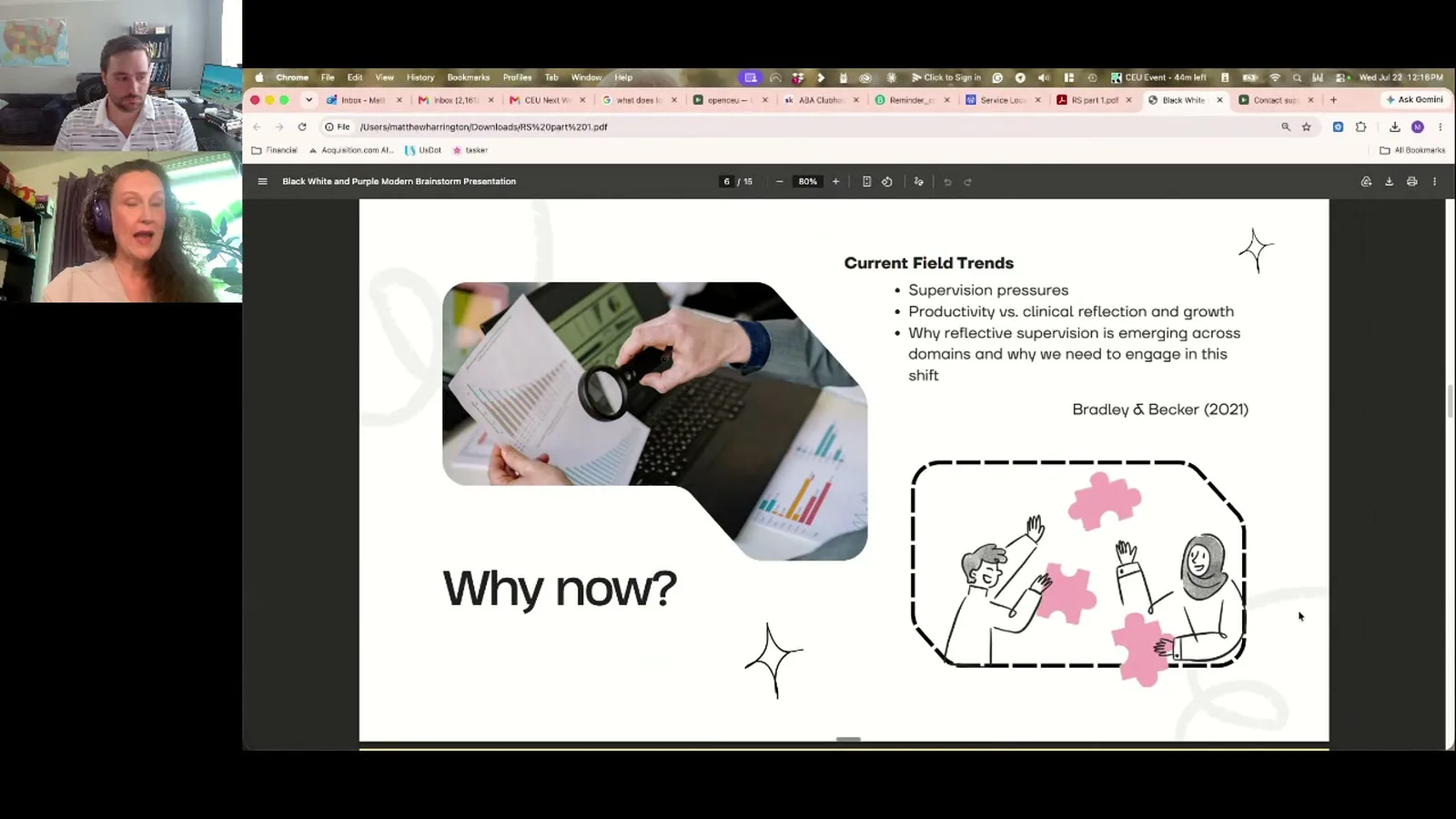
Reflective supervision is relationship based, curiosity driven, and collaborative. It keeps its focus on clinical reasoning and emotional awareness. Gray was blunt about what it is not. It is not a check on your billable hours. It is not a review of whether your treatment plans were written in the approved format.
That work still has to happen. It just belongs to administrative supervision (a check on rules and paperwork), which is a different job. Reflective sessions are also not advice hours. Gray ruled out the have you tried this move and the handout of strategies to consider. There is no one right answer zone here, and no I am right and you are wrong zone either.
The group came in with homework from the prior session. For a month they had practiced reflective dialogue during case discussions and watched what their teams did. Their reports were concrete. People were more patient with each other. Conversations felt more personal and more humane. Communication improved, and so did treatment implementation.
Gray also tied the content to the BACB task list (the board's required study topics). The material lands under personnel supervision and management. It also lands under selecting and implementing interventions, for staff and colleagues as much as for clients. The rest covers the risks of ineffective supervision and clear performance expectations. It also covers evaluating whether your supervision is working at all.
Snowden, Liggett and Taylor (2017): Faster Action, Higher Fidelity
Gray opened the research portion with a 2017 review by Snowden, Liggett and Taylor. The team screened a very large pool of studies, and strict criteria cut that pool down to 17. They looked at how health professionals were supervised across many different fields. The questions were which supervision model was used and how care was affected.
One finding was about speed. Staff on a cardiac unit responded faster to situations calling for CPR (emergency steps to restart breathing and heartbeat). This happened after they received reflective supervision. They began the right procedure sooner than they had before. Gray tied that gain to having a place to reason through hard clinical decisions with other people.
Quality and fidelity of intervention also rose. That pattern held across several groups, including birth and neonatal professionals and social workers. Their results beat those of workers who got only the standard administrative supervision most of us know. They also beat those of workers who got no supervision at all.
Two findings cut the other way, and Gray did not hide them. Patient satisfaction did not track with reflective supervision, and it likely depends on many other variables. Administrative supervision did lift adherence to process, but mostly in controlled environments. In busier outpatient settings, that gain did not generalize, because more decisions had to be made on the spot.
The Comparison We Still Need: Administrative Versus Reflective
Gray flagged a real gap in this literature, and she did it from a scientific angle. Clean evidence would compare three groups: no supervision, administrative supervision, and reflective supervision. Then you could see each variable clearly and point to the effect on clinical growth. Most of the included studies never set it up that way.
Instead the comparisons were administrative supervision against none, or reflective supervision against none. That leaves the most useful question open. It also leaves us short of the evidence base. We would need that evidence to build this into a standard supervision model.
Then she named the bind that comes with fixing it. Behavior analysts want clean data, and getting it here would mean leaving some providers unsupervised on purpose. Those providers are people with working lives, and their clients are people too. Gray said this is exactly where our field gets criticized for a lack of compassion. Her ask was for designs that respect the humanity on both sides of the service.
There weren't administrative versus reflective, so that was a barrier in this study.
From the talk — B. Kuereine Gray
What Providers and Families Actually Reported
Helenin and McMahon ran a four month reflective supervision pilot group with Irish social workers who support autistic adults. The anecdotal material that came out of it was rich. One participant said the sessions left them energized and gave their skill set room to develop. They described work that moved past the theory behind an intervention. It also covered what the intervention looks like, why it matters, and how you evaluate it.
Another participant described improved awareness of pace and of supporting different individuals. That is perspective taking applied to treatment planning. Gray noted that she left a couple of the study quotes out of her slides. She said they could be upsetting to read.
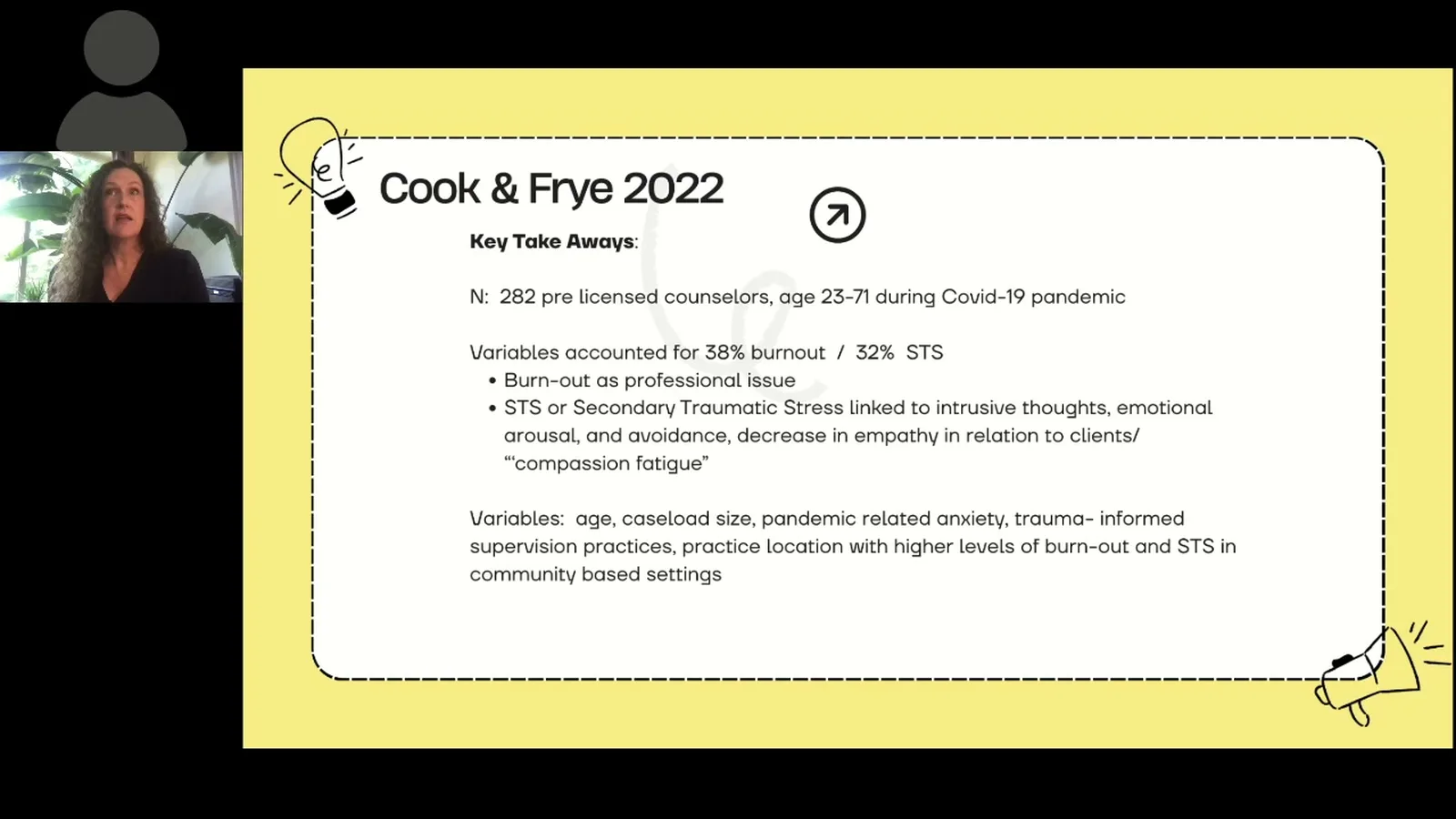
Ravalier reviewed 27 papers in 2022 on reflective supervision in social work. The review kept an eye on the service users themselves. The measurable link on the client end turned out to be thin, and the process is complex. Much of the evidence rested on provider self ratings. Providers said they felt more successful and built better relationships with the people they serve. When recipients were assessed, they reported more skills, more quality of life activities, and more satisfaction with their support.
Huff Hines looked at early intervention providers in 2023 and found only three qualitative papers. Those showed a change in how professionals interacted with the families on their caseloads. Gray summed up the whole picture as A to B to C, not A to B. The primary effect is client centered care from a curious clinician. The secondary effect is higher fidelity and quality in what providers use and teach. The third is less burnout and stress, fewer call outs, and steadier delivery.
Vulnerability, Bias, and Knowing Your Own Barriers
Reflective work gets personal faster than most supervision does. A case can echo something from your own history. It can echo something you watched happen to someone close to you. That brings a real emotional response into the middle of clinical decision making.
Gray's guidance was not to broadcast everything in a group setting. Vulnerability does not always have to be public. It does mean you notice what came up instead of pushing straight past it.
From there the work is on the supervisor. Know your own barriers. Then seek out help, support, and guidance for them, so they do not quietly shape the care you give. Gray also told the room to plan on making mistakes, including as an experienced supervisor. You can catch yourself, apologize, interrupt, and reframe. Correcting your own behavior in the moment is the actual skill.
And it's important that we allow ourselves to be vulnerable.
From the talk — B. Kuereine Gray
Reflection Inside Case Conceptualization
This model is not only a meeting on the calendar. Gray applied it directly to case conceptualization (how you frame a case). Before treatment starts, take a proactive pass at your own bias. Look hard at the personal and environmental barriers that could block the plan you are about to write.
Once services begin, look at every variable that shapes response to treatment. That includes setting events (things that set up behavior) and motivating operations (what makes a reward matter). It also includes antecedent patterns (what happens right before behavior). Behavior analysts already do all of this. The reflective difference lives in the question you ask next.
Taking data and analyzing it can quietly turn a person into a data point. Gray pushed for a habit of wondering out loud about why a pattern is there. Ask what you might be missing and what sits between the lines of the record.
She compared the shift to moving from a classic functional behavior assessment (a test of why behavior happens). The other approach is an open ended interview and synthesized contingency analysis (an interview based function test). One checks the usual suspects in a tidy way. The other digs for everything that might be contributing. That includes influences you cannot see yet but still have to plan around.
We deal with human beings.
From the talk — B. Kuereine Gray
How to Build a Simple Reflective Supervision Protocol
Gray admitted the model can feel hard to pin down and too abstract, so she starts with guardrails. Set your parameters and expectations before the first session runs. Tell the group plainly what this hour is and what it is not. If your team is still new to it, repeat those expectations every time.
Many groups open with a short centering activity, and five minutes is usually enough. It might be a guided meditation, or a single question to sit with quietly. It might also be physical. Gray builds movement into her own groups. Not everyone becomes present and ready to learn just by sitting and thinking. She frames that as accessibility, not extra. In her monthly group of reflective supervisors, members rotate who leads so everyone keeps practicing.
Next comes a case presentation. The group gets a reminder up front about HIPAA (privacy rules for health records) and FERPA (privacy rules for school records). The discussion that follows is not a list of fixes. Ask what has not been considered yet. Explore different avenues and the evidence base for choosing one over another. People should leave with more tools and more confidence using them alone.
Follow up is the step teams skip, and Gray does not run it as a did it work review. She asks whether the provider, the parent, the teacher, and the caregiver felt successful. That is not a slide into mentalism (explaining behavior by inner feelings alone). Those feelings happened because something happened, and the data is usually there to back it up. She closed by sharing a practice resource with three sample cases and reflective questions for role play.
Reminder, this is a no-judgment session.
From the talk — B. Kuereine Gray
Common questions
What is reflective supervision in ABA?▾
It is a relationship based, curiosity driven, and collaborative form of supervision. The focus is clinical reasoning and emotional awareness rather than paperwork and hours. Sessions usually pair a short centering activity with a real case discussion. The goal is better clinical decision making, not a list of strategies to try.
How is reflective supervision different from administrative supervision?▾
Administrative supervision checks rules, hours, documentation, and process adherence. Reflective supervision asks why you made the clinical decisions you made. In the research Gray reviewed, administrative supervision lifted process adherence mainly in controlled settings. That gain did not generalize to outpatient work. Reflective supervision was linked to better quality of care and to repeating evidence based practice across patients and settings.
Does reflective supervision actually improve client outcomes?▾
The evidence is promising but still young, and Gray was honest about that. Reviews found improved treatment fidelity, quality, and speed to action among providers. Direct measured links to client outcomes rest largely on self ratings. Almost no study compares administrative supervision to reflective supervision head to head. The clearest path is indirect: supervision changes how providers work with families, and that reaches the client.
How do I start reflective supervision with a team that has never done it?▾
Set your parameters first and say out loud that this is a no judgment space. Open with five minutes of centering, and offer a movement option for people who do not settle by sitting. Bring one case, protect confidentiality, and ask what has not been considered rather than handing out fixes. Then close the loop at the next session by asking whether everyone involved felt successful.
Why does feedback to supervisees so often fail to change anything?▾
One theme in the Q and A was feedback that flows only one direction. Supervisees fill out a survey, everyone calls it great, and nothing in the supervisor's behavior changes afterward. That pattern crushes motivation and drives turnover. It also sends a clear message that the evaluation was never taken seriously. That is exactly what a follow up step is meant to prevent.
About the speaker
B. Kuereine Gray is a small business owner, clinician, and presenter. She has worked in the disability field since 1997 and has been a BCBA (Board Certified Behavior Analyst) since 2007. She is an infant and early childhood family mental health specialist and a reflective supervisor. She says she was the first licensed behavior analyst in Maryland. She is also a parent and says she is neurodiverse herself. She takes part in a monthly reflective supervision group where members rotate who leads.
This summary was generated from the recording’s transcript. Quotes are taken word for word from the talk.
What you'll learn
- 1-Describe how provider functioning is linked to client outcomes -Explain how reflective supervision is linked to treatment fidelity -Describe how reflective supervision improves clinical quality -Identify strategies for integrating reflective supervision across service models
Concepts in this CEU
Related talks
Talks that cover the same concepts
Reflective Supervision and Provider Outcomes in ABA
The Behaviorist Bookclub
Foundations of Reflective Supervision in Behavior Analysis
The Behaviorist Bookclub
Research to practice - extending past the pages
The Behaviorist Bookclub
Dunder Mifflin’s Guide to BCBA Supervision: Lessons from The Office
The Behaviorist Bookclub

So You Think You Can Lead, Ten Self Reflection Questions for Leaders in ABA
Hickory Learning Group
Toward an Evidence-based Supervision Model: Training Students in Independent Fieldwork
Willow Mentorship & Consulting, LLC
More from The Behaviorist Bookclub
Supervising Beyond Technical Skills: Professionalism, Communication, and Clinical Judgment
The Behaviorist Bookclub
When the Foundations Are Right: Unlocking Advanced Verbal Repertoires
The Behaviorist Bookclub
Empowering Autonomy and Self-Management in ADHD Learners
The Behaviorist Bookclub
OpenCEU is supported by advertising from third-party sponsors. Sponsors are clearly labeled, have no influence over course content, instructors, or CEU decisions, and never appear on certificates. The BACB does not sponsor, approve, or endorse OpenCEU sponsors or their products.