The Four Function Paradigm (Part 1)
Presented by Stu Law, Ph.D.
The ‘four-function’ paradigm has had hamstringing effects—where complex human issues like dignity and assent demand we go next. Functional analysis (FA), as originally articulated by Skinner (1938), was not constrained to any fixed set of functional categories. The emergence and subsequent technological success of the ‘Iwata-style’ FA, however, led to the widespread adoption of four broad functional classes within Applied Behavior Analysis. Although these categories have demonstrated utility—particularly with individuals whose verbal repertoires are extremely limited, they are woefully insufficient for capturing the full range of human behavioral complexity. The limitations emerge more quickly than one might imagine, as once a person reliably demonstrates even basic relational operants such as mutual entailment, the probability of obtaining undifferentiated FA outcomes increases dramatically (Belisle et al., 2017). Despite these constraints, the four-function model continues to be applied to verbally able populations (e.g., Sasso et al., 2001), often without consideration of its conceptual or empirical limits. This two-part series examines the shortcomings of the four-function paradigm, the emergence of approaches that aim to address these gaps, and some (both verbally and non-verbally mediated) consequences that may be more up to the task of understanding why humans do the things they do.
Register free & watch nowCancel any time. Cert delivered to your inbox the moment you pass the quiz.
About this CEU
The ‘four-function’ paradigm has had hamstringing effects—where complex human issues like dignity and assent demand we go next. Functional analysis (FA), as originally articulated by Skinner (1938), was not constrained to any fixed set of functional categories. The emergence and subsequent technological success of the ‘Iwata-style’ FA, however, led to the widespread adoption of four broad functional classes within Applied Behavior Analysis. Although these categories have demonstrated utility—particularly with individuals whose verbal repertoires are extremely limited, they are woefully insufficient for capturing the full range of human behavioral complexity. The limitations emerge more quickly than one might imagine, as once a person reliably demonstrates even basic relational operants such as mutual entailment, the probability of obtaining undifferentiated FA outcomes increases dramatically (Belisle et al., 2017). Despite these constraints, the four-function model continues to be applied to verbally able populations (e.g., Sasso et al., 2001), often without consideration of its conceptual or empirical limits. This two-part series examines the shortcomings of the four-function paradigm, the emergence of approaches that aim to address these gaps, and some (both verbally and non-verbally mediated) consequences that may be more up to the task of understanding why humans do the things they do.
Credits
1.5 CEUs · 89 min
From the talk
What was covered
Stu Law breaks down why the four functions fall short for clients who use language. He offers other words, like rule-following, control, and things fitting together, to describe what really maintains behavior.
- Treat each function label as a tool, not a fact. Ask if the word helps you predict what happens next.
- Check how well a client uses language before you run a standard FA (a test to find out why behavior happens). Strong language skills make a clear result less likely.
- Learn new words for rule following, like doing something because people like the asker, or because the rule worked before.
- Treat control, and giving up control, as real reasons behavior happens. Don't rule them out just because they sound odd.
- When you call something a synthesized function (several reasons combined into one), say what it is made of. Don't leave it vague.
- Watch for other reinforcers in clients who use language. These include signs of damage (proof someone got hurt), sensed order (a felt need for things to be complete), and coherence (a sense that things fit together).
Worldviews Come Before the Four Functions
Stu Law did not start with data sheets. He started with worldviews (beliefs you hold before you even pick a topic to study). A worldview answers a basic question: what is science for? He traced this idea to older work on Stephen Pepper. Law later said the paper was by Hayes, Hayes, and Reese. It discusses Pepper's ideas about science. Pepper did not write it himself. Most training skips this step. Law thinks that is a real loss.
A mechanist (someone who sees the world as moving parts, like a machine) sees a person as wires, gears, and forces. Say a child wets their pants in class. A mechanist might ask about brain signals or bladder size. Much of what we call mainstream science works this way.
A formist (someone who sorts the world into types and categories) wants a catalog instead. What types of things exist? What are the subtypes? Think of the DSM (the manual used to sort mental health conditions) or lists of personality types.
An organicist (someone who looks for orderly growth stages) looks for steps, like stages of growth or stages of learning language. Picture a plant moving from one phase to the next.
Then there is functional contextualism (a view that judges ideas by whether they work), which is where Law stands. Put all four worldviews at one table and they will argue about what to do next. Law said an IEP meeting can feel just like that table. His move is to guess each person's worldview first. Then he talks in terms that person already values. He also said a worldview is not tied to one field. You can be a mechanist and a behavior analyst. You can be a functional contextualist and an engineer or a teacher.
Functional Contextualism: Useful Beats Real
Pragmatism sits at the heart of this view. What is true is what works. That sounds loose, but it is a sharp line. Take gravity. We do not ask whether gravity exists. We ask whether the word helps us predict and act.
Law shared his advisor's definition of science. He liked it for two reasons. First, science is a human activity. People organize themselves to study things. It is not handed down from on high. Second, science aims at goals. We build organized statements about how things relate. We base them on evidence we can check. That helps us reach our goals. Three tests keep coming back in this talk: precision, scope, and depth.
Skinner said the purpose of science is prediction and control. Law noted that the field later swapped the word control for influence. Control sounds harsh to many of us. He thinks that was a good change. This stance also brings relief. Physicists can argue about whether life is a computer simulation. A behavior analyst can shrug and keep working. We are trying to make lives better either way.
This changes the whole question about functions. Asking how many functions exist is almost the wrong question. There are as many as our words allow. The real test is whether a word buys you precision. Does it help you act well next time?
So we didn't discover gravity, we created a word called gravity that's really helpful.
From the talk — Stu Law, Ph.D.
The Four Function Paradigm and the Grenade Question
Law argued that a four function paradigm (the habit of sorting all behavior into four categories) is everywhere in the field. It shows up in training, in talk, and in reports. One split is worth keeping clear. Functional analysis (figuring out why behavior happens) can mean a broad activity. It can also mean a formal test with set conditions. You hope one condition stands out from the rest.
The common four are attention, escape from demand, access to tangible items, and automatic reinforcement (reinforcement that does not depend on another person). Some people relabel them as positive and negative social functions. Law said that relabel does not fix the problem. He was fair to the four, though. They earned their place because they work. Attention is very common. He often tells parents that even a reprimand can feed the behavior. The point is not to throw the four out. The point is that four words are not enough.
His turning point came from an old online discussion thread. Someone new to the field asked a question. People with doctorates answered attention. Their logic was that the person somehow knows a monument will come later. Law found that view grotesque. A sacrifice gets reduced to applause the person will never hear. He brought the idea to his lab under the title 'the case against functional analysis.' His advisor called that unnecessarily incendiary (needlessly provoking).
He also showed a photo from a local conference trivia night. The question asked which option is not one of the four functions of behavior. That slide shows the paradigm sitting in plain view.
if a soldier jumps on a grenade to save his platoon, which of the four functions is that?
From the talk — Stu Law, Ph.D.
Where the Four Functions Break Down: Verbal Repertoires
Mutual entailment (flipping a stated relation around) is a simple skill. Say my aunt is older than my uncle. If you can tell me my uncle is younger than my aunt, you have it.
Law pointed to work showing what happens once a person can do that. Undifferentiated results (tests that show no clear function) become far more likely.
This matters because caseloads have changed. The field built its track record when early intervention often capped out around ages three to five. The age range served is much wider now, and it varies by state. Law said he and his wife work with people in foster care who use complex language. Most of us learned the four functions, plus mands (requests) and tacts (labels for things). Few of us learned enough about language itself to keep up.
He made the point using himself as an example. Run an FA on him and he could give you whatever result you wanted. So who draws the line? Which skills tell us a formal FA will not pay off? He said almost nobody is doing that work.
He pointed to an article from another field. Teachers in social and emotional classrooms described behavior analysts coming in to run FAs. The analysts reported functions, and the teachers stayed confused, because nothing useful followed. Law also described a recent case with a high school student. The team ran an FA and used a red card and green card for lying. He was not mocking those practitioners. He thinks they had no tools for a person with that much language.
as soon as a person can engage in mutual entailment, the notion of a four-function FA goes out the window.
From the talk — Stu Law, Ph.D.
Functional Analysis Is Bigger Than Four Conditions
Law pushed back on hero worship in the field. Nobody in physics asks what Newton would do. Evolution researchers say they have moved far past Darwin. He wishes we could talk that way about Skinner. He pointed to our small footprint in psychology and to journal impact factors near two. He was clear that Skinner is not the problem here.
Skinner wrote about functional analysis broadly. He asked why a person does what they are doing right now. He wrote about seeing something in the absence of the thing itself. Those are questions about people with long histories and full language skills.
Functional analysis also lives outside our field. Most of Law's lab mates were clinical psychologists. They would say their job is functional analysis too. They sit with a client, ask questions, create small moments of discomfort, and watch. Functional analytic psychotherapy is built on that idea. Process based therapy goes further, and Law is a fan of it. He said ACT (a therapy built on language work) assumes some functions ahead of time. Process based therapy tells you to go look instead.
The outside view of our version is not flattering. Law said these writers call our functional analysis limited and weak, and some say it is dead. He mostly agrees about the narrow scope. He called the ISCA (a newer, broader way to study function) a step forward. Some critics say it already goes too far. Law says it does not go far enough. The synthesized function (several reinforcers combined into one result) is honest about how different each person is. It is still too vague for him. He wants us to name the thing. Say what it is made of.
Pliance, Tracking, and Augmenting as Functions
Pliance (following a rule because of who is asking) comes from relational frame theory (RFT, a theory about how language links ideas). You follow a rule based on your history with people who look like the rule giver. A police officer says get off that lawn. A stranger who smells like whiskey says the same thing. You respond differently, based on who is talking and your history with people like them. Teachers and therapists carry those same features.
Law shared a case from a clinical colleague. A client stayed late for every deadline at work. She was first to haul boxes on a friend's moving day, even before anything was packed. People were leaning on her, and she felt real distress. The therapist gave her odd homework: empty the pantry, then put everything back. She did it. He asked her why she bothered, since it served no real purpose. The point landed. She follows instructions even when they make no sense.
Tracking (following a rule because you have seen it work) is a second reason. A friend gives you directions to a campsite. You spot the oak tree, then the people partying, then the yellow tent. Each sign feels good. A pottery teacher tells you to cup your hands, and your pot comes out better. A coach says turn your wrist, and the ball goes farther while your hands sting less.
Augmentals (words that raise or lower the value of something) are the third. They work like motivating operations (things that shift how much a reward matters), but through language. A teacher says this is not a regular pen, it is a special pen. Trading cards are the loud example. You never check every card to prove one is rare. Someone tells you it is rare, and people start fighting over it in line.
when you see a rule working that can function as reinforcement
From the talk — Stu Law, Ph.D.
Control, Choice, and the Relief of Not Choosing
A supervisee brought Law a hard case. A client would look her in the eye and pee on the floor. The client knew an adult had to clean it up afterward. Her supervisor insisted that control cannot be a function. Law reframed the whole dispute. He thinks the answer here is clearly yes. Calling it control points you at the real reason the behavior keeps happening.
Toddlers show this plainly. You sit at a pretend tea party. You drink the tea and say it was delicious. The child corrects you. Hold the pinky up. Do it again. That child is testing the edges of their own influence.
Giving up control can also work as a reinforcer. Law used judges as his example. You decide other people's futures all day. You come home and want to make zero decisions. He does the same thing at dinner. He will clean the kitchen if someone else picks the food. At a sushi restaurant, he asks the server to just bring whatever they would eat.
Choice has a clean study behind it. Law pointed to a study by Hanley showing choice working as a reinforcer. Kids picked their own M&M, with some small ceremony around the pick. He recalled roughly ten times the reinforcing value compared to just handing one over. The flip side shows up in toys. Mystery boxes and surprise packs sell on not knowing what you got. The missing choice is part of what people respond to.
We're asking the question, is it useful to call it control?
From the talk — Stu Law, Ph.D.
Signs of Damage, Sensed Order, and Coherence
Signs of damage (visible proof that another person got hurt) has real research behind it. Law described work with pigeons. Put a bird under harsh conditions and it will work to get access to another bird, just to peck at it. The pattern looks like working for food after going hungry. Humans do a version of this too, and revenge is the easy example. Law was careful about how we use this idea clinically.
There are pro-social ways to meet this need. Board games do it well. You send a friend's piece back to the start and they groan. Whole schools read stacks of books to hit a goal, so they can shave the principal's head. Law described a child who used to cook him pretend food. He would eat it and fake a big dramatic gag. The child worked hard just to see that reaction. Signs of emotional damage often carry the whole weight on their own. A simple oh, dang it can do it. When real blood shows up, things can escalate. Staff then learn not to show the mark. Signs of joy are a separate thing from attention. A student hands over a gift and hears a polite thank you. If the joy sounds fake, that response can work as an aversive (something the person tries to avoid), not a reward.
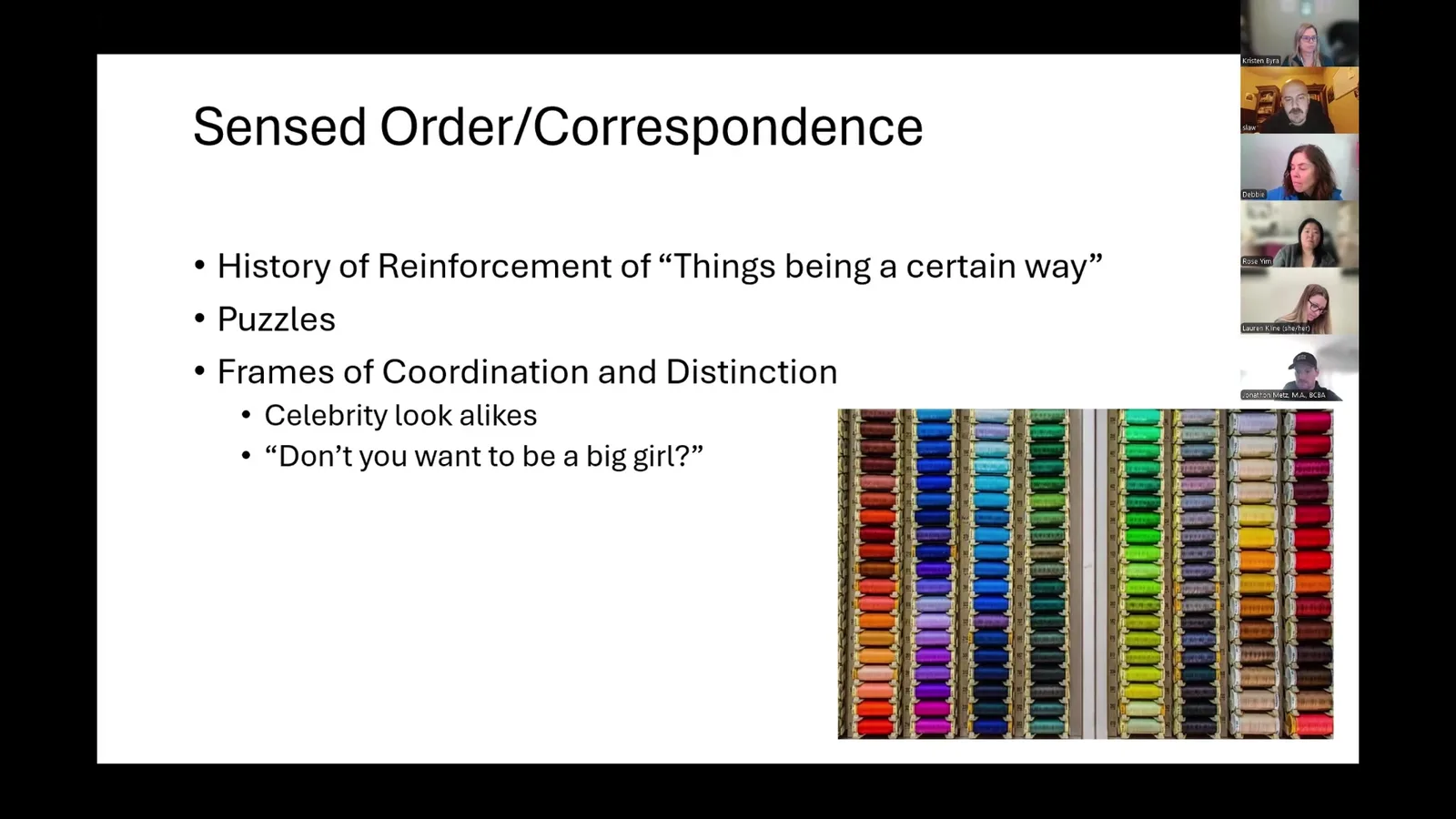
Sensed order and correspondence (a felt sense that things are complete or in the right place) shows up constantly. One missing piece from a thousand piece puzzle will haunt you. Law described a dollhouse with place settings and one empty seat. A child would work hard just to get the missing plate and set it in place. That is not plain access to a tangible item. Frames of coordination (treating two things as the same because they share a link) work the same way. A parent might say you went potty just like your big brother. Adults are no different. Tell Law his paper sounds like a writer he admires, and watch that land as a reward.
Coherence (a sense that things fit together and make sense) closed out his list. Law said Skinner wrote about this, likely in Verbal Behavior. A high school student will not sit through a lecture on surgery, and will not sit through the ABCs either. Good talks stretch a listener's understanding without losing them. Music resolves back to a home note. Jokes resolve with a punchline. A show resolves with a final episode. Law pointed to the kid who is one minute from beating a boss when the timer goes off. We often call what follows counter control. He thinks the cleaner story is that we cut off coherence. His closing call to action was simple. Put these words into our writing. Then the field can use them in real cases.
having an awareness of signs of damage as a reinforcer doesn't make us monsters
From the talk — Stu Law, Ph.D.
Common questions
What are the four functions of behavior?▾
They are attention, escape from demand, access to tangible items, and automatic reinforcement. Stu Law does not say these are wrong. He says they are useful words that cover a narrow slice of human behavior. They work best with people whose language is very limited.
Why does a functional analysis come back undifferentiated with a verbal client?▾
Once a person can flip a stated relation around, the odds of an unclear result rise sharply. This skill is called mutual entailment, and it is simple for many people. Language also lets a client guess what the test is checking. Law said he could produce whatever result you wanted if you ran a test on him.
What is the difference between pliance and tracking?▾
Pliance means following a rule because of your history with people who look like the rule giver. Tracking means following a rule because you have seen it work. A pottery student who first cups their hands out of pliance will keep doing it through tracking, once the pot comes out better.
Can control be a function of behavior?▾
Law says the real question is whether the word is useful, not whether control sits on an approved list. When a person acts to make an adult do something unpleasant, calling it control points you at the real reason. He also argues the reverse holds. Giving up control can work as a reinforcer too.
Does this talk reject functional analysis?▾
No. Law argues that functional analysis, in Skinner's broad sense, was never limited to four categories. His target is the narrow four function paradigm and the formal test applied to people it does not fit. He wants more precise words, not fewer analyses.
About the speaker
Stu Law, Ph.D., is a behavior analyst who focuses on the conceptual foundations (basic assumptions and philosophy) behind the science. He trained in Steve Hayes's lab, where most of his lab mates were clinical psychologists. He has authored over 20 publications and helped create a skill-based assessment. In this talk, he links worldviews and pragmatism to the limits of the four function paradigm, then offers other words for verbal consequences, like pliance, tracking, control, and coherence.
This summary was generated from the recording’s transcript. Quotes are taken word for word from the talk.
What you'll learn
- 11) More adequately frame ‘the four functions’ in a broader understanding of functional assessment 2) Discuss functions like ‘pliance’ and ‘tracking’, and ‘signs of damage’ that may or may not be more adequate for verbally mediated behavior 3) Describe a broad history of Functional Assessment
Related talks
Talks that cover the same concepts
A Panel on Collaboration in Practice: SLP, OT & ABA Services
Upskill ABA
From Peer to Professional: Becoming & Supporting Early Career Behavior Analysts
Upskill ABA
From Idea to IRB: Conducting Research in Your ABA Practice
Upskill ABA
Quality Without Measurement is Just Marketing: A Critical Analysis of Quality Service Delivery
Upskill ABA
Practical RFT
Upskill ABA
Assent and Compassionate Care: Ethical Issues and Considerations for Practice
Upskill ABA
More from Upskill ABA
OpenCEU is supported by advertising from third-party sponsors. Sponsors are clearly labeled, have no influence over course content, instructors, or CEU decisions, and never appear on certificates. The BACB does not sponsor, approve, or endorse OpenCEU sponsors or their products.