What Is Assent in ABA? A Plain-English Definition
Assent in ABA means a kid's ongoing okay to keep going, not a one-time form. Learn what counts, what withdrawal looks like, and why it matters.
Key takeaway
Assent in ABA is a kid's ongoing okay to keep going in a session, not a one-time form a parent signs. It is a moment-by-moment yes from the learner.
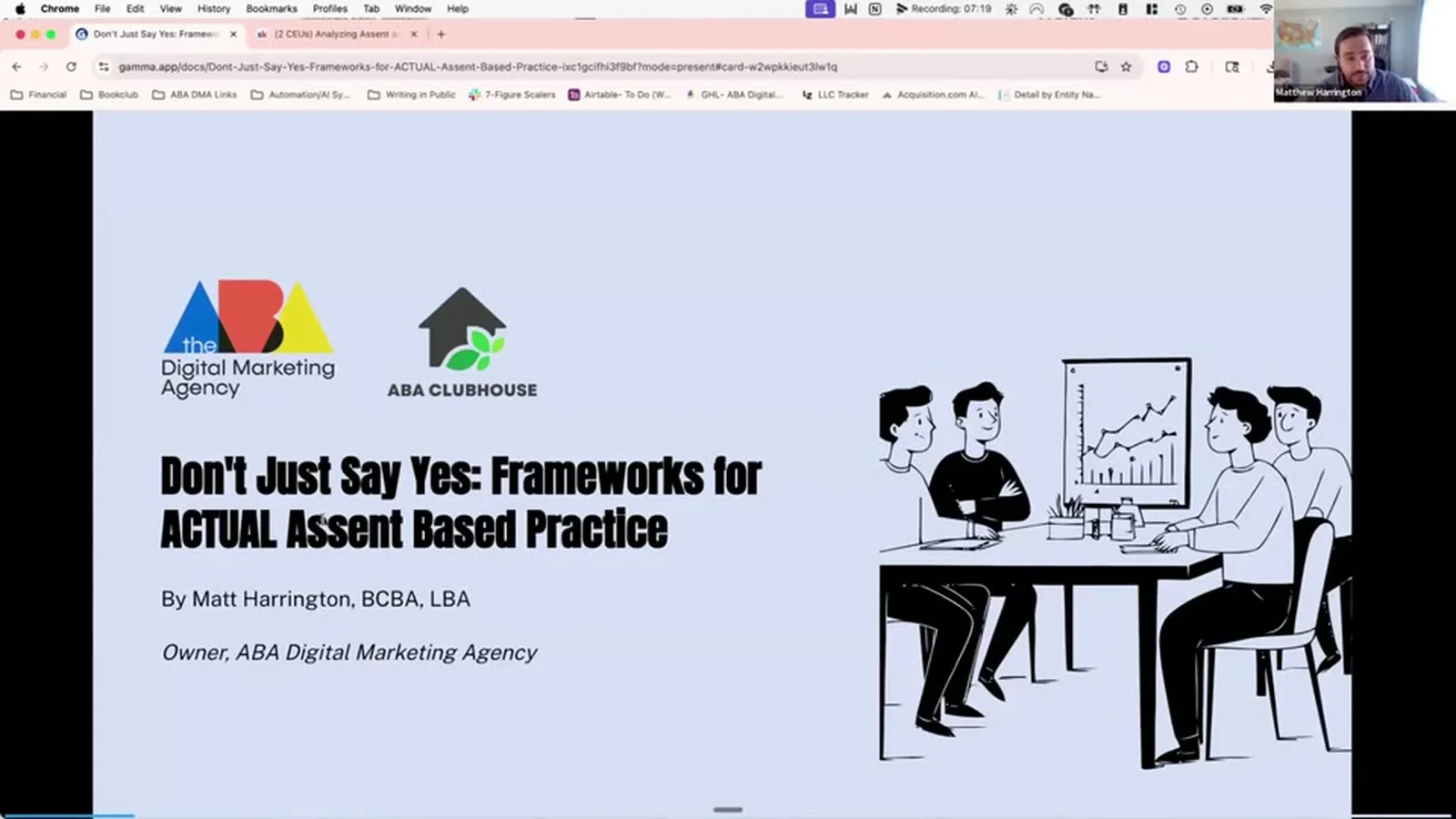
Assent: Don't just say Yes!-
On this page · 9 sections▾
Assent in ABA is a kid's ongoing okay to keep going in a session, not a one-time form a parent signs. It is a moment-by-moment yes from the learner. A BCBA (a board-certified behavior analyst who runs the plan) watches for it the whole time. So does the RBT (a registered behavior technician who runs the trials). The yes can change at any second. When it changes, the session has to change too.
This page is the plain-English definition. It is not the ethics theory page. It is not the "how to write it into your treatment plan" page. It is the one you read when someone says "we are an assent-based clinic" and you need to know what that actually means in a room with a real kid.
H2 outline#
- Assent is ongoing agreement, not a one-time yes
- What assent looks like in a real session
- Three signs a client just withdrew assent
- Why ABA needs assent (not just consent)
- What assent does NOT mean
- How to start measuring assent today
Assent is ongoing agreement, not a one-time yes#
Consent is a one-time thing. A parent reads the plan, gets the risks, and signs. That signature covers the whole stretch of services. It does not have to be re-checked every five minutes.
Assent is different. Assent is the kid showing, in real time, that they are still on board. It can shift in the middle of a trial. It can shift between trials. Matt Harrington puts the definition this way in the talk:
Assent means a continuous dynamic agreement to the continued intervention process. From the talk — Matt Harrington
"Continuous" is the load-bearing word. The kid is not signing a paper at 8am that locks them in for the day. They are voting yes or no with their body and their behavior the whole time. The job of the team is to read those votes and respond.
What assent looks like in a real session#
Here is the part that trips up most new clinicians. They expect assent to look like a big happy yes. A grin. A high five. A "let's do math!"
That is not the bar. The bar is much lower. Matt names it directly:
Assent provision is not yes, yes, yes. Oh my gosh, I want to do this. It is, sure, let's go for it. From the talk — Matt Harrington
Call this the "eh, whatever" bar. The kid shrugs. The kid sits down. The kid picks up the pencil without complaint. That counts. You are not trying to manufacture excitement about a worksheet. You are trying to get a calm "sure" so the work can happen.
If you want a real-world check, look at your own day. Did you sprint to your laptop to fold laundry? No. You sighed, put on music, and got to it. That is assent. It is good enough. It is the goal.
Three signs a client just withdrew assent#
Assent withdrawal is not just a kid running across the room. That is the most obvious version. There are quieter ones that come first. If you only spot the loud version, you have already missed two or three earlier chances to change course.
Here are three early signs to train your eyes on.
1. Body shifts away from the work. The kid turns their shoulders. They lean back. They drop their head onto the table. The body is voting before the mouth is. A trained RBT picks this up in the first second.
2. Pace drops to a crawl. A kid who was answering in two seconds is now taking thirty. They are not stuck on the content. They are stuck on the situation. Slow pace is a soft "I am done."
3. Eyes find the door, the window, or a preferred item. The kid is mentally somewhere else. They are scanning for a way out, or for something better. This is assent withdrawal even if no behavior has fired yet.
These three show up before the headbang, the tantrum, the throw. Catch them, and the session never gets to the loud version.
Why ABA needs assent (not just consent)#
Other helping fields can mostly lean on consent. A speech session is thirty minutes. A counseling visit is fifty. A doctor visit is fifteen. The parent's one yes covers a small block of time.
ABA is different. ABA sessions can run three, four, six hours. They can run every day. The kid who walked in at 8am is not the same kid at 3:30pm. They are tired. They are hungry. They have already done a hundred trials. Matt frames it like this:
A five-year-old saying yeah, let's get started with therapy at 8am is not the same five-year-old who says yeah, let's do the ninth DTT task at 3:30pm with no nap. From the talk — Matt Harrington
DTT here means discrete trial training, a short repeating teaching format. Nine rounds of it on no nap is a different ask than the first one of the day. The parent's signature from intake cannot speak for that 3:30pm kid. Only the kid can. So the team checks in, in real time, the whole session.
That is why ABA built the assent concept into modern practice. The work is long. The work is hard. The work has to keep checking that the learner is still in the room with us.
What assent does NOT mean#
This is where most outside teams get stuck. They hear "assent-based" and they picture a clinic where kids do whatever they want, where nothing hard ever happens, where the BCBA shrugs and lets the kid eat candy for lunch.
That is not what it means. Matt is blunt about this:
Assent is not just backing off when you meet resistance. There's a lot more to it. From the talk — Matt Harrington
Backing off is step one. Step two is the part most people skip. Step two is changing something so the next try is easier to say yes to. You might shrink the hard part. You might grow the good part. You might teach a small skill that makes the task less of a wall. Then you re-present.
If you only back off and re-present the same exact trial, you have not done assent-based care. You have just stalled. The trial will fail the same way next time. Real assent-based work changes the setup between tries.
A few more things assent does NOT mean.
- It does not mean the kid never does hard things. Hard things are the whole point of growth. The job is to make hard things doable, not to delete them.
- It does not mean the parent loses authority. Parents still set the goals. The team just gets there with the kid on board, not dragged.
- It does not mean nonverbal kids are left out. Body, eyes, pace, and behavior all speak. A nonverbal kid gives assent and withdraws it just as clearly as a verbal one. The team learns to read it.
How to start measuring assent today#
You can start tracking assent in your next session. You do not need a new app. You do not need a new form from your BCBA. You need a simple count.
Step 1. Pick one routine. Maybe it is the morning DTT block. Maybe it is the tooth-brushing program. Pick one chunk of the day that runs the same way every day.
Step 2. Tally two numbers. First number: how many times did the kid give that "sure, let's go for it" yes? Second number: how many times did they back off, freeze, or push away? You are counting assent and withdrawal. Both are data.
Step 3. Look at the ratio after a week. If withdrawal is climbing, the setup is wrong. Something in the routine needs to change. Talk to your BCBA. Bring the numbers. The numbers are the argument.
Step 4. Use the three-withdrawal rule. Matt teaches this guardrail in the talk. After three withdrawals in a row on the same task, the RBT calls the BCBA. The BCBA changes the plan. The team does not keep hitting the same wall hoping it cracks. The rule keeps everyone honest and keeps the kid safe.
That is the whole starter system. You can run it tomorrow. The point is not perfect data. The point is to make assent something the team is actually watching, not a word in the marketing brochure.
Frequently asked questions#
Is assent the same as cooperation?
No. Cooperation is the kid doing the task. Assent is the kid being okay with doing the task. A kid can cooperate without assent. They can comply because they have learned that complaint does not work. That is not assent. That is shutdown. Assent has to feel like a calm "sure," not a worn-down "fine."
Can a nonverbal client give assent?
Yes. Assent is read from the whole person, not from the mouth. Body posture, eye direction, pace, breathing, and behavior all count. A nonverbal learner who leans in, picks up the materials, and stays in their seat is giving assent. A nonverbal learner who pushes the work away, looks at the door, or starts a precursor behavior is withdrawing it. The team learns to read the signals their specific learner uses.
Do I need a signed form for assent?
No, and a signed form would miss the point. Consent gets a form. Assent gets watched. The team's job is to track assent in the session, write the rate into the treatment notes, and adjust the plan when withdrawal climbs. The form is for the parent at intake. The behavior is for the learner, all day, every day.
Start with the "eh, whatever" bar#
If you only remember one line from this page, remember the bar. You are not chasing big yeses. You are chasing calm shrugs. A kid who shrugs and sits down is a kid who has consented to the work in this moment. That is what you build a session on. That is what you protect when you see the early signs of withdrawal. That is the standard the team measures against.
Want to see how Matt walks through this in a live session, with real examples from his own caseload? Watch the full CEU. It runs about an hour and earns one credit.
Turn this topic into a CEU
You just studied this. Now get credit for it.
Watch Assent: Don't just say Yes!- with Matt Harrington and earn 1 free BCBA CEU. Detailed certificate, delivered the moment you finish.