What Does Compassionate Care Look Like in ABA Sessions?
A clinician-level answer to what compassionate ABA actually looks like in a real session, from a BCBA-led CEU.
Key takeaway
Compassionate care in ABA is the difference between doing things to a client and doing things with them, and you can spot it in tiny moments like Damon, a teen client, lighting up the first time staff played with their elbows the way he asked them to.
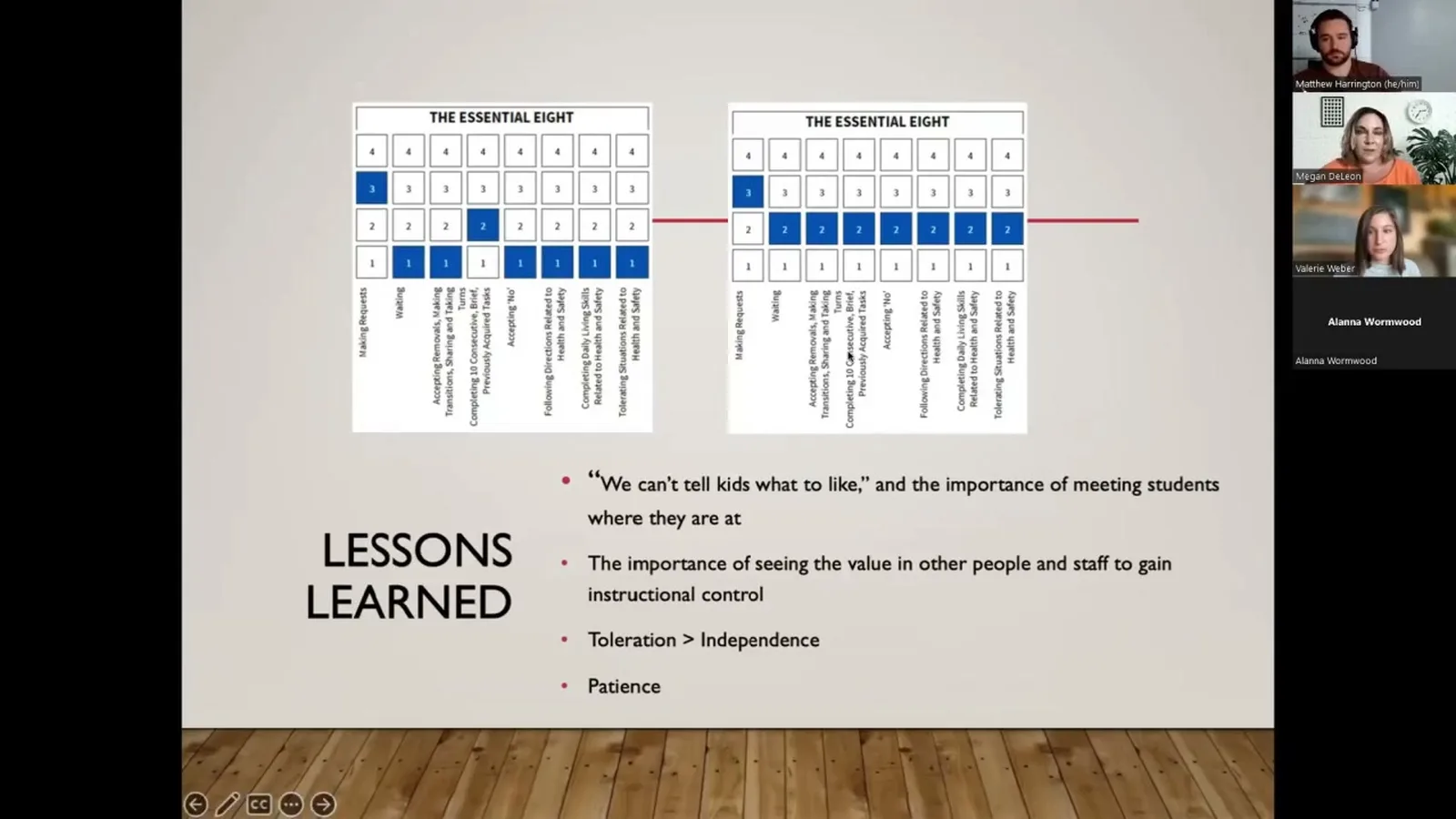
The Heart of ABA Service Delivery: Creating Connected Relationships - Applied 2023
On this page · 9 sections▾
Compassionate care in ABA is the difference between doing things to a client and doing things with them, and you can spot it in tiny moments like Damon, a teen client, lighting up the first time staff played with their elbows the way he asked them to. It is not a value you write on a treatment plan. It is what your hands, your voice, and your eyes do in the next ten minutes of session.
This page gives you the observable behaviors. What a compassionate session sounds like out loud. What it looks like on video. And how to tell when a session has slipped back into checklist mode.
The "To vs With" Test for Any ABA Session#
Watch any five minutes of session. Ask one question. Is the practitioner doing things to the client, or with the client? That test cuts through every other debate about what compassionate ABA means.
A BCBA (a Board Certified Behavior Analyst, the clinician who designs the program) might walk in with a stack of flashcards and run trials for twenty minutes without ever explaining why. The client sits. The client answers. The client gets a token. Nothing about that session is with the client. It is happening to them.
Dr. Megan DeLeon names this exact pattern in the talk:
I can't tell you how many times I've seen people doing stuff to their clients and not with their clients. From the talk — Dr. Megan DeLeon
The fix is not a new program. It is a shift in posture. You stop running drills at a person. You sit next to them, name what you are doing, and notice what they are showing you back.
Five Things You Hear in a Compassionate Session That You Do Not Hear Elsewhere#
If you cannot watch a session, listen to it. Compassionate care has a sound. Here are five things you hear out loud in the room.
- The practitioner says what they are about to do before they do it. "I'm going to move this chair so you have room." Not silent reaching.
- The practitioner names what the client is feeling or noticing. "You stopped. The fan got loud, huh?"
- The practitioner asks before they touch. Even with a young client. Even for hand-over-hand.
- The practitioner explains why a task matters. Not "do three more." Instead, "we are working on this so you can ask for a break by yourself."
- The practitioner pauses when the client signals they are done. They do not push one more trial to hit a session goal.
Those five sounds map to one rule from the talk:
Consistently explain to the learner what is happening and why. Even if there's not a ton of communication coming back to you, we can still take the time to explain what it is that we're doing. From the talk — Dr. Megan DeLeon
The rule applies whether the client speaks in full sentences or has not yet used words. The talking is not for compliance. It is for connection.
Honoring Weird Preferences (The Elbow Story)#
The single best test of compassionate care is what a team does with a client's odd, specific, hard-to-explain preference.
In the talk, Dr. DeLeon describes a teen client named Damon. He liked elbows. Not high-fives. Not hugs. Elbows. When one staff member moved her arm a certain way, he lit up. He started asking her to do it again. He wanted more.
Some staff pushed back. They tried to explain it away or stop it.
When she would put her arm like this, he really liked that. He really lit up when she had her elbows. And he started requesting for her to do some of these different things around her elbows. And there was some resistance from staff. From the talk — Dr. Megan DeLeon
Compassionate care says: the elbow thing is not weird. It is a request. The client is telling you what they like. The clinical move is to follow it, not redirect it.
This is where most teams fail. They treat unusual preferences as problems to extinguish instead of doors the client just opened. The compassionate team walks through the door.
What Compassionate Care Is Not (Common Misreads)#
Compassionate care is not the same as easy care.
It is not skipping demands. It is not letting a session drift. It is not avoiding any task that a client finds hard. A team can be very gentle and still be doing things to a client.
It is also not a vibe. "We have great rapport" is not evidence. Saying "I love this kid" is not evidence. What you do in the next session is the evidence.
A few things compassionate care is not:
- Praise-bombing. Constant "good job!" with no real connection is just noise.
- One-way reinforcement. Handing a client an iPad to keep them quiet is management, not connection.
- Performing warmth for the parent at the door, then running drills as soon as the parent leaves.
- Calling a session "play-based" because there are toys on the floor, while every toy is a covert demand.
If you cannot point to a moment in session where you changed plans because of something the client told you (in words, in gestures, in pulling away), the session was not yet with the client.
Three Client Signs You Need to Slow Down Before Adding Programs#
Some clients need you to build the relationship before you add a single new program. Dr. DeLeon's second learning objective in the talk lists at least three client signs to watch for.
Here are three you can spot in week one.
1. The client runs from adults, not just from work. If a child leaves the room when an unfamiliar adult enters, even with no demand placed, the relationship is the program. Anything else you stack on top will fail.
2. The client does not seek you out for anything good. Not for food, not for toys, not for help. If you are only present for tasks, you have become a task. Nothing connected has been built yet.
3. The client masks. A lot. Older clients, especially teens and adults, often comply on the surface and shut down underneath. If you only have eye contact and "good answers" and no real reaction, something is being hidden. Slow down.
In each case, the answer is the same. You pause skill programs. You build a real connection first. You treat the relationship as the intervention, not the warm-up.
Dr. DeLeon's adult case, EB, makes this concrete. Staff were engaging with him, doing things in the room. They just were not talking with him. When she watched the baseline video, she noticed they were not really talking to EB at all. They were running activities. They were not explaining why, and they were not naming what they saw him do.
One variable changed. Talk more. Explain more. Notice more out loud. That was the whole intervention before any other goal got added.
What Parents Should Look For When Watching Their First Session#
If you are a parent watching ABA for the first time, you do not need to learn the field's terms. You need to watch for five small things.
- Does the therapist greet your child by name and wait for them to respond in their own way before starting?
- Does the therapist explain what they are about to do, in words your child can understand, even if your child does not talk back?
- When your child pulls away, looks away, or says no, does the therapist pause and notice?
- Does the therapist follow your child's lead at least sometimes, even when it looks "off topic"?
- At the end of session, can the therapist tell you one specific thing your child showed them today, beyond a data point?
If you see all five, the session was compassionate. If you see one or two, ask questions. If you see none, raise it with the BCBA running the case.
A compassionate session ends with the therapist knowing your kid a little better than when they walked in. That is the bar.
How to Tell Your Supervisor This Is Not Optional#
If you are a behavior technician or a BCaBA (a Board Certified Assistant Behavior Analyst, the clinician one rung below a BCBA), you may already see when a session is going to a client instead of with them. The harder part is naming it to your supervisor.
Three things help.
Bring a specific example, not a feeling. "In Tuesday's session, we ran 14 trials in a row with no break and the client started head-banging on trial 12." That is data your supervisor cannot wave off.
Tie it to a learning objective. Compassionate care lines up with the second objective in this CEU: identifying client signs that you need to focus on the relationship before stacking programs. That is BACB-aligned, not opinion.
Offer one change, not a full rewrite. "Can we add a five-minute connection block at the start of each session for the next two weeks and re-check pre-session behavior?" Small enough to say yes to. Specific enough to measure.
If your supervisor pushes back with "we do not have time," the answer is in the data. Sessions where the relationship is real run faster, not slower. Clients escape less. Programs stick.
This is the values statement Dr. DeLeon leaves the audience with:
We really have to make sure we're putting in that effort to develop these connected relationships as early as possible and service delivery and continue to honor and affirm the client for who they are. From the talk — Dr. Megan DeLeon
You do not need permission to start. You need one client, one session, and a willingness to talk out loud about what you are doing and why.
Frequently asked questions#
Is compassionate ABA the same as neurodiversity-affirming ABA?
They overlap, but they are not the same. Neurodiversity-affirming ABA is a stance on what counts as a goal worth working on. It rules out goals like "reduce stimming for its own sake." Compassionate ABA is about how you run the session, no matter the goal. You can run a neurodiversity-affirming program in a non-compassionate way. You can also run a compassionate session and still pick goals a neurodiversity-affirming clinician would push back on. Aim for both.
What should I see in a good ABA session as a parent?
You should see your child being talked with, not at. You should see the therapist pause when your child signals they are done. You should see the therapist follow at least some of your child's leads, even the strange ones. And at the end, the therapist should be able to tell you one specific thing your child showed them that day. Not just a percent correct.
How is compassionate care different from regular ABA?
Regular ABA, done poorly, can become a list of programs run on a person. Compassionate care keeps the person in the room. It still uses the same science, the same reinforcement, the same shaping. It just refuses to skip the part where you check whether the client is actually with you. The science does not change. The posture does.
Watch the full talk#
Dr. DeLeon walks through the full SORF assessment, the shaping steps she uses to build a connected relationship in the first weeks of services, and three full case examples (a young child, a teen, and an adult) that show the method in action. The article gives you the principle. The recording gives you the playbook.
Watch the full CEU on openceu.com (2 CEUs, BCBA-aligned).