Sleep Hygiene for ABA Therapists: A Realistic Bedtime Routine
A sleep routine that survives session notes and 6am parent texts. Four pillars and a sample plan, from a BCBA-led CEU.
Key takeaway
An adult bedtime routine is just an antecedent package for sleep: the same cues, in the same order, every night, so your brain learns to expect lights-out at the same time.
Why Am I So Tired? The Science of Sleep for BCBAs
On this page · 8 sections▾
An adult bedtime routine is just an antecedent package for sleep: the same cues, in the same order, every night, so your brain learns to expect lights-out at the same time. A BCBA (Board Certified Behavior Analyst, the clinician who designs behavior plans) already knows how to do this for a client. The trick is doing it for yourself when notes ran late. Here is the worked sample plan you can lift straight onto your calendar: goal bedtime 10pm, wake 6:30am, morning walk with light from 7 to 7:15, meals at 8am, 1pm, and 6pm, last coffee by 1pm, thermostat down by 8pm, timer goes off at 9pm to start the routine, lights out at 9:40 so you have the 20 minutes the body actually needs to fall asleep. That is the whole page in one paragraph. The rest is why it works and how to keep it on the rails when life does not cooperate.
Why bedtime routines are not just for the kids on our caseload#
We write bedtime routines into parent training all the time. Same activities, same order, faded prompts, light dimmed, screen off. Then we close the laptop and go straight to bed at the time we promised ourselves we would, which is also the time our brain has zero cues that sleep is next. The routine is the antecedent. Without it, the response (falling asleep within about 20 minutes) does not happen on cue.
We usually don't think of adults having a bedtime routine. But it's just as important for us as it is for kids to give the body those cues that it's time to wind down. From the talk — Lindsay Anderson
The talk leans on Dr. Matthew Walker's four pillars: quantity (seven to nine hours for most adults), quality (about 85% of time in bed actually asleep), regularity (bed and wake within an hour every day, ideally within 15 minutes), and timing (awake during the day, asleep at night, matched to your chronotype). Pick the pillar you are worst at. That is your first target. Everyone else's plan is a distraction.
Building the routine backward from your goal bedtime#
Start with the bedtime you want and work backward. If the goal is 10pm with eight and a half hours of sleep, the math fixes your wake time at 6:30am. Then you backfill the supports the research says actually move sleep: morning light within the first hour after waking, physical activity earlier in the day, regular meals (including breakfast), last coffee at least 8.8 hours before bed, no pre-workout within 13.2 hours, and screens away an hour before lights-out.
If we have a goal bedtime of 10 p.m. and we find we do best with eight and a half hours of sleep, maybe we set a consistent wake-up time for 6.30 a.m. We get in our walk for that physical activity plus our morning light from 7 to 7.15. From the talk — Lindsay Anderson
This is one example, not a prescription. If you are a wolf chronotype (about 15% of people, peak productivity 1pm to 5pm, natural bedtime closer to midnight), shift the whole grid two hours later. If you are a lion (early riser, bed by 10), pull it earlier. The pattern stays the same. The clock changes.
Antecedent supports that actually work for tired clinicians#
This is where ABA-trained brains have an unfair advantage. You already know how to set up the environment so the behavior happens without willpower. Apply it to yourself. The two interventions the talk highlights are both antecedent-based and both cost nothing.
Something like using a timer that goes off an hour before bedtime can really help us stay on track with starting the bedtime routine. Or something like putting a sticky note on your bathroom mirror can remind you to read after you brush your teeth. From the talk — Lindsay Anderson
The timer is the SD (discriminative stimulus, the cue that signals the response): when it goes off, electronics go away. The sticky note is a written prompt that survives end-of-day cognitive load. Both are designed to be faded later, once the chain is fluent. You will not need the sticky note in three weeks because the response will be under stimulus control of brushing your teeth, the way you taught a learner's transition cue to take over from a verbal prompt.
A few more supports the research supports:
- Morning light within an hour of waking. A walk works. Coffee on the porch works. Even sticking your head out a window works. Every extra 30 minutes of pre-10am light has been shown to improve that night's sleep quality.
- Ten minutes of light morning exercise. The Al Noir study showed this adds roughly two and a half minutes of sleep that night. Small, but on a busy day it is what you have.
- A five-minute to-do list written right before the routine starts. One study found people who wrote a specific list of what they had to do the next few days fell asleep faster than people who wrote about anything else. The more specific the list, the bigger the effect.
- Thermostat between 65 and 68 degrees. Drop it earlier in the evening so the room is at temperature when you lie down.
- A nightlight or low ambient light is fine. Overhead lights and an on TV in the room are not.
A sample 90-minute wind-down (steal this)#
This is the sample plan from the talk, structured as a chain you can run on autopilot.
- 9:00pm. Timer goes off. Handheld electronics go in a drawer. TV on a sleep timer if you use it. Lights dim.
- 9:00 to 9:15pm. Hygiene tasks. Wash face, brush teeth, take medication.
- 9:15 to 9:20pm. Write a specific to-do list for tomorrow. Five minutes. The point is to get the open loops out of your head and onto paper.
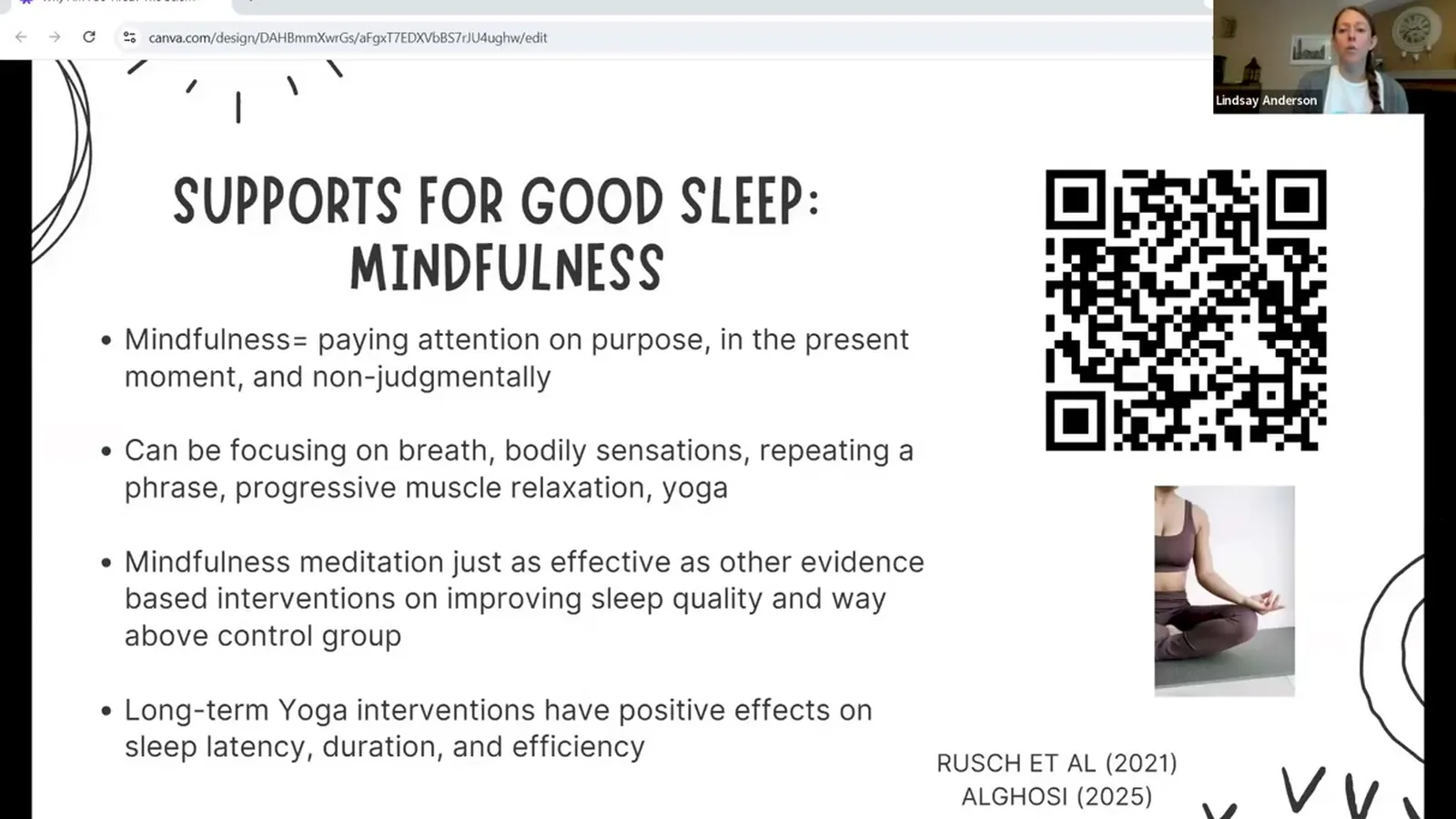
- 9:20 to 9:40pm. Wind-down activity. Reading in bed (the one study with controlled groups showed readers had better subjective sleep quality), a short bedtime yoga sequence, or a body scan.
- 9:40pm. Lights out. Box breathing if your heart rate is still up: in for four, hold for five, out for eight, hold for five. The long exhale activates the parasympathetic nervous system.
- 10:00pm. The 20-minute fall-asleep window is built into the plan, so the goal is realistic, not aspirational.
The whole point of writing it as a chain is that you do not have to decide anything once the timer goes off. Decisions at 9pm after a heavy caseload day are how the plan dies.
It takes about 20 minutes or so to actually fall asleep. So many of us have a goal of maybe going to bed at 10 o'clock. And then we kind of slam our laptops, run upstairs, and jump in bed at 9.59. So that's probably not going to get us meeting that goal. From the talk — Lindsay Anderson
What to skip the night before a heavy data review#
If you have a big skills assessment, RBT competency check, or a parent meeting in the morning, the night before is not the night to test your tolerance for any of the known disruptors. The talk's list, in priority order:
- Alcohol within three hours of bed. Two drinks delays REM and shortens it. More drinks, more damage. Skip it.
- Caffeine after lunch. Coffee needs an 8.8 hour buffer. If you are in bed at 10, the last cup is at 1:13pm. Pre-workout needs 13.2 hours, so an evening lift is fine but the supplement is not.
- A late, heavy meal. GERD (gastroesophageal reflux disease, when stomach acid flows back up the esophagus, which is worse lying down) gets worse at night. The fix is eating at least three hours before bed and elevating the head of the bed.
- Doomscrolling. The 2025 Zong study followed 165,000 adults and found daily handheld use within an hour of bedtime cost roughly 19 minutes of sleep. Over a month that is several hours of lost sleep on top of an already short night.
- Stress journaling without an action. Open-ended worry writing keeps the loop active. The to-do list version (specific, what you will do tomorrow) shuts the loop instead.
If you only protect one thing, protect the no-screens-in-bed rule. It is the single highest-leverage habit for clinical decision quality the next morning.
How to keep the routine on call weeks#
Call weeks are where these plans usually die, because the response cost goes up just when the support is needed most. The fix is not more discipline. It is lowering the bar so the chain still runs.
- Anchor the wake time, not the bedtime. Even on call, keep the wake time within an hour of normal. Regularity does more for cognition than total sleep does. If a 3am call wakes you up, you still wake at 6:30 the next day, then bank an early bedtime that night.
- Bank sleep before known short nights. If you know Tuesday's overnight is on you, sleep an extra hour Sunday and Monday. The research is clear that banked sleep blunts the cognitive hit even if it does not fully replace it.
- Catch up on the weekend, but cap it. One to two extra hours on a non-work day is helpful. Four extra hours pushes social jet lag and you start Monday worse than you ended Friday.
- Drop the optional steps first, not the core chain. Reading and yoga are nice. The timer, the screens-away cue, and lights-out at 9:40 are the load-bearing parts. Keep those even when the wind-down is five minutes instead of forty.
- Use the box breathing in the middle of the night. If you wake at 3am and your heart rate spikes, the four-five-eight-five pattern brings it back down so you fall back asleep without lying there for an hour.
The routine is a chain. Chains tolerate weak links if the strong ones hold.
Frequently asked questions#
Does a bedtime routine still help if I work shift hours?
Yes, and the principles are the same. You still want the same chain in the same order before your sleep window, even if that window is 9am to 5pm instead of 10pm to 6:30am. Block out light during your sleep window (blackout curtains or a sleep mask), keep your sleep environment cool and quiet, and protect a 20-minute fall-asleep buffer. Get bright light at the start of your wake window the way a day shift worker would in the morning. The research on circadian rhythm and shift work is its own topic, and we cover it in the sibling article on circadian rhythm and shift work for BCBAs.
What if my partner goes to bed at a different time?
The chain still works because most of it does not depend on the bedroom. Start the wind-down (timer, screens away, hygiene, to-do list, reading) in the living room or a different room if your partner is not on the same schedule. Move into the bedroom only at lights-out. A small reading light, a sleep mask, and an agreement about phones in bed are usually enough. If the disturbance is loud or unpredictable, add white noise or a fan, both of which the research supports for masking variable sound.
How long until a new routine starts working?
Most people notice quality changes within about a week of consistent execution, and regularity benefits build for three to four weeks before they fully stabilize. The honest answer is that the first three nights can feel worse, because your sleep pressure is being moved around. Push through the first week, hold the wake time steady (this is the biggest lever), and track only two things: time you actually fell asleep and how you felt at 3pm. The 3pm energy dip is the canary. If it gets smaller, the plan is working.
Want the full hour with the case examples#
The CEU goes deeper on the four pillars, the barriers we did not cover here (sleep apnea, restless leg syndrome, revenge bedtime procrastination), and the box-breathing practice in real time. Watch the talk to hear Lindsay Anderson sequence the four pillars with the supports, and to take the assessment that tells you which pillar to target first.
Turn this topic into a CEU
You just studied this. Now get credit for it.
Watch Why Am I So Tired? The Science of Sleep for BCBAs with Lindsay Anderson and earn 1 free BCBA CEU. Detailed certificate, delivered the moment you finish.