BCBA Burnout and Sleep: How Tired Clinicians Lose Their Edge
Burnout hits BCBAs hardest when sleep slips. Learn how poor sleep fuels clinical fatigue and what to fix tonight, from a BCBA-led CEU.
Key takeaway
When sleep slips for a Board Certified Behavior Analyst (BCBA), burnout is not far behind, and that burnout can pull you into the territory of Behavior Analyst Certification Board (BACB) Ethics Code 1.10, because a tired clinician is a clinician doing a quiet disservice to clients.
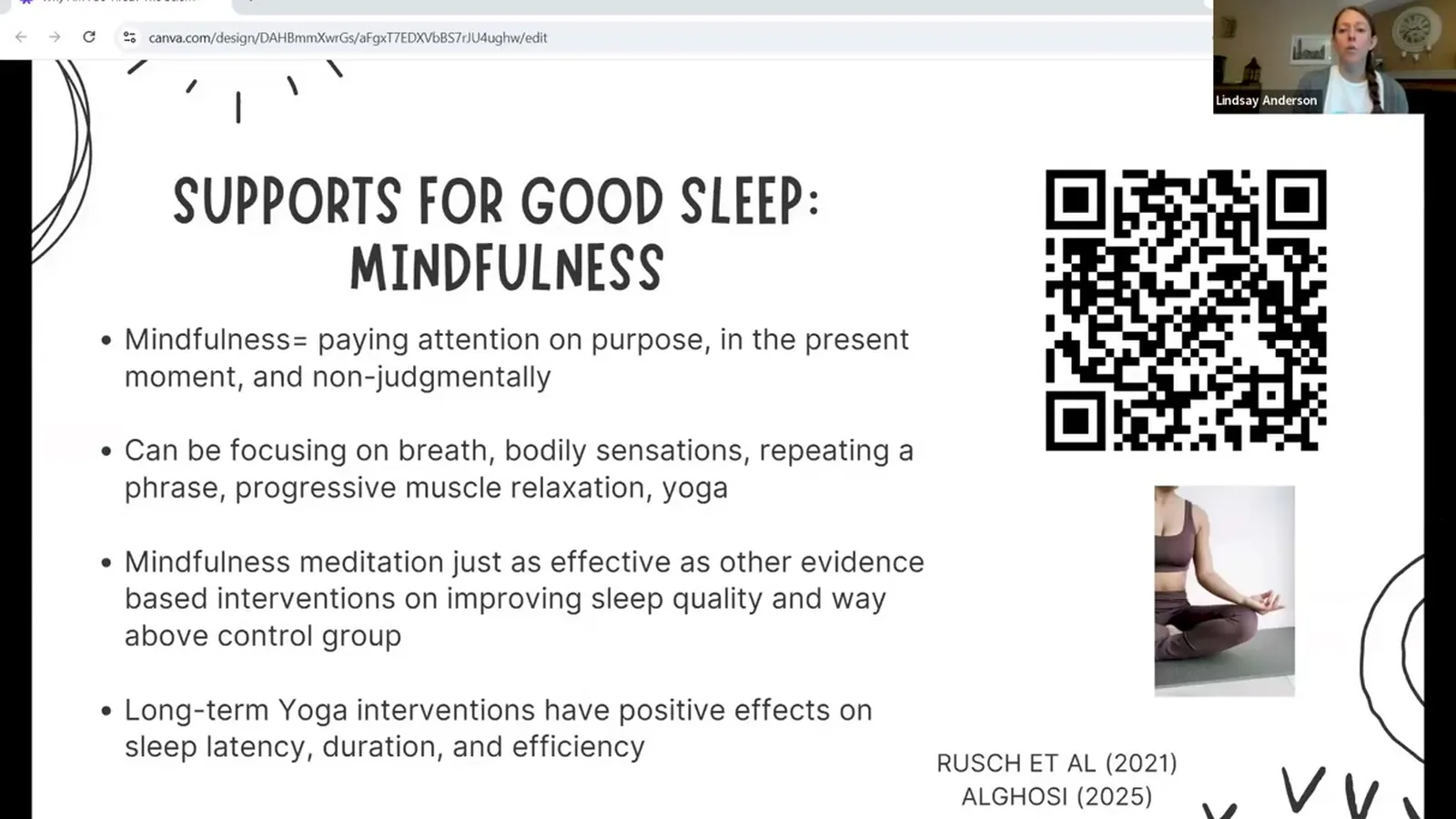
Why Am I So Tired? The Science of Sleep for BCBAs
On this page · 8 sections▾
When sleep slips for a Board Certified Behavior Analyst (BCBA), burnout is not far behind, and that burnout can pull you into the territory of Behavior Analyst Certification Board (BACB) Ethics Code 1.10, because a tired clinician is a clinician doing a quiet disservice to clients. The hardest part to hear is that this is not a willpower problem. Most of us are running on a thought pattern that says we have to earn our rest first by being productive enough, so we stay up answering one more parent text, finishing one more graph, reviewing one more program. Then we wonder why session feels foggy the next morning.
Lindsay Anderson, BCBA and certified sleep practitioner, walks through the science of sleep for BCBAs in a way that names this trap out loud. The talk reframes sleep as part of your clinical work, not the reward you get after it.
Why burnout in our field looks a lot like sleep loss#
The symptom list for BCBA burnout and the symptom list for short sleep are almost the same list. Both show up as irritability with your team, a shorter fuse with caregivers, more sick days, and that flat feeling where work that used to feel like a calling now feels like a chore. Both leave you reading the same line of a treatment plan three times before it lands.
The reason these lists overlap is that they share a root cause. When you cut sleep, you cut the brain's chance to clear out the day, repair tissue, and reset mood. So the BCBA who is "burned out" is often a BCBA who is sleep-starved, and the BCBA who is "fine on six hours" is often the BCBA whose burnout is six months away.
As BCBAs, we are really reinforced for always just kind of doing more and neglecting our own needs sometimes in the service to our clients. But as I started learning more about just how important sleep is, I realized that we're actually doing a disservice to our clients if we aren't prioritizing our own sleep. From the talk — Lindsay Anderson
That reframe matters. If you only count sleep as self-care, it is the first thing to go when caseload spikes. If you count sleep as client care, it stays on the schedule.
What the research says about tired clinicians making harder calls#
The work-side cost of short sleep is not soft. It shows up in the kind of decisions BCBAs make every day, from picking a reinforcer to deciding whether to fade a prompt.
Decreased sleep duration has been shown to lead to increased work-related injuries, critical mistakes in the workplace, critical burnout, an impaired immune system, meaning we're more likely to be out sick, worse clinical decision making, worse problem solving, and more irritability. From the talk — Lindsay Anderson
Worse clinical decision making is the line to sit with. Our job is decisions. We read data, we pick a hypothesis, we adjust a program. A tired brain takes more shortcuts, leans harder on what worked last time, and misses the small data shifts that flag a problem early. Multiply that across a caseload of eight to ten clients, and a few bad nights stop being a personal issue. They become a clinical one.
Anderson also points out the CDC finding that close to 37% of adults are not getting enough sleep, and that the group with the most trouble falling asleep is women between 18 and 44. That is the demographic profile of a huge slice of our field. So if you feel like everyone in your office is dragging, it is not in your head.
Ethics Code 1.10 and what counts as taking "appropriate steps"#
This is where the talk goes from wellness blog to credentialed clinical territory. BACB Ethics Code 1.10 names this directly.
Behavior analysts maintain awareness that their personal biases or challenges, such as mental or physical health conditions, may interfere with the effectiveness of their professional work. Behavior analysts take appropriate steps to resolve interference, ensure that their professional work is not compromised, and document all actions taken. From the talk — Lindsay Anderson
A few clarifiers. Code 1.10 is not a trap door. Having a few rough nights does not mean you are out of compliance. The code is about awareness and action. If you notice that sleep loss is bleeding into your clinical judgment, the ethical move is to take a step, not to push through and pretend it is fine.
What counts as a step? A few examples that fit inside a BCBA's actual life:
- Naming it in supervision notes. "Sleep has been short this month. Watching for impact on decisions on Client X program."
- Moving a high-stakes meeting away from the back end of a long stretch of poor sleep.
- Asking a peer to second-read a treatment plan you wrote on three hours of sleep.
- Booking a sleep study if you suspect apnea, which Anderson notes affects up to 33% of adults.
The documentation piece matters. Code 1.10 asks you to document the actions you take. A short note in your own files is enough.
The thought patterns that keep BCBAs up past midnight#
Anderson gets specific about the internal scripts that keep us doomscrolling at 11:47pm. These are the lines we say to ourselves, often without noticing.
We might have thoughts like, if I'm resting, I'm not helping my clients enough. Or I have to earn my rest first by being productive enough. From the talk — Lindsay Anderson
Read those slowly. "If I'm resting, I'm not helping my clients enough." "I have to earn my rest first." These are not facts. They are rules our field rewards us for following. A BCBA who answers a parent text at 10:30pm gets praised for being responsive. A BCBA who closes the laptop at 9pm does not get a gold star for sleeping. So the contingencies push us one way.
Acceptance and commitment training (ACT) gives a useful tool here. Instead of fighting the thought, you notice it. "I am having the thought that I have to earn my rest." That small bit of distance is enough to let you choose a different behavior. Then you tie the new behavior to a value you actually hold, like showing up at your best for your clients. Sleep becomes the action that moves you toward the value, not the thing standing in your way.
Three small changes that lower burnout risk this week#
You do not need a full sleep overhaul. Anderson focuses on a few high-yield moves that fit a real BCBA schedule.
- Get morning light before 10am. Even ten minutes outside, or coffee on the porch, or your head out an open window. The research shows that more morning light correlates with better sleep that night. This is the cheapest intervention in the talk.
- Cut coffee 8.8 hours before bed. That is the number the meta-analysis landed on. If your goal bedtime is 10pm, last sip by about 1pm. This one stings, and it works.
- Five-minute to-do list before bed. Write out the specific tasks you need to remember tomorrow. The study Anderson cites found that the more specifically you describe each task, the faster you fall asleep. The page absorbs the worry so your brain can let go of it.
None of these require new equipment, a sleep tracker, or a perfect routine. They require about fifteen minutes total. Pick one for this week.
When to ask for help beyond sleep hygiene#
Sleep hygiene is the floor, not the ceiling. If you are doing the basics and still cannot sleep, there is a layer below sleep hygiene that needs a professional, not a checklist.
Signals that it is time to call a doctor or a sleep specialist:
- Loud snoring or gasping at night, especially with daytime exhaustion. That is the apnea profile.
- Trouble falling asleep, staying asleep, or waking too early more nights than not for a month.
- An uncomfortable urge to move your legs at night.
- Heartburn that gets worse when you lie down.
For the insomnia track, Cognitive Behavioral Therapy for Insomnia (CBT-I) is the evidence-based treatment and is covered by many insurance plans. It is not the same as general talk therapy. It is a specific protocol that targets the exact loop keeping you awake. If you have been treating your sleep as a willpower problem for months, CBT-I is the next step.
And one more note. If sleep loss is affecting your clinical work in a way you cannot resolve with these moves, loop in your supervisor. Code 1.10 expects you to take steps, and asking for a temporary caseload adjustment is a step.
Frequently asked questions#
Can you be burned out and still be sleeping seven hours?
Yes. Seven hours is the minimum to avoid the worst health outcomes, not the amount that lets most adults thrive. Quality, regularity, and timing matter as much as total hours. A BCBA who sleeps seven hours but goes to bed at a different time every night, wakes up to a phone in their face, and never sees morning light is still running a sleep debt that feeds burnout.
Is it ever okay to take a mental health day from sessions because of sleep?
Yes, and Code 1.10 actually points in that direction. If you know your decisions are compromised, the ethical move is to take a step, not to push through. A planned day off costs the team a day. A bad clinical call costs the client more.
Does supervising RBTs while tired count as an ethics issue?
Supervision is one of the highest-stakes things BCBAs do. If short sleep is making your feedback sloppy, your observations shallow, or your modeling inconsistent, that is the kind of interference Code 1.10 is asking you to notice. The fix is not to stop supervising. The fix is to schedule supervision when you are at your best, document that you are watching for impact, and address the underlying sleep loss.
Watch the full talk#
Lindsay Anderson covers the four pillars of sleep, the most common barriers BCBAs face, and a complete sample evening plan you can adapt. If burnout is creeping up on you, this one earns its sixty minutes.
Turn this topic into a CEU
You just studied this. Now get credit for it.
Watch Why Am I So Tired? The Science of Sleep for BCBAs with Lindsay Anderson and earn 1 free BCBA CEU. Detailed certificate, delivered the moment you finish.