TL's Writing Exercise: Teaching Present-Moment ACT Skills in ABA
TL's two-round writing exercise for teaching present-moment awareness with planned distractions, with debrief, from a BCBA-led CEU.
Key takeaway
TL's writing protocol is two rounds with planned distractions baked into round two, and it is practice number six in the panel's seven Acceptance and Commitment Training (ACT) takeaways. You hand the client a pen.
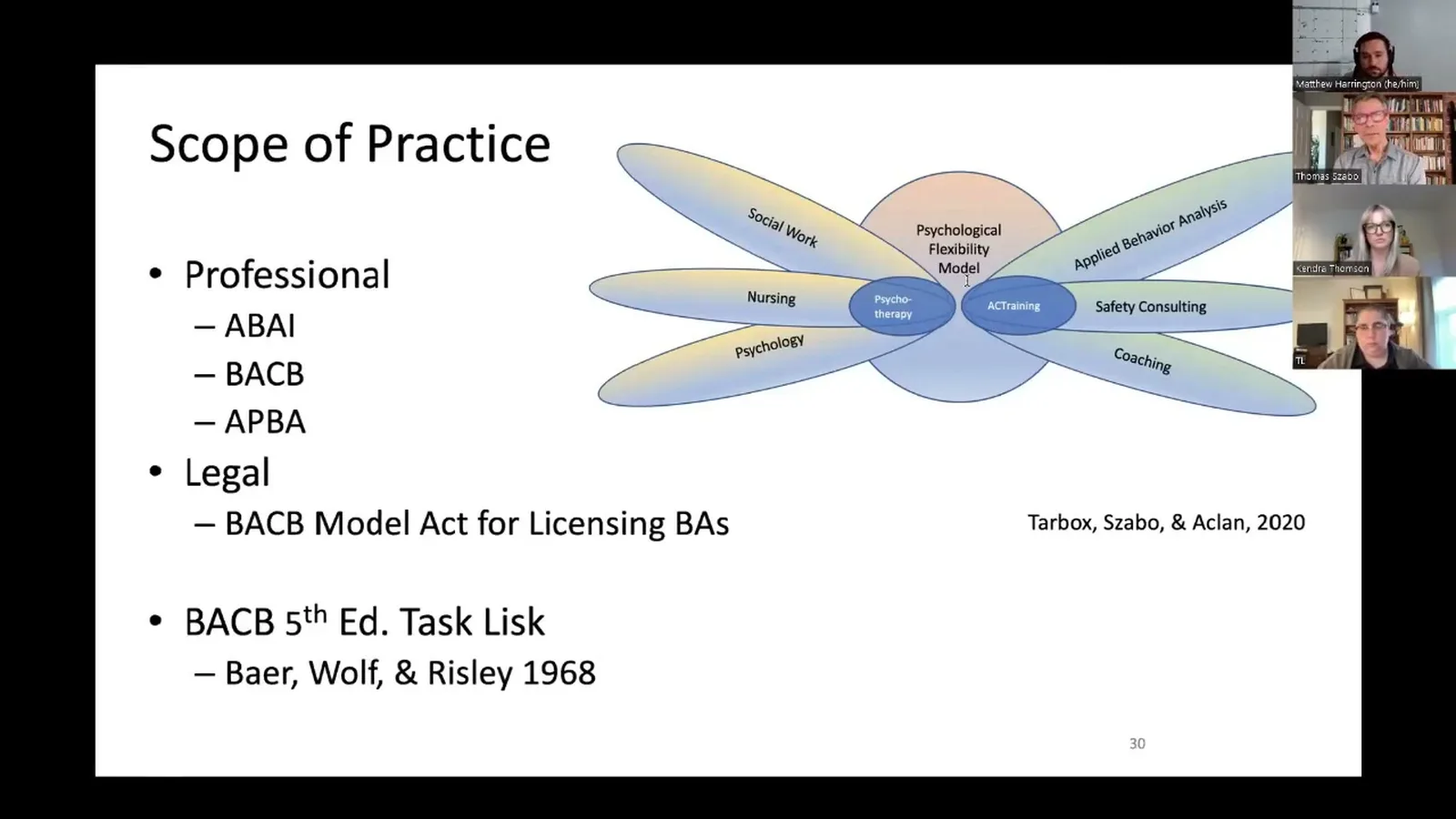
From Research to Practice: Seven Acceptance and Commitment Training Practices You Can Begin Using Today
On this page · 9 sections▾
TL's writing protocol is two rounds with planned distractions baked into round two, and it is practice number six in the panel's seven Acceptance and Commitment Training (ACT) takeaways. You hand the client a pen. You give them a prompt. You let them write for one to two minutes. Then you do it again with sounds, songs, and interruptions on purpose. The point is not a clean piece of writing. The point is that the client feels the pull of a distraction and then comes back to the page. That coming back is the present-moment skill.
This page is for the BCBA who wants the actual script. Not the model. Not the hexaflex. The script TL used on the call, the debrief questions she asked, and the homework she handed out at the end.
What the present-moment skill actually is#
Present-moment work in ACT is not meditation. It is not sitting still. It is the small, repeated act of noticing you got pulled away and coming back to what you were doing. TL says it this way to clients:
being okay with being distracted sometimes that's a really key one the distractions are going to come they're going to come I notice them and I get back to what I'm doing I notice them and I get back to what I'm doing From the talk — the panel
That is the whole skill in 5th-grade words. You can read it to your client tomorrow. The reason it lives inside ACT and not somewhere else is that the come-back move is what builds psychological flexibility. The client learns that a thought, a sound, or a feeling does not have to run the show.
For the board-certified behavior analyst (BCBA), this maps to the panel's stated learning objective: help a client bring focused attention to things and events in their life. It is a teachable repertoire. It has a clear procedure. You can take data on it.
TL's first writing round: the prompt and the setup#
Here is the exact setup TL ran on the panel. Use this verbatim.
- Hand the client a pen and paper, or open a blank doc.
- Tell them you will give one prompt. They will write for one to two minutes. They write the whole time without stopping.
- Read the prompt:
the writing prompt is to write about how you want to show up for your family, your child, your partner, your clients, etc. So how do you personally want to show up for people who matter the most to you? From the talk — the panel
- Say "ready, set, go." Start a timer.
- When time is up, say stop.
A note for the BCBA: this prompt is doing two things at once. On the surface it is a writing task. Under the surface it is a values prompt. You are getting a peek at what matters to the client before you ever introduce the present-moment piece in round two. Save what they wrote. It is useful later when you build a behavioral contract.
For young or low-verbal clients, swap the writing for a one-minute drawing task. Same prompt. Same setup. The procedure does not care about the medium. It cares about the come-back.
What goes wrong on round one (and why that's the point)#
Round one is supposed to feel pretty smooth. The client writes, the client stops, you move on. On the panel, TL ran round one with an extra wrinkle. She had screen-share trouble. There were background sounds. A dog barked. Some folks could not start at all. Others wrote a line and got pulled out. That mess is the data. Mark it down.
When you debrief, ask the client what that was like. Then ask the question that does the teaching:
what strategies do you think would be helpful when all of those distractions are coming to be able to keep doing the thing that you're trying to do From the talk — the panel
Let the client answer first. Most clients will say something like "earplugs" or "go somewhere quiet" or "switch tasks." Write those answers down without judging them. You are about to test them in round two.
TL's second writing round: planned distractions#
Round two is where the protocol earns its keep. You warn the client up front. You tell them this round will have sounds, songs, or interruptions, and the job is to notice the distraction and come back to the writing.
Here is the script:
- Tell the client: "This time I'll warn you. There will be distractions. Your job is to notice them and come back to the page. Hold the pen. Feel it in your hand. Pay attention to what it feels like to write the words. Notice the distraction. Come back."
- Read the new prompt: "Write about how you want to be remembered." Use a different prompt than round one so the writing itself is new.
- Say go. Start the timer for one to two minutes.
- Run the distractions on purpose. TL used random sounds, a barking dog clip, and a Taylor Swift beat. Pick three. Stagger them. A doorbell sound at 20 seconds. A song beat at 45 seconds. A spoken interruption at 75 seconds.
- When time is up, say stop.
Why the warning matters. In round one, distractions hit and the client had no plan. In round two, the client has a plan and gets to test it. The contrast is the lesson. Most clients report round two felt easier, even though the distractions were louder. That is the come-back muscle starting to fire.
The debrief script that makes the skill stick#
After round two, sit back. Ask three short questions in this order.
- "How was that compared to round one?" Listen for "easier" or "I got back faster."
- "What did you do when the song came on?" You are looking for them to name the come-back. "I noticed it. I went back to writing." Reinforce that answer with a clean "yes, that is it."
- "If you moved on to a different task every time you got distracted, what might go wrong?" TL surfaced this one on the panel because most clients (and most BCBAs) default to "remove the distraction." Her answer:
if you move on every time you get distracted what might not work about that yeah it's don't think about the elephant effect you may never get back to the task that for sure there's other there's still distractions there's still distractions From the talk — the panel
That is the trap to name out loud. Switching tasks does not kill distractions. Other distractions show up in the new task. The only stable move is the come-back.
End the debrief with one sentence the client can take home: "Distractions are going to come. I notice them. I get back to what I'm doing."
Three places clients can practice this between sessions#
TL's homework is small on purpose. She picked two activities the client already has to do.
- Washing dishes. Hands are busy. Mind wanders. Catch the wander. Come back to the soap and the water.
- Showering. Same idea. Notice the thought. Come back to the warm water on your shoulders.
- Walking from the car to the front door. A 30-second built-in rep. Add it if the client wants a third.
Tell the client to do this once per day, for one to two minutes, on whichever activity feels easiest. One rep a day for two weeks is plenty to start. The skill is more like flossing than like lifting. Small and daily beats big and rare.
The line TL gives the client for homework:
Notice the distraction. Go back to your activity. Notice. Go back. That is the practice.
How to take data on present-moment practice#
You can take data on this without making it a chore.
- Frequency of practice. A simple yes-no on a daily check-in card. Did the client do one dishes or shower rep today? Goal: 5 of 7 days.
- Self-report of come-backs. During each rep, the client tallies how many times they noticed and came back. A scratch on the soap bottle works. Numbers do not need to be exact. The point is the client is doing the noticing.
- In-session probe. Once a week, run a 60-second version of round two in session. Count the come-backs you observe. If the count is going up, the skill is generalizing.
- Caregiver report. Ask the parent or partner if they noticed the client staying with a task longer than usual. One line in your weekly notes.
Tie this back to the BCBA Task List items the panel referenced. Practice frequency is a use of self-management. The in-session probe is multiple exemplar training. The caregiver report is a check on generalization. All of it stays inside scope.
Frequently asked questions#
Can I use TL's writing exercise with a non-verbal client?
Yes, with a small swap. Replace writing with a one-minute drawing task or a one-minute sorting task with picture cards. The come-back move is what matters, not the words. Set up round one quiet, round two with planned sounds, and debrief with picture choices ("Did the sound pull you away? Point to yes or no. Did you come back? Point to yes or no.").
How is present-moment ACT work different from a mindfulness meditation?
A meditation usually asks the person to sit still and watch the breath. TL's exercise asks the person to keep doing a normal task while distractions hit. The target is not stillness. The target is the come-back during action. That difference matters in ABA because the come-back is a measurable behavior tied to a task, which makes it easier to write into a goal and easier to take data on.
How many times per week should a client practice the come-back-to-now skill?
Start with once per day, attached to an activity the client already does. Five days a week for two weeks is a strong first dose. Increase only if the client wants more. Daily and short beats long and infrequent, the same way 10 trials a day for two weeks usually beats 70 trials in one Saturday.
Try TL's protocol with a client this week#
Pick one client on your caseload who has a focus or follow-through goal. Run round one this week. Run round two next week. Use the debrief script word for word. Send them home with dishes or showers as their reps. Then take five minutes to watch the full panel for the rest of the seven practices, including the sticky-thought defusion exercise and the ACT-extended behavioral contract.