OARS: The Four Core Skills of Motivational Interviewing
OARS stands for open questions, affirmations, reflections, and summarizing. Learn what each skill means and how to use it with caregivers and staff.
Key takeaway
Motivational interviewing is a style of conversation that helps a person find their own reasons to change, instead of being told what to do. In motivational interviewing, OARS stands for Open questions, Affirmations, Reflections, and Summarizing.

From Expert to Guide: Motivational Interviewing Skills for BCBA Coaches
Free learning path on this topic
Supervision, Done Right
Four supervision CEUs that build on each other. What reflective supervision is, how to build a supervision system, how to assess supervisee competence instead of counting hours, and how supervision affects provider outcomes. The BACB asks supervisors for three supervision CEUs per cycle. This covers it.
Experts who cover this
2 recordings on openceu cover OARS.
- Featured talk1.5 Learning CEUs
From Expert to Guide: Motivational Interviewing Skills for BCBA Coaches
Mellanie PageThe ABA Collective, LLC.
The OARS acronym (open questions, affirmations, reflections, summaries) provides the core communication skills used to elicit and build change talk.
- 1 Learning CEU
Motivational Interviewing Across Treatment Team Members
Kelly BrzakUpskill ABA
Kelly teaches OARS (open questions, affirmations, reflections, summarizing) as the core skill set of motivational interviewing, giving example scripts for each…

On this page · 10 sections▾
Motivational interviewing is a style of conversation that helps a person find their own reasons to change, instead of being told what to do. In motivational interviewing, OARS stands for Open questions, Affirmations, Reflections, and Summarizing. These are the four core talking skills that make that approach work.
OARS is not a script you read off a card. It is a set of habits for how you ask, listen, and respond. For BCBAs, these habits matter in coaching sessions, parent meetings, and staff training. They help you move from being the expert who tells to the guide who draws ideas out.
What each letter in OARS means#
The acronym is short on purpose. It gives you four skills you can remember in the middle of a hard conversation.
So O-A-R-S is the acronym. From the talk — Mellanie Page
Here is the quick version of each letter:
- O is for open questions. These are questions that cannot be answered with a simple yes or no.
- A is for affirmations. These are honest statements that notice a person's strengths and efforts.
- R is for reflections. These are statements that say back what you heard, in your own words.
- S is for summarizing. This means pulling together the main points of a talk and handing them back.
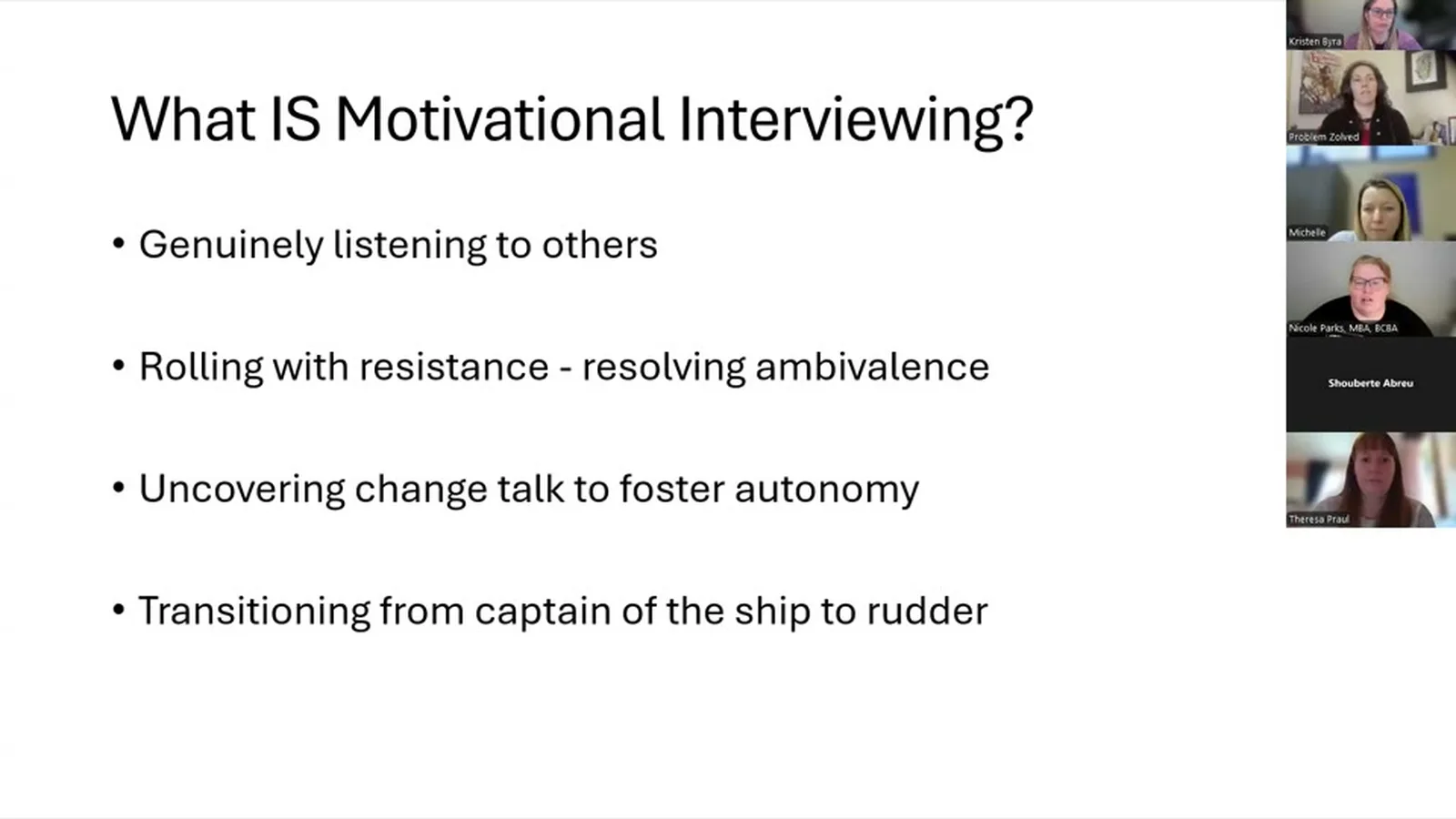
Kelly Brzak frames these four skills as the heart of the whole approach. In her view, much of what makes motivational interviewing work fits inside this one small word.
can be summed up by the word ors, open questions, affirmations, reflections, and summarizing. From the talk — Kelly Brzak
Some speakers say the acronym as "O-A-R-S." Others say it like the word "oars," as in rowing a boat. Both mean the same four skills.
Open questions: inviting the person to explore#
Open questions come first in the acronym. They are also the skill most people think they already have.
O is. for open questions From the talk — Mellanie Page
Mellanie Page describes open questions as a way of inviting exploration. They are not yes or no questions. A closed question like "Did the plan work?" can end with one word. An open question like "How did the plan go this week?" gives the person room to tell a story.
That room is the point. Page explains that a coach can ask about what a person cares about, their values, and the direction they want to go. When that happens, the person starts to discover their own reasons for change, and the coach does not have to push their own reasons onto anyone.
She gives a simple pair of questions that show the idea: "Is it possible? And if so, what does it look like for you?" The first part opens the door. The second part asks the person to picture a future in their own words. When they describe that future out loud, it can feel motivating to them. That is very different from hearing a coach describe it for them.
Sample open questions for caregivers and families#
Kelly Brzak shares a set of starter questions that BCBAs can use with families. She notes that some of them are fine to ask even the very first time you meet a caregiver. They help you learn about the person before you talk about goals or programs.
Her examples include:
- "What is your favorite or least favorite part of your job?"
- "How many students do you have?"
- "What do you do for fun?"
- "What do you like to do with your brother or sister?" (for a sibling)
Brzak offers these to give a variety of options for different people in a family. The same approach works for a tired grandparent. It also works for a client who is trying to decide whether to apply for a job. You adjust the words to fit the person in front of you.
Notice that not every question on a starter list is fully open. "How many students do you have?" can be answered with a number. That is fine for building rapport. But it is a good reminder to follow up with something wider, such as "What is that like for you?" The favorite or least favorite question is a strong model. It invites both good and hard feelings, and it lets the person choose where to go.
The open question trap#
Here is a surprising problem. Many people believe they ask lots of open questions. When you listen closely, they often do not.
Mellanie Page calls this one of the most fascinating things she hears about. People know in their heads that open questions are better and richer. Because they know it, they assume they are doing it. In real conversations, closed questions tend to slip in again and again.
This gap matters. A string of closed questions can make a meeting feel like a quiz. The caregiver answers "yes," "no," and "fine," and the coach does most of the talking. Very little of the caregiver's own thinking comes out.
A few simple checks can help you catch the trap:
- Notice how your questions start. "Do you," "Is it," and "Did you" often lead to one-word answers.
- Try starting with "what" or "how" instead. "What has been working?" invites more than "Is it working?"
- Ask one question at a time. Stacking several questions makes it easy for the person to answer only the last, simplest one.
- Record a practice session, with consent, and count your open and closed questions.
The goal is not to ban closed questions. Sometimes you need a quick fact. The goal is to make open questions your default.
Affirmations: noticing real strengths#
An affirmation is an honest statement that names something good about the person: an effort they made, a value they hold, or a strength they showed. It is not the same as general praise. A comment like "Great job!" is vague, while a good affirmation is specific and tied to something you actually noticed.
This skill fits with the idea of genuine listening that Kelly Brzak puts at the center of motivational interviewing. You cannot affirm a strength you did not hear. Affirmations also help build what Brzak calls the therapeutic alliance. That term means the working bond between a clinician and the people they serve. She points out that when this bond is strong, outcomes tend to be better.
Reflections: saying back what you heard#
A reflection is a statement, not a question. You listen, then you say back the core of what the person shared, either by repeating their meaning in new words or by naming the feeling behind it.
Reflections show that you are truly listening. They also let the person hear their own words again. Hearing it back often leads them to add more, correct you, or think more deeply.
Reflections are a key tool for what Brzak calls rolling with resistance. That phrase means you do not argue when someone pushes back. Instead of pushing back with what you think is clinically necessary, you reflect what they said. Brzak describes motivational interviewing as a way to resolve ambivalence. Ambivalence means feeling two ways about a change at once, such as wanting it and dreading it. A calm reflection lets both sides of those feelings sit on the table.
Reflections also help you hear change talk. Change talk is when a person says things in favor of change in their own words. When you reflect those words, you help them grow.
Summarizing: tying the conversation together#
A summary is like a longer reflection. It gathers several things the person has said over the course of a conversation and hands them back together, often at the end of a meeting or when you want to shift topics. A good summary shows the person you have been listening throughout, and it gives them a chance to correct or add to what you heard.
Summaries are also a useful place to gather change talk. When a person has given several reasons of their own for wanting something to be different, a summary lets them hear those reasons together.
Why OARS works in coaching#
All four skills share one goal. They help the other person do more of the thinking and talking. Mellanie Page explains that when a coach evokes motivation, the person starts generating their own change talk. They discover their own reasons, so the coach does not have to impose theirs.
Page names two big payoffs. First, OARS builds internal motivation. That is motivation that comes from inside the person, not from outside pressure. Second, it strengthens the coaching relationship. Both matter for BCBA supervisors and coaches who want changes to last after the session ends.
Kelly Brzak adds a related point. She describes motivational interviewing as taking a back seat and trying to uncover more of the person's "why." OARS gives you the practical tools to do that. Open questions start the exploration. Affirmations build trust. Reflections and summaries help the person hear and grow their own reasons.
Why BCBAs need to practice OARS on purpose#
Brzak points out a training gap in the field. Most behavior analysts are not explicitly trained to use motivational interviewing. She cites work by Plattner and colleagues on this point. They suggest that adding motivational interviewing to graduate coursework could help fix some current gaps in the field.
That means many BCBAs have to build OARS skills on their own. These skills can feel simple on paper. In practice, they take repetition. As Page's point about open questions shows, knowing a skill is not the same as using it.
A practical way to start is to pick one letter per week. Spend one week focusing on open questions with caregivers. Spend the next week adding one honest affirmation to each meeting. Then practice reflections, and then summaries. Over time, the four skills blend into a natural style of talking.
Brzak's full training, Motivational Interviewing Across Treatment Team Members, walks through how to use these skills with caregivers and staff.
FAQ#
What does OARS stand for in motivational interviewing?
OARS stands for Open questions, Affirmations, Reflections, and Summarizing. These four skills form the core way of talking in motivational interviewing.
What is the difference between an open and a closed question?
A closed question can be answered with yes, no, or one word. An open question invites the person to explain, describe, or explore. "Did it work?" is closed. "How did it go?" is open.
Can OARS be used with caregivers and staff, not just clients?
Yes. OARS works in any helping conversation. BCBAs can use it in parent training, staff coaching, and supervision to build trust and draw out each person's own reasons for change.
Turn this topic into a CEU
You just studied this. Now get credit for it.
Watch From Expert to Guide: Motivational Interviewing Skills for BCBA Coaches with Mellanie Page and earn 1.5 free BCBA CEUs. Detailed certificate, delivered the moment you finish.
Keep going with a free learning path
Supervision, Done Right
Four supervision CEUs that build on each other. What reflective supervision is, how to build a supervision system, how to assess supervisee competence instead of counting hours, and how supervision affects provider outcomes. The BACB asks supervisors for three supervision CEUs per cycle. This covers it.