The Proven Path for Clinicians to Multiply Their Impact & Income
Presented by Mellanie Page
Cancel any time. Cert delivered to your inbox the moment you pass the quiz.
About this CEU
This opening session challenges the traditional clinical career trajectory by presenting viable business models specifically designed for mental health professionals. Participants will explore how their existing clinical expertise can be repackaged into scalable revenue streams through continuing education programs, digital courses, or coaching services. The session addresses common barriers clinicians face - including burnout, income limitations, and the time-for-money trap - while providing a practical roadmap for transitioning from solely direct service delivery to diversified income models. Through real-world examples and a clear framework, attendees will discover how to leverage their professional knowledge beyond the therapy room without abandoning their clinical identity.
Credits
0 CEUs · 75 min
From the talk
What was covered
A behavior analyst's guide to turning clinical expertise into a second income: two side hustle paths, the 5 Ps, and eight vehicles.
- Do the math on your real hourly rate: take your salary, divide it by the weeks you work, then divide by the hours you actually work, billable and non-billable.
- Sort every idea into one of two paths first: service based work you deliver one to one, or leveraged work you build once and sell to many.
- Score your idea against the 5 Ps before you build anything: passion, profit, positioning, person, and a problem you have already solved.
- If your expertise is high but almost nobody knows you yet, start service based, because you only need one client to begin.
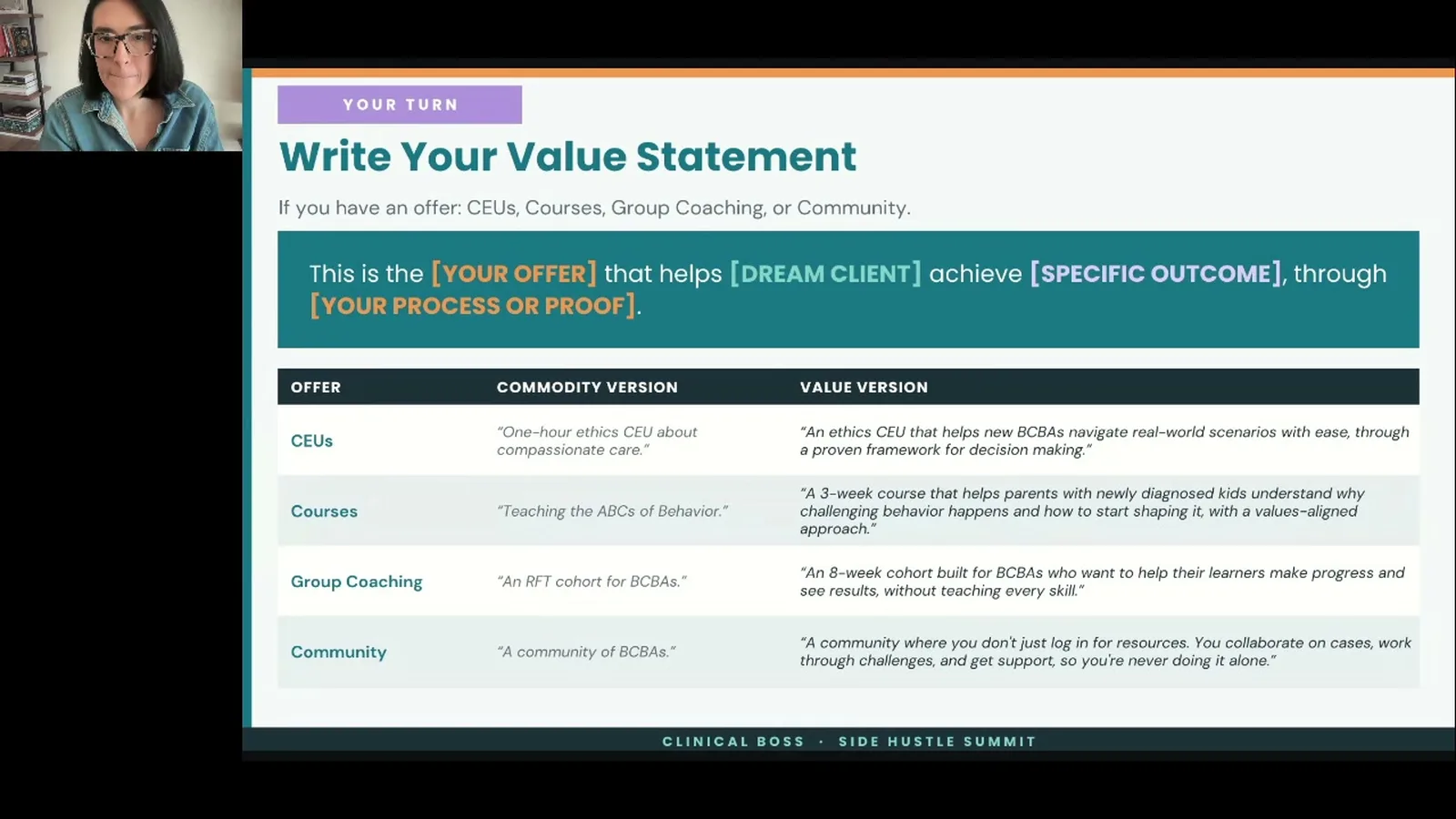
- Stop listing your credential, your hours, and your rate in your marketing, because that makes you look like every other clinician.
- Pick one problem and one vehicle for now, since failing to focus is what stalls most clinicians who try this.
Why the Clinical Career Ladder Stops Paying Off
Page opened with a list of quiet signs. You dread work some mornings. You have looked up a new degree or a new certification. You have thought there has to be something more. Many people in the chat said all three were true. They said every sign came from their own career first.
Then they named four real constraints. Burnout is real, because you carry heavy clinical weight without matching pay or autonomy (control over your own work). Income has a ceiling, so a raise feels big once and then fades. You do not control the systems you work inside, since insurance shapes your notes, your plans, and your clinical choices. They said they loved treatment planning. That changed once peer-to-peer reviews (calls where you defend your plan) started changing what they believed would work. Last came what they called the right way myth. We are taught there is only one proper way to use a clinical degree.
Their sharpest point was about direction. Most clinicians move away from something instead of toward something. You chase relief from burnout and from low pay. You rarely name what you actually want: autonomy, ownership, freedom, and reach. A new credential almost never delivers those four things. They said they grabbed the first option they saw other clinicians grab.
But for me, I was chasing the wrong thing.
From the talk — Mellanie Page
What a Side Hustle Is and What It Is Not
Page said they dislike the word hustle. They use it because people understand it. Their definition is narrow on purpose. A side hustle is not a career change. It is not quitting your job. It is not starting over with a new degree. It is a second income built from what you already know. It is structured on your terms: your hours, your rate, your rules. And it lets you do more of the work you actually enjoy.
They read an anonymous post from social media that called side hustles unprofessional for clinicians. Their answer was direct. A credential is not an obligation to earn all of your income from one role. Physicians, attorneys, psychologists, and professors consult, teach, write, invest, and build businesses next to their main work. If that works for them, it can work for you. In a volatile field, a second income stream is also a contingency plan for your family.
They also warned against waiting for a better moment. When they started, they had no extra time, no extra money, and very little energy. Those conditions do not fix themselves. They usually get tighter each year. They said leveraged work helped roughly eight times more people than a decade of direct clinical work did.
I had absolutely no extra time.
From the talk — Mellanie Page
The Hourly Math Nobody Shows Clinicians
This was the exercise with the most reaction in the chat. Take your salary. Divide it by the number of weeks you actually work, which is often around 48 after time off and holidays. Then divide that by the hours you really work each week. Count the billable hours and the admin time too. The number that comes out is usually much lower than people expect. Several attendees shared their own hourly numbers in the chat.
Page was careful about blame. They said they are not criticizing the companies that pay clinicians. That number is often the most generous margin a business can pass along. Reimbursement rates (the amount insurance pays per hour) set that ceiling. They also made a choice about their own time. Advocating for better funding matters, but they decided not to spend their hours trying to fix a broken payment system.
One attendee pointed out that a lower paying school job left more time and energy to build something. Page treated that as a key idea. Your current salary is the capital you invest in leveraged work. A job is not the enemy. It funds the build while you create capacity for yourself.
But the goal here is awareness.
From the talk — Mellanie Page
Service Based and Leveraged: Two Very Different Paths
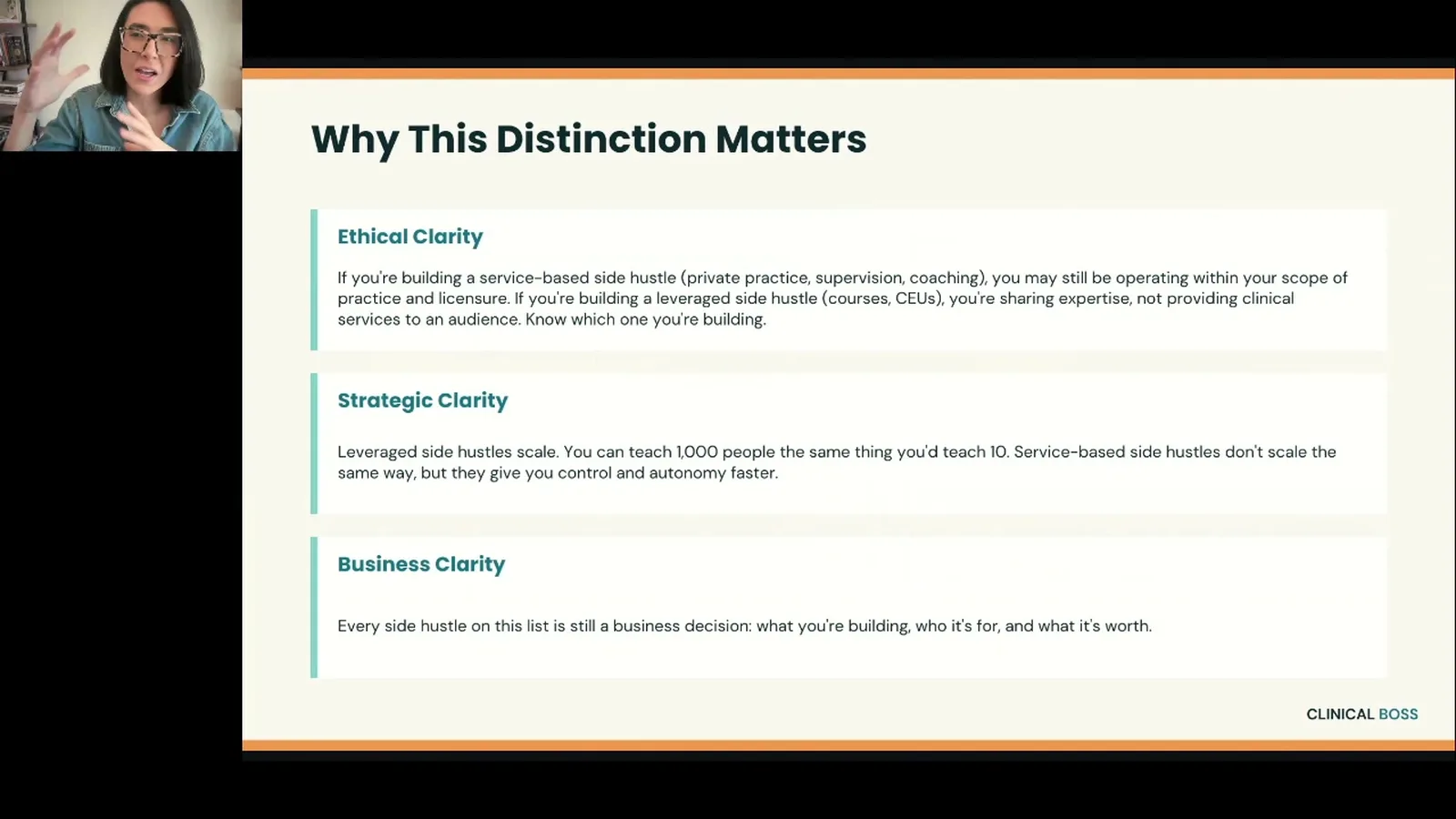
Every idea fits one of two paths, and they do not work the same way. Service based work is still delivery, one person or one small group at a time. Private pay practice, supervision of students, coaching, and consulting all sit here. Your income is still capped by your calendar. The difference is who sets that calendar. You pick the hours, the rate, the problem, and the client. You can also charge far more per hour than insurance reimburses.
Leveraged work is build once and sell to many. CEUs (continuing education units clinicians must earn), courses, group coaching, and paid communities sit here. The price per person is naturally lower than a long one to one engagement. The upside is that your income is no longer tied to hours. Group coaching stretches a single hour across five people solving the same problem. A community can hold members for years if the value keeps coming.
The path you pick also changes your ethical footing. Service based work often sits inside your scope of practice (the work you are trained and licensed for). So licensure rules apply. Leveraged offers usually share expertise with an audience rather than provide clinical services. Knowing which one you are building makes that territory easier to navigate.
Their strategic advice was to start service based for most people. You reach a higher rate and more control faster. You also learn which parts of your method work again and again across real cases. That reliable method is what you later package into a leveraged offer.
Every side hustle on this list is still a business decision, what you're building.
From the talk — Mellanie Page
The Expertise and Visibility Matrix: Where to Start
Page used a simple two by two grid. One axis is expertise. The other is visibility, meaning the number of people who already know you solve a problem. That includes social media followers, an email list, and speaking history.
High expertise with low visibility is where most clinicians sit. That combination points to service based work. You do not need a crowd. You need one private pay family, one supervision student, one consulting contract, or one coaching client. That single yes creates the momentum you learn from.
High expertise with high visibility is where leveraged offers work well. You need real humans to buy the thing. If only ten people know you exist, a course launch will be painful. High visibility with low expertise is a different problem. Build the expertise first in the area you want to grow into, then come back to the offer.
They called the belief that you need a following first a misconception, and said they held it themselves for years. This is not a gig delivering food on the side. It is a professional extension of work you already do.
So your credentials are not the limiter here, they are the launch pad.
From the talk — Mellanie Page
Run Your Idea Through the 5 Ps
Most clinicians arrive with three or four ideas. Page said new ideas are never the problem. Picking one is. The 5 Ps are a quick test you run on each idea before you build.
Passion comes first. Not what you are good at, but what actually lights you up. Could you teach or deliver this for two years without resenting it? Would you still want to do it at a smaller scale if nobody paid you? Profit comes second. There is a difference between a narrow niche and something so obscure that nobody buys. There is also the problem of a market that cannot afford your solution. She gave the example of RBTs (registered behavior technicians who run sessions), who are early in their careers. For that group, the buyer might be their employer or a school instead. Ask whether anyone, anywhere, already pays for your solution or something next to it.
Positioning is where they said most clinicians fail. We learn marketing by copying what we see other clinicians post. Most of those posts list a credential, available hours, and a rate. That is a commodity ad. Finish this sentence instead: unlike other coaches, consultants, course creators, and practice owners, I do this. Your edge may be your method, your specific client, or simply the way you work with people. One attendee named rapport with parents as the differentiator, and Page agreed that you can be the difference.
Person comes fourth. Name one specific human in one specific situation. Could you describe their problem in their own words without guessing? Knowing that is about half of marketing. Last comes the problem you have already solved. Have you gotten a real result for someone, paid or unpaid, on the job or off it? Your own story counts. You can score each idea against all five in the session workbook.
And then there's also a point where we are trying to solve a problem for a market that can't pay for that solution.
From the talk — Mellanie Page
The Eight Vehicles for Delivering Your Expertise
Page listed eight containers for the same expertise. Private pay practice, where you set the rate and skip insurance. Supervision for BCBA candidates (people working toward board certification), which they called an open ocean. One to one coaching in any area you care about. Consulting for businesses, priced by project or retainer (a fixed fee paid regularly for ongoing work). CEUs, which come with built in demand because everyone has to earn them. Self paced courses that keep selling without you. Group coaching, which is semi leveraged and still high touch. And a paid community, which is the highest leverage of the eight.
Their examples showed how the same science travels. One example is a second opinion session for families already in applied behavior analysis services (ABA, therapy based on behavior science). They leave knowing whether progress is adequate. They also learn whether the program fits behavior science and whether what they notice at home is normal. Another is supervision built around people skills instead of hours. The hardest part of becoming a new BCBA is usually conversations, communication, and conflict, not clinical skill. A third example is coaching a new mother to stick to a routine using schedules and competing contingencies (other pulls on her attention). A fourth is consulting for agency owners who lose staff faster than they can hire and train replacements.
One warning tied all the examples together. Do not dump information on people. Build a pathway that moves them from where they are to where they want to end up. That promise is the offer. The container is just how you deliver it, and you can change containers later.
The format is just the vehicle.
From the talk — Mellanie Page
Your Clinical Advantage, and a Quiz to Pick a Format
Page closed on the part clinicians undersell. You already change behavior on purpose. You can spot what actually needs to change instead of guessing. You design conditions that make change more likely. You measure whether the change really happened. Those are not small skills in an open market, and most coaches selling similar help do not have them.
They then turned the same tools on your offer. Use motivating operations (things that change what someone wants) to keep your offer urgent and relevant. Structure lessons so the learner can actually use them. Use reinforcement, celebrate milestones, and build early wins so people keep going. If you feel like you have nothing special to say, that list is your answer.
The rapid fire quiz had four questions. How do you want to work with people: one at a time, a small group, or hundreds at once? What should your income look like now: higher ticket clients, recurring and predictable, or fully scalable? What energizes you: deep relationships, group discussion, or teaching and building a system once? How much time can you really give per week? Mostly A points to private pay practice, supervision, or one to one coaching. Mostly B points to group coaching, consulting, or a community. Mostly C points to courses and CEUs.
Their last instruction was about momentum, not perfection. Picking is the hard part, and not focusing is what stops most clinicians from getting anywhere. You are not married to the answer. You are a clinician packaging what you know, and the package can change whenever you want.
You know how to engineer change.
From the talk — Mellanie Page
Common questions
Is a side hustle the same as quitting clinical work?▾
No. Page defined it as a second income built from what you already know, not a career change. It can grow into something bigger over time, but it does not have to start there. You keep your clinical identity and your license.
Do I need a social media following before I can earn money outside my job?▾
Not for service based work. If your expertise is high and almost nobody knows you yet, start small. You only need one private client, one supervision student, or one consulting contract. A larger audience matters more when you want to sell something to many people at once. That includes a course, a CEU, or a community.
How do I figure out what my clinical hour is really worth?▾
Take your salary and divide it by the weeks you actually work, which is often about 48. Then divide that by the real hours you work each week, counting admin time along with billable time. Page said the goal is awareness, not shame, because you cannot escape a number you refuse to look at.
What are the 5 Ps for checking an idea?▾
Passion, profit, positioning, person, and a problem you have already solved. Passion asks whether you would still want to do this in two years. Profit asks whether anyone already pays for this or something next to it. Positioning, person, and problem push you further. Name your difference, your one specific client, and a real result you have already produced.
Can I serve people without an autism diagnosis or insurance funding?▾
Page argued yes, and spent time on it. Behavior science applies to anyone who has the problem you solve, not only to people insurance will pay for. They also noted something else. Staying credentialed and in contract with insurers is often harder than finding clients in the open market.
About the speaker
Mellanie Page is a behavior analyst certified since 2014. They later earned an MBA (a graduate business degree). They told attendees they grew up around their father's two telephone companies in Miami. They were the first in their family to graduate from college. They have worked in traditional clinical roles. They have also worked as an organizational behavior management consultant (helping businesses improve employee performance). They have also been a writer, a speaker, and a health and wellness coach. In this session, they taught their framework for choosing a side hustle path. That framework includes the expertise and visibility matrix, the 5 Ps, and the eight vehicles for packaging clinical expertise.
This summary was generated from the recording’s transcript. Quotes are taken word for word from the talk.
What you'll learn
- 1Determine which side hustle path is compatible with your interests. Check it against the 5 Ps for viability. Narrow in on one problem.
Concepts in this CEU
Related talks
Talks that cover the same concepts

Cultural Considerations Across Teams, Systems & Practice
The Behaviorist Bookclub
Dunder Mifflin’s Guide to Training and Onboarding: Lessons from The Office
The Behaviorist Bookclub

Identifying Trauma in Behavior Analytic Practice
The Behaviorist Bookclub

Rad N Bad: The Middle Ground of NET — Escaping the Babysitting Trap with Rigorous Natural Environment Teaching
Hickory Learning Group

So You Want to Do OBM Fieldwork?
Rooted Consultation, LLC
Feedback, Why So Serious? Removing Barriers to Feedback Delivery, Tolerance, Incorporation, and Learner Progress Through a Card-Based System (Part 1)
Upskill ABA
More from The ABA Collective, LLC.
OpenCEU is supported by advertising from third-party sponsors. Sponsors are clearly labeled, have no influence over course content, instructors, or CEU decisions, and never appear on certificates. The BACB does not sponsor, approve, or endorse OpenCEU sponsors or their products.