Aligned Attraction: The Clinician’s Way to Get Clients
Presented by Mellanie Page
Cancel any time. Cert delivered to your inbox the moment you pass the quiz.
About this CEU
This session dismantles the myth that clinicians need massive social media followings to build successful client pipelines. Participants will learn a values-aligned approach to client attraction that prioritizes depth over reach and authenticity over algorithm-chasing. The session guides clinicians through identifying their ideal audience with precision - moving beyond broad demographics to understanding the specific problems, pain points, and transformation their future clients or students are seeking. Attendees will explore how to create lead magnets that naturally attract their dream clients while setting the foundation for aligned offers, and they'll gain clarity on which platforms (Instagram, email, or podcasts) best suit their communication style and audience preferences. By reframing audience-building as an extension of their clinical values rather than a marketing tactic, participants will leave with a practical, heart-centered roadmap for connecting with the people they're meant to serve - without sacrificing their integrity or burning out in the process.
Credits
0 CEUs · 75 min
From the talk
What was covered
A behavior analyst's guide to attracting clients without chasing followers: dream client clarity, empathy maps, lead magnets, and value statements.
- Treat marketing as a skill you can train, not a personality trait you lack.
- Name one narrow dream client (the exact person you most want to help) and the exact problem you solve for them.
- Fill an empathy map (a chart of client thoughts) with your client's own raw words, not clinical language.
- Build one free resource that delivers a real win in ten to twenty minutes.
- Choose the single platform you will show up on consistently, then bridge other traffic to it.
- Replace a generic credential pitch with a precise problem, real proof, and clear positioning.
Marketing Is a Skill Gap, Not a Character Flaw
Ask a room of clinicians what blocks their side business. The answers come fast. Marketing. Selling. Putting myself out there. Mellanie Page named the pattern behind all of it. When we see a gap in clinical skill, we train it. We read, we practice, we ask for feedback. Then we step into business, hit the same kind of gap, and call it who we are. I am just not good at marketing. That is not a behavioral read of the problem.
Her reframe is simple. Marketing is a skill set. Selling is a service to the people who need you. She used a picture to make it land. You are sitting on a park bench. A mom beside you talks about her child's tantrums all day. She is exhausted. She says she cannot be the parent she wants to be. You have solved that problem a thousand times. Staying quiet would be the real disservice. You turn around and start a conversation. That is all selling is. You line up your solution with what someone already wants.
The legal worry got the same treatment. Book one meeting with a small business attorney. Ask what insurance you need. Ask how to file your entity (the legal form of business). Ask which contracts you should have. One short meeting replaces months of dread. The ethics side stays yours. The BACB (the board that certifies analysts) already gives guidance here. It covers your scope of competence (the work you are trained to do), testimonials, and how you describe your services. Decide whether what you sell is behavioral or not, then market it that way.
Could I get more comfortable? Could I sell myself well enough?
From the talk — Mellanie Page
Why You Do Not Need More Followers
The first myth she took apart was reach. Clinicians believe they need a huge following before anyone will pay them. So they chase the algorithm (the system picking who sees posts). She called social reach rented attention. You can study your dream client and write a post that names their pain. Still, only ten people might see it. Momentum does not grow that way.
Her own experience backs it up. She rarely gets paying clients from social media, and she does not enjoy being there. She still thinks a presence matters for your brand. She said social media can help, but it is not the main fire. It can be one input. It cannot be the whole engine.
The opposite mistake is just as costly. Clinicians list every audience they could serve. Teachers. Paraprofessionals. RBTs (staff who run daily sessions). BCBAs (board certified behavior analysts). SLPs (speech and language therapists). It feels like a wide net. It reads as noise. If people cannot tell you are for them, they will not buy from you. She used food to explain it. When you want sushi on a Friday night, you skip the buffet that also sells mac and cheese. You go to the sushi place. Do not be the buffet.
You don't need more followers.
From the talk — Mellanie Page
Define Your Dream Client With Clinical Precision
Here is the skill she says clinicians already own. In clinical work, nobody serves every person with behavior problems. You narrow by age. You narrow by skill level, setting, and presenting concerns (the specific issues a client brings to you). You ask why the behavior happens and what skills the learner needs. That kind of precision is normal to you.
Business asks for the same work. Who is the dream client? What problem do they have? Where are they in their journey? What solution fits them best? Burn the mental calories once and write it down. What you get is not a limit. A niche (a narrow group you serve) works like a magnet. She said people who can describe their dream client well tend to stay full.
The session ran a three part exercise. First, name the skill or strategy you already deliver and wish you did more of. Second, ask who else struggles with that problem. You are not stuck inside the bubble of what insurance covers. New parents, daycare staff, and pediatricians may share it. Third, write what that person desperately wants in their own words, not clinical ones.
That third step matters most. Buyers decide with emotion. A list of clinical features misses them. The chat filled with better answers fast. Parents who want to travel as a family. A child who loves learning. More sleep. Passing the exam. She still pushed for sharper detail. Asking parents if they are struggling gets a shrug. Picture the morning you were seventeen minutes late. Your child is screaming. One shoe is in the trunk, and the other is still at home. That picture gets recognition.
I start narrowing in, I get specific on age, skill level.
From the talk — Mellanie Page
Build an Empathy Map in Your Client's Own Words
Next came an empathy map. It has four boxes. What does your dream client say out loud in messages, comments, and consult calls? What do they think and never say? What are they feeling? What are they doing right now to fix it? Her rule for filling it in was blunt. Use their words. Do not clean it up. No professional polish.
The thinking box holds the most power. A parent may think the technicians are running the program wrong and never say it to anyone. A supervisor may think the team does not hear them. When your content names that unspoken thought, the reader feels known. The rawest version is the version that attracts. Many of us flinch there, and the flinch costs us the connection.
The doing box tells you what you are competing with. She shared her own. Clinicians who want a new income stream watch videos. They collect every free resource they can find. They copy what other people appear to be doing. They run a lot of trial and error. None of it is malicious, and none of it gets them there. Knowing that lets her speak to the gap instead of the surface.
Keep the map. You will pull from it later when you write emails, posts, and offers. Those words are the raw material for every other step in this plan.
Lead Magnets That Create Behavioral Momentum
Someone liked your post. Now what? That gap is the job of a lead magnet (a free resource you give). It is small, it is useful, and you trade it for a way to reach that person again. Usually that means an email address. People rarely buy cold, especially for expert work. The free thing also gives a taste of your style. The reader gets a quick win and decides if you are for them. She is fine when the answer is no, because that clarity helps both sides.
Behavior analysts have a name for this: behavioral momentum (small wins build toward bigger action). The free resource is a small first step toward you. The client acts, gets a quick win, and feels rewarded for it. You get the credit for that reward. You cannot ask for the big leap first.
Bad lead magnets happen to everyone, so treat a flop as data. She named four levers to check. One, does it solve one tiny problem? A guide to parent training sounds huge and reads as vague, so nobody can picture what they get. Two, can someone use it in ten to twenty minutes? Three, does it move them to act, or does it only add more information? Four, is it relevant, with a through line to your paid offer? The exercise went topic, then specialty, then one problem. Her example problem: my toddler will not fall asleep unless I am in the room. Her example tool: a short quiz in everyday language. It helps a parent see what might be keeping the behavior going.
She shared a result from one member of her program. No following. No email list. The idea was brand new to her. She chose a specific problem, promised a clear win, and posted her lead magnet once on LinkedIn. That single post brought in a hundred and twenty leads (people who may become clients) within hours. A free fifteen to twenty minute consult call can work too. Use a framework so the call stays focused and delivers value instead of drifting.
A lead magnet is something small and valuable that you give away for free.
From the talk — Mellanie Page
Pick One Lane: Social, Blog, Podcast, or Presentation
She is a strong believer in picking one lane and owning it. Social media helps with discovery. People consume short content and get to know you quickly. Blogs serve a different job. They are evergreen (useful for many years). They build authority over time. They also fit SEO (how search engines rank pages). They are also easy to feed. Take the questions and objections you hear most and answer one per post.
Podcasts build trust quietly. Hers are short by design. Presentations fit clinicians well, because teaching is already the work. One warning came with that. Do not stop at giving information. Build in implementation, so people leave able to apply the idea, not just name it. She chose presentations and CEUs (credits clinicians need to renew) as her lane. She knew she would not be consistent on social media, and there was built in demand for the format she liked.
One attendee had been told to pick the platform their clients use. Her answer was softer. Almost everyone is on almost every platform now. You scroll, and you also attend presentations and listen to podcasts. So choose the place you can show up on week after week, because consistency is what builds momentum. If you are sure your dream client lives on Instagram, use it as a bridge. Post there and invite people to the place where you actually build the relationship.
LinkedIn came up as a good option for people who do not want to be on camera. It leans professional, which helps when you serve leaders and clinicians. It helps less when your audience is students or people without a professional presence online. Posting there can feel like a second job. Her take: get the reps in and you become fluent, the same way we build any other skill.
My podcasts are less than 10 minutes.
From the talk — Mellanie Page
Why Get Referrals Stopped Working as a Strategy
Referrals used to be enough. Our field had high demand and low supply, so clinicians learned to wait for the wait list. She said that is changing in most places. Many new providers have entered the field. Dropping brochures at local pediatric offices and hoping is not a plan. People try it, it fails, and then they decide marketing does not work for them.
Then she showed the ad we have all seen. I am a BCBA with this many years. I am licensed in these states, with three supervision spots on Tuesdays and Thursdays. Here is my price. Fifty other clinicians could paste the same post. When every option reads the same, the buyer has only one thing left to compare. She does not accept that people simply want the cheapest option. Others in that same space position themselves differently, and price stops being the deciding factor.
Her framing is sharp. Price competes on sameness. Value competes on fit. If you offer what twenty other people offer, your only lever is price. Your license is the floor, not the pitch. Saying you are a behavior analyst grounded in science does not separate you. Every other analyst says the same thing. If that stings a little, treat it as a skill gap and not a verdict on your work.
The fix has three parts. Be precise: name exactly who you help and what you solve, then go narrower. Bring proof: show what you have produced, not what you are licensed to do. Better retention. Higher survey scores. Candidates who passed. Then set your positioning (how you are seen) by saying why your way differs from the next clinician. Moving into a new area? Your proof does not need to match perfectly. You have solved that kind of problem before, and your own story counts as evidence.
You do not need to be the cheapest. You need to be the obvious choice.
From the talk — Mellanie Page
Write Your Value Statement, Then Aim for the Smallest Win
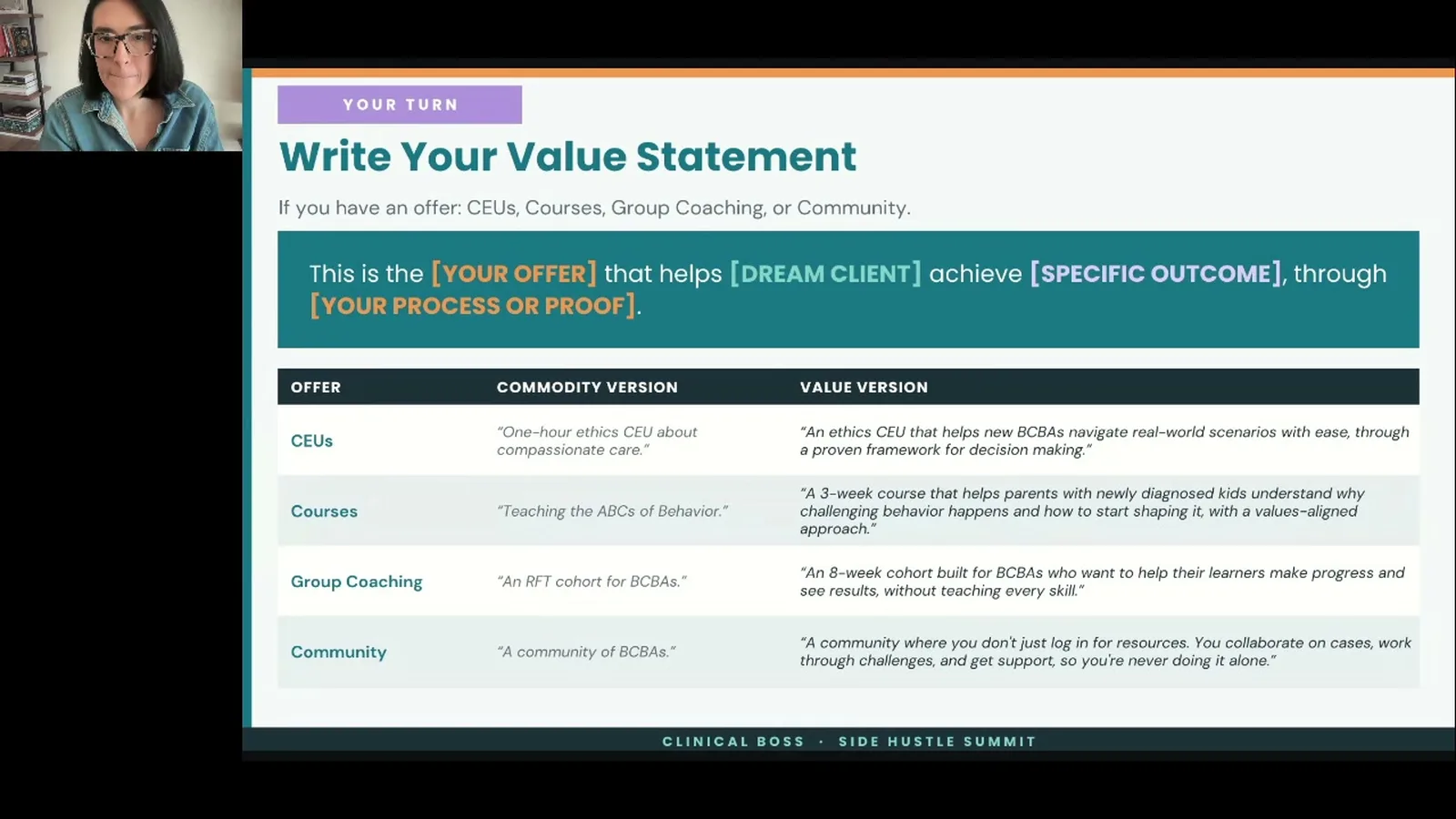
She gave a formula for your value statement (a short line that says what you do and for whom). I am the role who helps this specific person achieve this specific outcome through this process or proof. If you sell a leveraged offer (one product serving many people), do this instead of your time. Swap the role for the offer. This is the course or CEU that helps this person reach this outcome. It doubles as your answer when someone asks what you do.
Live feedback on attendee drafts showed the same three fixes over and over. Add the so what. Helping a parent navigate the IEP process (the written school plan) is not the win. The win is a child who can access learning, or a morning that stops being a fight. Cut the how. People care about the destination, not the connecting flight, unless the route itself is what sets you apart. Swap jargon for plain words. Most buyers do not know what evidence based (proven by research) means. What they hear is that you know this works. Pair a feeling with something concrete, like confidence plus better grades.
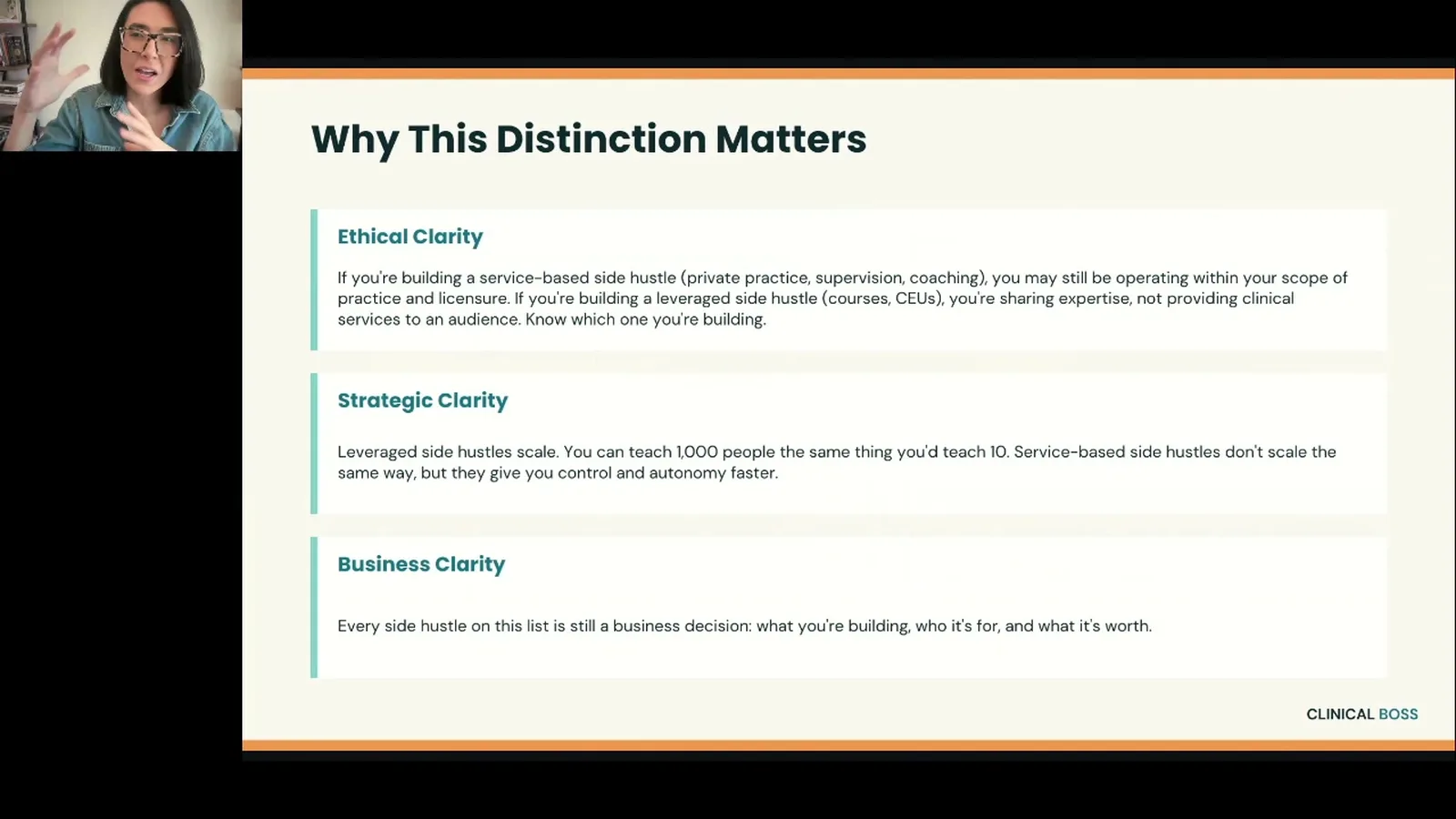
She also answered the money worry raised in the chat. You do not have to deliver the same one to one service to every person. Think about serving ten people in the same hour instead of one. The value stays high and only the format changes. Service work can come first, and leveraged work can grow beside it over time.
The session closed with a gut check. A side income does not have to replace your salary tomorrow. Picturing a packed caseload is exactly what keeps people frozen. So pick the smallest unit you believe is possible. One private pay client in ninety days. One supervisee. One consulting project. Ten sales of a course or CEU. Two people saying yes. Hitting that one unit unlocks the momentum to keep going. After that, it comes down to two things she repeated all session. Build an audience of the right people. Then give them a clear reason to choose you. And do not plant a seed, watch it for one afternoon, then walk away.
The problem is many of us don't start.
From the talk — Mellanie Page
Common questions
Do I need a big social media following to get clients as a clinician?▾
No. Mellanie Page says she rarely gets paying clients from social media and does not enjoy being there. Reach is rented attention, because the algorithm decides who sees your post. What you need is a small group of aligned people who see their own problem in your message.
What makes a lead magnet actually work?▾
It solves one tiny problem, not a huge topic. Someone can use it in ten to twenty minutes and get a real win. It moves them to act instead of only adding information. And it connects clearly to the paid offer that comes next.
How do I stand out from other analysts offering the same service?▾
Stop leading with your credential, because everyone else has one too. Name the precise problem you solve. Show proof of results you have produced, then say why your way is different. When every ad reads the same, buyers have nothing left to compare except price.
Which platform should I pick if I hate social media?▾
Pick the one you will keep showing up on. Blogs are searchable and stay useful for years. Short podcasts build trust. Presentations fit clinicians who already teach, as long as you include how to apply the ideas. You can also use social media only as a bridge to invite people somewhere else.
What legal steps do I need before taking my first client?▾
She recommends one meeting with a small business attorney. Ask about insurance, how to file your entity, and which contracts you need. The ethics piece stays with you. The BACB already gives guidance on scope of competence, testimonials, and how you describe services.
How do I define a dream client without turning people away?▾
Use the same precision you use clinically. Narrow by setting, skill level, presenting concern, and the problem the person is trying to escape. A narrow focus is a magnet, not a limit, because people can finally tell that you are for them.
About the speaker
Mellanie Page teaches clinicians how to build side income through service based and leveraged offers, and she coaches private clients through those strategies. In this session she walked attendees through defining a dream client, building an empathy map, designing a lead magnet, choosing one platform, and writing a value statement. She says she dislikes social media and grew her own audience through presentations and CEUs instead.
This summary was generated from the recording’s transcript. Quotes are taken word for word from the talk.
What you'll learn
- 1Define your dream client and how you can help them Use this strategy to attract your dream client and grow your pipeline. Build trust and nurture your audience to get clients.
Concepts in this CEU
Related talks
Talks that cover the same concepts
The ADHD Exchange: Understanding the Neurobiology of ADHD
ABA Made Ez

Beyond Competence: Using ACT to Cultivate Psychological Flexibility in Behavior Analytic Supervision
Rooted Consultation, LLC

So You Want to Do OBM Fieldwork?
Rooted Consultation, LLC

Collaboration and Building Rapport: Starting a Strong Foundation With Caregivers and Stakeholders in the Home
The Behaviorist Bookclub
The Life of a Showgirl (BCBA’s Version)
Upskill ABA

Shaping Behavior Change when ADHD is in the Picture
The Behaviorist Bookclub
More from The ABA Collective, LLC.
OpenCEU is supported by advertising from third-party sponsors. Sponsors are clearly labeled, have no influence over course content, instructors, or CEU decisions, and never appear on certificates. The BACB does not sponsor, approve, or endorse OpenCEU sponsors or their products.