That's Outside My Scope of Competence
Presented by Dr. Allison Bowhers-Peutin
The event will review 3 BACB ethical codes about scope of competency. In addition, 2 additional research articles will be briefly discussed in regards to scope of competency. Attendees will learn how to use the Competence and Confidence Checklist (Broadhead, et al., 2018) and apply it to their daily work. The presenter will also discuss possible variables that are influencing BCBAs from learning new skills to expand their scope. Recommendations will be reviewed on what BCBAs, clinical directors, and companies can do to proactively expand BCBAs scope of competence.
Sign in to buy — $10One-time purchase, permanent access. Cert delivered to your inbox the moment you pass the quiz.
About this CEU
As BCBAs, it is important for us to identify if cases are within scope of competence. If cases or situations are outside our scope of competence, it is important that we access professional development, supervision, or mentorship, to expand our scope. We are encouraged as BCBAs to maintain and expand our scope of competency. The question is, is this happening? Why might BCBAs not be expanding our scope of competence? Could some variables, such as an increase in medical insurance clinics be limiting our scope?
From the talk
What was covered
A BCBA's guide to scope of competence: three BACB codes, the four question Competence and Confidence Checklist, and how to name real gaps.
- Run the four question Competence and Confidence Checklist before you accept a case, not after the case goes sideways.
- Any low rating on procedures, populations, or settings means you pursue supervision or professional development for that case.
- Replace the phrase "that is outside my scope" with the specific gap and the exact support you are asking for.
- Age alone is rarely the real barrier: name the behavior, the assessment, or the programming that is new to you.
- If you are directed to take a case outside your scope, discuss it with your company and document what you did.
- Pick your next job, CEU, or journal club for what it teaches you, not for what it repeats.
Scope of Competence Is Not the Same as Scope of Practice
Two terms get mixed up all the time. Scope of practice (what your license allows) is set for the whole field. The BACB (the board that certifies behavior analysts) and state licensure laws define it. A BCBA (a certified behavior analyst) can assess behavior and build programs based on function (the reason a behavior happens). That is true for every BCBA.
Scope of competence (what you can do well) is personal. Broadhead and colleagues (2018) framed it as work you can do with success and confidence. One BCBA may list severe self-injury (behavior that hurts your own body) as in scope. Another has only seen mild forms. Same certification. Different scope.
Dr. Bowhers-Peutin used two TV doctors to make it stick. One doctor on Scrubs keeps attempting skills his license allows. He has neither the competence nor the confidence for them. He later thrives at finding out why a patient died. Same scope of practice, real competence this time. Dr. House is the mirror image. He is very competent and still works outside the rules, breaking laws and hospital policy along the way.
Scope of competency are activities that an individual BCBA feels they can do successfully and with confidence.
From the talk — Dr. Allison Bowhers-Peutin
Three BACB Codes That Govern Scope: 1.05, 1.06, and 3.03
Code 1.05 covers practicing within your scope. Behavior analysts work only within their identified scope of competence. You may move into a new population or a new procedure. First you access and document study, training, supervised experience, consultation, or co treatment. That support has to come from someone competent in the new area. If you cannot get it, you refer or transition the case.
Code 1.06 covers maintaining competence. You stay current through professional development activities. The code names reading relevant literature, conferences, workshops, and extra coursework. It also names coaching, consultation, supervision, and mentorship. A CEU (a continuing education credit) counts. So does the article you keep putting off.
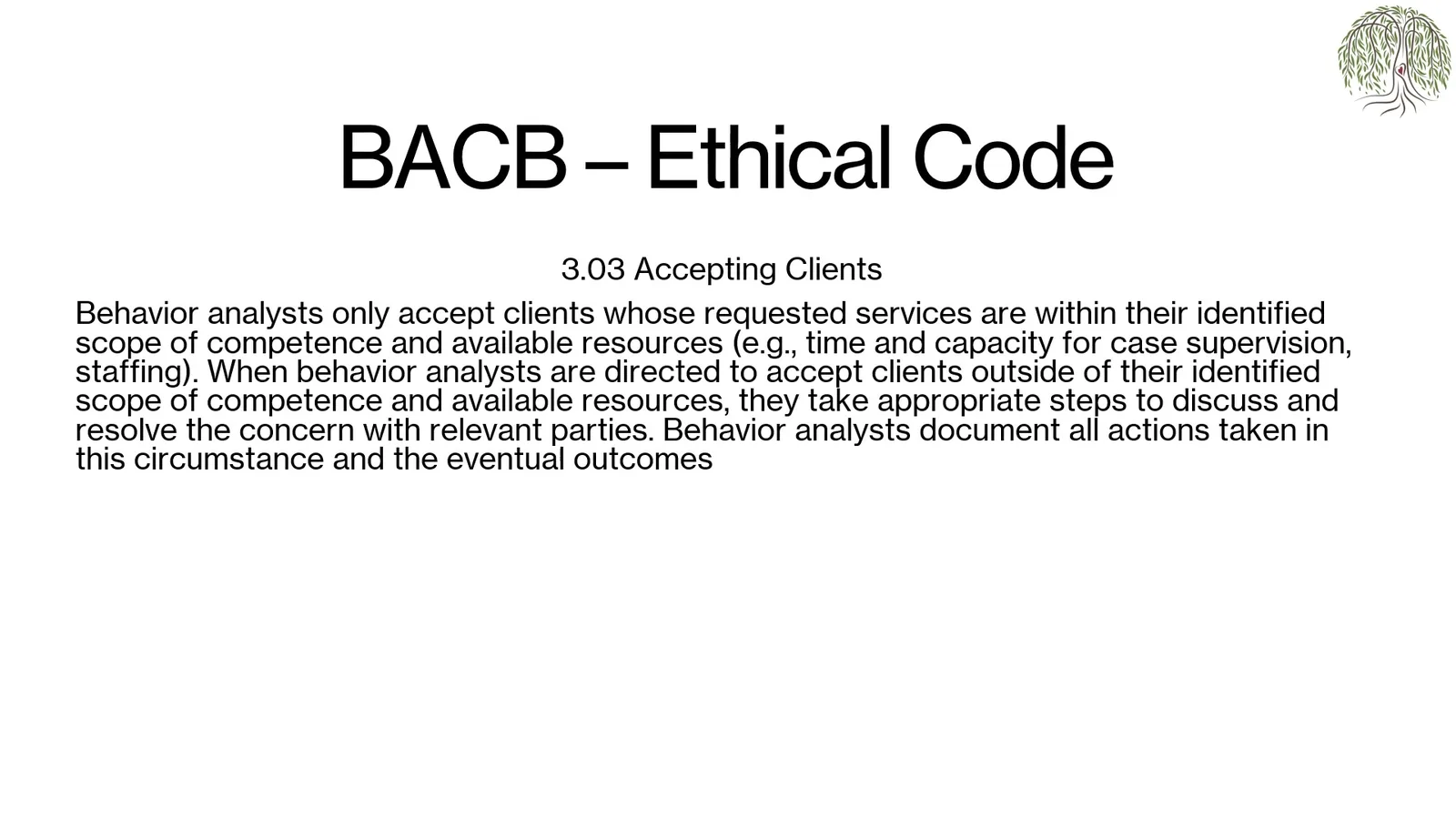
Code 3.03 covers accepting clients. You accept only clients whose requested services fit your scope and your available resources. Resources include your time and your capacity for supervision. Sometimes you are directed to accept a client outside that scope. Then you must take steps to discuss and resolve the concern with the relevant parties. Do not just take the case to keep the peace.
Behavior analysts document all actions taken in this circumstance and the outcomes.
From the talk — Dr. Allison Bowhers-Peutin
How to Run the Competence and Confidence Checklist
Broadhead and colleagues named three domains of competence. Procedures and strategies is one. That covers tools like task analysis (breaking a skill into steps) and functional analysis (a test of why behavior happens). Populations is the second, meaning the diagnoses you serve. Settings is the third. A medical clinic runs on one model. A school runs on the IEP (a school's written learning plan), so goals get written a different way.
The checklist has only four questions. Question one asks your level of competence on this case in all three domains. You circle high, medium, or low. Any low means you circle yes for more supervision or professional development. Question two asks your confidence in treatment success. That draws on past experience, how well you know the literature, and the resources you can reach.
Question three asks how similar this case is to your past work. You compare the behavior, the setting, your past resources, and the people described in relevant research. Question four asks for the overall rating. You sit back, read your own answers, and circle high, medium, or low.
The tool is built to be proactive and ongoing. In real life it often comes out after a case is already on your desk. Either way, it turns a vague feeling into something you can show a supervisor.
The checklist is only four questions and it should be done on an ongoing basis
From the talk — Dr. Allison Bowhers-Peutin
Three Case Scenarios, Scored With the Checklist
Scenario one. A BCBA with ten years of experience works with children ages two to ten. She is strong at task analysis programming for handwashing, teeth brushing, and dressing. She likes that work. She is offered a client who is twenty and needs life skills. She scored high across the board. Nothing changed except age, so the case looks fair to take.
Scenario two. A BCBA with two years of experience works with three to five year olds at a clinic. Most of his work is skill acquisition (teaching brand new skills). The new client hits his own head often, hard enough to bruise and swell. He saw that profile during his practicum, but he has never supervised it. Procedures scored high, and so did the setting. Population scored medium, and the overall rating landed at medium. That case can work if a supervisor is on site for the first weeks.
Scenario three. A BCBA with one year of experience has a supervisor who works remotely by phone and video. The clinic runs discrete trials (short, repeated teaching tries) and task analyses. The new client is thirteen, needs social skills work, and makes threatening statements to students and staff. That behavior is new for the whole center. This one scored mostly low. The familiar setting was the only high.
The tell is not the age. It is the stack of new variables at once. This BCBA would have to lead staff through a behavior nobody there has handled. One year in, with a remote supervisor, that is a lot to carry alone.
I don't think age is really a huge factor.
From the talk — Dr. Allison Bowhers-Peutin
What Goes Wrong When You Work Outside Your Scope
Broadhead and colleagues listed the direct costs. Client outcomes get worse, because you are not competent with that case yet. There is real risk of harm to the client, especially with self injury or aggression. There is risk to the clinician too. A BCBA pushed into a case they already flagged may feel insecure and frustrated with the company.
Dr. Bowhers-Peutin added a few of her own. You may model unprofessional behavior, or model that working outside your scope is fine. You may model behavior analytic skills that are simply wrong. A task analysis written by someone who has never written one can be inaccurate, and staff will run it exactly as written.
Staff can get hurt as well. If nobody teaches them to redirect the behavior safely, they take the hits. Families notice when a case goes badly. Some decide ABA does not work and move to an approach that is not evidence based. There is also the plain risk of disciplinary action against your certification.
So we know that practicing within your scope is an ethical requirement.
From the talk — Dr. Allison Bowhers-Peutin
Why BCBA Scope May Be Shrinking: Clinics, Job Hopping, and Billables
Here is the worry she brought to the talk. Clinics keep opening, and most of that work is children about two to six. Many are built around 40 hour clients with similar profiles. Some do not teach any crisis prevention curriculum at all, because they will not accept those referrals. That raises a generation of BCBAs inside one narrow lane.
Moving jobs does not fix it by itself. Going from one clinic to a clinic that looks the same keeps you in scope. It does not grow your scope. A move to a public or private school teaches you IEPs and school funding. A home program teaches you something else again. Pick the new arena for what it can teach you, and check that a supervisor there can back you up.
Billable pressure is part of the story too. Billable hours (time you can charge for) shape how companies judge clinicians. Suppose a case needs extra analysis and heavy staff training. Much of that time is not billable, so your numbers drop. The company may read that as a weak clinician. That contingency quietly pushes people to refuse cases they could learn from.
There's benefit to job hopping to other arenas to help you expand your scope
From the talk — Dr. Allison Bowhers-Peutin
Say What Is Actually Outside Your Scope, and Be Specific
Said after the fact, the phrase can signal avoidance. Said early, it starts a useful conversation. The difference is usually specificity. Age is the most common vague answer, and it is too arbitrary. An eighteen year old with mild aggression is not off limits because of a birth year. The aggression itself just looks different at eighteen than at two.
Assessments work the same way. If you have only used early learner assessments, an older student needs tools you have never run. That is not an age problem. That is a training gap with a name, and named gaps can be filled.
So name the thing. Tell your supervisor that the magnitude of the aggression is new to you and ask for two weeks of shadowing. Say you have never served a client who speaks English as a second language, name the CEU you plan to watch, and ask what else they recommend. Ask for a weekly meeting on the case and say why you want it.
it's the magnitude of aggression that's new for me can I have someone shadow me for two weeks
From the talk — Dr. Allison Bowhers-Peutin
Action Steps for BCBAs, Clinical Directors, and Companies
If you are the BCBA, start small. Find specialists on LinkedIn and message them, because most are glad to talk. Book a CEU on something you have never done. Read a book. Tell your supervisor your growth plan and ask them to add to it. Join a book or journal club where someone else picks the reading, so you land outside your usual preferences. At your next conference, sit in one talk that feels totally unfamiliar.
If you supervise BCBAs, hand some of the work back to them. Ask the clinician for their own action steps and the reasons behind them. Set up shadowing with a colleague who has that competence. Then protect that colleague by easing their billable target for that week. Finally, make the honest call on whether the case is ethical for that clinician right now.
If you run the company, move earlier than the referral. Offer continuing education that varies on purpose, not only what is easy to schedule. Rotate fieldwork placements and client populations where you can, especially for aspiring BCBAs. Name the internal mentors who specialize in specific areas so staff know who to ask. Push collaboration across centers, schools, and departments.
People will start learning before the case is assigned to them.
From the talk — Dr. Allison Bowhers-Peutin
Common questions
What is the difference between scope of practice and scope of competence?▾
Scope of practice is what the profession is allowed to do, and it is set by the BACB and state licensure laws. Scope of competence is personal. It is the set of activities you can do with success and confidence, based on your own training and experience. Two BCBAs with the same certification can have very different scopes of competence.
Which BACB ethical codes cover scope of competence?▾
The talk reviewed three. Code 1.05 says you practice only within your identified scope of competence and get documented study, training, supervision, consultation, or co treatment before entering a new area. Code 1.06 says you maintain competence through professional development. Code 3.03 says you accept only clients who fit your scope and your resources, and you document what you do when you are directed to take a case that does not fit.
What is the Competence and Confidence Checklist?▾
It is a four question tool from Broadhead and colleagues (2018). Question one rates your competence on the case across procedures and strategies, populations, and settings. Question two rates your confidence in treatment success. Question three rates how similar the case is to your past work and to relevant research, and question four gives an overall rating. Any low rating means you pursue supervision or professional development.
Is a client's age a good reason to say a case is outside my scope?▾
Usually not on its own. The talk argued that age is too arbitrary to be the real answer. Drill down instead: the magnitude of the aggression, the assessment you have never run, or the type of programming may be the actual gap. Those gaps have names, and named gaps can be trained.
What do I do if my employer directs me to take a case outside my scope?▾
Code 3.03 tells you to take steps to discuss and resolve the concern with the relevant parties, then document every action and the outcome. Bring the specific gap to your supervisor along with what support would close it, such as shadowing, weekly case meetings, or a mentor. If no support is available, the case should transition to another professional.
About the speaker
Dr. Allison Bowhers-Peutin was first certified as a BCBA in 2011 and has been a BCBA-D (a doctoral level certification) since 2019. She completed her master's degree at Columbia University and her PhD at Simmons University, and she has worked in schools, clinics, telehealth, and home programs with clients from about eighteen months to twenty two years old. Through her company, Willow Mentorship and Consulting, she coaches BCBAs on professional skills such as public speaking, confidence building, decision making, and feedback delivery.
This summary was generated from the recording’s transcript. Quotes are taken word for word from the talk.
What you'll learn
- 1Participants will be able to identify 3 ethical codes from the BACB about scope of competence Participants will learn how to use the Competence and Confidence Checklist (Broadhead, et al., 2018) and apply it to case examples Participants will identify several ideas that they can do to expand scope of competence
Concepts in this CEU
Related talks
Talks that cover the same concepts
School Collaboration as an Area of Competence - Applied 2022
The Behaviorist Bookclub
Hey, Chillax Man! Understanding the Logic of Anxiety
The Behaviorist Bookclub
Interdisciplinary Grief Support for People with Disabilities: Enhancing Outcomes Through BCBA-LPC Collaboration
The Behaviorist Bookclub

Rad N Bad: The Other Side of the Table — Ethical Failures, Compassionate Care, and Consumer Realities in ABA
Hickory Learning Group

Harm Reduction Within ABA Practice
The Behaviorist Bookclub
Shaping Behavior Change when ADHD is in the Picture
The Behaviorist Bookclub
More from Willow Mentorship & Consulting, LLC

OpenCEU is supported by advertising from third-party sponsors. Sponsors are clearly labeled, have no influence over course content, instructors, or CEU decisions, and never appear on certificates. The BACB does not sponsor, approve, or endorse OpenCEU sponsors or their products.