Jessel's IISCA Efficiency: How a 30-Minute Functional Analysis Holds Up
Dr. Joshua Jessel shows how the IISCA cuts a 3-hour FA down to about 30 minutes without losing control. Plain breakdown from a BCBA-led CEU.
Key takeaway
A standard functional analysis runs about three hours on average, and Dr. Joshua Jessel's literature review found the IISCA gets the same job done in roughly 30 minutes, an 80% efficiency gain.
Redefining the Boundaries of Efficiency during a Functional Analysis of Problem Behavior - Applied 2022
On this page · 8 sections▾
A standard functional analysis runs about three hours on average, and Dr. Joshua Jessel's literature review found the IISCA gets the same job done in roughly 30 minutes, an 80% efficiency gain. That gap is the whole point of this talk. If you are a Board Certified Behavior Analyst (BCBA) who has been told that long FAs are best practice but cannot fit them into a real caseload, this page walks through what Jessel actually proved, how he proved it, and where the tradeoffs sit.
Why the standard FA averages three hours (and why that matters in clinic)#
The standard functional analysis traces back to Iwata and colleagues in 1982, with a second wave after the 1994 republication. The format that became "the standard" uses multiple test conditions (attention, escape, alone, tangible) repeated and compared to a play control. Each potential reinforcer gets its own isolated context. To get a clean read, you run sessions across all of those conditions multiple times.
Jessel and his team pulled every functional analysis published in the last 10 years, counted the sessions, and multiplied by session duration. The number that came back was sobering.
"The standard functional analysis takes an average of around three hours to conduct. That's if you're not including undifferentiated outcomes, multiple attempts or multiple analyses for each topography as recommended." From the talk — Dr. Joshua Jessel
Three hours is just the analysis itself. It does not include setup, prep, or staff training. In a real clinic with a real caseload, that number is why most clinicians do not run FAs. A survey by Oliver and colleagues found that 63% of practitioners reported running an FA "never" or "almost never." The barriers were not theoretical. They were time, staffing, and safety.
If a method is best practice but nobody uses it, the field has a problem. Jessel built the practical functional assessment (PFA) and the IISCA to close that gap.
The PFA workflow that feeds the IISCA: interview, observation, single test condition#
The IISCA does not stand alone. It sits at the end of a three-step workflow Jessel calls the practical functional assessment.
Step 1, open-ended interview. You talk to caregivers about when problem behavior shows up, what tends to happen around it, and what they have tried. You leave with "function hunches" instead of pre-baked condition labels. Jessel is firm that walking in with attention/escape/tangible conditions already mapped out means you have assumed too much.
Step 2, unstructured observation. You watch the child briefly with the caregiver-described contingencies playing out. You test the hunches in a low-stakes way and refine them. By the end of this step, you should have one synthesized contingency you want to evaluate.
Step 3, IISCA. The interview-informed synthesized contingency analysis. A single test condition, individualized to that child, compared to a non-contingent matched control. Any functionally related problem behavior (including non-dangerous precursors) gets reinforced. That open contingency class is what lets you avoid pushing the kid into a full severe episode just to "see it."
The IISCA earns its name from five defining features: a single individualized test, a matched control, contingencies informed by interview plus observation, an open contingency class, and brief sessions.
Three tests, two controls: the IISCA session structure in plain English#
The standard FA needs you to run attention, escape, alone, tangible, and play, then replicate them enough times to get clear data. The IISCA does not split contingencies into isolated buckets. It runs the synthesized contingency the caregiver described, then a matched control where those reinforcers are freely available.
"Three tests, two controls is the norm to conduct. And this translates to a quicker analysis period." From the talk — Dr. Joshua Jessel
Five sessions. Three of the synthesized test and two of the matched control. That is the typical IISCA. In Jessel's earliest publication of the IISCA, this structure held up across 30 participants of various ages, diagnoses, and topographies including self-injurious behavior and aggression.
The reason it works is the front-end PFA. The interview and observation do the heavy lifting of identifying the contingency. By the time you hit the analysis, you are not searching for which reinforcer matters. You are confirming the one you already have strong evidence for.
The 80% efficiency gain Jessel's review found (and how he measured it)#
Here is where the headline number comes from. Jessel pulled 127 IISCA applications from the published literature alongside the standard FA dataset. He calculated total analysis duration the same way for both: count the sessions, multiply by session length, ignore prep and setup.
"The ISCA only required a mean of 30 minutes to conduct. And that is around an 80% improvement in efficiency, which will probably have a large impact on when practitioners are able to start implementing treatment." From the talk — Dr. Joshua Jessel
Three hours becomes 30 minutes. Same job, same goal, same end state of being ready to design a function-based treatment.
That efficiency matters for three concrete reasons:
- The FA is the only point in the assessment-to-treatment process where you are intentionally evoking problem behavior. Shorter means less evoked behavior.
- Less time in analysis means faster transition to treatment, which is the part everyone actually wants.
- Faster analyses fit inside the real schedules of clinicians who carry full caseloads.
The argument is not that shorter is better in the abstract. The argument is that shorter is better when it does not cost you analytic control. Which leads to the next question.
What "pristine differentiation" looks like compared to standard FA outcomes#
Skeptics of brief FAs usually push back with one objection: faster has to mean weaker control. Jessel addressed that head-on by scoring control across every published IISCA and every standard FA from the past decade against an explicit rubric (none, weak, moderate, strong).
"The majority of these ISCA applications had pristine differentiation with no overlap and no problem behavior in the control condition." From the talk — Dr. Joshua Jessel
"Pristine" in this context means the strong-control rating: no overlap between test and control data, and no problem behavior occurring during the control condition. The IISCA outperformed the standard FA on that measure. Faster was not just acceptable. It was cleaner.
In follow-up studies, Jessel pushed the sessions even shorter. Study one ran 18 participants with 10-minute IISCA sessions, then re-analyzed the first five and three minutes of each. Study two ran eight new participants at three-minute sessions from the start. Most analyses still showed strong control.
The takeaway is that the standard FA carries a lot of redundant time. Once you have the synthesized contingency dialed in from the PFA, you do not need three hours to demonstrate control. You need clean differentiation between when the reinforcer is absent and when it is present.
When the 30-minute IISCA is the right call (and when to keep tightening)#
The IISCA is not a one-size answer. Jessel's framework treats efficiency as a construct that depends on the situation. There are cases where 30 minutes is still too long.
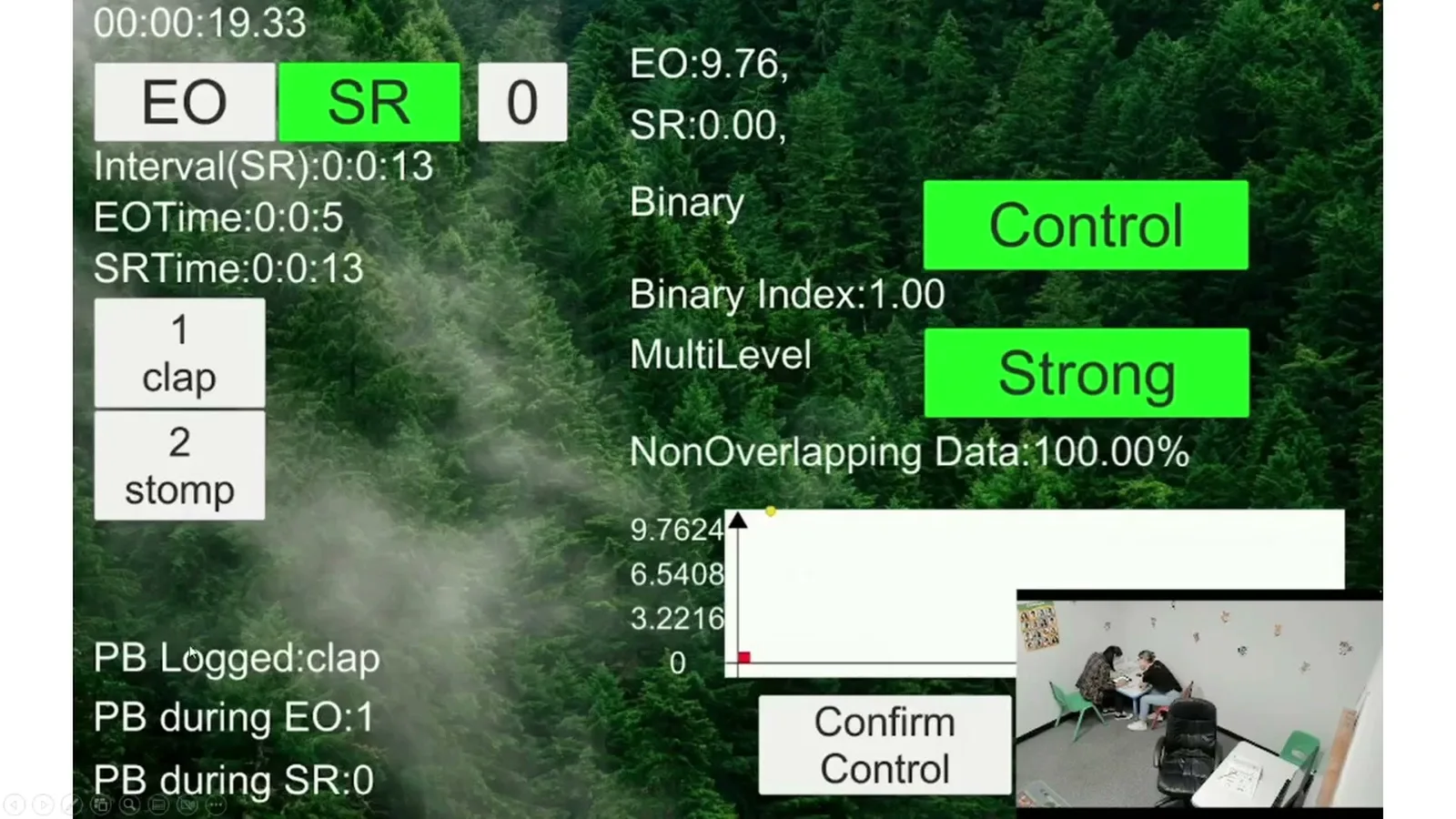
If the target behavior is severe enough that even a 30-minute window of repeated instances is unsafe, you go further. Jessel walks through the single-session IISCA (alternating reinforcer-absent and reinforcer-present intervals inside one session, often three to five minutes total) and the performance-based IISCA (terminate after five evocative-event presentations, no fixed session duration, calm-contingent reinforcement). Both keep the IISCA logic but shrink the exposure window further.
If the target behavior is moderate and you have a confident hypothesis from the interview, the standard 30-minute IISCA is usually the right place to land.
If you do not have a confident hypothesis and the behavior is not dangerous, the standard 30-minute IISCA is still faster and cleaner than the 3-hour standard FA. Use it.
The thing to avoid is defaulting back to the 3-hour FA out of habit. Jessel's review showed that more time does not mean more control. Control comes from the design, not the duration.
FAQ#
How long does an IISCA actually take versus a standard functional analysis?
Jessel's literature review found the standard FA averages about three hours, while the IISCA averages about 30 minutes. That is an 80% efficiency gain on analysis duration. The number reflects session count times session length, not setup or training time.
Does a shorter FA mean weaker functional control?
Jessel's review found the opposite. The majority of IISCA applications showed pristine differentiation, meaning no overlap between test and control data and no problem behavior during the control condition. That outperformed standard FA control ratings in the same review window.
How many sessions does the IISCA usually need?
Three test sessions and two control sessions is the norm, for a total of five sessions. Single-session and performance-based IISCA variations cut that further when safety or speed demands it.
Is the IISCA accepted as a functional analysis under BACB ethical standards?
The BACB requires a functional assessment when problem behavior is present but does not mandate a specific format. The IISCA meets the definition of an empirical demonstration of functional control. Jessel argues it is more ethical than the 3-hour standard FA precisely because it reduces evoked problem behavior and accelerates time to treatment.
Keep going#
Want to see Jessel walk through the data himself, including the single-session IISCA app demo and the performance-based clinical case with Rich? The full talk is on openceu.com.