Is a Shorter Functional Analysis Reliable? What Jessel's Data Shows
Three-minute FA sessions held up across 26 IISCAs in Jessel's research. Here's what 'level of control' looked like at 10, 5, and 3 minutes from a BCBA-led CEU.
Key takeaway
A shorter functional analysis can be reliable, and Dr. Joshua Jessel proved it by grading 26 IISCAs against a four-point "level of control" rubric and watching how the result degraded (or did not) when sessions were trimmed from 10 minutes to 5 to 3.
Redefining the Boundaries of Efficiency during a Functional Analysis of Problem Behavior - Applied 2022
On this page · 9 sections▾
Is a Shorter Functional Analysis Reliable? What Jessel's Data Shows
A shorter functional analysis can be reliable, and Dr. Joshua Jessel proved it by grading 26 IISCAs against a four-point "level of control" rubric and watching how the result degraded (or did not) when sessions were trimmed from 10 minutes to 5 to 3.
That single sentence is the whole point of his Applied 2022 talk, but the path he took to get there is what makes the finding usable for a BCBA on Monday morning. He did not just claim that a brief FA works. He built a way to grade the FA you already ran, then showed what happened when he shortened the clock on real cases.
The level-of-control rubric: none, weak, moderate, strong#
Jessel's rubric grades any FA on two things at once: do the test and control conditions overlap, and is there problem behavior showing up in the control condition. From those two questions you get four buckets.
"It begins with the default no control, where there is extensive overlap and consistent problem behavior during the control condition."
That is the floor. The graph is muddy, the control condition is firing, and you have nothing you can trust to inform treatment. Jessel calls this "back to the drawing board." Weak control is the next step up, with some overlap and some problem behavior in the control. Moderate is an either-or: you see overlap or you see control-condition problem behavior, but not both. Strong is the ceiling.
"Our top rating scale goes to functional analyses without overlap or problem behavior during the control."
Both conditions have to be clean. Once you can sort your own graphs into one of those four buckets, you can start asking the more interesting question: does shrinking the session length push a graph down the rubric?
Study 1: 18 IISCAs reanalyzed at 10, 5, and 3 minutes#
The first study took 18 IISCAs already run at 10 minutes per session and reanalyzed the rates of problem behavior using only the first 5 minutes of each session, then only the first 3 minutes. Same data, narrower windows. The question was simple: if you only had three minutes of footage, would you still grade the analysis at the same level of control?
"We used this criteria of control to evaluate 26 ISCA's and we were particularly interested in determining if less time would result in a degradation of control."
For most participants, the answer was yes. A graph that earned a green "strong" rating at 10 minutes mostly stayed green at 5 and at 3. A few cases slid from strong to moderate, or from moderate to weak, when the window closed. But the dominant pattern across 18 cases was that the rubric grade held.
That is a counterintuitive finding for a BCBA trained on Iwata-style FAs that run for hours. The instinct is that more time equals more confidence. Jessel's data argue the opposite for the IISCA format: most of the signal you need is in the first three minutes of the session.
Study 2: 8 new IISCAs run live at 3-minute sessions#
Study 1 was a reanalysis. Study 2 was the prospective test. Eight new clients walked into the clinic and Jessel's team ran their IISCAs at 3-minute sessions from the start.
"We did not see much degradation and control, even with sessions as brief as five or three minutes."
The 8 new cases looked like the 18 reanalyzed cases. Most graphs landed in the strong-control bucket. A few were moderate. The pattern from Study 1 was not a fluke of how you slice an existing dataset. It held when 3 minutes was the actual session duration.
Put the two studies together and you get 26 IISCAs graded on the same rubric, with the same general result: the IISCA format produces a clear signal fast, and dragging it out longer rarely changes the answer.
What "degradation of control" looks like on a graph (and when it actually shows up)#
Jessel walked the audience through one case where degradation did happen. At 10 minutes the test condition was high, the control was flat, and the rubric scored it as strong. At 5 minutes the rates dropped because the longest stretches of problem behavior had not yet shown up. At 3 minutes the graph was sparse enough that "control" became hard to read at all.
That is a real risk to name. When degradation shows up, it usually shows up as the test-condition rate quietly falling because the heavier responding clustered in minutes 4 through 10. The control condition is rarely the problem. It is the test condition that needs enough time to actually evoke behavior.
The rubric catches this. If your 3-minute test condition is not producing problem behavior, you do not have moderate or strong control. You have weak control or no control, and the right move is to extend the session, not to push into treatment. The rubric is the safety net that makes shorter sessions defensible.
Why shorter sessions did not weaken results for most participants#
The IISCA is built differently from a standard multielement FA, and that is most of the reason short sessions work.
A standard FA isolates each putative reinforcer in its own condition and compares it to a play control. You need repeated, separated test conditions to see the function emerge. An IISCA uses one test condition built from an open-ended interview and an unstructured observation, and it compares that synthesized contingency to its matched control. The function has already been hypothesized before the FA starts. You are not searching for the function in the data. You are confirming a hunch.
When the contingency is already individualized to the client, the establishing operation hits faster. Problem behavior shows up in the first minute or two because the EO is calibrated. The control condition stays clean because the matched reinforcers are present. The graph differentiates quickly, and the rubric grades it as strong control.
This is why "shorter FA" is reliable for the IISCA specifically. The pre-work, the interview and the observation, front-loaded the analysis. The session is short because the thinking happened before the session started.
When you should NOT trust a 3-minute FA result#
There are three situations where a 3-minute IISCA result deserves a longer second look.
The first is when the rubric grades it as moderate, weak, or no control. A short FA is only as good as the signal it produces. If the graph is muddy, extending the session is the right call, not pushing into treatment with shaky data.
The second is when the target behavior is dangerous and low-rate. Some severe problem behaviors do not occur every 30 seconds. They occur every several minutes. Three minutes may not be enough time to see the response class you actually care about. The interview and observation should flag this before the session starts.
The third is when the open-ended interview produced a weak hunch. The IISCA depends on the synthesized contingency being close to right. If you walked into the FA still unsure which EO and which reinforcer to test, a longer session will not save you. A second interview will.
In all three cases the answer is not "abandon the short FA." The answer is "the rubric told you something, so listen to it." The rubric is the deciding voice, not the clock.
How a BCBA actually uses this on Monday#
Start with the rubric, not the stopwatch. After any IISCA you run, grade the graph against the four-point scale. Strong control means proceed to treatment. Moderate control means you can usually proceed, but flag the apprehension. Weak control or no control means stop and rework either the contingency or the session duration.
If you are already running IISCAs at 30 minutes and the rubric says strong, Jessel's data suggest you could safely run them at 15, or in some cases at one 3-minute session, and reach the same conclusion in a fraction of the time. The path to faster treatment is not to skip the FA. It is to grade the FA you already ran, then trim what is not adding information.
The point is not "every FA should be 3 minutes." The point is that the rubric, not the duration, is what tells you whether to trust the result.
FAQ#
Can a 3-minute FA session really produce reliable results?
Yes, for the IISCA format, and only when the rubric grades the session at strong or moderate control. Jessel's Study 2 ran 8 new IISCAs with 3-minute sessions and most landed in the strong-control bucket. The session is short because the pre-work, the interview and the unstructured observation, already narrowed the contingency. If your rubric grade is weak or no control, the 3-minute window is not enough.
What is the "level of control" rubric and how do I use it?
The rubric grades any FA on two questions: do test and control conditions overlap on the graph, and is there problem behavior showing up in the control condition. Both clean equals strong control. Either-or equals moderate. Both present and small equals weak. Both extensive equals no control. Use it after every FA to decide whether to proceed to treatment or to adjust the assessment.
What does it mean if my FA shows "no control"?
It means extensive overlap between test and control, plus consistent problem behavior during the control condition. The graph cannot tell you what is maintaining the behavior. Jessel calls this "back to the drawing board." Do not write a function-based intervention from a no-control FA. Revisit the open-ended interview, refine the synthesized contingency, and run the FA again.
Should every FA use 3-minute sessions now?
No. Jessel's data say the IISCA format can produce strong control in 3 minutes for most cases, not that 3 minutes is the right default for every FA. Standard multielement FAs were not tested in this research. Low-rate dangerous behavior, weak interview hunches, and any rubric grade below moderate are all signs that a longer session is warranted. The rubric is what decides, not the clock.
Watch the full session#
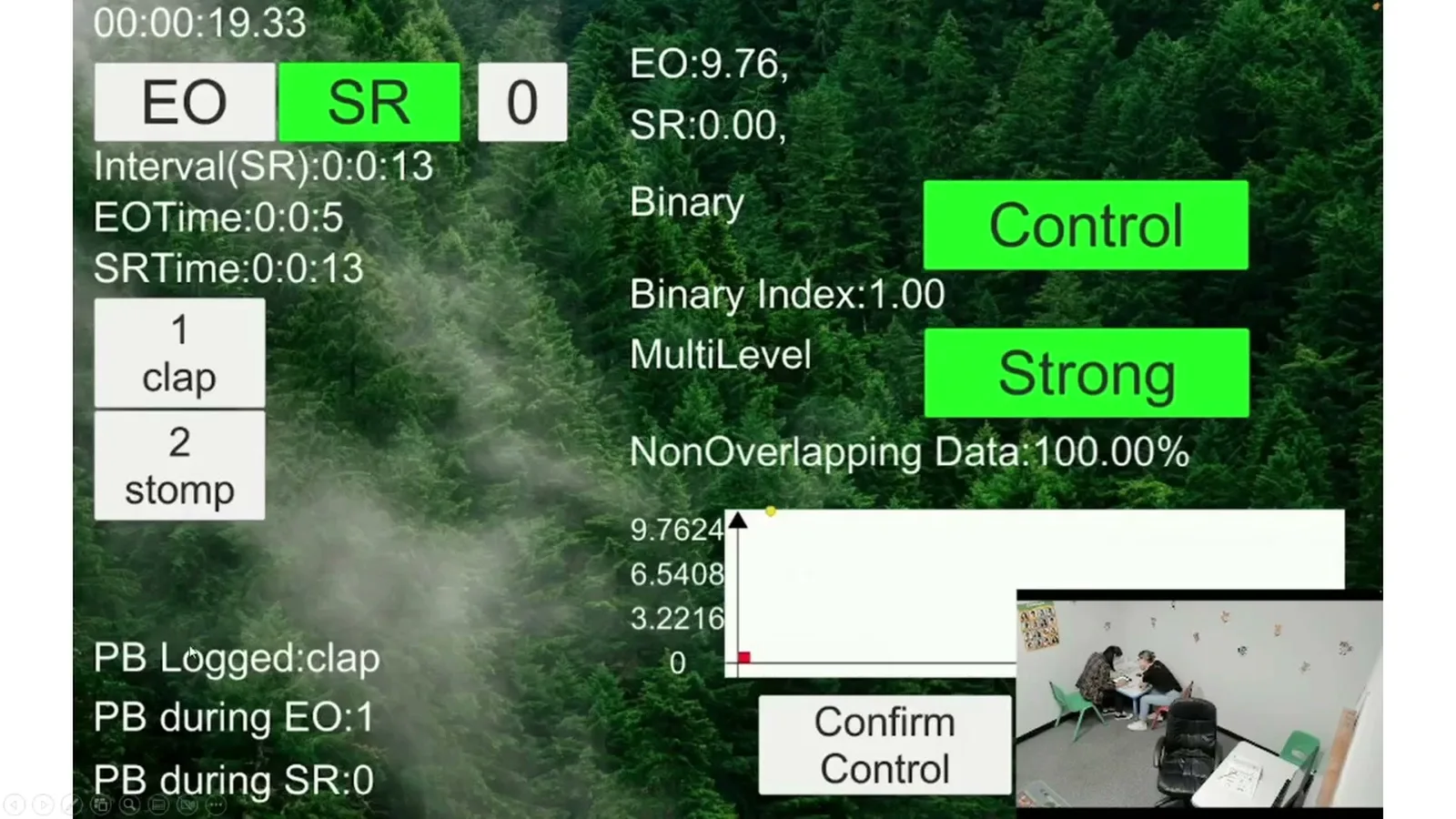
Jessel walks through the rubric on real graphs, shows the degradation patterns, and demos the PB&ME app he and his team built to grade level of control in real time during a session. The level-of-control sections start about a third of the way in.