How to Teach Manding to a Nonverbal Child (Pick Modality First)
Pick sign, picture, or vocal based on imitation, matching, and echoic skills, not caregiver preference alone, from a BCBA-led CEU.
Key takeaway
The fastest way to teach a nonverbal child to ask for things is to pick the modality first, using a brief prerequisite check (the Valentino 2018 modality-assessment-first approach), and stop guessing between sign, pictures, and vocal.
5 Days of Manding Mastery
Free learning path on this topic
Verbal Behavior: Beyond WH-Questions
Dana Pettus's three-part series on building generative verbal behavior. Why WH-question programs stall, how to establish speaker-listener repertoires, and how to scaffold advanced verbal skills like recall and simple inference. Three hours, three CEUs.
On this page · 7 sections▾
The fastest way to teach a nonverbal child to ask for things is to pick the modality first, using a brief prerequisite check (the Valentino 2018 modality-assessment-first approach), and stop guessing between sign, pictures, and vocal. The kid's current imitation, echoic, and matching skills tell you which mand mode (the way they will ask, including sign, picture exchange, or vocal output) is most likely to stick this month. Caregiver preference is real and matters in the conversation, but it does not pick the modality. The data does. This page walks the steps Matt uses in the talk, with the real cases he shared.
Before you pick a modality, run a brief prerequisite check#
Before any teaching trial, sit with the learner for one short session and watch three things. Can they copy a body movement when you do it first? Can they repeat a sound or word when you say it first? Can they put a picture of a goldfish on top of a matching goldfish picture? You are not running a full VB-MAPP. You are running a quick screen so the next four weeks of teaching do not get wasted on the wrong mode.
The screen does not have to be formal. A 15 to 30 minute play session, with a few planted probes, is enough to tell you which skill is strongest and which is weakest. Write down what you saw with simple yes, partial, or no marks. Keep the materials boring: a few preferred items, a flat picture, your own hands and voice. The point is to see what the learner already does, not to teach anything new.
If the screen comes back almost flat (no imitation, no echoic, no matching), do not panic. That just tells you to start by building one of those skills in parallel with a low-effort mand mode. We will get to that part.
Three skills that predict the right modality (imitation, echoic, matching)#
The cleanest mapping in the research comes from the Valentino 2018 paper. The skill the learner already has predicts the mand mode that will work. Said the simplest way:
motor imitation obviously corresponded with sign. Echoic corresponded with vocal. Matching corresponded with pictures.From the talk — Matt Harrington
Read that as a decision rule. Motor imitation (copying body movement) goes with sign (using your hands to make a word, like a fist to the lips for "eat"). Echoic (repeating a sound or word back) goes with vocal (saying the actual word out loud). Matching (putting like with like) goes with pictures, usually through PECS (Picture Exchange Communication System, where the learner hands you a card to ask for something).
The same paper makes the echoic point even more directly. If the learner can echo, vocal mand training is likely to move quickly. If they cannot echo, vocal mand training is going to grind.
if imitation skills were present, there was going to be strong likelihood that vocal imitation, vocal manning, was going to be an efficient training model. If it wasn't present, then vocal manning training probably was not going to work.From the talk — Matt Harrington
You do not need all three skills to teach a mand. You need at least one. Pick the mode that matches the strongest skill. That is the fastest path to a kid asking for something on day one, instead of day sixty.
If echoics are weak, start with sign or pictures#
This is the part most teams skip. If the echoic data says no, vocal is not the next move. Sign or pictures is.
Picking between sign and pictures comes down to the screen. If motor imitation was the strongest of the three, sign is the lead. Sign is fast in the moment because the learner's hands are always available. There is nothing to carry, nothing to lose under the couch. The trade is that you, the team, and the family all have to learn the signs. Untrained adults cannot read the mand, and that limits where the kid can use it.
If matching was the strongest of the three, pictures is the lead. Pictures (usually through PECS) are slower in the moment because the learner has to find the card and hand it over. The trade is that any adult who sees a goldfish picture on a goldfish bag understands the mand without training. Pictures travel better outside the home.
Either way, the rule is the same. Choose the mode that matches the strongest current skill. You can always add a second mode later. You do not have to commit forever.
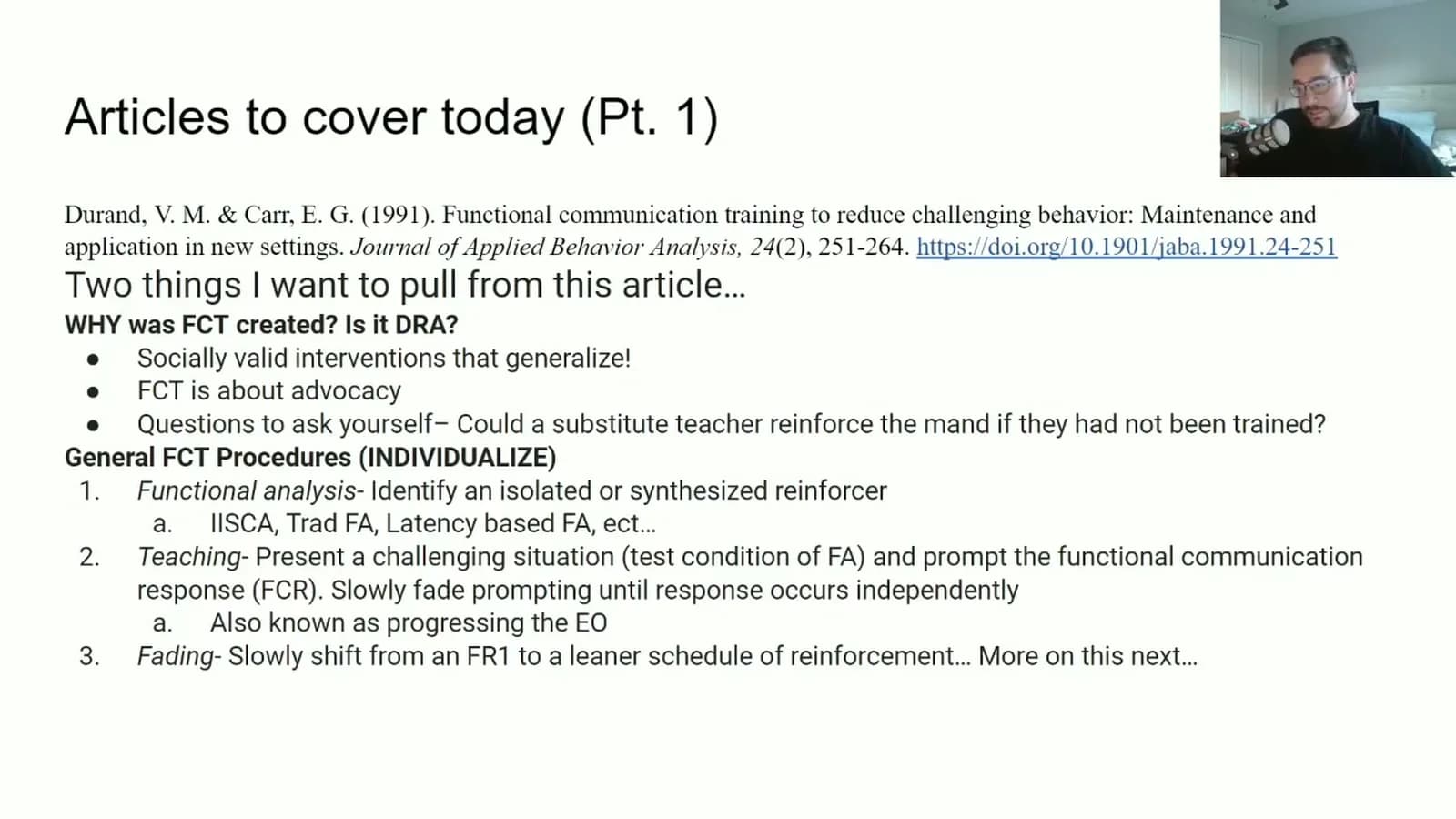
A note on FCT (functional communication training, where you teach a kid to ask for what they need instead of acting out to get it). The mand mode is the response form inside FCT. Pick the form first, then run FCT on it. Do not pick the form last and hope it works.
What to do when caregivers want vocal but the data says picture#
This is the hardest part of the job, and Matt is honest about it in the talk.
I found that a lot of times caregivers want a vocal mand no matter what. They just feel like they want their kid to be able to come home and say mommy or daddy. And that can be a really hard conversation when you begin to identify that maybe the vocal mand isn't really the best option.From the talk — Matt Harrington
Read that quote twice. The parent's wish is not wrong. The wish is real and it is the right wish. The job is not to talk the parent out of vocal. The job is to be clear about what the data says, and then build a plan that respects both the data and the wish.
Here is the script that works. First, name the wish out loud. "I hear you. You want them to say mommy. That is what I want too." Second, show the screen results plainly. "Right now, when I make a sound, they do not copy it back yet. When I clap, they clap. When I lay out a goldfish card, they put it on a goldfish bag." Third, lay out the plan. "We are going to teach them to ask using a picture, because that is going to give them a word they can use today. At the same time, we are going to spend a few minutes every session building the copying-sound skill, so that vocal becomes possible later."
Most parents say yes to that. The ones who do not say yes usually need one more piece of information: the cost of pushing vocal when echoics are not there. Spell that out.
We can slam our heads into the wall for months and months and months with some of our clients trying to do vocal man training, for example... if the prerequisite skills aren't there, we're never really going to get anywhere.From the talk — Matt Harrington
Months of slow progress is months of the kid not asking for the goldfish. Months of the kid getting frustrated. Months of the family asking why nothing is changing. Picture mand now, with vocal imitation work in the background, gets the kid a working word in days. That is the trade you are offering. Most families take it once they see it that way.
Setting up the first picture-exchange or sign trial#
The first trial is small. You need one strong reinforcer, one teaching adult, and (for picture) one card or (for sign) one prompt-ready hand. Do not start with six items. Start with one.
For picture exchange, sit across from the learner. Put the picture between you. Put the goldfish (or whatever the reinforcer is) right next to your face, above the picture, in their line of sight. Wait for any reach. Prompt the hand to pick up the card and place it in your other hand. The second the card hits your hand, deliver the goldfish and the spoken word ("goldfish!"). That is one trial. Run a few of these in a short block, then stop. End on a win, not on a refusal.
For sign, do the same setup with the reinforcer in view. The prompt is hand-over-hand: you guide their hand into the sign for "eat" or "more" or "goldfish." The second the sign happens, deliver the goldfish and the spoken word. End on a win.
A few details from the talk and the published procedures that matter. Keep the reinforcer present and visible. Do not test (do not ask "what do you want?"). Mands are pulled by motivation, not by a question. Pair every delivery with the spoken word, even when the mand is a picture or a sign, so the vocal form gets practiced as input. Block all other ways of getting the item: no reach-grabs, no pointing, no whining-and-getting. The mand is the only path to the goldfish during the block.
Five to ten trials is a session. If the kid is loving it, do more. If the kid is leaning out, stop. End with the item in their hand, not in yours.
Running vocal imitation in the background so you can switch later#
This is the move that keeps the parent meeting easy. You are not abandoning vocal. You are stacking it.
The talk has a clean example of how to do this. Picture mand on the front of the program, vocal imitation work in the background, so the second the echoic skill builds, you can swap modes.
we decided that we were going to work on the picture exchange system. But then at the same time, we're going to start reinforcing and training spontaneous and prompted imitation so that we can start building up to that vocal mand eventually.From the talk — Matt Harrington
In session, this looks like two parallel tracks. Track one is the active mand program (pictures, say). Track two is a few short blocks of vocal imitation work mixed into the day. Vocal imitation work means you say a sound or word the learner can almost make, in a high-motivation moment, and reinforce any approximation. "Buh." "Mmm." "Guh." You are not asking them to label. You are pairing your voice with a good moment and catching any sound that comes out.
The trick is to keep the vocal imitation work warm but quiet. You are not pushing it. You are watering it. When the echoic data starts moving (more approximations, faster approximations, the learner echoing without a prompt), you have a green light to add a vocal mand for one or two items the kid already mands with pictures.
Do not throw out the picture system the day the first echoic lands. Layer the vocal on top. Picture plus vocal for the same item, then vocal alone, then pull the picture only for items the vocal mand is strong on. The kid keeps a working word the whole time.
Frequently asked questions#
How long should the prerequisite assessment take? One short session. Fifteen to thirty minutes inside a normal first visit is enough to call the three skills (imitation, echoic, matching) at a yes, partial, or no level. You are not running the full VB-MAPP on day one. You are screening. If you want a tighter sample, run a second 15-minute probe a few days later to confirm the picture you got the first time. Move into the first teaching trial as soon as one skill is clearly strongest. Do not stall on the screen.
Does using pictures or signs slow down later vocal speech? The research has not shown that. Pictures and signs work as a bridge while vocal imitation builds in the background. The plan in the talk pairs every picture or sign delivery with the spoken word and runs vocal imitation as a parallel track, so the learner is getting voice input the whole time. When the echoic data moves, the team layers vocal mands on top of the working mode and fades the picture or sign per item. The kid keeps a way to ask the whole time.
What if the school SLP recommends a different modality than my assessment says? Bring the data. Share the screen results, the Valentino 2018 mapping, and a one-page plan that shows how you would build the other modality as a second track instead of a replacement. Most disagreements come from the SLP and the BCBA running different assessments, not from real conflict about what helps the kid. Offer a 30-day trial of the modality your data picked, with clear goals and a check-in date. If the data does not move, you swap. Treat the SLP as a teammate, not an obstacle.
Ready to go deeper on the full prerequisite check, the picture and sign teaching scripts, and the parent-conversation case from start to finish? Watch the full talk for the rest, including the day-by-day plan Matt walks through for the 5 Days of Manding Mastery course.
Turn this topic into a CEU
You just studied this. Now get credit for it.
Watch 5 Days of Manding Mastery with Matt Harrington and earn 2.5 free BCBA CEUs. Detailed certificate, delivered the moment you finish.
Keep going with a free learning path
Verbal Behavior: Beyond WH-Questions
Dana Pettus's three-part series on building generative verbal behavior. Why WH-question programs stall, how to establish speaker-listener repertoires, and how to scaffold advanced verbal skills like recall and simple inference. Three hours, three CEUs.