Why Escape Extinction Backfires on Trauma Histories
What escape extinction feels like to a kid with a neglect history, and what to run instead, from a BCBA-led CEU.
Key takeaway
If you are writing a trauma-informed plan and you want a real alternative to escape extinction, the short answer from the panel is shaping without extinction (Ricciardi et al., 2006).
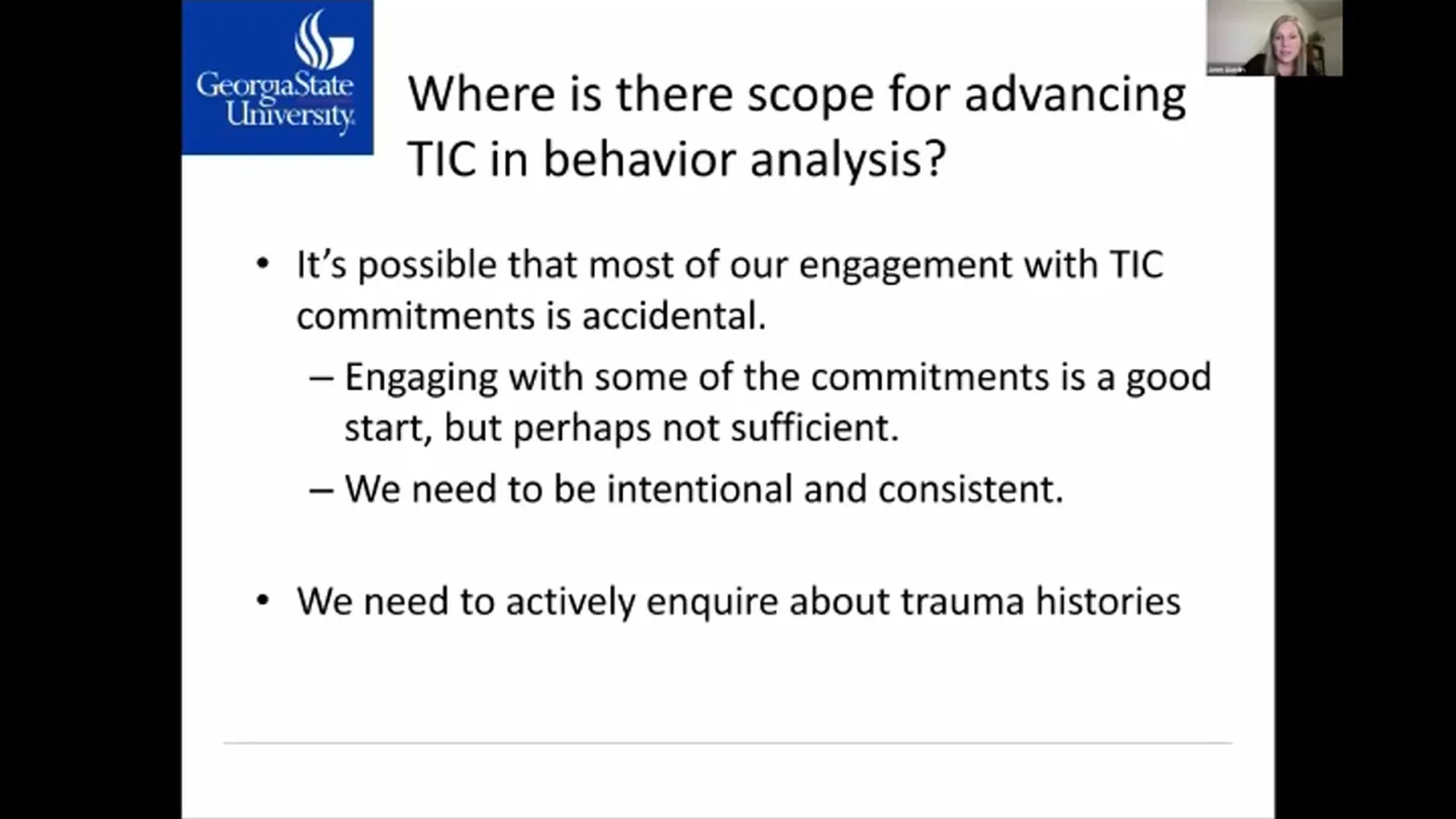
Clarifying Trauma Informed Care
On this page · 8 sections▾
If you are writing a trauma-informed plan and you want a real alternative to escape extinction, the short answer from the panel is shaping without extinction (Ricciardi et al., 2006). It is the same teaching arc you already know, except you stop blocking the kid's way out of the demand. You build the response slowly, you keep the exit open, and you reinforce the small step instead of waiting out the meltdown. One of the panelists, Dr. Camille Kolu, calls the test for it "a dignified way out." If your procedure does not pass that test, do not run it on a kid with a history of neglect, abuse, or removal.
This page is the clinical-decision version of that answer. The pillar page covers what trauma-informed care means in ABA in general. This page is narrower. It is the specific question a BCBA (Board Certified Behavior Analyst) has to answer when a kid with a trauma history hits a demand: what do I do instead of escape extinction, and how do I know it is enough?
What escape extinction does on paper#
On paper, escape extinction is simple. The kid uses a behavior to get out of a task. You stop letting the behavior work. Hands stay on the task. The demand stays in place. You hold the line until the kid completes the step or gives up trying to escape. The technical name for the response is "extinction" because you are taking away the thing that used to reinforce the behavior. In escape-maintained cases, that thing is escape from the demand. Done in a controlled setting with a kid who has no history of harm, it produces fast learning. That is why it ended up in so many programs.
What it does to a kid with a neglect history#
The procedure looks the same on the data sheet. The meaning inside the kid is not the same. Dr. Tyra Sellers' co-panelist, Dr. Worner Leland, and especially Dr. Austin, are direct about this. Picture the actual kid in the room. Not a graph. A child who has been left alone for long stretches, ignored when they cried, or punished for asking for help.
imagine being a child who has experienced living for days on end without food, without clean clothes, without positive interactions with adults. And when that child arrives on your doorstep for behavior analytic therapy, he likely has a number of inappropriate attention seeking behaviors. Now, imagine how attention extinction might feel to that child. From the talk — the panel
That is the thesis of this page. The form of the procedure is identical to the textbook version. The signal it sends to a kid with a neglect history is "the adult who is supposed to help me will hold the line and not move." That signal is exactly what their nervous system already learned to expect. You are not extinguishing a behavior. You are confirming a prediction.
Dr. Austin says it out loud about her own past practice. The things she ran twenty years ago, including physical restraint, escape extinction, and what she calls "hardcore" extinction, she does not run anymore. Not because they were wrong in 2005, but because the field knows more now and she changed what she does. That is the move this page is asking you to consider.
Three things to check before you put it in the plan#
Before you write escape extinction into a treatment plan, walk through three checks. None of these are gatekeeping. They are decision points.
- Is there a known or suspected trauma history? Removal, foster placement, neglect findings, a history of medical procedures the kid could not escape, a previous program that used restraint. If yes, the default tilts away from extinction.
- What does the kid's nervous system do when the demand stays put? If the behavior gets bigger, faster, or more dangerous when you hold the line, that is the procedure stacking on top of the trauma response, not teaching past it. That is your signal to switch.
- Do you have a working alternative ready to run today? If the answer is "no, but we will figure it out," do not start extinction this week. Build the alternative first. That is the next section.
Shaping without extinction (Ricciardi 2006)#
Dr. Kolu names a specific replacement procedure. The paper is Ricciardi, Luiselli, and Camare (2006). The procedure is shaping without extinction. You teach the same target response, but you keep the exit open the whole time.
shaping without extinction. The 2006 article. I don't know if you've read that maybe Riccardi at all 2006. So shaping without extinction, you know, here they were looking at what are you going to do if you, if you don't want to close that door, don't want to get all those, elicit all those physiological responses. From the talk — the panel
What this looks like in a session, in plain language:
- You set a tiny first step. Touch the worksheet. Look at the worksheet. Pick up the pencil. One unit of progress, not the full task.
- You reinforce that tiny step right away. With whatever actually works for the kid. Praise, a break, a preferred item.
- If the kid wants out of the demand, they can have out. Asking for a break is honored. The break is not delayed to "shape harder work." The break is part of the program.
- The next trial, you raise the bar by one notch. Two seconds longer. One more letter. Same rule. Reinforce the step. Honor the exit.
You are still teaching. You are still using shaping. You are not blocking the kid's way out. That is the part that changes.
The dignified-way-out test#
Dr. Kolu's heuristic is the cleanest test for whether a procedure belongs in a trauma-informed plan. She frames it the way she would explain it to a caregiver.
Can you still give somebody a dignified way out, which is the way I say it to caregivers. Can you give somebody a dignified way out while still helping them meet their needs? From the talk — the panel
Run any procedure you are considering through that test. Escape extinction does not pass. The whole point of the procedure is to remove the dignified way out. Differential reinforcement of an alternative behavior (DRA) where you teach a functional communication response (FCR) like "break, please" can pass, but only if the break is actually given when asked. If you teach "break" and then put the kid on a delay schedule the first week, you have rebuilt extinction with a new label on it.
When extinction is still okay (and what 'okay' means)#
Be honest with yourself here. There are still cases where some form of extinction shows up. A kid with no trauma history learning a tolerance step in a feeding program. A self-injurious behavior that is putting the kid in the ER and where every alternative has been tried and the team and family have weighed the risks together. The point is not "never extinction." The point is that the default flipped. The starting position is now "we are not running this unless we can defend it." Not the other way around.
The other reason to keep the option on the table is that you will make mistakes in real sessions. A demand will land harder than you planned. The reinforcer will be weaker than you guessed. The kid will escalate. Dr. Austin offers the mantra for that moment.
reinforce problem behavior this moment and live to teach another day and figure out what to do better is a really good mantra to live by. From the talk — the panel
Translation. If you are mid-trial and the only honest choices are "hold the line through a trauma response" or "give the kid the break and write a better plan tonight," give the break. You will not undo your program. You will get another session.
Frequently asked questions#
Is escape extinction banned under trauma-informed care?
No. There is no rule, no BACB code line, that bans it by name. What changes under a trauma-informed lens is the default. The starting position becomes "do not use it on this kid unless we can defend the choice in writing." For a kid with a known trauma history, that defense is hard to write. For a kid with no trauma history, it is easier, but the dignified-way-out test still applies.
What about the extended alone condition in a functional analysis?
The panel is blunt about this one. Dr. Rajaraman calls it out by name. Putting a child who engages in dangerous behavior alone in a room to see what happens, then capping the session at ten minutes or one hundred responses as a "safety precaution," is a procedure that maps almost perfectly onto the kid's prior trauma. Her own word for it is "trauma-inducing, not trauma-informed." If you cannot get the function another way, there are now several alternatives in the literature: interview-informed synthesized contingency analysis (IISCA), latency-based FA, structured descriptive assessment. Reach for those first.
How do I explain to a parent that I am reinforcing the behavior on purpose?
Use Dr. Kolu's caregiver language. You are giving their kid a dignified way out while you teach the new skill. You are not rewarding the behavior. You are honoring a signal the kid is sending while you build a better signal. Most parents understand "we are not going to corner your kid" faster than they understand a four-color graph. Then show the data on the new skill going up. That is the proof.
Take the full CEU and earn the credit#
If you want the full panel discussion, the data slides, and the BACB-eligible CEU credit, watch the recording on openceu.com. You will see Dr. Kolu, Dr. Austin, Dr. Rajaraman, and the rest of the panel work through the trade-offs you just read about, plus the screening tools, the supervision pieces, and the antecedent strategies that pair with this work.
Watch "Clarifying Trauma Informed Care" on openceu.com →