Trauma Screening Tools BCBAs Can Use at Intake
Two intake screeners for BCBAs, plus a script for asking parents about trauma without offending them, from a BCBA-led CEU.
Key takeaway
The intake playbook from this talk is short and concrete. You hand the caregiver the Purewal count-only screener, where they give you one number instead of naming any single event.
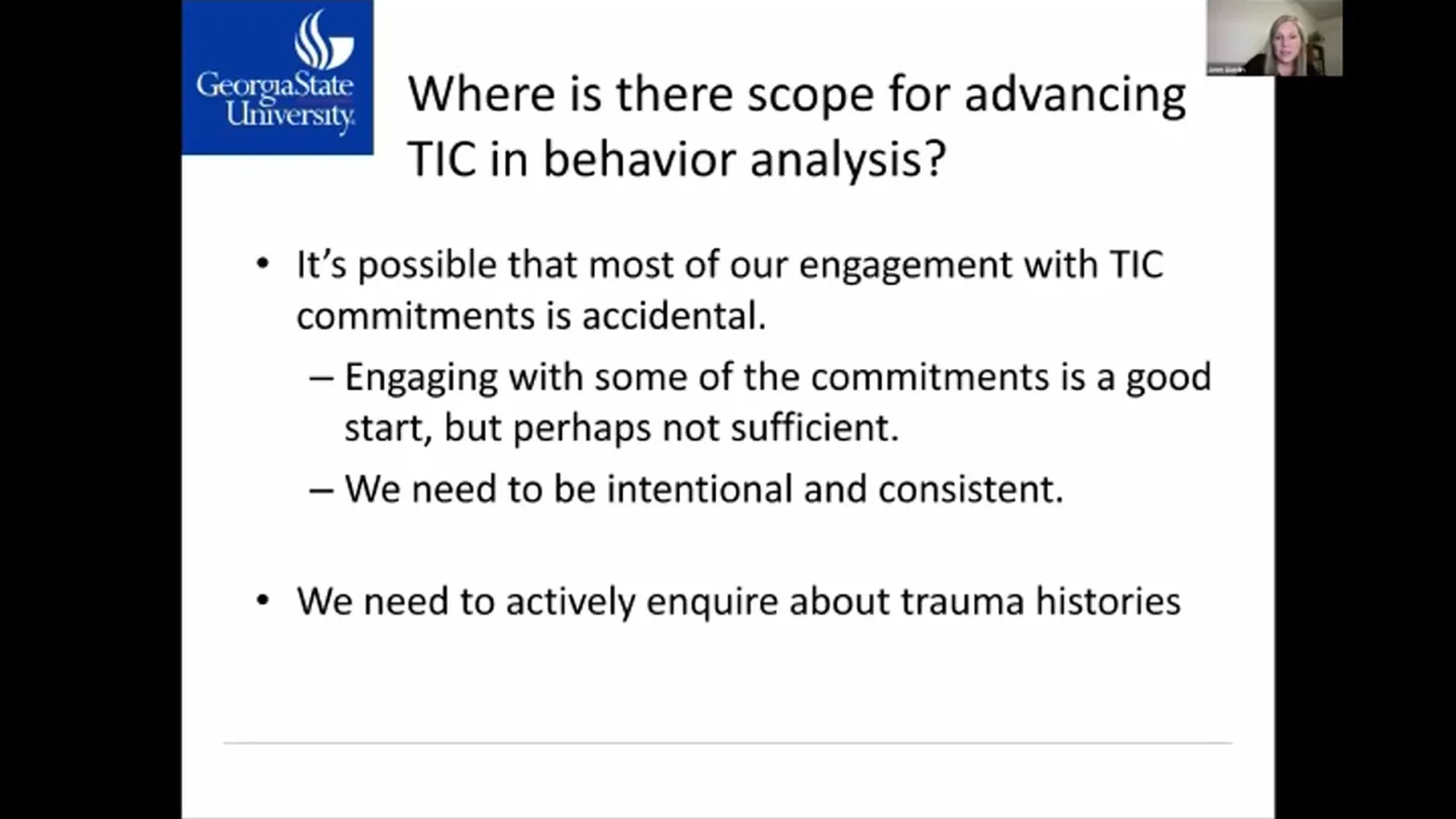
Clarifying Trauma Informed Care
On this page · 7 sections▾
The intake playbook from this talk is short and concrete. You hand the caregiver the Purewal count-only screener, where they give you one number instead of naming any single event. You pair it with Kolu's TIPS and BIPS checklist (Trauma Indicator and Behavioral Possibilities), which screens settings and behavior signs that often track with a history of trauma. And you open the conversation with a caregiver script that puts you on their side before you ever hand over a form. This page is the how-to for those three pieces. What tool to use, what to ask, and how to score what comes back.
Why most BCBA intakes skip trauma (and why that breaks treatment later)#
Most intake packets ask about current behavior, communication, sleep, food, and medical history. They do not ask about trauma. The panel's own survey put a number on this gap, and the number is hard to look away from.
Only 38% of our sample reported that their assessment processes specifically inquired about trauma histories, despite 73% agreeing that it was important to do so.From the talk — the panel
That gap shows up later in the work. The panel walked through a real supervision case where a young client had a known suicide attempt in the file. The supervising BCBA opened with the standard intake script. She asked about current challenging behaviors at home. She asked about communication skills. She did not ask the family about the trauma. Both of her questions were fair questions. Neither one told her what she actually needed to know to plan safe sessions.
The reason we skip it is partly training. We are taught to focus on current contingencies (what is reinforcing the behavior right now). Remote history feels out of scope. The other reason is social. Asking about ACEs (Adverse Childhood Experiences, the ten common events Felitti and Anda studied in 1998) feels like crossing a line. So we leave the question off the form. The three pieces below exist so you do not have to ask the line-crossing version of the question. You ask a softer one. You still get the signal you came for.
Tool 1: the Purewal Boykin count-only screener#
The first tool comes from a 2016 paper by Purewal Boykin and the team around Dr. Nadine Burke Harris, the pediatrician who later served as the Surgeon General of California. Her group ran a comparison. They tested asking caregivers about specific events ("has your child been through X, have they been through Y") against asking for a single number.
They compared two things. Do we have to say you've been through X, have you been through Y, have you been through Z, versus, hey caregiver, here's a few things that impact our clients sometimes. Would you just give me a number? Do you think your client's been through maybe between one and 20?From the talk — the panel
The count-only version did the job. The caregiver looks at a short list of common adverse events, thinks about which ones apply, and writes one number on the line. They never have to label a single event. You never have to read the label out loud. You get the signal you came for. They keep their privacy.
Here is the way to run it at intake. Print the short list on a single page. Put the line for the number at the bottom. Hand it to the caregiver in the room or include it in the digital packet. Tell them three things up front. The list is not a test. You do not need to know which items apply. You only need the count.
Score it like this. Any number above zero is information. A higher count is more information, not a diagnosis. The screener tells you the caregiver believes the client has been through some hard things. That is all it tells you. You will not act on the number by itself. You will use it to decide what to ask next, and what to plan around.
Tool 2: Kolu's TIPS and BIPS checklist#
The second tool is from one of the panel members, Dr. Camille Kolu. She built it because the Purewal screener asks the caregiver to remember events. Sometimes the caregiver does not know. Sometimes the events happened before they had the child. Sometimes the client is the one with the history and the caregiver is new.
It's just called the TIPS and BIPS. Trauma indicator and behavioral possibilities. And then buffering possibilities. It has a section in it for what I screen for. I screen for challenging settings and situations as well as behavioral needs that might be a red flag to me that somebody's been through trauma.From the talk — the panel
This is a behavior-led screen, not an event-led screen. You look at what the client is doing right now and at what the current setting looks like, and you flag patterns that often track with a trauma history. New aggression. Crying at school that did not used to be there. A sharp shift after a move, a new school, a new sibling. A pattern of fear around a specific room or specific person. None of those are a diagnosis. All of them are red flags worth a second look.
The checklist also has a "buffering" side, the BIPS part. The panel uses it to log what is going right. Adults the client trusts. Routines that calm them. Places that feel safe. You will need that list when you build the treatment plan, because you will want to lean on the buffers, not just remove the triggers.
Run TIPS and BIPS the same week you run the Purewal screener. The two tools answer different questions. Purewal asks the caregiver what they know. TIPS and BIPS asks you what you are seeing. When both flag something, you trust the signal more than when either one flags alone.
How to introduce the screener so parents do not feel accused#
The hardest part of intake screening is not the form. It is the moment you hand the form over. Caregivers can read it as an accusation. The panel gives a clean script for the handoff. It works because it puts you on the caregiver's side first.
I can say, you know what, I'm a parent. I have struggled so much with some of my kids' behaviors, and I've been through some really hard things when I was a kid. I don't know if you have too, but if you're interested, I have this little handout.From the talk — the panel
Three things make that script work. You start with shared ground (you are a parent, or you work with parents, or your own childhood had hard parts). You do not promise the caregiver anything. You hand the form over as an offer, not as a step in the assessment. The caregiver can take it or leave it. Most take it.
If you are not a parent, the panel's lead-in still works with a small change. "I work with a lot of families who have been through hard things, and I have a little handout that helps me ask about it without being weird. Would you take a look?" The shape of the move is what matters. You name the awkwardness. You make the form small. You hand it over.
What to do with the score (it is not a referral trigger by itself)#
A common mistake is to treat any positive count as a referral. That is not how the panel uses it. The score is data for your plan, not a hand-off to someone else.
If the Purewal count is above zero, you do three things. You write the count in your assessment notes. You adjust how you set up the first few sessions (more co-regulation, slower demands, more assent-based work). You plan for one more conversation with the caregiver in week two or three about what supports the family already has in place. None of that is a referral.
You make a referral when the TIPS and BIPS checklist also flags current red flag behaviors that you cannot safely run behavior procedures on yet. New aggression with an unclear cause. A clear fear response to a specific adult who is still in the home. Self-injury that started after a specific event. Those are not behaviors to treat operantly without first looping in a trauma specialist (a clinician trained in trauma assessment, like a licensed therapist or a child psychiatrist). The screen pointed you at the right call. It did not make the call for you.
Re-screening: when to ask again#
The intake screen is a starting point. It is not the last time you ask. Two situations call for a re-screen, and you should write both into your supervision plan now so you do not have to invent them later.
The first is when behavior changes sharply with no clear antecedent. A client who was tracking up suddenly drops. A new aggression shows up in a setting that used to be calm. A previously quiet client starts crying at drop-off. Hand the Purewal screener to the caregiver again. Ask the IRB-style question (Institutional Review Board, the body that approves ethical research) only if your agency has a re-consent process. Otherwise, ask in plain language whether anything has changed at home that the family wants you to know about.
The second is at the start of every new program year, every move, and every change of staff. Trauma does not stay still. Buffers come and go. A buffer who left the household three months ago changes the meaning of a TIPS and BIPS flag you did not flag at intake. Asking again is not nagging. It is your job.
Frequently asked questions#
Can I ask about trauma if the family did not bring it up first?
Yes. Asking is part of an ethical assessment, not a privacy violation. The Purewal count-only screener is the tool that makes the ask feel safe. The caregiver gives you a number, not a story. You learn what you need to plan. They keep their details. If your agency has not added a trauma question to the intake packet, you can use the script above to add it as an offer at the first session.
What if the caregiver gets defensive when I hand them the screener?
Drop the form and lead with the relationship. Say something like, "no pressure, this is something I offer to every family because it helps me plan better. We do not have to fill it out today." Set the form on the table. Move on. Come back to it on session three or four, after the caregiver has seen you with the client a few times. The defensiveness is almost never about you. It is about the topic. Time fixes it more than re-pitching does.
Do I screen the staff too?
Yes, with the staff version of TIPS and BIPS that lives inside the same handout. The panel built it because RBTs and BCBAs also bring histories into the room, and those histories shape how they respond to a client's hard moments. Run it during onboarding. Run it again after a hard case. Make it private. The point is not to file a record. The point is to give the supervisor a way to ask, "how are you doing, really," with a tool that makes the question easier to answer.
Watch the full talk: Clarifying Trauma Informed Care. The recording walks through the Purewal screener, the TIPS and BIPS checklist, the caregiver script, and several real intake cases where the screen changed the plan.