Supervising BCBAs and RBTs Who Have Trauma Histories
What moral injury, coercion, and vicarious trauma look like in supervision and how to adjust, from a BCBA-led CEU.
Key takeaway
Your supervisee, a Board Certified Behavior Analyst (BCBA) or Registered Behavior Technician (RBT), is shutting down in your meetings, pushing back on a procedure, or quietly burning out, and you can feel it but cannot name it.
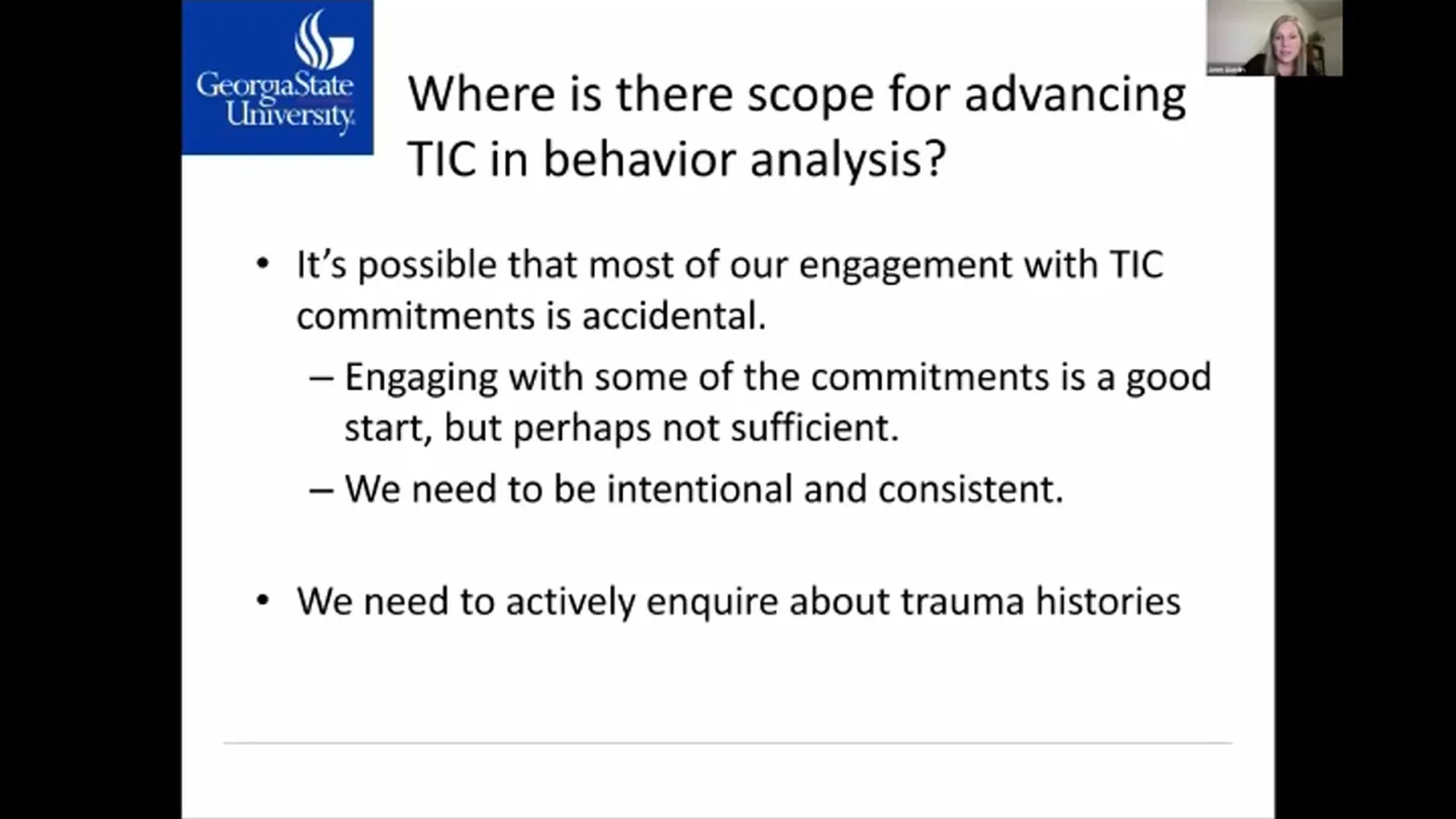
Clarifying Trauma Informed Care
On this page · 7 sections▾
Your supervisee, a Board Certified Behavior Analyst (BCBA) or Registered Behavior Technician (RBT), is shutting down in your meetings, pushing back on a procedure, or quietly burning out, and you can feel it but cannot name it. The work of supervision changes when the person across from you has their own trauma history. Three things are usually moving under the surface: moral injury (being asked to do something that violates your own ethics), vicarious trauma (absorbing the trauma your client carries), and coercion you do not realize you are using. This page is for the supervisor. It covers what those three look like in a real supervisee, what staff TIPS and BIPS are, how to adjust fieldwork hours when a supervisee is reactivated by a case, and when to refer out without breaking trust.
Two ways supervision can harm: moral injury and vicarious trauma#
Most BCBA supervision training talks about feedback, fieldwork hours, and procedural integrity. It does not talk about the two things that quietly hurt staff the most. The first is moral injury. That is what happens when you ask a supervisee to run a procedure that feels wrong to them in their body, often because that same procedure was used on them as a child. The second is vicarious trauma. That is what happens when a supervisee hears the client's history, sees the client get hurt, and starts carrying it home.
Moral injury... have you ever been in a situation where you were asked to do something you absolutely felt in your bones that you detested and felt like it was going against what you had been taught... That is perhaps what some of my supervisees go through when they're having to implement a procedure that was used on them. From the talk — the panel
Both are real. Both change how a supervisee shows up. If you only watch for missed sessions and late notes, you will miss them.
What moral injury sounds like in a supervisee#
Moral injury rarely shows up as a clean sentence like "this hurts me." It shows up as resistance you cannot quite explain. The RBT asks a lot of clarifying questions on one specific procedure. The BCBA trainee pushes the start date back. Someone says the protocol "feels off" but cannot say why. Someone refuses to run escape extinction with a kid who reminds them of themselves.
What to listen for in supervision:
- Repeated, narrow pushback on one procedure (not the whole case).
- A flat affect, or tears, after a specific session type.
- "I know I'm supposed to, but I can't."
- A request to swap clients without a clear reason.
- Quiet quitting on one case while the rest of their work stays solid.
When you hear it, do not lead with the protocol. Lead with the person. Ask if the procedure is sitting wrong for them. Tell them they do not have to disclose why. Then either adjust the procedure or reassign the case. The cost of moving a case is small. The cost of forcing a supervisee through moral injury is staff turnover and, eventually, harm to the client.
Coercion you might not notice in your own supervision#
This is the part most supervisors miss. The supervisor-supervisee relationship is a power imbalance by design. You sign their hours. You write their evaluation. You can fail them. That power, used carelessly, becomes coercion. And coercion does measurable damage.
Effects of coercion are awful. Somebody's experiencing arousal, emotional responding, biological changes, long-term physical outcomes. Your repertoires of behavior are being restricted and they become more and more inflexible. From the talk — the panel
Coercion in supervision often looks like: "If you do not log these hours by Friday, I cannot sign them." "Everyone runs this procedure, you are the only one with a problem." Or the quieter version, the long silence after a supervisee disagrees with you. None of that is feedback. That is pressure used to override someone's no.
Watch out for coercion that you don't notice, power imbalances that feel unsafe, and therefore you're violating the trauma sensitivity principles of ensuring safety and trust first. From the talk — the panel
A simple supervisor check: in your last three meetings, did your supervisee ever say no, push back, or change your mind? If the answer is no on all three, the relationship is not safe. It is compliant. Those are not the same thing.
Screening staff with TIPS and BIPS (the staff version)#
Most BCBAs have heard of TIPS and BIPS as a client intake screening tool. The panel pointed out a version many people miss: there is a staff version. You can hand it to your RBTs and trainees, not to dig into their childhood, but to ask, in a low-stakes way, how they are doing right now.
Tipscan BIPS... has a version for staff. And that's what I want to say to you is that before I ever go through, hey, has your client been through anything really awful?... I can approach it from a, I want to know more about you. Are you doing okay? From the talk — the panel
Use it as a check-in, not an interrogation. Frame it like this: "I use this with my team once a quarter. It is private. The point is for me to know how to support you, not to get into your history. You skip anything you want to skip."
What you do with the answers:
- If a staff member flags reactivation by a specific case type, you reassign or adjust.
- If a staff member flags a specific procedure, you do not assign them that procedure.
- If a staff member flags general overload, you cut their caseload before they burn out.
- You never put the answers in their personnel file.
Adjusting fieldwork hours when a supervisee is reactivated#
Sometimes a supervisee tells you, often hours after a session, that a kid's behavior pulled them back into their own childhood. The technical word is reactivation. The practical question is what to do with their hours. The BACB (the BCBA certifying board) requires fieldwork hours for certification. A reactivated trainee cannot collect quality hours on a case that is hurting them.
The adjustment is not complicated. It is just rarely done because supervisors worry about slowing the trainee down. The trainee always cares more about their long-term career than about one week of hours. Options that work:
- Move them off the triggering case for two to four weeks.
- Replace those hours with a different case at the same skill level.
- Give them observation-only hours on a recorded session, not live, while they regulate.
- Keep the meeting schedule normal. Do not pull all support at once.
Document the adjustment in your own supervision notes as "caseload adjustment for staff support." You do not document the reactivation itself. That is the supervisee's medical information, not yours to write down.
When to refer out (and how to do it without breaching trust)#
You are not your supervisee's therapist. You should not try to be. If a supervisee discloses ongoing trauma, active flashbacks, or anything you are not trained to hold, your job is to refer out. The fear most supervisors have is that referring out will feel like rejection. It does not have to.
How to make the referral land:
- Name what you heard, briefly: "What you are telling me is bigger than what supervision is built for."
- Name your role limit: "I am not trained as a therapist, and I do not want to do that part badly."
- Give them two or three real options: an Employee Assistance Program (EAP, free short-term counseling through their employer), a therapist who knows ABA culture, or a trauma-focused clinician.
- Keep the supervision relationship: "We will keep meeting. This does not change your hours or your standing with me."
- Follow up once, gently, the next week. Then drop it. Their healing is not your case to manage.
If your agency does not have an EAP or a referral list, build one before you need it. Three local therapists, one who takes their insurance, one who slides scale, one who does virtual. Hand it out at onboarding, not in the middle of a crisis.
Frequently asked questions#
Is it ethical to ask my supervisee about their own trauma history?
No, not directly. You can ask how they are doing, what cases feel hard, and whether any procedure is sitting wrong for them. You should not ask "what happened to you as a kid." The staff TIPS and BIPS works because it lets the supervisee share only what they choose to share. The line is consent and relevance: relevant to their work, consented to in the moment.
What if my supervisee refuses to run a procedure that was used on them as a kid?
You do not push. You move the procedure to a different staff member, or you change the procedure. Most procedures that get flagged this way have a less coercive alternative that works as well or better. The supervisee's refusal is information. It is telling you something about the procedure, not just about them.
How do I document supervision changes I make for trauma reasons?
Document the change, not the reason. "Trainee reassigned from Client A to Client B, effective 3/4, to support training goals." You do not write down the supervisee's history, their reactivation, or anything that could land in a personnel file and hurt them later. If your agency requires a reason field, use "staff support" or "caseload balancing." The supervisee's health information is not yours to record.
The shortest version: watch for moral injury, watch for vicarious trauma, watch for the coercion you do not notice in yourself, hand out the staff TIPS and BIPS once a quarter, adjust hours without making a thing of it, and refer out before you are in over your head. Your supervisees will stay longer, run cleaner sessions, and trust you with the things that actually need supervisor input.
Watch the full panel discussion for the specific examples and the back-and-forth between presenters that this page is built on. The conversation about coercion in particular is worth hearing in their own words.