What Trauma-Informed Care Actually Means in ABA
The four trauma-informed commitments in ABA, what they look like in session, and what they are not, from a BCBA-led CEU.
Key takeaway
Trauma-informed care in ABA means four daily commitments from board-certified clinicians (BCBAs): name that trauma is common, build safety and trust, share real choices with the learner, and teach skills before trying to shrink behavior. That is the working definition the panel uses.
Clarifying Trauma Informed Care
On this page · 9 sections▾
Trauma-informed care in ABA means four daily commitments from board-certified clinicians (BCBAs): name that trauma is common, build safety and trust, share real choices with the learner, and teach skills before trying to shrink behavior. That is the working definition the panel uses. It is not a brand of therapy. It is not a binder of forms. It is the tier-one posture you bring to every session, no matter the client.
This page is the plain-English pillar on what TIC is. If you want the specific procedures, the sibling pages cover those.
The one-sentence definition#
The clearest definition on the panel comes from Mariela Castro-Hostetler Austin. She frames trauma-informed care (TIC) as a stance, not a script. It is what your whole team does for every learner. It is not what you reserve for the kids with a flagged history.
TIC refers to the culture and practices of an organization or field with respect to acknowledging trauma prevalence... we can think of it as tier one intervention where TIC are those things that you would do or provide to any client or research participant, regardless of their history or needs. From the talk — the panel
That word "tier one" matters. In schools and clinics, tier one is the universal layer. Everyone gets it. You do not wait for proof of harm. You assume some learners carry it, and you act so the work itself does not add more.
The panel ties this back to a line Hayden Gilbertson pulls from Greg Hanley. It is the tension the whole field sits inside.
ABA has the potential to inflict trauma and it has the potential to alleviate trauma. That's from Greg Hanley's 2021. From the talk — the panel
If both are true, then your default setting has to lean toward alleviating. TIC is the daily habit that keeps you on that side of the line.
Why a person-centered approach is not the same thing#
A lot of practitioners hear the TIC pitch and say, "We already do that. We use assent. We follow the learner's lead." The panel pushes back hard on this. Person-centered work is part of the picture. It is not the whole picture.
Doesn't taking a person-centered, individualized approach necessarily make us trauma-informed? And my response is probably not. From the talk — the panel
Why "probably not"? Because person-centered care can still skip the screening step. It can still leave protocols in place that pull escape away from a kid who needs it. It can still be delivered in a setting where the staff are not safe themselves. TIC adds the trauma lens on top of person-centered work. It does not replace it. It checks it.
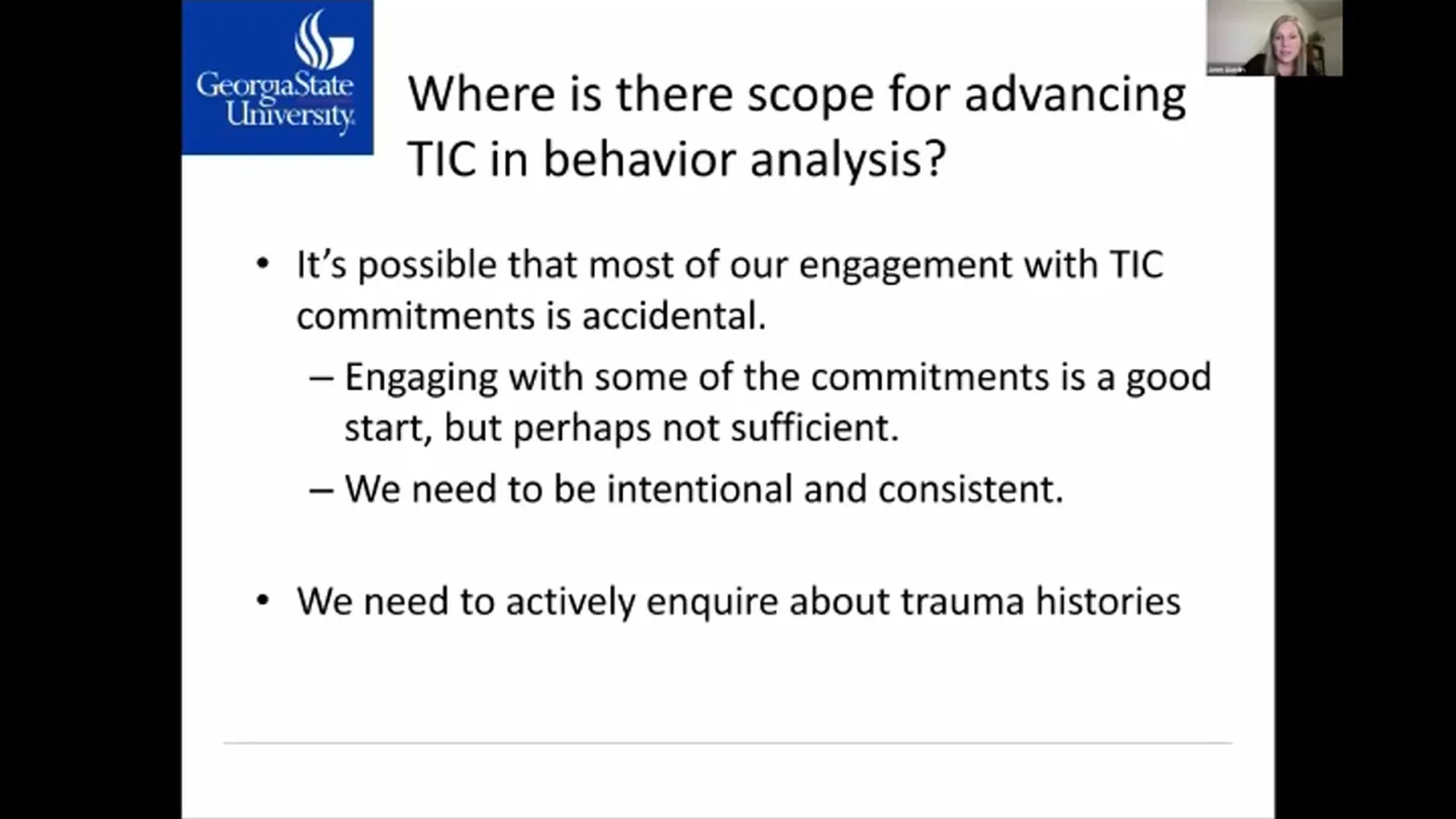
The survey data the panel shares lands hard here. Most BCBAs think they are already doing the work. Most cannot define it.
Only 36% were confident that they could identify some principles of trauma-informed care... 32% reported that they believe that they or their organization was trauma-informed. From the talk — the panel
So the field has a gap. A third of clinicians feel competent. A third say their org is there. The other two-thirds are honest about not knowing yet. This page is for the honest two-thirds.
Commitment 1: acknowledge trauma and its impact#
The first commitment is the easiest to nod at and the hardest to actually do. It means you assume some of your learners have lived through hard things. Adverse Childhood Experiences (ACEs, the well-known stress scorecard) are common. Studies put rates above 60% in the general population. In autistic populations the rates often run higher.
In practice, "acknowledge" means three things. You learn the basics of how stress shows up in behavior. You document what you see without locking the kid into a label. You also do not pretend the family's history does not matter when you write the plan.
The panel is clear that this is not the same as becoming a trauma therapist. You do not need a PhD in clinical psych to acknowledge trauma. You need a working vocabulary, an open intake, and a habit of asking, "Could this behavior be tied to something the kid lived through?"
If you skip this commitment, the rest of the model collapses. You will keep writing function-based plans that miss the function. You will keep treating fear like noncompliance.
Commitment 2: ensure safety and trust#
The second commitment is about the room, the routine, and the relationship. Safety has two layers. Physical safety, which is the obvious one. And felt safety, which is the kid's read of whether this place is okay.
A learner can be in a physically safe clinic and still not feel safe. The lights are bright. The schedule shifts without warning. A new tech walks in mid-session. None of that is dangerous. All of it can land like danger if the nervous system is already on alert.
Trust is the slow-build version of safety. You build it by doing what you said you would do. You build it by honoring breaks. You build it by not surprising the kid with hard demands when they came in expecting play. The panel returns to this point often: trust is a record. Each session either adds to it or pulls from it.
For a clinician, this commitment lives in the small choices. How you greet the kid. Whether you pause when their body tells you to pause. Whether your team is calm and warm with each other, because kids read that.
Commitment 3: promote choice and shared governance#
The third commitment is the one that scares teams who run tight protocols. Choice and shared governance mean the learner gets real input on the work, and the family gets a real seat in the planning. Not a polite check-in. Real input.
In session, this is the assent lens. The learner can decline a target. The learner can ask for a different reinforcer. The learner can leave the table. None of that ends the session. It informs the next one.
In planning, shared governance means the family is not handed a finished plan to sign. They are pulled into the build. Their priorities shape what gets targeted first. Their cultural knowledge shapes what counts as success.
This commitment also lives in the team itself. Staff need a voice. If a tech sees a procedure landing badly, that feedback has to reach the BCBA and change something. Top-down only is not trauma-informed. The whole layered system has to share governance, or the model is theater.
The panel does not pretend this is easy. It changes how meetings run. It slows some decisions down. It also catches harm earlier, which is the trade you want.
Commitment 4: build skills before reducing behavior#
The fourth commitment flips the old order of operations. The classic ABA playbook reaches for a reduction procedure when a behavior is severe. The trauma-informed version reaches for a skill first.
The logic is plain. Most challenging behavior is doing a job for the learner. It gets them out of something. It gets them something. It tells the room they are not okay. If you take the behavior away without giving them a working replacement, you have left them with the same problem and one fewer tool.
So the first move is the skill side. Communication. Coping. Tolerance. A real way to ask for a break. A real way to say no. Only after the skill is taking root do you think about whether any reduction work is needed at all. Often it is not. Often the new skill carries the load.
This commitment also reframes "behavior reduction" as a last resort, not a first instinct. The panel ties this back to Hanley's framing. You can shrink a behavior and grow a trauma at the same time. The skill-first stance is the guardrail against that trade.
What trauma-informed care is not (a treatment, a protocol, a vibe)#
It helps to name what TIC is not. It is not a treatment for trauma. If a learner needs trauma-focused therapy, that is a separate clinician with separate training. It is not a protocol you bolt onto a BIP (behavior intervention plan). It is not a vibe. It is not the warm feeling you get when you remember to say please.
It is also not a one-time training. The panel makes the point that confidence is not competence. Sitting through a webinar does not make a clinic trauma-informed. Building the four commitments into hiring, supervision, intake, and daily session work does.
And it is not a free pass to skip the science. The procedures still get measured. The data still get reviewed. The model just changes what counts as an acceptable side effect. Iatrogenic harm (harm caused by treatment) is now on the data sheet, even when the target behavior went down.
Frequently asked questions#
Is trauma-informed ABA the same as trauma-focused therapy? No. Trauma-informed care is a posture you bring to every learner. Trauma-focused therapy is a treatment for someone with a known trauma history. The panel makes this split very clearly. TIC is tier one. Trauma-focused therapy is a tier higher and a different scope of practice.
Do I need a documented trauma history before I treat a client as if they have one? No. That is the point of the tier-one framing. You bring the four commitments to every learner because you do not know what they carry. Waiting for documentation builds a system that only protects the kids who got caught in a screening. The rest get default care that may add harm.
Does trauma-informed care mean I can never use extinction or restraint? The panel does not write a blanket rule on a single page. The honest answer is that any reduction or escape-blocking procedure now has a much higher bar. You ask whether the skill is in place. You ask what the learner is telling you. You ask whether the cost of the procedure outweighs the benefit for this specific kid. Many teams find that, once the skill side is built, those tools come off the shelf far less often. The sibling page on escape extinction goes deeper on that one specifically.
Keep going#
If you want to hear the panel work through these four commitments in their own words, the recording is the next step. They walk through the survey data, the JABA paper (the Journal of Applied Behavior Analysis), and several case examples that did not make it onto this page.