Increasing Competence and Confidence in Helping People with Disabilities through Grief
Presented by Patricia Lund
This presentation addresses the critical role of Board Certified Behavior Analysts (BCBAs) in supporting clients through grief, establishing bereavement as a behavioral process involving respondent and operant changes following the loss of a significant reinforcer. By exploring environmental variables and relevant Ethics Codes, the session underscores the importance of maintaining professional competence and pursuing interdisciplinary collaboration within the BCBA’s scope of practice. Given that adults with developmental disabilities are living longer and increasingly facing the death of primary caregivers, we will examine the resulting "secondary losses"—such as shifts in housing and social support—and engage in interactive activities to develop behaviorally-based strategies that provide compassionate, evidence-based support during these significant life transitions.
Register free & watch nowCancel any time. Cert delivered to your inbox the moment you pass the quiz.
Learner ratings
from 59 learners
100% would recommend this CEU to other professionals in their field (40 responses)
“good”
— Yongqiang M.“Love seeing different areas covered instead of just being ABA. This is an amazing resource!”
— Danielle M.“5/5 ⭐ ⭐ ⭐ ⭐ ⭐ Depth, precision and captivation!”
— Reagan P.“Excellent, timely,relevant and necessary”
— Robyn M.“useful”
— Hongjun J.
About this CEU
This presentation addresses the critical role of Board Certified Behavior Analysts (BCBAs) in supporting clients through grief, establishing bereavement as a behavioral process involving respondent and operant changes following the loss of a significant reinforcer. By exploring environmental variables and relevant Ethics Codes, the session underscores the importance of maintaining professional competence and pursuing interdisciplinary collaboration within the BCBA’s scope of practice. Given that adults with developmental disabilities are living longer and increasingly facing the death of primary caregivers, we will examine the resulting "secondary losses"—such as shifts in housing and social support—and engage in interactive activities to develop behaviorally-based strategies that provide compassionate, evidence-based support during these significant life transitions.
From the talk
What was covered
Patricia Lund shows behavior analysts how to support grieving disabled adults: grief as behavior, setting events, secondary losses, and planning.
- Define grief as the public and private behaviors that follow a death loss, then measure them like any other behavior.
- Ask about closeness, suddenness, dependence, trauma history, and culture before you read a single data point.
- Treat a spike six or eight months after a death as a possible grief burst, not a brand new behavior problem.
- Never strip the phone or a preferred activity as a consequence for a grief response, because that removes the support network too.
- Raise succession planning at intake by asking what the plan is when the caregiver can no longer provide care.
- Map the secondary losses after a death and rebuild each one: rides, money, friends, and daily contact.
Grief as Behavior: A Working Definition for BCBAs
Grief is not only a feeling. In behavior terms, it is what a person does after a death loss. When someone a person depends on dies, a lot changes at once: who gives them rides, who manages their money, who gives them attention and comfort. The behaviors that follow, the crying, the withdrawal, the acting out, are called grief responses.
Lund credits Carilla Dillenberger and Dr. Keenan, both professors of behavior analysis. They framed a grief response as a mix of public and private behavior. Crying may go up after a death. So may hours alone in a bedroom. Both count as grief. Neither one is the whole picture.
They also warned about how we look at it. Lund compares grief to a film strip. We tend to study one frame: the behavior, what came right before, what came right after. Grief does not fit in one frame. It is shaped by the whole strip, including the bond, how the death happened, what the person understands, and any past trauma. So take a long history before you write a plan.
it's almost like you're looking at a film strip, right?
From the talk — Patricia Lund
The Old Assumption That Disabled People Do Not Grieve
Until the 1970s, most people assumed that disabled people did not mourn. The logic ran like this. Death is a hard idea. If a person has cognitive differences, they cannot grasp it. So they cannot grieve. Lund points out how recent that is. Many staff and parents we work with were raised inside that belief.
A second assumption did just as much damage. When a caregiver died and behavior got worse, the change was blamed on the disability. Not on the loss. That habit has not gone away. Group home staff still call grief a behavior and treat it as something to shut down.
Researchers pushed back in the 1970s and 1980s. Lund names Maureen Oswin and her book, Am I allowed to cry? Oswin wrote about a man with severe disabilities who bowed his head at a casket and reached to touch the body. He was clearly grieving. Lund says she found only six or seven ABA papers on this topic, most from the UK. That gap is an opening for anyone who wants to build something new.
So there used to be this general idea that people with disabilities didn't necessarily grieve because they couldn't understand death, right?
From the talk — Patricia Lund
Drop the Euphemisms: Why to Say Dead and Disabled
Western culture is death averse. We hand the body to a funeral home. Someone else does the dressing. Our words keep the same distance. We say we lost someone, or that they passed, or went to a better place. Lund used those words for years. She now argues for the plain ones: dead, died, death.
The reason is practical. Euphemisms confuse people who take language at face value. Lund had a client whose family said they had lost his grandpa. He went looking for him. Elopement (leaving a safe place without telling staff) went up. The team had to go back and teach what dead actually means.
She makes a parallel case for the word disabled. She grew up on terms like special needs and differently abled. Disability advocates increasingly prefer disabled, because it names an identity instead of covering it. Preferences still vary by person and by setting. Ask the person, then use the words they use.
So one way I think we can already start bettering our practice and increasing our competence is just by start, you know, using the D word, using the word dead.
From the talk — Patricia Lund
Staying in Scope: What a BCBA Can and Cannot Do With Grief
Lund's first worry about this work was scope. The ethics code tells us to practice inside our competence. She is not a therapist and does not pretend to be. Helping someone process feelings is therapy work. Diagnosis is out too. Prolonged grief disorder and complicated grief (grief that stays severe far too long) are not ours to name.
Plenty is still ours. We count behavior. We can say how often crying, aggression, or elopement happens now compared to before the death. We can report a change in topography (what the behavior looks like). We can flag a spike that shows up months later. That data helps the clinician who does treat grief.
The rest is collaboration and advocacy. Find the social worker, the LPC, or the mental health clinician, and get on one team. Then do the part only you can do. Tell the group home staff and the family what a grief response is. A grieving person is not simply having behaviors.
And so it's not our goal to help someone process their feelings of grief.
From the talk — Patricia Lund
Grief Responses That Teams Miss
Some grief responses are easy to spot. Yelling, swearing, and arguing go up. So do aggression and property destruction. Sleep and eating change. School and work get harder. Headaches and stomach aches show up. BCBAs notice these, because they look like the referral.
The quiet ones get missed. A teen says it does not bother him at all. A client avoids the room, the diner, or older men who look like grandpa. Another clings to every remaining caregiver and fights every transition. Some become the perfect child, because in their family nobody cries. And some ask, over and over, where their mom is. They were told. Asking again is the grief response.
Timing fools people too. Everything can look fine for months, then behavior explodes. Lund calls that a grief burst (a wave of grief months later). It is normal. It is common in children, because their understanding of death keeps growing.
Autistic clients may grieve in ways staff do not read. Some do not cry at all. That is not a lack of feeling and not a lack of empathy. You may see more stimming, more scripting, or self injury (behavior that hurts the person's own body). Stress went up and it shows somewhere. Many will not seek out a person to talk to, which is the very support that neurotypical (people without autism) mourners reach for.
So even if a death loss happened eight months ago, six months ago, still remember that these grief responses can still pop up.
From the talk — Patricia Lund
Setting Events That Shape How Someone Grieves
One learning objective was setting events (conditions that change how you react). Grief never happens in a vacuum. The same death lands in very different ways in different homes.
Closeness matters most. A client who lived with a parent grieves harder than one who saw that parent at holidays. How the death happened matters. Years of dementia give a family time to prepare. A car crash gives none. Where it happened matters, and so does whether the person was there. Dependence is its own variable. The more of daily life ran through that person, the bigger the hole.
Trauma history changes everything. Lund has had clients who felt relief when a caregiver died, because that caregiver had hurt them. Society tells them not to say so. We can be the ones who say it is allowed. Several losses close together are also harder than losses spread far apart.
Culture fills in the rest. In some homes the body stays, and the family wash and dress it. In others it leaves within the hour. Some cultures welcome loud grief. Others praise the person who stays stoic. What a family does teaches the client what grief is supposed to look like.
because the culture you grew up in is going to impact your grief responses, right?
From the talk — Patricia Lund
When a Caregiver Dies: The Cascade Into Restriction
People with IDD (intellectual and developmental disability) are living longer. So are their parents. That is good news with a hard edge. Aging caregivers struggle to keep up the lifting, the driving, and the daily care. More clients will outlive the person who ran their life.
When no plan exists, the death triggers an emergency placement. There is no time to tour homes. There is no time to call family first. The open bed may be hours away. Choice disappears, and that is its own trauma stacked on top of the death.
The next loss is advocacy. The parent knew the medication history, the triggers, and how the person communicates. In a new group home or nursing facility, nobody knows any of it yet. Lund points to evidence that health care quality drops when the familiar person is gone. Staff here are not villains. They are underpaid, stretched thin, and brand new to this person.
Then the cascade closes. Health slips, behavior rises, and the team answers with restriction. More medication. The phone taken away. Contrived consequences aimed at a human reaction to death.
And what we're doing is we're actually punishing a grief response.
From the talk — Patricia Lund
Succession Planning and Mapping Secondary Losses
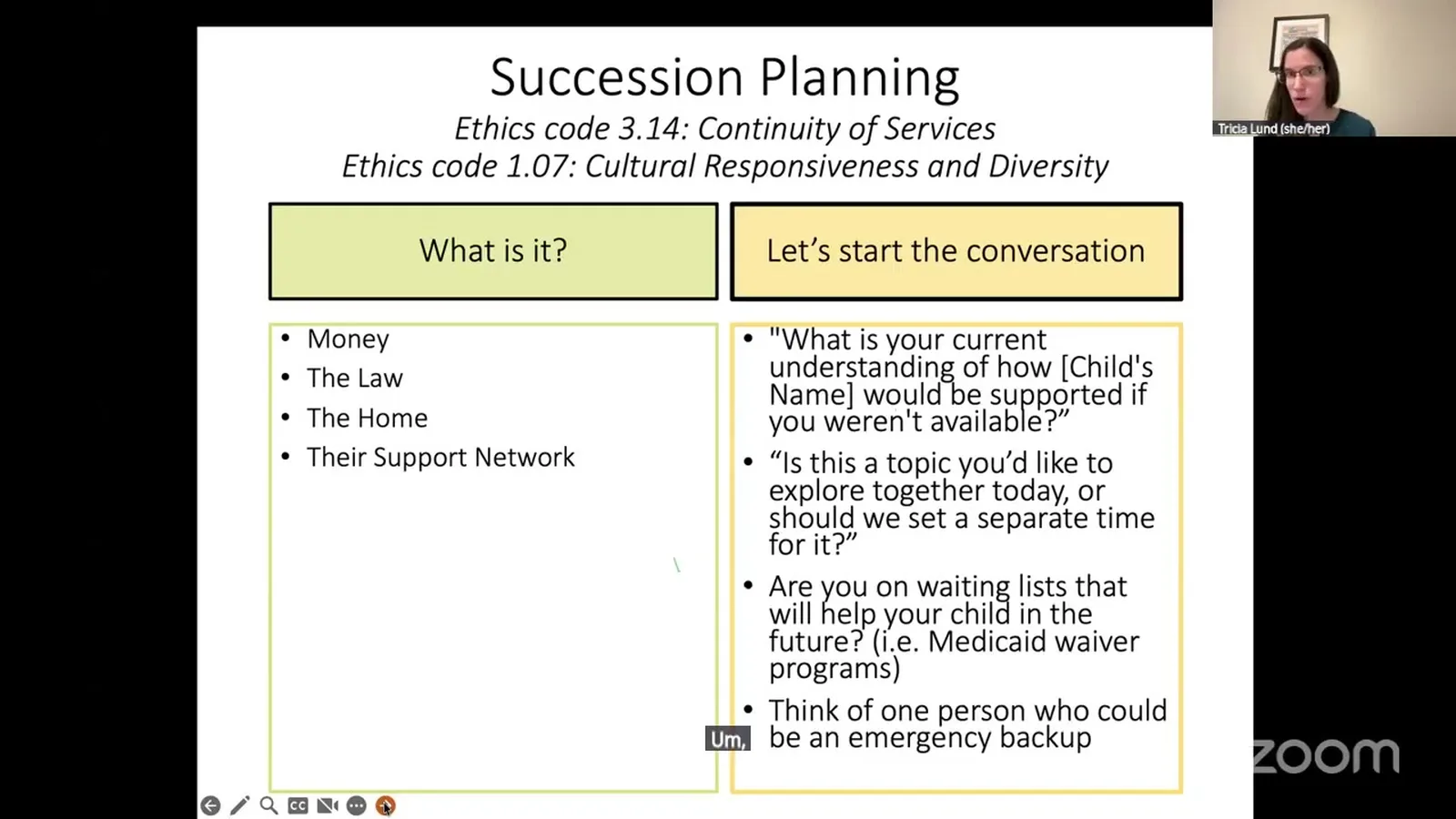
Lund's main prevention is succession planning (deciding now who cares for someone later). Bring it up at intake, not at the funeral. She softens the opening question: what is your plan for when you cannot care for your child anymore? Then cover money, housing, and the support network. Cover who helps make the hard calls. Terms worth learning are special needs trusts, wills, letters of intent, guardianship, and estate planning.
Expect resistance, and do not shame it. Parents are worn out by today. Some think planning is pointless with a ten or fifteen year wait list. Many just do not know what exists. Culture matters here too. A family may have a real plan without a notarized document. If a parent goes quiet, back off and leave resources behind.
The second half of the work is secondary losses (the things lost after the death). The death is the primary loss. The move, the lost rides, the lost money, the lost friends, and the lost independence come next. They pile up in the daily routine, day after day.
So map them and rebuild them. One adult client lost a father who drove him everywhere, managed his money while leaving him real control, brought friends into his life, and texted good morning every day. The team arranged other rides, asked a sibling to take him to visit his mother, set up a rotation of fishing trips with those friends, interviewed carefully for the money role, and found someone to send that morning text. Lund also builds support maps with clients, names and numbers included, so staff can see the network. One warning: take the phone away and you take the whole network with it.
the research does show that people with disabilities are often more impacted by the secondary losses than they are the primary losses
From the talk — Patricia Lund
Common questions
Is grief work inside a BCBA's scope of practice?▾
Part of it is. You cannot diagnose a grief disorder and you should not run therapy to process feelings, since that belongs to a licensed clinician. You can measure grief responses, report changes in how often and how severe they are, adjust supports, and advocate for the client. Collaboration with a therapist or social worker is the way to cover the rest.
How do you define grief in behavior analytic terms?▾
Lund defines grief as the public and private behavior that follows a death loss. Crying, aggression, isolation, and withdrawal all count as grief responses. So does the loss of everyday support a caregiver used to provide. These behaviors are shaped by the person's whole history, not just by what happened in the last ten minutes.
Why do challenging behaviors increase after a caregiver dies?▾
Several things hit at the same time. The client loses their main support, and often loses their home, their routine, and their advocate in medical settings too. Care quality can drop because nobody in the new setting knows the person. The behavior spike that follows then gets met with restrictions, which makes the situation worse.
What are secondary losses?▾
Secondary losses are everything the person loses because of the death. That includes moving, losing rides, losing friends who were really the caregiver's friends, losing spending control, and losing daily contact. Lund says research shows disabled people are often hit harder by these than by the death itself. Listing them and replacing them one by one is concrete work a team can do.
My client keeps asking where their dead parent is. Should I keep answering?▾
Yes, and treat the question as grief, not defiance. Repeated asking is a common grief response even when the person has been told. Answer with plain words like died and dead rather than lost or passed away. A visual support that shows who now does each job can lower the anxiety driving the question.
When should I start succession planning with a family?▾
Start early, ideally during the intake interview, long before there is a crisis. Ask gently what the plan is for when the caregiver can no longer provide care. Cover money, housing, who is in the support network, and who helps with big decisions. If the parent avoids it, leave resources and revisit later.
About the speaker
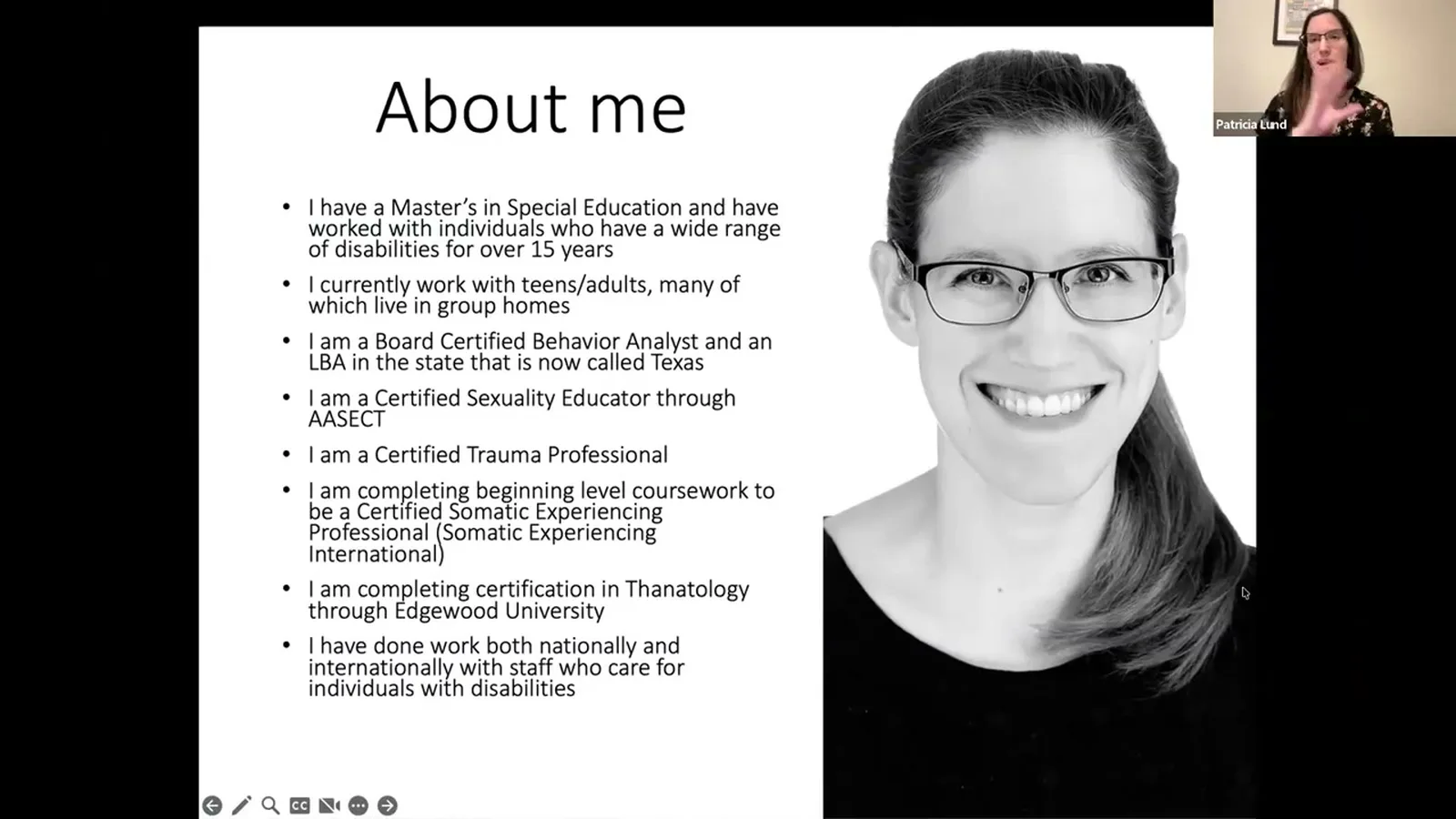
Patricia Lund is a board certified behavior analyst with a master's in special education. She works with teens and adults in Texas, mostly in group homes and day habilitation settings, after starting out teaching special education and then working briefly in a clinic. She is also a certified sexuality educator and certified trauma professional, is training in somatic experiencing (a body based approach to trauma) under supervision, facilitates grief support groups, and is finishing coursework in death education and counseling.
This summary was generated from the recording’s transcript. Quotes are taken word for word from the talk.
What you'll learn
- 1Objectives
- 2Participants will be able to define grief in behavior analytic terms
- 3Participants will identify setting events that can impact how someone grieves.
- 4Participants will identify why the death of a caregiver can lead to an increase in challenging behaviors
- 5Participants will identify interventions that can help support adults with disabilities who are grieving a death loss.
Concepts in this CEU
Related talks
Talks that cover the same concepts
Grief Support at the Front Lines: Training Day Hab and Group Home Staff to Support Adults with IDD Through Bereavement
The Behaviorist Bookclub
Interdisciplinary Grief Support for People with Disabilities: Enhancing Outcomes Through BCBA-LPC Collaboration
The Behaviorist Bookclub

Shaping Behavior Change when ADHD is in the Picture
The Behaviorist Bookclub
That's Outside My Scope of Competence
Willow Mentorship & Consulting, LLC
Reframing Behavior through an ADHD Lens
The Behaviorist Bookclub
Practical Takeaways for School-Based Behavior Analysts
The Behaviorist Bookclub
More from The Behaviorist Bookclub
Harm Reduction Within ABA Practice
The Behaviorist Bookclub
Supervising Beyond Technical Skills: Professionalism, Communication, and Clinical Judgment
The Behaviorist Bookclub
Reflective Supervision and Client Outcomes
The Behaviorist Bookclub
OpenCEU is supported by advertising from third-party sponsors. Sponsors are clearly labeled, have no influence over course content, instructors, or CEU decisions, and never appear on certificates. The BACB does not sponsor, approve, or endorse OpenCEU sponsors or their products.