When the Foundations Are Right: Unlocking Advanced Verbal Repertoires
Presented by Dana Pettus

Cancel any time. Cert delivered to your inbox the moment you pass the quiz.
Learner ratings
from 101 learners
100% would recommend this CEU to other professionals in their field (101 responses)
“well explained”
— Nelson F.“10/10 Sensational Content just like the other videos in her 3 part series.”
— Reagan P.
About this CEU
When learners have been taught with precise conditional discrimination and established speaker–listener mediation, advanced verbal repertoires become significantly more teachable. In this final installment of the series on engineering generative verbal behaviour, we examine how the tools introduced in the previous sessions can be systematically scaffolded to establish more complex skills. Question discrimination, autoclitic frames (e.g., “because I see…,” “because I hear…”), and verbal mediation function as critical sources of stimulus control for event description, recall of past events, and simple inferencing. Building on previously established discrimination and mediation repertoires, participants will analyze how learners move from tacting compound stimuli to recalling events in the absence of the original stimulus conditions and explaining the controlling variables for their responses. Emphasis will be placed on sequencing instruction so that recall and visually or intraverbally based inferences emerge from cumulative stimulus control rather than isolated task training. Applications will focus on strengthening event description, tacting sources of control, and establishing simple inferential responding. The session will briefly outline how these repertoires set the stage for later complex reasoning, highlighting the cumulative impact of earlier programming decisions.
From the talk
What was covered
How to build recall, inferencing, and perspective taking from question discrimination, listing, and verbal mediation.
- Hold the terminal reinforcer (the reward that ends the round) until the learner gives one or two new answers. Never tell them how many you want.
- When a learner stalls, ask a question that adds cues instead of handing over the answer.
- Check question discrimination (telling question types apart) before you treat a recall failure as a memory problem.
- Start recall with one simple picture and a short delay. Ask at least one question you never asked before the picture came down.
- Teach how do you know with because I see frames before you expect real inferencing.
- Fade paper lists, pictures, and pointing so the problem solving moves back inside the learner's head.
Why Inferencing Looks Simple Until You Break It Apart
The talk opened with a short scene. Mia walks into the kitchen. She sees a big cake with her name on it. Her family stands around the table, smiling. She covers her mouth and says, oh my gosh. The chat filled up fast: surprise birthday party.
The answer was not the point. How people got there was the point. You had to link a cake plus a name to a party. You had to read a covered mouth as surprise. Then you had to stack those clues into one guess.
Pettus gave a second case. You walk into a meeting room and it is quiet. You guess the meeting is starting, so you stay quiet too. If the room were loud, you would keep talking. That is covert problem solving (private talk inside your head). We do it all day and rarely notice it. Learners who cannot do it struggle in daily social life.
Convergent and Divergent Control Behind Every Complex Answer
A pure tact (naming a thing you see) has one source of control. You see a chair. You say chair. Most tacting is not that clean. Ask what color is it while a blue car sits there. Two things control the word blue: the question and the car.
That is convergent control (many cues, one answer). Divergent control is the flip side. One cue pulls many answers. What color can pull blue, yellow, red, or green. A green ball can pull ball, round, small, or green. Both are forms of multiple control.
This matters for how we build programs. Complex answers need several sources of stimulus control (cues that set off a response) working at once. If we teach with one cue, one answer, and one reward, we leave the rest of the control out. The response then breaks down in the real world, where cues come in bunches.
Most complex verbal behavior is is a synthesis of multiple components.
From the talk — Dana Pettus
Verbal Mediation: The Quiet Talking That Produces an Answer
A simple intraverbal (words that pull other words) runs on direct history. Ask two plus two and you say four. Ask the color of the sky and you say blue. That is a cue, a response, and a reward. Most real intraverbals do not work that way.
Ask someone what they had for breakfast on Sunday. Most people do not just know. They search in their head first. Sunday I was home. I was cooking. Right, eggs and toast. Only then does the answer come out.
That search is verbal mediation (talking to yourself to find answers). It adds cues until one answer wins. You rehearse a grocery list on the way to the store. You reach for subcategories when a list of countries stalls. You repeat and reword a lecture while you listen to it. Most learners never get taught any of this.
You're going to prompt yourself with these subcategories.
From the talk — Dana Pettus
Teaching Listing So It Builds Search, Not a Memorized List
Pettus ran the same test on the room. Name as many cold foods as you can. Then watch what you do when you run dry. People pictured the inside of the fridge. People walked the refrigerated aisle in their head. People thought about summer meals and packed lunches.
That is why listing earns program time. It is practice in divergent control, one cue and many answers. It also feeds later skills. Conversation needs it. Inferencing needs it too, since naming what belongs at a birthday helps you read a birthday scene.
Listing by category comes first: tell me some animals, some foods, some clothes. Before that, the learner should tact the class of many items. They should also answer class questions fast and under discrimination with other question types.
Then change how you reinforce. Do not end the run until you get one or two new answers. Use fingers, check marks, or an indiscriminate token board (no fixed number of tokens). Never name a number, so ask for some animals, not five. Use the 50 percent rule: if you can name sixteen, expect about half of that. Repeats get no check mark. The learner never knows when the run ends, so they keep searching.
They should be able to be generating novel exemplars.
From the talk — Dana Pettus
Thematic Prompting, List and Check, and Visualizing
Errors will happen, since the skill is not taught yet. The fix is thematic prompting: ask a question that adds control instead of giving the answer. A learner stuck on foods gets asked what a salad is. They say a salad is a food. Ask for foods again and salad, broccoli, and corn come out.
Subcategories work the same way. A learner stuck on animals gets asked about the trip to the zoo. Giraffe shows up, and more animals follow. For clothing, ask what you wear when it is cold outside.
List and check makes the search visible. The learner lists the big class first. Then you check each item against the rule for the subcategory. Ask for animals with wings and you may hear horse. Back up, list animals, then check each one for wings. Writing the list on paper helps the first few times.
Visualizing is a third tool. Prompt the learner to picture the fridge or the store aisle. You can start with the real fridge or a photo, then fade it out. From there, raise the bar: feature, function, and class lists, two part lists, lists with negation, and lists by context.
We're giving them the tools to generate the answer.
From the talk — Dana Pettus
The Three Parts of Recall Most Programs Skip
Recall here means answering questions about past events. Families ask for it constantly. It is harder to teach than it looks. Pettus split it into three parts.
First, the learner has to be verbally present during the event. Listening is behavior. While you listen, you build links between new words and old ones. You rehearse, you reword, you picture things, you make associations. Salient events (big, meaningful moments) do that work for you. You talk about your wedding for weeks, so it sticks. A party four years ago has few links, so it fades. A learner who sits in class without engaging cannot report it later.
Second, the learner has to discriminate the question. What did you do today packs several demands at once. What means an action, not a person or a place. Did means the past, not now and not later. Today rules out yesterday and last summer. A learner who answers with a trip from months ago may have a question problem, not a memory problem.
Third comes problem solving. The question pulls many possible answers at first. The learner then adds their own cues to narrow it down. That is divergent control moving to convergent control. It only works if the mediation skills are already in place.
The important part of recall is being verbally present in the moment that you want to recall later.
From the talk — Dana Pettus
A Beginner Recall Program You Can Run This Week
Start with one picture: one agent, one action. Pettus used a dog jumping over a log in a forest. Show it and ask two or three questions. What is the dog doing. Where is the dog. Then say remember that and take the picture away.
Run distractor trials (busywork tasks placed between the event and the questions) for your target delay. Bring the questions back, including at least one you never asked. What color was the dog forces real recall. Before you run this, the learner should answer those question types about a scene in front of them. They should do it fluently. They should also describe a scene well, naming the salient parts instead of every tree.
Errors get thematic prompts, not answers. Does the dog have fur or feathers. Is the dog white or black. Then go back to your target question. If they are still stuck, show the picture again, remove it, use a shorter delay, and ask again.
Fade your prompts as they succeed. Move from asking questions to pointing at key parts, then to nothing but a heads up that questions are coming. Then raise difficulty. Stretch the delay. Add verbal distractor trials, since those block simple rehearsal. Use busier pictures, then short video clips, then real salient events with a growing gap before you ask.
Because the goal is not that they get the answer right.
From the talk — Dana Pettus
From Tacting Your Own Cues to Perspective Taking
Before inference, teach the learner to tact their own sources of control. Show a picture and ask where is it. They say the beach. Then ask how do you know. They answer with an autoclitic frame (a phrase naming your own cue): because I see sand and water and buckets. The items have to be in the picture and specific to the place. Kids do not count, since kids are everywhere. Run the negative version too. Are they in a kitchen. No, because I do not see a stove or a fridge.
Simple inference comes next, visual or intraverbal. The cues you present are what is the person doing, what do they want, or why are they doing it. Then you ask how do you know. Prerequisites are solid question discrimination, tacting the senses, and answering why questions about events and intentions. Use many novel pictures. Do not call it mastered on the scripted set. When a learner stalls on the boy throwing out a sandwich, ask related questions. What is his face showing. Why might you throw out food.
All of this points toward perspective taking (seeing things from someone else's point of view). One activity showed someone deleting a group chat message after nobody replied. To guess embarrassment, you need her feelings to be separate from yours, with no face to read. Pettus also used the Sally and Ann task, where Sally hides a ball, leaves, and Ann moves it. A child without the skill says Sally will look where the ball really is.
Pettus walked through a verbal behavior account of this from Dr. Espinoza's article. It covers theory of mind (knowing others think and believe differently). You contact the variables controlling another person's behavior as different from your own. Then you respond under multiple conditional control (a different answer depending on who asks) that reflects that gap. The prerequisites are concrete. They include pronoun discrimination and temporal terms like now, did, and will. They also include full sentences using both, plus reporting on what controlled your own answer. After that come knowing by seeing or hearing, and false belief games (tasks testing what someone else wrongly believes). Then come short stories where one character knows something and another does not.
So I'm not going to give the answer.
From the talk — Dana Pettus
Common questions
What is thematic prompting in verbal behavior programming?▾
It means asking a clarifying question that adds sources of stimulus control instead of supplying the answer. If a learner stalls listing vehicles, you ask what class a car is, then ask for vehicles again. The learner still produces the answer, so the search itself gets practiced. Pettus said staff usually pick it up once you model a few rounds.
Why not just use pictures or an echoic prompt when listing breaks down?▾
Those transfers teach a memorized list of animals or foods. They do not teach the learner how to find members of a class on their own. A ready list is sometimes handy, but the search skill is the part that transfers to harder programs. Thematic prompts build the search.
My learner answers questions about today with a trip from months ago. Is that a recall problem?▾
It may not be. Pettus described this as a question discrimination issue instead. What did you do today requires sensitivity to what, to did versus doing, and to today versus last summer. Check whether the learner discriminates those parts before you assume they cannot remember.
Can I run recall with gross motor actions like touch nose and touch head?▾
You can, and it is real recall practice. Pettus noted two drawbacks. Those actions are not very salient, so they are harder to hold onto, and they disappear once done. A picture is closer to the scenes and events a learner will actually be asked about later.
Should I teach recall with photos or videos first?▾
Photos first. A still picture holds one scene with one thing happening, so it is simpler. Videos are more complex and should be treated as a later step, not as a lighter prompt level. Move to short video clips once photos are solid.
What has to be in place before starting a recall program?▾
The learner should answer every question type you plan to use, while looking at a picture, scene, or video. They should do this fluently. They should also describe a scene well, naming the salient parts rather than listing everything. Verbal presence during the event matters just as much, so keep asking questions during the event itself.
About the speaker
Dana Pettus is a behavior analyst in Ontario who has worked as a clinical supervisor with AlphaBee for many years. Most of her caseload is children and teens with autism. Much of her experience is in early intervention and intensive behavior analysis. This talk was the third in her CEU series on verbal behavior, building on two earlier sessions. It covered listing, recall, and simple inferencing.
This summary was generated from the recording’s transcript and reviewed for accuracy. Quotes are taken word for word from the talk.
What you'll learn
- 11. Analyze how previously established conditional discrimination and speaker–listener mediation repertoires facilitate the acquisition of recall and simple inferencing skills. 2. Differentiate between recall and inferential responding under cumulative stimulus control and responding produced by isolated task training. 3. Design instructional sequences that use question discrimination and autoclitic frames (e.g., tacting sources of control) to establish event description and recall of past events. 4. Program for simple visually and intraverbally based inferences by strengthening covert verbal mediations skills including the tacting of controlling variables.
Related talks
Talks that cover the same concepts
Reflective Supervision and Client Outcomes
The Behaviorist Bookclub
Empowering Autonomy and Self-Management in ADHD Learners
The Behaviorist Bookclub
Shaping Behavior Change when ADHD is in the Picture
The Behaviorist Bookclub
From Hours to Competence: Assessing and Developing Supervisee Skills
The Behaviorist Bookclub
Reflective Supervision and Provider Outcomes in ABA
The Behaviorist Bookclub
Getting the Right Answer Isn’t Enough: Establishing Speaker–Listener Repertoires for Complex Learning
The Behaviorist Bookclub
More from The Behaviorist Bookclub
Building a Supervision System That Actually Works
The Behaviorist Bookclub
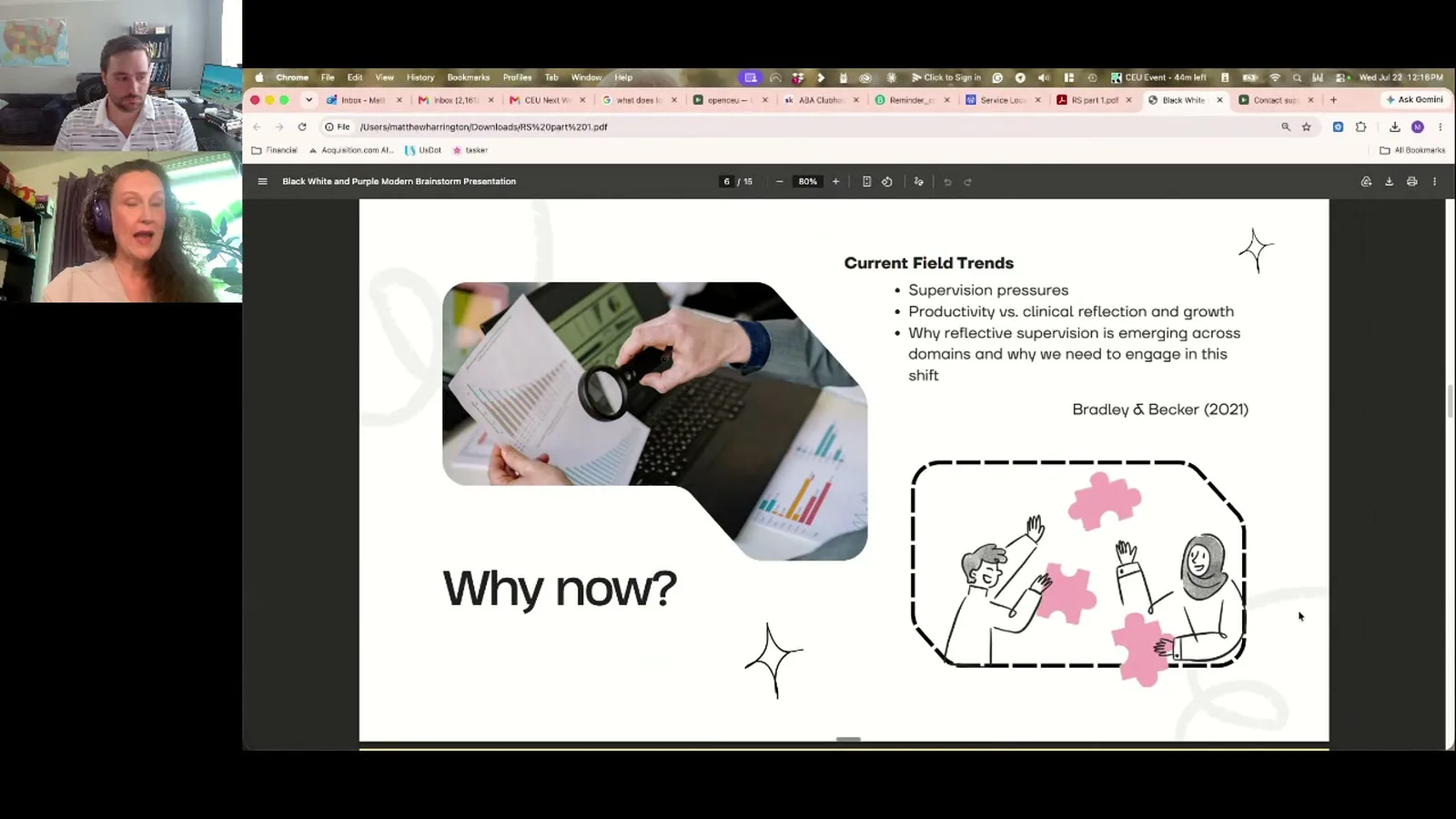
Foundations of Reflective Supervision in Behavior Analysis
The Behaviorist Bookclub
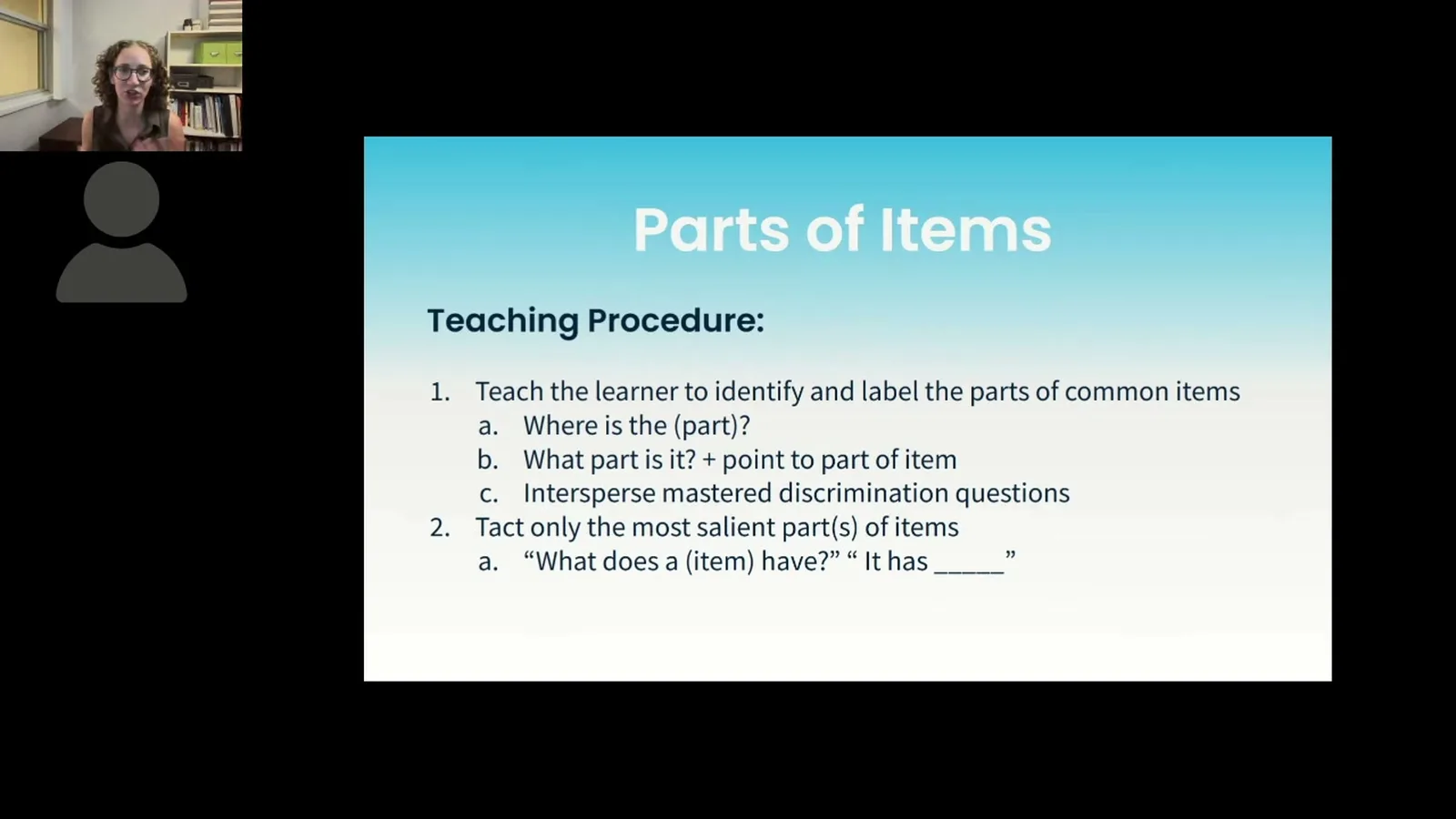
Teaching WH-Questions Isn’t Enough: Building True Conditional Discrimination
The Behaviorist Bookclub
OpenCEU is supported by advertising from third-party sponsors. Sponsors are clearly labeled, have no influence over course content, instructors, or CEU decisions, and never appear on certificates. The BACB does not sponsor, approve, or endorse OpenCEU sponsors or their products.