The ADHD Exchange: Teaching Emotional Regulation
Presented by Nicole Stewart
Emotional regulation sits at the center of effective behavior support, and teaching it well starts with understanding how emotions develop. This training for BCBAs reviews emotional development from infancy through adolescence and the variables that shape it, including temperament, neurodivergence such as ADHD and autism, and the supportiveness of the environment. Participants then walk through a strategic sequence for teaching emotional regulation: building tolerance for talking about emotions, teaching emotion recognition, connecting emotions to their causes and to sensations in the body, and differentiating coping skills based on the emotion. Practical recommendations cover lesson planning, visual supports, multiple exemplars, coregulation, and adaptations for learners with greater support needs. The training closes with guidance on writing emotional regulation goals for insurance and collecting meaningful data through probes, duration, and Likert scales.
Sign in to buy — $17One-time purchase, permanent access. Cert delivered to your inbox the moment you pass the quiz.
About this CEU
Emotional regulation sits at the center of effective behavior support, and teaching it well starts with understanding how emotions develop. This training for BCBAs reviews emotional development from infancy through adolescence and the variables that shape it, including temperament, neurodivergence such as ADHD and autism, and the supportiveness of the environment. Participants then walk through a strategic sequence for teaching emotional regulation: building tolerance for talking about emotions, teaching emotion recognition, connecting emotions to their causes and to sensations in the body, and differentiating coping skills based on the emotion. Practical recommendations cover lesson planning, visual supports, multiple exemplars, coregulation, and adaptations for learners with greater support needs. The training closes with guidance on writing emotional regulation goals for insurance and collecting meaningful data through probes, duration, and Likert scales.
Credits
1 CEU · 72 min
From the talk
What was covered
A BCBA (board certified behavior analyst) walks through her sequence for teaching emotional regulation. It moves from tolerance first, to recognition, causes, body sensations, and matched coping skills.
- Start emotional regulation instruction at tolerance for talking about feelings, not at coping skills.
- Never teach a new skill while a child is flooded (overwhelmed by emotion). Hold the boundary in the moment, then repair once they are calm.
- Build one-emotion lesson plans that cycle through a book, a game, coloring, and a worksheet for repetition without boredom.
- Lower response effort with receptive tasks (pointing or matching instead of talking), like placing a picture on a body outline.
- Match the coping skill to the feeling, since calming strategies and energizing strategies do different jobs.
- Write goals under behavior management, self-management (managing your own behavior), communication, or restricted and repetitive behaviors (narrow routines and interests). Then measure progress with probes, duration data, or Likert scales (a simple one to five rating).
Emotions Are Private Events That Drive Behavior
Emotions are mental states that come from changes in the brain and body. They mix with mood, temperament (a person's inborn style), and personality. So two kids can face the same event and feel very different things. Emotions are private events (things only that person can feel). You cannot see them from the outside. You can still teach a child to notice them and name them.
Stewart described a near miss while making a U-turn. Her heart skipped. Her chest got tight. Because she knows that big version of the feeling, she can spot the small version later. That is the skill we want for our clients. Emotions lead to body sensations. Sensations lead to actions. Those actions then feed new emotions.
She walked through a shame spiral (a cycle where one bad feeling leads to a worse one). A bored child scribbles on another kid's paper. The other kid yells at him. Now he feels bad about himself and starts to cry. The boredom was just the first link in a chain. Behavior analysts tend to work only on the last link.
Stopping the behavior does not stop the feeling. The child may simply be masking (hiding a feeling instead of handling it). Stewart used herself as the example. After a hard day, she will not melt down at a work event. The hard day still happened. She just got better at hiding it.
just removing that fog and removing those behaviors doesn't necessarily stop the emotions and the feelings
From the talk — Nicole Stewart
Emotional Development From Babies Through the Teen Years
Babies start with imitation. Clap and smile, and they clap and smile. They also share emotions. A loud noise goes off, the safe adult looks scared, and the baby reacts too. Babies cannot calm themselves down. They need coregulation (calming down together with an adult). Stewart pushed back on the idea that holding a baby too much blocks self-soothing. A baby cannot meet a single one of its own needs yet.
In early childhood, kids get mad, sad, and glad. How they show those feelings varies a lot. One child may show almost every feeling as anger. Another may cry for everything. Stewart warned against the neurotypical script (what we assume a feeling should look like). A flat face can still mean joy. She took two boys to a concert. One of them looked blank the whole night and said he was having the time of his life. He was taking it all in rather than sending it back out.
By early elementary, guilt and shame get louder. Kids notice they could look different from peers. Crying in class starts to feel risky. Coping skills show up around then too. Some are healthy. Some are not, like pushing a feeling down all day. Then come the tween years and a much wider emotional range. Stewart frames early work as a stakes problem. A six-year-old who punches a kid at the pool is a small problem. A seventeen-year-old who does the same thing can get arrested. A meltdown over a bagel is practice for a meltdown over a breakup. By then, no adult is sitting there to coregulate.
Development varies for real reasons. Temperament is one. Some kids are just easygoing, which is why the comparison to a friend's child rarely helps a parent. Neurodivergence (brain differences such as ADHD and autism) brings more dysregulation (trouble staying calm and in control). Then there is the environment: parent engagement, parent mood, social opportunity, and how supportive the setting is. Stewart sees big gaps between schools in her own town in how bullying reports get handled. Kids with ADHD are more likely to be bullied. They are also more likely to sit in general education classrooms. And they are more likely to feel rejection sensitivity (criticism that stings much harder).
babies in general don't know how to regulate themselves they're not supposed to
From the talk — Nicole Stewart
The Pyramid: Why Coping Skills Belong at the Top
Stewart puts the sequence in a pyramid, and you build from the bottom. Level one is tolerance for talking about emotions at all. Level two is recognizing emotions. Level three is linking a feeling to its cause and to where it lives in the body. Level four is coping. Emotional regulation sits at the top as the outcome, not the first lesson.
Most people start at level four. Kids get referred to her with a calming bottle and a breathing card already in place, and nothing underneath. The problem is timing. A flooded brain cannot take in a new skill. Her test is simple: how would a child know when to use a coping skill? Nobody taught them what they were coping with.
The live chat showed the gap clearly. One attendee said they start at level four and now see they should have started lower. Another described a client who can discuss emotion recognition, causes, and coping skills, but cannot talk about their own feelings. That is a level one problem. Adding a fifth coping skill will not fix it.
But we all know when you're upset, your brain is offline and that's not the time to be learning new skills.
From the talk — Nicole Stewart
Level One: Getting a Kid to Talk About Their Own Feelings
Tolerance gets built inside preferred activities, not in a sit-down lesson. Stewart starts most kids with popsicle stick people from Diane Albert. The child colors in the faces. Those sticks then work as a visual later on. When a kid says the day felt bad, she asks which face it felt like. Receptive language (what a child can point to) comes in before expressive language (what they can say out loud). So pointing is the way in.
Special interests do a lot of the work here. One child drew his anger as a Pokemon card. He named it. He drew its attacks and showed where the heat came out of its body. They spent about five sessions on that one card. The whole time, they were talking about anger. Words like mad and sad are just words. A named character gives a kid language that means something to them.
Progress is slow, and the signs are specific. Stewart knew one kid had turned a corner when she walked in and he narrated his Legos for her. This one is mad. His boss will not let him leave. Another client did nearly the same thing. She had worked with that first family for a long stretch. Only then did he tell her he wanted to talk about his feelings. Tolerance turns into expectation, and then into something the kid enjoys.
the receptive piece is such a lower demand
From the talk — Nicole Stewart
Level Two: Teaching Emotion Recognition Without Flashcard Drills
The mixed flashcard drill is the field default. Show me happy. Show me sad. Show me mad. Mix them up. Stewart does not claim it never works. She says it will not hold an ADHD learner. The kid shuts down or goes looking for something better to do.
Her fix is a lesson plan built around one emotion. Say today is happy. Read a book and find who is happy on each page. Play a card game and talk about the happy cards. Color a scene of happy people. Finish with a short worksheet about feeling happy. Same target all session, new activity every few minutes. That gives you repetition plus novelty, and it stacks up multiple exemplars (many different examples of one skill).
Match the format to the learner. Some kids are workbook driven and want that structure. Others cannot tolerate anything on a piece of paper. Stewart showed a feelings workbook she picked up at a big box store. One spread asks the child to copy the angry face and match feelings to pictures. It also has the child count the angry faces and draw what makes them angry. Another activity showed stomping, which opened up a talk about how differently people show anger. A page like that touches levels one through three at once.
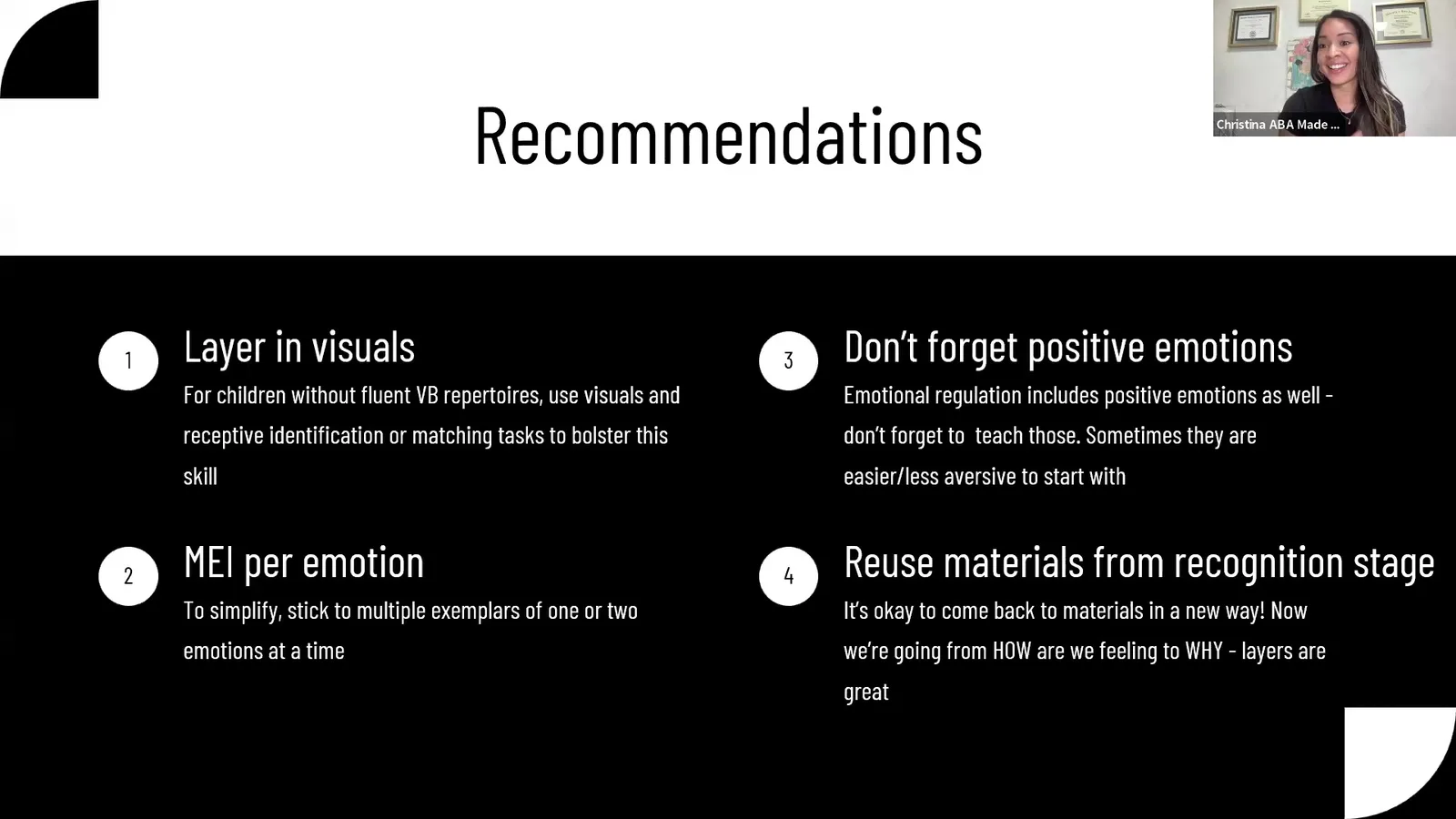
A few rules came up again and again. Layer in visuals. Use matching and receptive ID when talking is too hard. Stick to one or two emotions at a time. Do not skip positive emotions, because getting too excited at a birthday party is a regulation problem too. Positive emotions are also less aversive (less unpleasant to approach) for kids who have been punished around big feelings. Watch your wording, since many kids only catch the last few words. Do not flick the light switches can land as flick the light switches. Put your hands down works better. And reuse your materials a month later. The second conversation almost always goes deeper.
kids with ADHD thrive on repetition and novelty
From the talk — Nicole Stewart
Level Three: Causes, Other People, and Sensations in the Body
Cause and effect answers one question. Why am I feeling this? Stewart uses clips, games, and story cards. In one clip, a kid drops his ice cream cone. He was sad first. Then the adult filming laughed, and sad turned into angry. He was looking for comfort, but got laughter instead. The sadness did not need to be erased. It needed a name and a calm response.
She recommends the Everyday Speech website for videos and games. Situation cards work the same way. A character has surgery for the first time. The child picks the feelings that fit: tense, confused, excited, frustrated, anxious. For a kid who hates worksheets, she cuts the items apart and hides them around the room. They find them and match them instead of sitting still. Picture cards also open up perspective taking (seeing an event from someone else's view). One player is angry about the missed ball. Another is embarrassed. Same event, two feelings.
There is a trap at this level. Some kids can tell you every sign that a parent is angry and nothing at all about themselves. Stewart worked with siblings who could describe exactly what dad looks like when he is mad. Their own anger was blank. Kids who scan the adults around them for safety often never learn to scan themselves.
For body sensations, she uses a visual from Rise Children's Society. The child cuts out images like a cactus, a fire, jello, bubbles, ice cubes, and a spinning swirl. Then they draw a gingerbread man and place each picture where they feel it. The swirl lands on the head a lot. A frog shows up for excited. A cactus on the arm tells you something real about mad. She pairs this with movement: jumping jacks for a fast heartbeat, ice on the face, warm hands on the cheeks. Then she asks whether that feeling reminds them of anything.
when kids are so hyper focused on like making sure they can read other people's emotions they neglect to learn how to read their own
From the talk — Nicole Stewart
Level Four: Matching Coping Skills to the Emotion
Coping skills fall into three groups. Calming ones include sensory bottles, cozy spaces, yoga, and deep breathing. Energizing ones include exercise, screaming, and ripping paper. In between sit things like punching a pillow, music, writing, and drawing. The right choice depends on the feeling and how revved up the body is.
Stewart used herself as the test case. Sad means climbing into bed with a favorite show. Angry means cleaning and throwing things out. Those two are not interchangeable. Adults sort this out for themselves and then hand kids one tool for every feeling.
Practice happens when the child is calm and having fun. She drops breathing cards into an obstacle course. You wheelbarrow walk, then you hit lion's breath, so you breathe like a lion. She does not announce that this is what you do when you are upset. Later she asks what they thought of lion's breath, and whether they might want to try it sometime. Kids with ADHD do not love being told what to do. You can also reward the practice itself: do five kinds of breathing, then pick a card. Ownership helps most of all. One child built his own book of calming choices, added stickers, and ran out to show his parents. That took months of shaping (teaching in small steps).
Nobody learns while they are flooded. Hold the boundary in the moment and skip the lesson. Once the child is fully calm, you can ask if they know why that happened. Stewart also reframes limits for parents. Boundaries should protect safety, including mental health, rather than deliver punishment. These toys are finished for now lands very differently from I am taking these away until you behave. Kids work harder on a skill when the limit is about learning instead of blame.
We teach kids to take deep breaths, no matter what they're feeling.
From the talk — Nicole Stewart
Adapting for Greater Needs, Writing Insurance Goals, and Taking Data
For learners with greater support needs, strip it down. Simplify the materials. Repeat more. Raise your rate of prompts and reinforcement (rewards that encourage a behavior). Stick to the necessities, which may mean mad, sad, and glad for a long while. Jealousy and love can wait. A color system like the Zones of Regulation can group feelings into four buckets. Bored, tired, and sad all feel heavy in the body, so they can live together in blue. You also have to read precursor behaviors (small signs before a problem starts). A head going down on a desk is data. Those tiny signals are how you help a child make a private event public.
For insurance, Stewart maps emotion work onto domains that already get funded. Behavior management and replacement skills (new skills that take the place of a problem behavior) are the obvious ones. Problem solving can sit under self-management or under safety. Emotion work also fits communication and socialization. It can even fit restricted and repetitive behaviors. Teaching other ways to cope helps expand that narrow pattern. If a child melts down whenever someone else picks the activity, target tolerance for adult-led play. Then make the content of that play emotion work. One goal, two jobs.
Data is the part that feels loose, because the materials change every session. Stewart uses a few options. Probe data means you check the skill every so often with one standard set of materials. Duration data tracks how long the child takes part or stays in the conversation. Likert scales work well for participation and engagement. She finds them accurate when a single person is doing the scoring. Percent correct still works for a target like causes of emotions. Three out of four correct on cause questions is a real number you can graph.
If the numbers are all over the place, treat that as information. Some materials land with a client and some do not. Scattered data may be telling you which ones are working.
You don't have to use the same materials every single time to have accurate data collection.
From the talk — Nicole Stewart
Common questions
Where should I start when teaching emotional regulation?▾
Start with tolerance for talking about emotions at all. Many clients will not discuss their own feelings even when they can label emotions in other people. Stewart builds that tolerance inside preferred activities, using visuals and the child's special interests. Recognition, causes, and coping all come after that.
Why don't coping skills work when the child is already upset?▾
Because a flooded brain is in survival mode and cannot take in new learning. Stewart says your brain is offline in those moments, for kids and adults alike. In the moment, hold your boundary and help the child calm down. Save the conversation and the teaching for after the storm passes.
How do I teach emotion identification to a kid who shuts down during flashcard drills?▾
Swap the mixed drill for a one-emotion lesson plan. Read a book, play a game, color a scene, and do a short worksheet, all about the same feeling. That gives you repetition with enough novelty to hold attention. For kids who cannot tolerate paper, cut worksheet items apart and hide them around the room.
Should coping strategies be different for different emotions?▾
Yes. Stewart groups strategies as calming, energizing, and in between. She matches them to the feeling and the arousal level (how keyed up the body feels). She might watch a show in bed when sad and clean the house when angry. Teaching deep breathing for every emotion ignores how coping actually works.
How do I write an emotional regulation goal that insurance will approve?▾
Map it onto a funded domain rather than writing it as a standalone emotion goal. Behavior management and replacement skills, problem solving as self-management or safety, communication, socialization, and restricted and repetitive behaviors all work. For example, target tolerance for adult-directed activities, then make the content of those activities emotion instruction.
What data can I collect on emotional regulation instruction?▾
Stewart uses probes with a standard set of materials. She also tracks duration of participation, Likert scales for engagement, and percent correct on targets like causes of emotions. You do not need identical materials each session to get usable data. If the data looks scattered, check which materials are resonating with the client.
About the speaker
Nicole Stewart is a BCBA and a certified special education teacher based in New Jersey. She teaches at Hunter and serves on the boards of NJ ABA and the Association for Science in Autism Treatment. Her work focuses on ADHD, anxiety, and autistic learners in general education settings. These are kids whose needs often get read as mild and go untreated.
This summary was generated from the recording’s transcript. Quotes are taken word for word from the talk.
What you'll learn
- 11. Sequence emotional regulation instruction from tolerance through recognition, cause and effect, and coping. 2. Match coping strategies to the emotion and arousal level a client presents. 3. Write insurance-ready emotional regulation goals measured with probe, duration, or Likert data.
Related talks
Talks that cover the same concepts
The ADHD Exchange: Best Practices
ABA Made Ez
The ADHD Exchange: Classroom Management: ADHD Behavior Management
ABA Made Ez
The ADHD Exchange: Social Skills: Performance or Skill Deficit?
ABA Made Ez
The ADHD Exchange: Understanding the Neurobiology of ADHD
ABA Made Ez
The ADHD Exchange: Executive Functioning
ABA Made Ez
OpenCEU is supported by advertising from third-party sponsors. Sponsors are clearly labeled, have no influence over course content, instructors, or CEU decisions, and never appear on certificates. The BACB does not sponsor, approve, or endorse OpenCEU sponsors or their products.