The ADHD Exchange: Understanding the Neurobiology of ADHD
Presented by Nicole Stewart
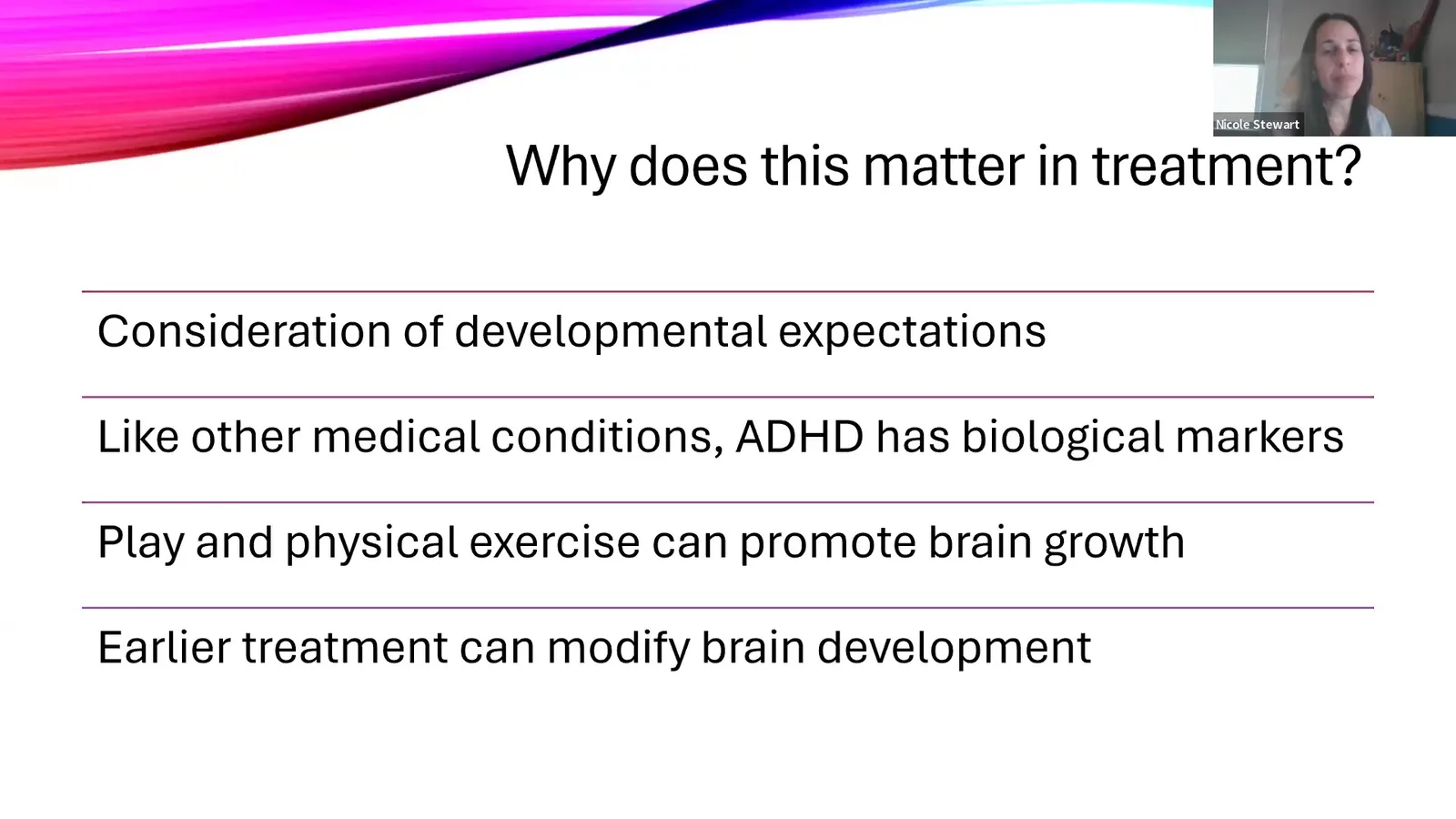
Effective behavioral intervention for ADHD begins with understanding what is happening in the brain. This training for BCBAs traces ADHD from its earliest historical descriptions through the current DSM-5 criteria and presentations, then looks at how ADHD affects emotional regulation, social skills, executive functioning, and self-management. From there, participants explore the neurobiology behind those patterns: the genetic contribution to ADHD, the role of dopamine and overall brain chemistry, and the development and function of the prefrontal cortex and basal ganglia. The training also examines environmental factors, including early adversity, parenting styles, and lifestyle balance. Throughout, each topic returns to the same question: why does this matter in treatment? Behavior analysts leave with a clearer picture of the biological and environmental variables that shape ADHD and how that understanding informs assessment, treatment planning, and more compassionate, effective behavioral support.
Sign in to buy — $17One-time purchase, permanent access. Cert delivered to your inbox the moment you pass the quiz.
About this CEU
Effective behavioral intervention for ADHD begins with understanding what is happening in the brain. This training for BCBAs traces ADHD from its earliest historical descriptions through the current DSM-5 criteria and presentations, then looks at how ADHD affects emotional regulation, social skills, executive functioning, and self-management. From there, participants explore the neurobiology behind those patterns: the genetic contribution to ADHD, the role of dopamine and overall brain chemistry, and the development and function of the prefrontal cortex and basal ganglia. The training also examines environmental factors, including early adversity, parenting styles, and lifestyle balance. Throughout, each topic returns to the same question: why does this matter in treatment? Behavior analysts leave with a clearer picture of the biological and environmental variables that shape ADHD and how that understanding informs assessment, treatment planning, and more compassionate, effective behavioral support.
Credits
1 CEU · 70 min
From the talk
What was covered
Nicole Stewart covers the brain science behind ADHD, from dopamine to brain growth to early adversity. She ties each piece to a shift in treatment.
- When a parent says reinforcement does not work, check the reinforcer's potency and watch for self-protective shutdown.
- Before you call a plan extinction (removing the payoff for a behavior), stop and check one thing. Ask whether the behavior is being paid off chemically rather than socially.
- Treat caregiver follow through as a skill issue first. A parent who skips the schedule may have the same executive functioning needs as the child.
- Set goals against brain development, not age alone. The prefrontal cortex (the brain's planning and control center) keeps maturing into a person's twenties.
- Build routines that support dopamine (the brain's reward chemical): movement, play, sunlight, food, art, and a workable screen balance.
- Ask about early adversity and prenatal exposure during intake, because both can produce the same brain changes seen in ADHD.
Why ADHD brain science sits inside a BCBA's scope
Nicole Stewart opened by naming the worry in the room. Brain talk can feel like it is not ABA. Her answer was simple. It is still science, and the ethics code supports it. Scope of competence comes first. If you serve clients with ADHD (a brain based attention difference), you need to know how that brain works.
She compared it to a doctor treating strep throat. The doctor has to know how the infection works. They have to know which drugs help. The same logic applies to us. Effective treatment is next. Reward systems work differently in ADHD, so plans have to account for that. Consideration of medical needs applies too, because all of this is medical.
The strongest tie may be minimizing risk. If we treat a behavior as a choice, we add shame on top of a brain difference. That creates real risk of social and emotional harm. It also feeds the idea that something is wrong with the person. Data is the last link. When a client starts a medication, we can measure what shifts in daily life.
The session also framed why this matters on autism caseloads. Comorbidity (two diagnoses in one person) is common here. A child with autism and ADHD does not look like a child with autism alone. Stewart said that early in her career, the field often folded every behavior into the autism label.
I want to reassure you, this really strongly goes with our ethics code for a number of reasons.
From the talk — Nicole Stewart
From the 1700s to the DSM-5: a short history of the diagnosis
The pattern is old. People first described it as far back as the 1700s. One account called it the incapacity of attending with the necessary degree of constancy to one object or activity. It reached the DSM-2 (an older diagnostic manual) in 1950 as ADD with or without hyperactivity. Ritalin started being prescribed that same decade. Stewart was blunt about what followed. The stimulants were handed out widely and often for the wrong reasons.
ADHD replaced ADD in the DSM in the 1980s. The American Academy of Pediatrics did not publish guidance for diagnosis and treatment until 2000. That is only about two dozen years of clinical guidelines. Strattera arrived in 2002 as the first non stimulant option, roughly 50 years after Ritalin. She noted why other pathways matter. Stimulants are not a good fit for everyone, including some people who have ADHD and anxiety together.
The DSM-5 now lists three presentations: mostly inattentive, mostly hyperactive or impulsive, and combined. It also sets levels of mild, moderate, and severe. A diagnosis asks for at least six symptoms beyond what fits the person's age. Those symptoms must impair more than one setting. They must also last at least six months, start before age 12, and not be better explained by something else. Children are not meant to be diagnosed before age five, since many of these behaviors are expected in preschoolers.
Prevalence is high and symptoms often last. Stewart said roughly 65% of people diagnosed still have symptoms as adults. Diagnosis today still leans on clinical judgment and the Vanderbilt form (a rating scale for parents and teachers).
About 5% to 7% of school-age children have an ADHD diagnosis, which is about 3.5 million children across the world.
From the talk — Nicole Stewart
Four domains ADHD touches, plus the symptoms the DSM leaves out
Stewart groups the effects into four domains. Executive functioning (planning, memory, and follow through) is the one most people name. Self management sits right next to it. Emotional regulation is hit hard. Social skills round it out. She stressed that the four feed each other. A child who is late to everything loses friends. A child who melts down over feedback loses friends too. Some social gaps are their own skill deficit. A child may miss the unwritten rules in a room because nothing there held their attention.
Several common features never made the DSM. Rejection dysphoria (intense pain from criticism or rejection) is one. Emotional dysregulation (trouble managing big feelings) is another, and it is well researched. So is hyperfocus (locking onto something of high interest). So is interest based motivation, which means working harder on what feels interesting than on what feels important.
She ran a live exercise that is worth borrowing for parent conversations. A five year old needing four reminders about laundry is expected behavior, not a symptom. A ten year old losing at least one item every day is a signal. A 15 year old who flies off the handle at any feedback is likely a regulation issue. We expect that kind of reaction to settle by that age. An adult who makes a daily to do list could have strong executive functioning or could be coping well. An 11 year old who overshares private family details may be impulsive or may not have learned the unwritten rules.
The lesson is about rate and age fit, not the behavior alone. Everybody loses things. Losing something every single day is different.
So being able to focus really well when something is of interest versus of importance.
From the talk — Nicole Stewart
Genetics: what 75% to 90% means for your parent training plan
Stewart put the genetic correlation somewhere between 75% and 90%. Research has started to pin down specific genes. Some affect brain chemicals. Some affect how a brain region develops. She chose not to drill into each gene, and gave a good reason. You do not need that detail to deliver informed treatment.
You do need two takeaways. First, ADHD often travels with other inherited conditions. She mentioned stomach and gut problems and motor planning trouble. One gene can set off a chain of effects. Second, ADHD rarely sits in one person in a family.
That second point lands straight in your parent training. You hand a family a schedule or a checklist. The parent may have the same executive functioning needs as the child. Stewart pointed to a complaint she sees often online: the parent who will not do the parent training. Her options were practical. Make the schedule yourself. Or admit you cannot, and build a different strategy together. Or help that parent get their own support in place.
She also sees the research direction as a reason to keep reading. As markers improve, we may get physical indicators for diagnosis, severity, and likely outcomes. That means more targeted treatment. In the meantime, there is a message for caregivers. This is largely genetic. They did not cause it.
Maybe it's not a won't, maybe it's a can't.
From the talk — Nicole Stewart
Dopamine and why reinforcement looks broken
Neurotransmitters (chemical messengers between brain cells) come in three kinds. Excitatory ones (signals that turn something on) send a message up, like the one that tells you your elbow hurts. Inhibitory ones (signals that turn something down) block or soften a message. Modulatory ones (signals that fine tune a message) edit it on the way through. Dopamine is mostly inhibitory and sometimes excitatory. It drives the reward system. It also supports focus, memory, motivation, sleep, and mood.
The research Stewart reviewed points two ways. People with ADHD either process dopamine poorly or run low on it. One study found damage in dopamine related brain cells that produced hyperactivity, weak stress responses, and ADHD like symptoms. A 1976 animal study showed that destroying those same cells after birth produced ADHD. In 2003, researchers found defects in the striatum (a dopamine rich brain region) in ADHD patients. Multiple studies show symptoms emerging when dopamine related genes are altered.
Here is where it meets your plan. Low or poorly used dopamine leads to seeking behavior: impulsivity, bids for negative attention, hyperactivity. Tolerance builds, so the seeking gets bigger and riskier. Brain structures that depend on dopamine grow less. Reward centers do not respond as expected. She compared it to low blood sugar. The body hunts for what it lacks.
So when a parent says reinforcement does not work, Stewart pushes back. It may need to be far more potent. Or the child may shut down and get dopamine an easier way, then say they never wanted the iPad. There is also a double punishment effect. Promising the reward releases dopamine. Losing it then feels like a punishment, and that can explode. One more wrinkle: ignoring a behavior may not stop it if the behavior still pays off chemically on its own.
So you want to have a certain balance of dopamine in your body.
From the talk — Nicole Stewart
The prefrontal cortex and basal ganglia in ADHD
The prefrontal cortex runs executive functioning, decision making, and stress management. It leans heavily on dopamine. It also controls the sympathetic nervous system (the body's danger and stress response). Stewart called this her light bulb moment. If dopamine is off, this region can be underpowered. A person may then not respond to danger or stress the way we expect. That reframes a lot of fight or flight reactions we see on the job.
Research she cited shows weaker function and structure here. White matter (the wiring between brain regions) is less dense too. Less dense wiring means less efficiency. This region is also one of the last to fully mature, often not until a person's twenties. Most 15 year olds have some executive functioning gaps for that reason alone. ADHD is thought of as a developmental delay, so growth may still come.
There is a catch. If skills are never taught directly, the window can pass. Nobody sits an adult down and teaches decision making or stress management. If the motivation to self teach is missing, the skill may never get built.
The basal ganglia (a cluster of cells that drives movement) is the other region she covered. It also handles sensory input, emotions, and learning, and it ties into reward. In ADHD, studies show reduced white matter, volume, and shape. Stimulant medication can change that volume and shape over time. That is the hopeful part. Brains change with medication, with therapy, with play, and with exercise, and earlier treatment can shape development.
And so just because they can't yet doesn't mean they won't ever.
From the talk — Nicole Stewart
Early adversity, parenting style, and lifestyle balance
Genes are not the whole story. Epigenetics (genes switching on and off with environment) means the same genes can lead to more or fewer symptoms. Some environmental factors cause ADHD type brain changes on their own. Prenatal exposure to alcohol or cigarettes raises risk apart from any family history.
Stewart showed a graph from a study by Stern and colleagues in 2018 on abuse, neglect, and ADHD. With no abuse or neglect, 9.6% had ADHD. With moderate abuse or neglect, that rose to 17.7%. With severe abuse or neglect, it reached 22.8%. Her point was mechanical, not moral. Trauma can produce the same structural brain changes as ADHD. That is worth knowing when you take a history.
On parenting, she cited a study on parents of children with ADHD. They are more likely to be authoritarian: rigid, harsh, demanding, and low in warmth. That style fits the ADHD brain profile worst and links to emotional problems and low self esteem. She was careful about cause and effect. A parent may get strict because they are constantly keeping a child safe. Our job is helping them hold both: honest feedback and real attunement (staying tuned in to their feelings).
Lifestyle is the last piece. Movement, food, community support, and school fit all shape how a brain runs. Screens cut both ways. Some neurodivergent people (people whose brains work differently) find them regulating. Others find them addictive and dysregulating. Protective factors are real too. Exercise helps. An authoritative parenting style (warm but firm) helps. Limiting toxin exposure helps. Lifestyle change alongside medication and behavioral therapy can move the needle.
Exercising is a protective factor.
From the talk — Nicole Stewart
What changes in your assessment and treatment plan
Start with reinforcement. Test potency instead of assuming a reinforcer failed. Watch for the double punishment pattern, where a promised reward becomes a loss. Ask whether a behavior is being paid off chemically. If so, think twice before calling the plan extinction. Some behaviors do not need a social replacement. They need a healthier route to dopamine, like movement, play, or art.
Set expectations against development. A teenager with weak planning skills is partly a teenager. Teach the skills directly anyway, since waiting for maturity can mean missing the window. Build in play and physical activity on purpose, not as a break from the real work. Those activities release dopamine and drive the brain connections you are after.
Widen the intake. Ask about family history, other inherited conditions, prenatal exposure, early adversity, sleep, food, screens, and school fit. Check what the caregivers can actually carry. Keep the medical team in the loop. Use your data skill where it adds value, like measuring what a medication change does to real behavior in real settings.
Stewart closed on the purpose of all of it. She described working with an adult who loses a wallet most days. The brain is running 200 things and never encodes where the wallet went down. That is harder to fix at 50 than at five. The goal is not a quieter brain. The goal is less distress and more independence.
I never work to reduce neurodiversity.
From the talk — Nicole Stewart
Common questions
Does teaching ADHD neurobiology count as behavior analytic content?▾
Stewart argued yes, and tied it to several parts of the ethics code. Scope of competence, effective treatment, and consideration of medical needs all apply. So do minimizing the risk of behavior change procedures and data use. If a client's reward system works differently, your plan has to account for it.
Why do parents say reinforcement does not work for their child with ADHD?▾
Low or poorly processed dopamine changes how reward lands. The reinforcer may need to be far more potent, or the child may shut down and seek dopamine somewhere easier. There is also a double punishment effect. The promise of a reward feels good, and losing it then feels like a penalty.
How genetic is ADHD?▾
Stewart put the genetic correlation somewhere between 75% and 90%. If one person in a family has ADHD, others often do too. That matters for parent training. A caregiver may have the same executive functioning needs you are asking them to support.
Can early adversity look like ADHD?▾
The study she cited, by Stern and colleagues in 2018, looked at abuse, neglect, and ADHD rates. With no abuse or neglect, 9.6% had ADHD. With moderate abuse or neglect, that rose to 17.7%. With severe abuse or neglect, it reached 22.8%. Trauma can cause brain changes similar to those seen in ADHD. That is a reason to ask about history during assessment.
At what age is ADHD usually diagnosed?▾
Children are not supposed to be diagnosed before age five, since many symptoms are expected in preschoolers. Symptoms must be present before age 12 for a DSM-5 diagnosis. Stewart looked up average ages of diagnosis during the session but flagged that she could not vouch for the source.
Can treatment actually change brain structure?▾
Stewart cited findings that stimulant medication can change the volume and shape of the basal ganglia. Research also supports play and physical exercise promoting brain growth. Earlier treatment can shape development, which is why she teaches skills directly instead of waiting for maturity.
About the speaker
Nicole Stewart has worked in the field for nearly 20 years, in residential, public school, and private school settings. She is now a private practitioner working mostly with children who have ADHD and anxiety, including students in general education who have no IEP but whose family life, social skills, or executive functioning is suffering. She also supports adults with ADHD, studied biology in college, and speaks about this work as the parent of a neurodivergent child. This talk is the first session in a six part ADHD series she presented with ABA Made Easy.
This summary was generated from the recording’s transcript. Quotes are taken word for word from the talk.
What you'll learn
- 11. Identify symptoms and behavioral presentations commonly associated with an ADHD diagnosis 2. Learn underlying physiological and neurobiological causes and factors associated with ADHD to better inform treatment 3. Discover new components within treatment that must be considered when neurobiological factors are understood
Related talks
Talks that cover the same concepts
The ADHD Exchange: Best Practices
ABA Made Ez
The ADHD Exchange: Teaching Emotional Regulation
ABA Made Ez
The ADHD Exchange: Classroom Management: ADHD Behavior Management
ABA Made Ez

The ADHD Exchange: Social Skills: Performance or Skill Deficit?
ABA Made Ez
The ADHD Exchange: Executive Functioning
ABA Made Ez
OpenCEU is supported by advertising from third-party sponsors. Sponsors are clearly labeled, have no influence over course content, instructors, or CEU decisions, and never appear on certificates. The BACB does not sponsor, approve, or endorse OpenCEU sponsors or their products.