The ADHD Exchange: Executive Functioning
Presented by Nicole Stewart
Executive functioning skills shape nearly every part of daily life, and they do not fully develop until early adulthood. This training for BCBAs breaks executive functioning into five components: working memory, planning, initiation, self-control, and mental flexibility. For each, participants review how the skill is used, what deficits look like in everyday behavior, and simple activities that strengthen it at home. The training also covers common causes of executive functioning deficits, from neurodivergence and mental health conditions to sleep, medication, and environmental factors. The second half focuses on home supports, including a goal, plan, do, check process adapted from Unstuck and On Target, strategies for building independence with chores and homework, visual supports, and consistent house values. Behavior analysts leave with practical tools to help families reduce nagging and build lasting habits.
Sign in to buy — $17One-time purchase, permanent access. Cert delivered to your inbox the moment you pass the quiz.
About this CEU
Executive functioning skills shape nearly every part of daily life, and they do not fully develop until early adulthood. This training for BCBAs breaks executive functioning into five components: working memory, planning, initiation, self-control, and mental flexibility. For each, participants review how the skill is used, what deficits look like in everyday behavior, and simple activities that strengthen it at home. The training also covers common causes of executive functioning deficits, from neurodivergence and mental health conditions to sleep, medication, and environmental factors. The second half focuses on home supports, including a goal, plan, do, check process adapted from Unstuck and On Target, strategies for building independence with chores and homework, visual supports, and consistent house values. Behavior analysts leave with practical tools to help families reduce nagging and build lasting habits.
Credits
1.5 CEUs · 77 min
From the talk
What was covered
Five executive functioning components, what deficits look like in daily life, and a goal, plan, do, check routine BCBAs can coach parents through.
- Separate planning from initiation before you write a goal, because many clients plan fine and stall at the first step.
- Match your expectations to development: goal setting and long-range planning do not arrive until the teen years.
- Treat working memory like a muscle by using memory games, multi-step directions, and recall checks a few minutes after a direction.
- Teach one goal, plan, do, check sequence and reuse it for groceries, mornings, studying, and session activities.
- Shrink initiation targets down to a single physical step, such as walking to the dresser, rather than the whole routine.
- Help families write down house values and consequences so kids are not holding the rules in working memory.
The Five Components of Executive Functioning
Executive functioning (thinking skills that control behavior) is hard to pin down. Search the term and you will find many different definitions. Some sources list seven skills. Others list five. In this talk, Nicole Stewart uses five: working memory, planning, initiation, self-control, and mental flexibility.
Working memory (holding information in your head) keeps a direction alive while you act. Planning maps the steps before you start. Initiation is getting that first step done. Self-control covers waiting, stopping, and choosing the harder task. Mental flexibility (shifting when things change) lets you see other options and other points of view.
The split between planning and initiation matters most in practice. Families report the same pattern over and over. Once the child starts, the work goes fine. The start is the wall.
The five skills are not separate boxes. Stewart compares them to marathon training. You build endurance, muscle, lung strength, and coordination at the same time. Self-control and mental flexibility both feed emotional regulation (managing your feelings). Working memory feeds planning, because a cluttered head cannot plan well.
the planning isn't the issue it's the actually like ripping the band-aid and getting the first step of the task done
From the talk — Nicole Stewart
What Executive Functioning Deficits Look Like in Everyday Behavior
Stewart polled the group with five behaviors and asked which component each one falls under. The answers spread out, and that was the point. The same behavior can come from different skill gaps.
Take insisting on doing a task the second it pops into your head. Most people called it self-control. It can also be working memory. One young client jumped up mid-session to water the Christmas tree. He knew he would forget if he waited. That was a choice built around a weak memory, not an impulse.
Procrastination landed on planning or initiation. Some people cannot break a goal into steps, so they never get moving. Others know the steps and stall until a deadline creates pressure. Self-control plays a role too, since scrolling a phone pays off faster than folding laundry.
Black and white thinking points to mental flexibility. So does weak perspective taking, which then drags down social skills. Motor planning problems (telling your body how to move) track with planning. Think clumsiness, poor awareness of the body in space, or messy handwriting.
we do see with a lot of kids with executive functioning deficits they may also be clumsy
From the talk — Nicole Stewart
Developmental Expectations BCBAs Are Rarely Taught
Behavior analysts do not often study developmental milestones. Stewart builds them in on purpose. Without them, we write goals for skills the brain has not grown into yet.
Working memory, attention, and flexibility start to show up around seven or eight years old. A younger child who insists on the red cup, or melts down when the bedtime routine changes, is on schedule. Inattention, impulsivity, and distractibility begin to drop around ten or eleven. Sustained work at a desk for twenty or thirty minutes starts around fourth or fifth grade. Younger classrooms run on five to seven minute chunks and many micro transitions for a reason.
Goal setting and long-range planning arrive in the later teen years. That changes what you can ask of a ten-year-old. A child that age cannot see that daily piano practice turns into music in five years. You model the long view and teach the skill. You do not expect the child to supply it.
Add a developmental delay and the whole timeline shifts. A seven-year-old may be working at a four or five-year-old level. Development also keeps going into the twenties, so nothing here is fixed.
Seven-year-olds are kind of supposed to.
From the talk — Nicole Stewart
Why Executive Functioning Goes Up and Down Day to Day
A diagnosis is one source of deficits. It is not the only one. Poor sleep drops executive functioning. So do skipped meals, too much sugar, a medication that leaves a child foggy, and a week of illness.
Stack those on top of a baseline delay and your expectations have to move. If peak performance already sits two years behind, a bad night of sleep pushes it lower. Check those variables before you decide a child has lost a skill for good.
Autism and executive functioning overlap in ways that help justify goals. Weak working memory holds back language learning. Self-control and mental flexibility are both needed to keep friendships going. Mental flexibility also lets a child accept variation and widen narrow interests. One client tantrumed anytime a new app opened, because the tablet meant one video site and nothing else.
Planning and initiation also shape sensory self-management. If you cannot plan ahead for a scratchy shirt or check the weather, you cannot meet your own sensory needs. The same goes for exercise. If you never plan or start it, you lose a tool that helps regulate emotions.
there's so many different reasons that your executive functioning could go up and down
From the talk — Nicole Stewart
Building Working Memory in Session and at Home
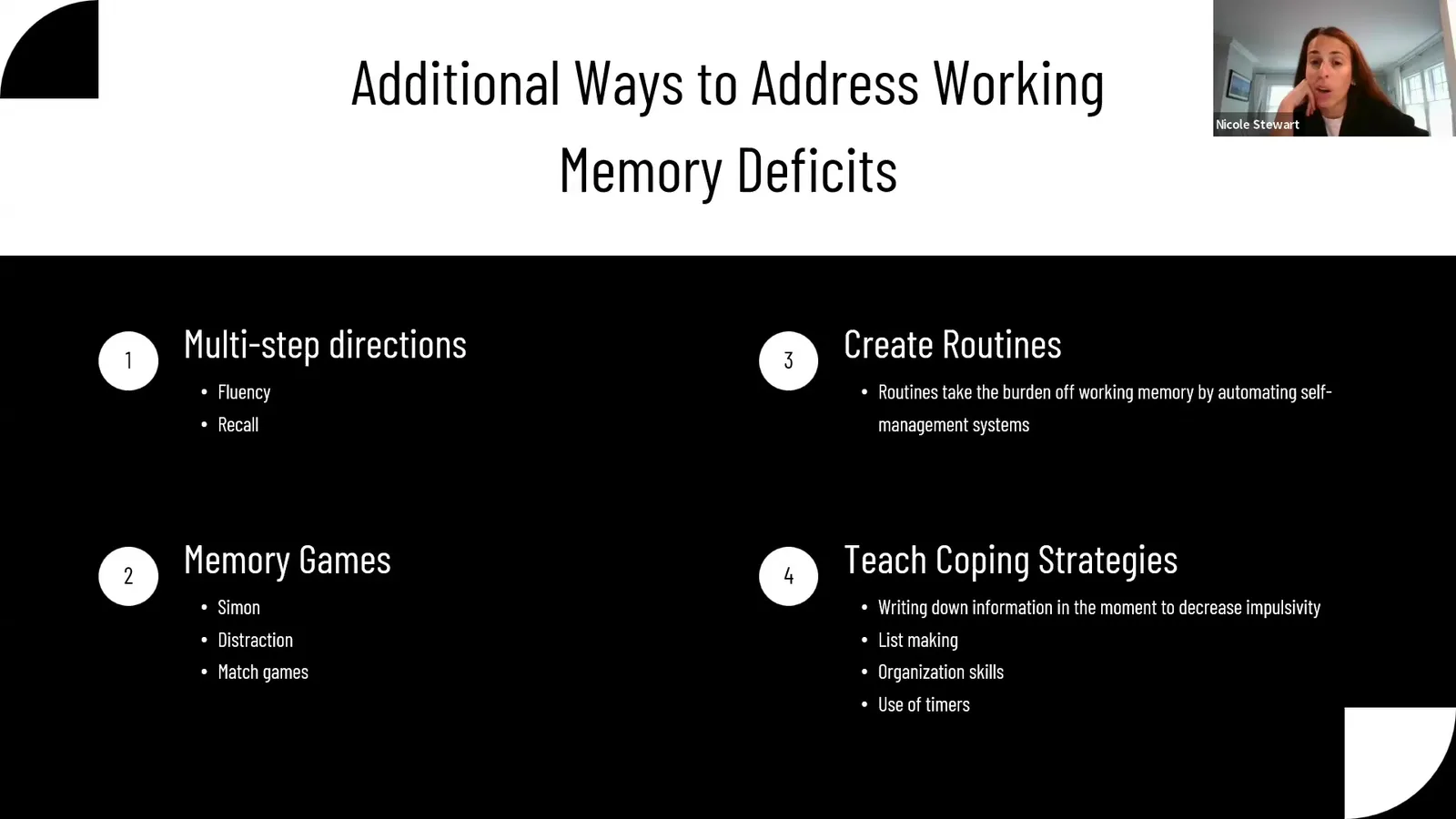
Working memory responds to practice. Stewart uses memory games directly: Simon, a card game called Distraction, and a silly sentence game. She says a sentence like six camels drinking soda out of a mug. Then she asks for it again five minutes later, and again twenty minutes later. Kids often take the game home and run it with friends and family.
Progress feedback matters as much as the game. Telling a child they held six items last time and nine today builds confidence in their own memory. That confidence is what lets a child write a task down instead of bolting to go do it.
Teach coping tools alongside the skill. Keep paper in several rooms. Make lists. Use timers and phone notes. For older clients and adults, block a half hour on Monday to map the week. Do the same on Friday to close it out. Stewart frames all of it around protecting self-esteem. Forgetting feels bad, and kids remember that feeling.
Routines do heavy lifting here by automating steps. Get up, get dressed, make the bed, eat breakfast. One step cues the next, so memory carries less. The same goes for fixed spots for keys, wallets, and a charger. Visual supports, mnemonic devices (memory tricks like rhymes or made-up scripts), and walking through a route in your head all help. For a sample goal, Stewart targets recalling phrases at least thirty minutes later. The target is ninety percent accuracy across four of five chances. She starts with silly sentences, then moves to functional ones, like putting clothes in the laundry after a shower.
it's like having all the tabs on your computer open you got to close some of them in order to improve your memory
From the talk — Nicole Stewart
Goal, Plan, Do, Check: One Framework for Planning and Initiation
Stewart teaches a sequence adapted from the book Unstuck and On Target. Set a goal. Say why it matters. Make a plan. Do it. Then check how it went. She writes it down and runs it inside sessions before sending it home.
The sequence solves an initiation problem on its own. If the first move is always naming the goal, the child has already started. The entry point never changes, which is exactly what a child with an initiation deficit needs.
Groceries show the loop in action. Goal: get groceries. Why: we need to eat. Plan: check the fridge and pantry, write the list, go to the store. Then shop and check the list. A first attempt might be nothing but go to the store, which ends with too many eggs and no milk. That feedback comes from the child's own behavior, not a lecture, so the next plan improves.
Morning routines run the same five steps. Set an 8:30 departure, talk through why, plan it, do it, then look at what broke. For younger kids the adult sets the goal, since goal setting is a teen skill. Kids can still handle the why, the plan, and the check.
The goal for this is that they have a framework to plan and execute and initiate things for almost anything
From the talk — Nicole Stewart
Initiation, Attention, and Flexibility Targets That Fit a Treatment Plan
For initiation, shrink the step until it is almost nothing. Not write the essay. Take out the notebook. Not get dressed. Walk to the dresser. One evening, Stewart's son refused to go into a restaurant. She broke it into steps: get out of the car seat, get out of the car, then take her hand. They were inside before the argument started. Sequencing questions help too: what is the first thing you do to brush your teeth?
Other initiation tools include activity schedules and scavenger hunts the child plans and leads. Transition signals, like a song or a clap, help too. Stewart also tracks latency (time between the cue and starting) and praises it out loud: six minutes out the door today. When attention drifts, she names the behavior instead of nagging. Saying she can see a mind wandering lets the child correct it without a correction.
One attendee asked about a student who masks attention, nodding along while fully tuned out. Stewart's answer: build in more active responding (getting the student to answer out loud, not just listen). Have the student repeat her words as she says them, then whisper them, then say them silently. Writing it down gives you a permanent product (a written record you can check later). Mindless doodling can also keep a brain just active enough to listen.
Self-control goals look familiar: reduce impulsivity, build emotion management, teach coping skills, and improve trigger awareness. For mental flexibility, Stewart uses published curricula like Superflex and Unstuck and On Target rather than inventing abstract lessons. A sample goal reads: tolerate non preferred (not fun) tabletop activities for up to thirty minutes without interfering behavior (behavior that gets in the way of the task). She also settles on shared language with the family, so everyone says flexible or shades of gray the same way.
The goal is to teach them skills to foster independence.
From the talk — Nicole Stewart
Coaching Caregivers: Chores, Homework, and House Values
Start chores with noticing, not doing. Ask what is on the table that belongs somewhere else. Say you see three things out of place and ask what the child sees. You may still put them away yourself. The skill being taught is noticing. Then pick the easiest next win: shoes after socks, or zipping a jacket.
Use the Premack principle (do the task, then the fun thing) as a schedule, not a prize. Load the dishwasher, then free time. Stewart compares it to a subway turnstile. It is not a reward. It is just the order things happen.
On homework, she tells families to stop stressing about academics and focus on the routine. The value sits in taking it out, doing a little, and putting it away. One client's first step every day was pulling out the planner and writing down the assignment. Another client wrote a weekly list that translated each activity into gear. Knowing you have lacrosse does not mean knowing what lacrosse requires. That list got built with parents on Sunday nights.
Finally, call them house values instead of rules and keep them short. Pick your battles. Keep consequences written down and consistent, and follow through without negotiating. Changing consequences adds load to a child's working memory. For data, keep the collection simple and encouraging with easy sheets or forms, so caregivers actually give you feedback.
kids who have executive functioning deficits are getting corrected and prompted much more than their peers
From the talk — Nicole Stewart
Common questions
What are the five components of executive functioning?▾
In this talk, the five are working memory, planning, initiation, self-control, and mental flexibility. Stewart notes that sources disagree, and some lists name seven skills or five. She also stresses that the five overlap heavily. A single behavior like procrastination can come from planning, initiation, or self-control.
At what age do executive functioning skills fully develop?▾
They keep developing into a person's twenties. Working memory, attention, and flexibility start showing up around seven or eight. Longer attention spans appear around ten or eleven. Goal setting and adult-style planning arrive in the later teen years.
How can I write an executive functioning goal that fits an existing treatment plan?▾
Tie the skill to a deficit already in the plan. Stewart gives two sample goals. One is recalling phrases at least thirty minutes later, with ninety percent accuracy across four of five chances. The other is tolerating non preferred (not fun) tabletop activities for up to thirty minutes without interfering behavior. Executive functioning ties into language delays, social skills, and restricted or repetitive interests (narrow or repeated interests common in autism). So you rarely need to rebuild a plan from scratch.
What is the goal, plan, do, check process?▾
It is a five-step sequence Stewart adapted from the book Unstuck and On Target. The child names the goal, says why it matters, makes a plan, carries it out, then checks how it went. Because the first step is always naming the goal, the routine itself gets the child started. The same five steps work for groceries, mornings, or studying for a test.
Why does my client plan fine but never start?▾
That pattern points to an initiation deficit rather than a planning one. Stewart hears it from families constantly: once the child starts, the task is not a problem. The fix is shrinking the first step until it is tiny, like walking to the dresser or taking out a notebook. Transition signals and sequencing questions help too.
Does skipping homework hurt a child academically?▾
Stewart tells families that homework carries little academic benefit and not to panic about falling behind. Its real value is executive functioning practice. Taking it out, doing some, and putting it away is the part worth protecting.
About the speaker
Nicole Stewart is a BCBA (board certified behavior analyst) and a certified special education teacher with close to twenty years in the field. She has worked in residential settings, homes, and clinics. She also served as clinical director of a multidisciplinary treatment center in Manhattan. She now runs a private practice in New Jersey. She works mostly with kids with ADHD, along with children who have rare neurodevelopmental genetic disorders (rare genetic conditions that affect brain development). She is also a parent to two boys.
This summary was generated from the recording’s transcript. Quotes are taken word for word from the talk.
What you'll learn
- 11. Distinguish behavioral indicators of deficits across five executive functioning components. 2. Select home-based activities that target a specific executive functioning deficit. 3. Coach caregivers through a goal, plan, do, check process for daily routines.
Related talks
Talks that cover the same concepts
The ADHD Exchange: Best Practices
ABA Made Ez
The ADHD Exchange: Teaching Emotional Regulation
ABA Made Ez
The ADHD Exchange: Classroom Management: ADHD Behavior Management
ABA Made Ez

The ADHD Exchange: Social Skills: Performance or Skill Deficit?
ABA Made Ez
The ADHD Exchange: Understanding the Neurobiology of ADHD
ABA Made Ez
OpenCEU is supported by advertising from third-party sponsors. Sponsors are clearly labeled, have no influence over course content, instructors, or CEU decisions, and never appear on certificates. The BACB does not sponsor, approve, or endorse OpenCEU sponsors or their products.